
Edge Computing Gateway Recommendation for Real-Time Industrial Analytics: When Local AI Makes Sense

Robustel EG5120 edge computing gateway is a strong fit when an industrial site needs both compatible local AI inference and integration with PLCs, meters, sensors, serial equipment, and upstream networks. A dedicated edge AI device may be more proportionate when one camera or sensor performs one narrowly defined inference task.
The correct choice depends on two factors: how much computing the workload requires and how broadly the device must integrate the industrial site. The term “edge AI” alone does not identify the right hardware category.
Start with the Device’s Responsibility
Product labels such as edge AI device, industrial gateway, edge computing gateway, and edge computer are often used inconsistently. A more reliable comparison begins with the responsibility assigned to the hardware.
Edge AI Device
An edge AI device usually performs a focused inference workload close to one data source.
Examples may include:
- An AI camera that detects people or vehicles
- A vibration sensor that calculates an anomaly score
- A vision appliance connected to one production line
- A compact accelerator that classifies images from one camera
- A smart sensor that converts raw measurements into events
Its main strength is specialization. The hardware, model, and input source may be optimized as one system.
Its limitation is integration scope. A dedicated device may provide an event or metadata output without collecting additional Modbus registers, connecting several PLCs, managing cellular backhaul, or hosting multiple site-level applications.
Edge Computing Gateway
An edge computing gateway connects field devices, runs local applications, and transfers selected data to upstream systems.
Its responsibilities may include:
- Connecting Ethernet and serial equipment
- Polling PLCs, meters, or sensors
- Converting Modbus data to MQTT or another application format
- Buffering data during temporary WAN interruptions
- Running rules, scripts, databases, or containers
- Hosting compatible local inference
- Routing traffic through cellular or Ethernet WAN
- Supporting remote monitoring and software maintenance
Robustel’s edge compting gateway series combines RobustOS Pro, industrial interfaces, Docker and Debian application support, cellular or Ethernet connectivity, and RCMS fleet management. AI inference is available on suitable models, but it is not the defining capability of every gateway in the series.
Industrial Edge Computer
An industrial edge computer usually emphasizes higher and more expandable computing capacity.
It may be more suitable for:
- Several large AI models
- Multiple high-resolution video streams
- GPU-specific applications
- Large local databases
- Complex visualization
- Heavy batch processing
- Workloads requiring more RAM or storage expansion
- Applications that cannot run efficiently on a gateway-class ARM platform
An edge computer may still require a separate router, protocol gateway, switch, or remote-management layer. Higher compute capacity does not automatically provide the OT integration and WAN functions of an industrial edge computing gateway.
Before comparing compute intensity and integration scope, watch Robustel’s video What is Edge Computing, and where exactly is “The Edge” for a concise overview of how an industrial edge gateway combines field-device connectivity, local data processing, protocol integration, secure upstream communication, and remote management.
Compare Integration Scope and Compute Intensity
The clearest selection method uses two axes:
- Compute intensity: How demanding is the local application?
- Integration scope: How many devices, protocols, and network functions must the hardware coordinate?
| Workload Pattern | Compute Intensity | Integration Scope | Better-Fit Category |
| One camera running one optimized model | Medium | Bajo | Dedicated edge AI device |
| One vibration sensor generating anomaly scores | Low to medium | Bajo | Smart sensor or edge AI device |
| Several Modbus devices with local rules | Bajo | Medium to high | Edge computing gateway |
| PLC, serial sensors, local MQTT, and AI inference | Medium | Alto | AI-capable edge computing gateway |
| Several cameras plus site-level event integration | Medium to high | Alto | Higher-interface edge AI gateway |
| Many high-resolution streams and several large models | Alto | Medium to high | Industrial edge computer |
| Fleet-wide model training and historical analysis | Very high | Cross-site | Cloud or data centre |
This comparison prevents two common mistakes.
The first is buying an edge computing gateway for a workload that one dedicated smart device could perform more simply.
The second is expecting a gateway-class platform to support workloads that require GPU resources, large memory capacity, or extensive local storage.
Choose an Edge AI Device for a Dedicated Workload
A dedicated edge AI device is usually the better fit when the project can define one stable relationship between the input, model, and output.
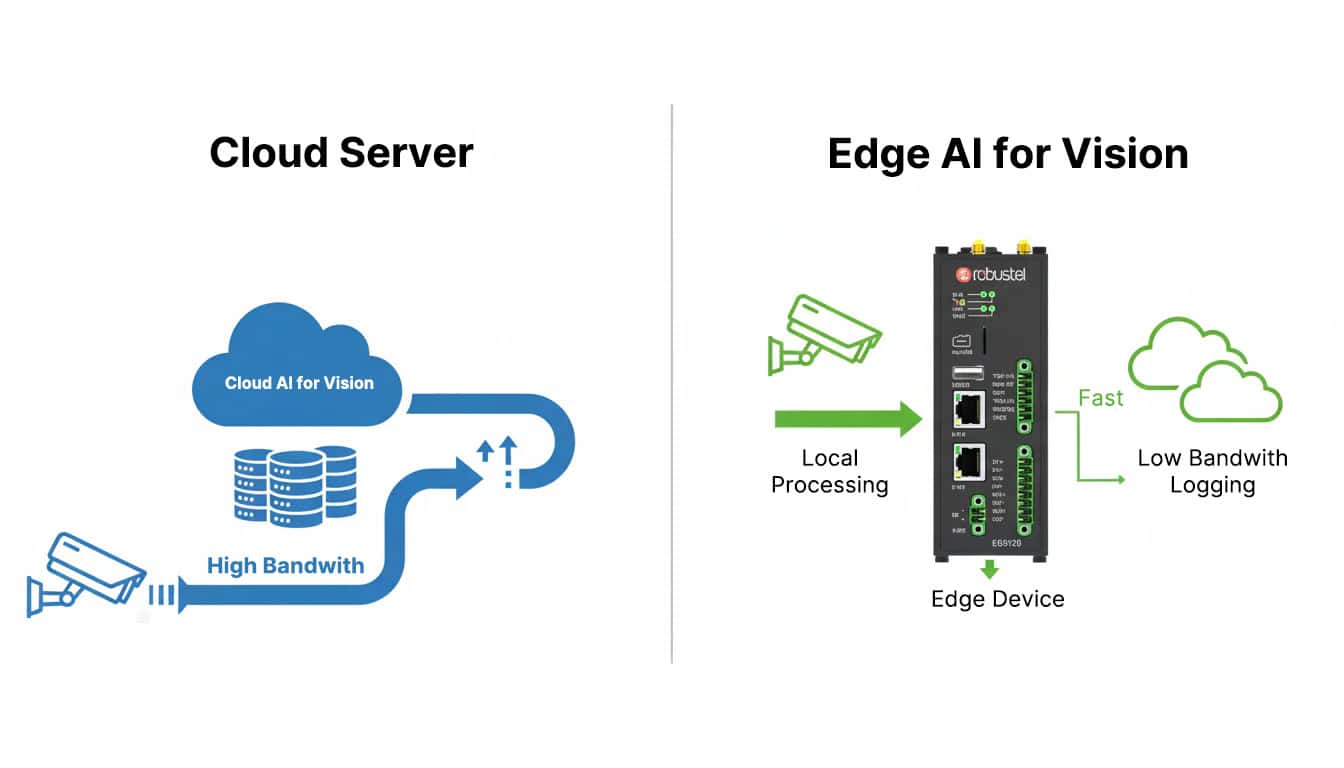
For example, a camera may analyse one production area and produce only:
- Object count
- Presence or absence status
- Equipment-state classification
- Selected event images
- Timestamped alerts
The wider industrial system receives the result without processing the raw video itself.
This architecture can reduce integration effort because the AI device may already include the camera interface, inference runtime, and optimized model pipeline.
A dedicated device is particularly suitable when:
- Only one sensor or camera requires AI
- The application is unlikely to expand
- Other industrial protocols are not involved
- Cellular routing is provided elsewhere
- The output is already usable by the application
- The device supplier maintains the model and runtime together
The main purchasing question becomes whether the device can perform its dedicated function accurately and reliably under the site’s lighting, vibration, temperature, and operating conditions.
An edge AI device becomes less attractive when the project must combine its output with several other industrial data sources or maintain separate networking, protocol, and management devices around it.
Choose an Edge Computing Gateway for Site-Level Integration
An edge computing gateway is more suitable when the local application must understand the wider operating context of the site.
Consider a predictive-maintenance project in which the result depends on:
- Vibration measurements from one sensor
- Motor current from a Modbus meter
- Operating state from a PLC
- A digital input showing whether the machine is active
- Production data from an Ethernet controller
A dedicated AI sensor may analyse vibration, but it may not know whether a high reading occurred during startup, normal production, or an abnormal operating state.
An edge computing gateway can collect these different inputs, normalize their timestamps and data formats, and provide the combined context to a local application.
The gateway may then publish:
- An anomaly score
- The associated operating state
- Relevant process measurements
- A timestamp
- A maintenance event
- A limited set of supporting raw data
This is the central advantage of an edge computing gateway: it combines local computing with site-level data integration.
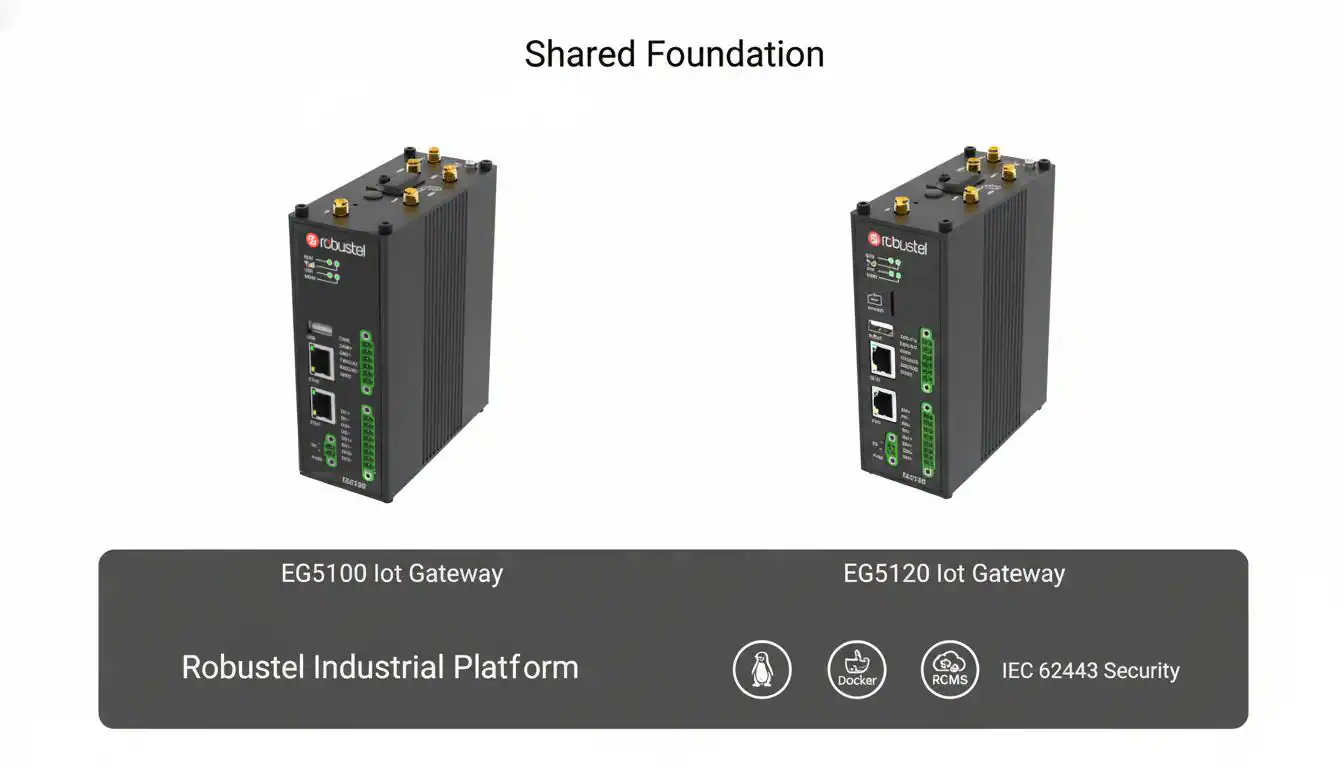
Robustel EG-series gateways run RobustOS Pro, a Debian-based environment that supports Docker containers and Debian-compatible packages. The series is designed to connect PLCs, sensors, meters, cameras, and upstream IT systems through industrial interfaces and OT/IT protocols.
An edge computing gateway should still not assume responsibility for every local function. PLCs and safety controllers should continue handling deterministic control, interlocks, and certified protection tasks unless a separate engineering assessment explicitly changes that architecture.
Not Every Edge Computing Gateway Is an AI Gateway
Running Linux or Docker does not automatically make an industrial gateway an edge AI device. Robustel EG5100 edge computing gateway demonstrates this distinction. It uses a 792 MHz Cortex-A7 processor, 1 GB DDR3, and 8 GB eMMC, with two Fast Ethernet ports, two configurable RS-232/RS-485 interfaces, and DI/DO. RobustOS Pro allows it to host protocol connectors, buffering, local preprocessing, and other resource-efficient edge applications.
The EG5100 does not list a dedicated NPU. Its strongest applications are therefore more likely to include:
- Protocol bridging
- Modbus data acquisition
- Serial-to-IP communication
- Data normalization
- Local buffering
- Threshold and event logic
- Lightweight containerized services
- Secure cellular backhaul
These are legitimate edge computing workloads even when they do not use machine learning.
This leads to an important product boundary: An edge computing gateway processes data locally, but it should only be described as an edge AI gateway when its hardware and software environment can support the intended inference workload.
Robustel EG5120 edge computing gateway adds a quad-core Cortex-A53 processor at 1.6 GHz, 2 GB or 4 GB LPDDR4, 64 GB eMMC, and a 2.3 TOPS NPU. It retains gateway functions including cellular routing, two Gigabit Ethernet ports, serial interfaces, DI/DO, Docker and Debian application support, and RCMS management.
The NPU makes compatible local inference possible. It does not mean every model, framework, operator, input resolution, or inference frequency is supported without testing.
Compact AI Gateway VS Multi-Device Gateway: Choose between Robustel EG5120 and EG5200
Once a project needs both AI inference and site integration, the next question is how many local devices and peripherals the gateway must support.
Robustel EG5120 Edge Computing Gateway for Compact Site-Level AI
Robustel EG5120 edge computing gateway is well aligned with sites that require:
- One or two Ethernet network segments
- Serial equipment
- Digital inputs and outputs
- Local model inference
- Data buffering or protocol conversion
- Cellular or Ethernet backhaul
- Relatively large built-in application and data storage
Its two Gigabit Ethernet ports may be sufficient for a machine, small industrial cabinet, or compact analytics node. The 64 GB eMMC provides more internal storage than many lightweight gateway platforms, although the usable capacity and retention period still depend on the operating system, applications, logs, and data format.
Robustel EG5200 Edge Computing Gateway for Broader Device Aggregation
Robustel EG5200 edge computing gateway uses the same listed CPU frequency and 2.3 TOPS NPU class, but it provides 4 GB LPDDR4, 32 GB eMMC, five Gigabit Ethernet ports, two configurable RS-232/422/485 interfaces, HDMI, USB expansion, digital inputs, and relay outputs.
Its main advantage over the EG5120 is not simply “more AI performance.” It is better suited to sites requiring:
- Several IP cameras or controllers
- More Ethernet connections
- RS-422 equipment
- Local HDMI display
- Multiple USB peripherals
- Salida de relé
- A broader combination of local devices
For example, a multi-camera inspection station may benefit from the EG5200’s Ethernet and peripheral layout even when its inference model is no larger than one used on the EG5120.
| Selection Area | Robustel EG5120 | Robustel EG5200 |
| CPU | Quad-core Cortex-A53, 1.6 GHz | Quad-core Cortex-A53, 1.6 GHz |
| NPU | 2.3 TOPS | 2.3 TOPS |
| RAM | 2 GB or 4 GB LPDDR4 | 4 GB LPDDR4 |
| eMMC | 64 GB | 32 GB |
| Ethernet | 2 × Gigabit | 5 × Gigabit |
| Serial | 2 × RS-232/RS-485 | 2 × RS-232/422/485 |
| Local display | Not listed | HDMI |
| Main distinction | Compact integration and greater internal storage | Broader device and peripheral integration |
Both Robustel edge computing gateways remain gateway-class platforms. The selected model and complete software stack should be benchmarked against real production data before the hardware is approved.
Know When an Edge Computing Gateway Is Not Enough
An edge computing gateway provides an efficient middle layer between dedicated devices and larger industrial computers. That does not make it suitable for every local workload.
An industrial edge computer may be more appropriate when the project requires:
- Several simultaneous high-resolution video streams
- Large neural-network models
- GPU or x86-specific software
- Extensive local historical storage
- Heavy database queries
- Complex local visualization
- Several computationally intensive containers
- Frequent model retraining
- Expansion through PCIe or other specialized hardware
- More memory than a gateway-class platform provides
The gateway may still remain part of this architecture. It can collect OT data, provide cellular backhaul, isolate the industrial network, and forward normalized data to the edge computer. Likewise, cloud infrastructure remains important for model training, long-term storage, fleet-wide comparison, and analytics requiring information from multiple sites. The architecture does not need one device to perform every function. It needs each processing layer to have a clearly defined responsibility.
Preguntas frecuentes
Q1. What is the main difference between an edge AI device and an edge computing gateway?
An edge AI device usually performs one focused inference task close to one camera or sensor. An edge computing gateway combines local processing with broader site responsibilities such as integrating PLCs, meters, serial devices, network segments, and upstream connectivity. The better choice depends on two separate axes: the compute intensity of the application and the number of devices, protocols, and network functions the hardware must coordinate.
Q2. When is a dedicated edge AI device the better choice?
Choose a dedicated device when one stable input, model, and output define the complete application. A smart camera or condition sensor may already include the optimised runtime and produce usable events without wider site integration. This approach can reduce engineering effort. It becomes less suitable when the result must be combined with PLC state, multiple sensors, protocol conversion, local buffering, cellular routing, or common fleet management.
Q3. When is an industrial edge computer more suitable than a gateway?
An industrial edge computer is more appropriate for several high-resolution video streams, large neural networks, GPU- or x86-specific software, heavy databases, complex visualisation, extensive local history, or applications needing greater memory and expansion. A gateway may remain alongside it to integrate OT devices, isolate networks, and provide WAN connectivity. Higher compute capacity does not automatically supply industrial interfaces, routing, or gateway fleet-management functions.
Q4. How does Robustel EG5120 edge computing gateway fit site-level edge AI?
Robustel EG5120 edge computing gateway fits compact sites where compatible inference must be combined with serial and Ethernet equipment, DI/DO, protocol processing, buffering, and cellular or Ethernet backhaul. Its 64 GB eMMC supports more local application and data storage than many lightweight gateways. The actual model, runtime, interface load, memory use, and production response target must still be benchmarked before selection.
Q5. When should a project consider Robustel EG5200 edge computing gateway instead?
Robustel EG5200 edge computing gateway becomes more suitable when the site needs broader device and peripheral integration, including more Gigabit Ethernet connections, RS-422 support, HDMI output, USB devices, digital inputs, or relay outputs. Its advantage over EG5120 is mainly interface scope rather than automatically higher AI performance. Teams should select between them using the site topology, retention need, application stack, and measured workload.
Conclusion: Edge AI Device Selection Takeaway
Robustel EG5120 edge computing gateway is a strong fit when industrial AI must be combined with serial and Ethernet equipment, protocol processing, local applications, WAN connectivity, and centralized gateway management. Robustel EG5200 edge computing gateway extends this fit to sites with more Ethernet devices and peripheral-integration requirements.
A dedicated edge AI device is usually more proportionate when one camera or sensor performs one stable inference function. An industrial edge computer becomes more suitable when the workload requires substantially greater compute, memory, storage, or software expansion.
The most useful decision framework is therefore not “edge AI device or gateway—which is more advanced?” It is:
- How computationally demanding is the workload?
- How many devices and protocols must be integrated?
- Does the hardware also need to provide routing and remote fleet management?
- Can the application run within the platform’s actual resource boundary?
When compute intensity and integration scope are evaluated separately, project teams can avoid both overengineering a simple AI task and underestimating the demands of a complex industrial site.
Related Reading on Edge Computing in Industrial IoT:
Acerca del autor
Robert Liao | Technical Support Engineer
Robert is an IoT Technical Support Engineer at Robustel, specializing in industrial networking and edge connectivity. A certified Networking Engineer, Robert focuses on the deployment and troubleshooting of large-scale IIoT infrastructures. His work centers on architecting reliable, scalable system performance for complex industrial applications, bridging the gap between field hardware and cloud-side data management.