
Remote PoE Device Recovery Through a 5G Router: Design and Failure Limits
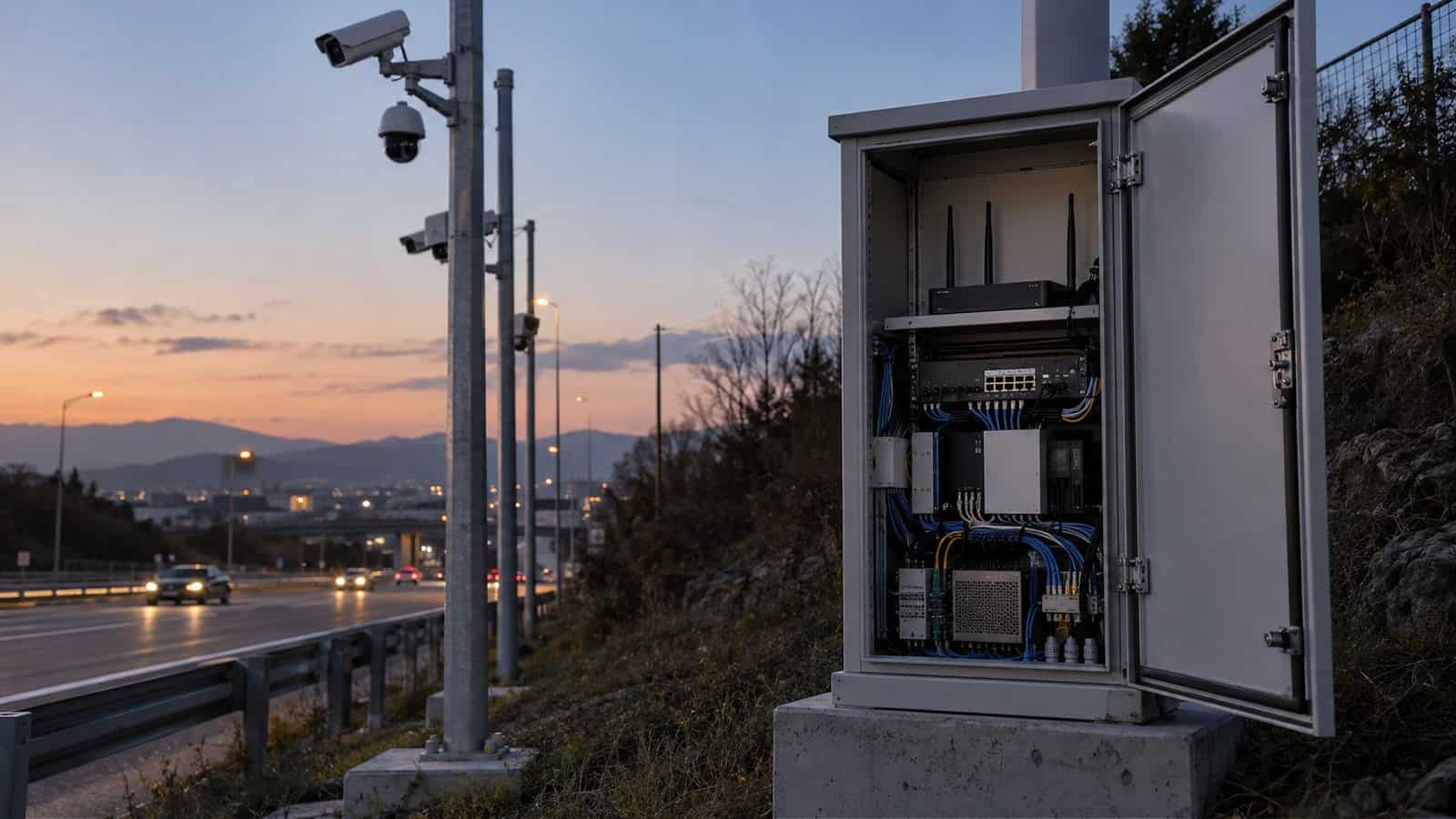
The Robustel R2120-5G Industrial Cellular PoE Router combines cellular backhaul with four managed PoE-PSE ports, making it well suited to remote camera and edge-device recovery. The design limit is just as important: cycling power can clear a locked endpoint, but it cannot repair a failed WAN, an undersized power supply, damaged cabling or a software fault that immediately returns.
First Ask Whether the Device Is Actually Hung
Remote power cycling is attractive because it appears decisive, but it can also erase the evidence needed to distinguish a device fault from a network or application fault. My starting point is the last useful observation available before power is removed. If the router can still reach the device, collect that evidence first; if it cannot, the recovery policy needs a clear retry limit and an escalation path.
Start from observable evidence. A device that stops responding while its switch port remains active is different from a device whose PoE draw disappears, and both differ from a site that has lost cellular backhaul. A blind reboot rule can repeatedly interrupt a healthy camera because the monitoring server or VPN is unavailable.
| Observation | Plausible fault domain | Remote action |
|---|---|---|
| One endpoint unreachable; router and peers healthy | Endpoint, cable or PoE port | Confirm port state, then controlled power cycle |
| All endpoints unreachable; router manageable | LAN policy, shared power or switch/router state | Inspect common dependencies before cycling devices |
| Router unreachable | WAN, router power, radio or upstream service | PoE action may be impossible or irrelevant |
| Endpoint returns then fails repeatedly | Thermal, PSU, cable or application fault | Stop automatic retries and escalate |
The recovery policy should include a maximum attempt count and a cooling-off period. After that, preserve logs and raise a service ticket instead of creating an endless power cycle.
Startup Current Changes the Recovery Decision
Robustel R2120-5G router provides four IEEE 802.3af/at PoE-PSE ports, with up to 30 W per port; the total budget depends on the power supply. Add the router’s own consumption, endpoint steady draw, startup behaviour, cable length and temperature margin. A nominal sum that fits on paper may dip during simultaneous camera startup.
Stagger recovery where possible. Re-energising four devices at once creates a different load from cycling one failed endpoint. Commission the exact PSU, cable runs and endpoint models in the real enclosure, then retain measured current and voltage as the site baseline.
The Robustel’s Smart Parking Application Example illustrates a distributed roadside architecture with cameras, meters and sensors sharing communications infrastructure. It is useful for identifying which endpoints can be restarted independently; it is not evidence that every roadside device supports remote recovery.
How the Robustel R2120-5G Industrial Cellular PoE Router Contains Remote Recovery
Industrial R2120-5G industrial cellular PoE router has five Gigabit Ethernet ports, including four 802.3af/at PoE-PSE outputs, dual SIM, Wi-Fi, RS-485, two digital inputs, two digital outputs and RCMS management. Product documentation includes remote PoE device management and scheduled restart or power-cycle capability.
This places power and data for several IP endpoints under one managed boundary. Operations can inspect the router and act on a specific PoE port without adding a separate managed switch. The trade-off is concentration: the router, PSU and cellular path become shared dependencies, so the architecture needs an explicit response when the whole cabinet is unreachable.
| Release item | Evidence to retain | Reject when |
|---|---|---|
| Port-specific recovery | Correct endpoint returns after one controlled cycle | Wrong port or multiple devices are affected |
| Power budget | Startup and steady load remain inside verified PSU margin | Voltage drops or router restarts |
| WAN-independent rules | Local monitoring does not create uncontrolled cycling | Cloud loss triggers endpoint reboots |
| Audit trail | Operator, reason, time and result are recorded | Recovery action cannot be reconstructed |
The R5020 quick-start video is not an R2120-5G configuration guide, but it can orient teams to Robustel commissioning conventions. Use the R2120-5G product documentation and deployed firmware for the actual PoE workflow.
A Recovery Sequence Needs an Exit
A practical sequence verifies router reachability, checks whether peer endpoints are healthy, tests the target at its local address where possible, records the port state, cycles only the selected port and waits for the device’s real boot time. It then checks data flow, not merely link-up. If the endpoint fails again within the defined observation period, automation stops.
Robustel’s Public Safety CCTV Application Example using the EG5100 separates camera connectivity, edge activity and remote access. Although it uses another gateway, that separation is useful here: a camera may be powered and locally reachable while the remote viewing path is still down. The example does not prove R2120-5G camera capacity or PoE behaviour.
Stop Conditions Matter in an Unattended Recovery Loop
Disconnect one camera, overload neither the port nor the PSU, remove cellular service, break the VPN and make the monitoring target unavailable in separate tests. Confirm which conditions permit a reboot and which must suppress it. Then repeat after restoring service to ensure queued alarms do not trigger delayed duplicate actions.
Record the manual fallback. Some faults still require a technician with a replacement endpoint, cable tester or PSU. Remote recovery reduces avoidable visits only when it correctly identifies the faults it cannot fix.
Preguntas frecuentes
Q1. Can PoE devices be rebooted remotely?
Yes, when the power-sourcing equipment supports individual port control and the management path is available. The recovery process should verify the fault, limit retries and confirm application data after the device restarts.
Q2. Does unplugging Ethernet reboot a PoE device?
Disconnecting the powered Ethernet link removes power from a standard PoE endpoint, but it is not a controlled remote method. Managed port cycling provides a safer, auditable process when the hardware supports it.
Q3. Why does a PoE camera keep going offline?
Possible causes include insufficient power, cable or connector faults, thermal conditions, endpoint software, network policy and upstream service loss. Compare power, port and network evidence before assuming a reboot is the remedy.
Q4. How long should a PoE power cycle last?
Long enough for power to fall and the endpoint to perform a clean restart, followed by its documented boot period. Use the actual device specification and measured startup behaviour instead of one fixed delay for every endpoint.
Q5. What does the Robustel R2120-5G Industrial Cellular PoE Router add to remote recovery?
It combines four managed PoE-PSE ports with 5G cellular backhaul and RCMS management, allowing operations to act on a selected powered endpoint. The PSU, router and WAN remain shared failure domains that need separate monitoring.
Conclusión
Where several remote Ethernet devices need power and managed cellular connectivity from the same cabinet, the Robustel R2120-5G Industrial Cellular PoE Router can create a useful recovery boundary. That fit depends on a verified power budget and on the team being able to distinguish a device fault from a wider path failure.
Before unattended rollout, prove the startup load, evidence captured before reboot, retry ceiling and manual escalation route. A recovery loop that knows when to stop is safer than one that can keep cycling power.
Explore More Articles About Robustel 5G Routers
Acerca del autor
Robert Liao | Technical Support Engineer
Robert is an IoT Technical Support Engineer at Robustel, specializing in industrial networking and edge connectivity. A certified Networking Engineer, Robert focuses on the deployment and troubleshooting of large-scale IIoT infrastructures. His work centers on architecting reliable, scalable system performance for complex industrial applications, bridging the gap between field hardware and cloud-side data management.