
5G WiFi 6 Router for Business: Capacity and Deployment Checklist
The Robustel R5030 Industrial Dual-SIM 5G Router fits business sites and vehicles that genuinely require modern local Wi-Fi alongside cellular backhaul. Wi-Fi 6 does not establish user capacity by itself, and 5G does not establish the available internet rate. Both are shared radio systems whose performance depends on the installation and traffic mix.
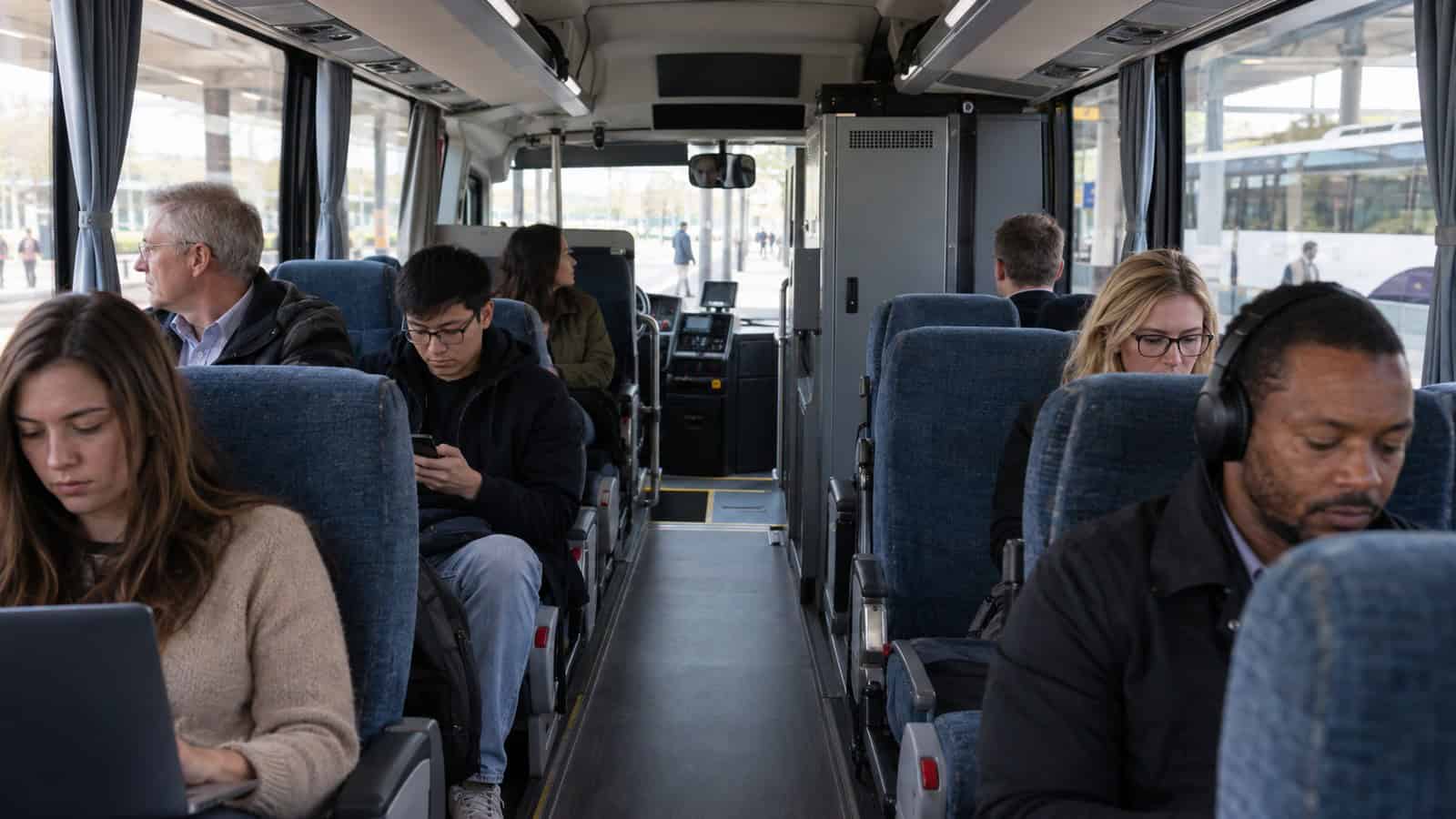
Buyers should translate “support many users” into a client inventory, application profile and acceptance test. A waiting room handling messaging behaves differently from a coach carrying passengers who stream video while onboard systems share the same WAN.
Start with Clients and Applications, Not a Peak Rate
Count active devices during the busiest interval, then group their traffic. Voice, payments and operational telemetry may need predictable treatment; guest browsing and large updates can tolerate limits or scheduling. Include devices that associate but send little data because management overhead and airtime still matter.
| Traffic class | Typical sensitivity | Design question | Test |
|---|---|---|---|
| Payments/operations | Loss and recovery | Must it be separated from guest traffic? | Transaction during busy load |
| Voice/video meetings | Jitter and interruption | What minimum service is needed? | Concurrent real sessions |
| Guest browsing/streaming | Aggregate capacity | Which limits protect operations? | Busy-hour client mix |
| Cameras/uploads | Sustained upstream load | Does cellular uplink become the constraint? | Representative upload |
| Updates/backups | Burst volume | Can they be scheduled or shaped? | Policy enforcement |
The output is a traffic policy, not a marketing number of users.
Separate Wi-Fi Capacity from 5G Backhaul
A client can have an excellent Wi-Fi connection to the router while the cellular WAN is congested or weak. The opposite can also occur: strong 5G service cannot compensate for poor access-point placement, interference or overloaded airtime.
Measure each layer separately. On the LAN side, review client capabilities, bands, channel plan, signal and airtime. On the WAN side, survey the production cellular variant, operator, antennas and representative time periods. End-to-end application testing then shows how the two layers interact.
Place the Router for Two Radio Systems
The best cellular position may not provide the best indoor Wi-Fi coverage. A router near an external wall or rooftop antenna route can be far from users; a centrally placed access point can sit in a poor cellular location. In some sites one integrated unit is proportionate. In larger or RF-complex buildings, separate cellular and Wi-Fi components may create a cleaner design.
The R5030 supports dual-band Wi-Fi 6 in AP or client mode and has five Gigabit Ethernet ports. Those ports make it possible to connect wired operational equipment or extend the LAN architecture, but they do not prove that one integrated access point covers every room or vehicle.
How the Robustel R5030 Industrial 5G Router Fits Business WiFi 6
The R5030 combines 5G/4G/3G cellular connectivity, dual SIM, dual-band Wi-Fi 6, five Gigabit Ethernet ports, DI/DO and GNSS. It is therefore a sensible candidate for passenger Wi-Fi, branches and other sites where cellular WAN and a modern local WLAN must share a managed industrial platform.
Its documented captive-portal capability can support controlled user access. The organization still needs to define authentication, acceptable use, session policy, privacy and traffic separation. Similarly, dual SIM may improve operator/subscription diversity but does not duplicate the router, power or antenna system.
The R5020 branch-routing Application Example illustrates how cellular WAN, segmentation and central operations can be combined at a branch. It uses a different Robustel model and is architecture evidence, but its division of payment, corporate, camera and guest traffic is directly relevant when writing an R5030 policy.
The Jones Technology retail resilience case study documents a live cellular backup layer supporting POS, kiosks, kitchen displays and guest Wi-Fi through an SD-WAN design. It demonstrates that business and guest services share wider branch dependencies; it does not claim Wi-Fi 6 capacity or universal cellular performance.
Build Operations into the WLAN Design
Robustel RCMS can provide centralized device visibility and supported configuration or update workflows. That helps distributed operators distinguish a router offline state from signal deterioration or configuration drift. Client experience and local interference still require suitable monitoring and site evidence.
Decide who owns guest access, password or portal changes, firmware windows and incident response. A remotely reachable router does not prove that users can complete their applications, so support procedures should include a reproducible client test.
Deployment and Acceptance Checklist
- Count active clients and classify their traffic at the busiest time.
- Decide which operational services must be separated or prioritized.
- Survey both cellular and Wi-Fi radio conditions at the final position.
- Confirm regional cellular SKU, operators, SIMs and antennas.
- Select Wi-Fi bands and channels for the actual environment.
- Test legacy and modern clients rather than assuming uniform Wi-Fi 6 support.
- Run representative upload and download traffic concurrently.
- Force WAN and SIM failover and observe application recovery.
- Confirm portal, credential and privacy processes.
- Record fleet configuration, alert and update ownership.
Robustel’s R5020 5G IoT Router Quick Start Guide video shows the basic commissioning style used across a related Robustel 5G platform. Use the R5030’s exact documentation for its configuration and validate the production WLAN rather than transferring model-specific screens or settings.
Preguntas frecuentes
Q1. What is the best router for a small business?
The best choice depends on the number and type of clients, floor plan, security zones, WAN options and who will manage the network. A compact site may suit one integrated router, while a larger or RF-complex building is usually better served by separate access points and a dedicated WAN edge.
Q2. Is Wi-Fi 6 faster than 5G?
They serve different links, so a direct speed comparison is not very useful: Wi-Fi 6 connects local clients, while 5G can provide the site’s WAN connection. End-to-end performance is limited by the slower or more congested part of that path and must be measured with the intended clients and applications.
Q3. Which 5G router is the best?
Choose against the deployment rather than a headline ranking. For business use, check client capacity, Ethernet layout, antenna options, regional cellular support, security, fleet management and how the router recovers when the WAN changes.
Q4. Which is the best Wi-Fi 6 router?
For a small industrial or commercial site, it is the model that provides the required coverage and policy controls without forcing an unnecessarily complex access-point design. Establish the client mix and traffic profile first, then test concurrent WLAN and cellular load at the actual installation point.
Q5. When is the Robustel R5030 Industrial Dual-SIM 5G Router a good fit?
It fits compact sites or vehicles that need integrated dual-band Wi-Fi 6, cellular backhaul and several Gigabit Ethernet connections in one managed device. It should still be tested with the expected number and mix of clients; large or RF-complex buildings may call for a separate access-point architecture.
Conclusión
The Robustel R5030 Industrial Dual-SIM 5G Router with 5x LAN, Wi-Fi 6, GNSS and PoE is a strong fit when an industrially packaged router must combine 5G backhaul, Wi-Fi 6 and several wired connections.
Approve the design only after testing the busiest client mix, traffic policy, radio placement and application recovery. Wi-Fi generation and cellular generation are inputs; the business service is the outcome to measure.
Explore more articles about Robustel’s 5G routers in industrial IoT:
Acerca del autor
Robert Liao | Technical Support Engineer
Robert is an IoT Technical Support Engineer at Robustel, specializing in industrial networking and edge connectivity. A certified Networking Engineer, Robert focuses on the deployment and troubleshooting of large-scale IIoT infrastructures. His work centers on architecting reliable, scalable system performance for complex industrial applications, bridging the gap between field hardware and cloud-side data management.