
Industrial 5G Router Security Checklist: 18 Controls to Require
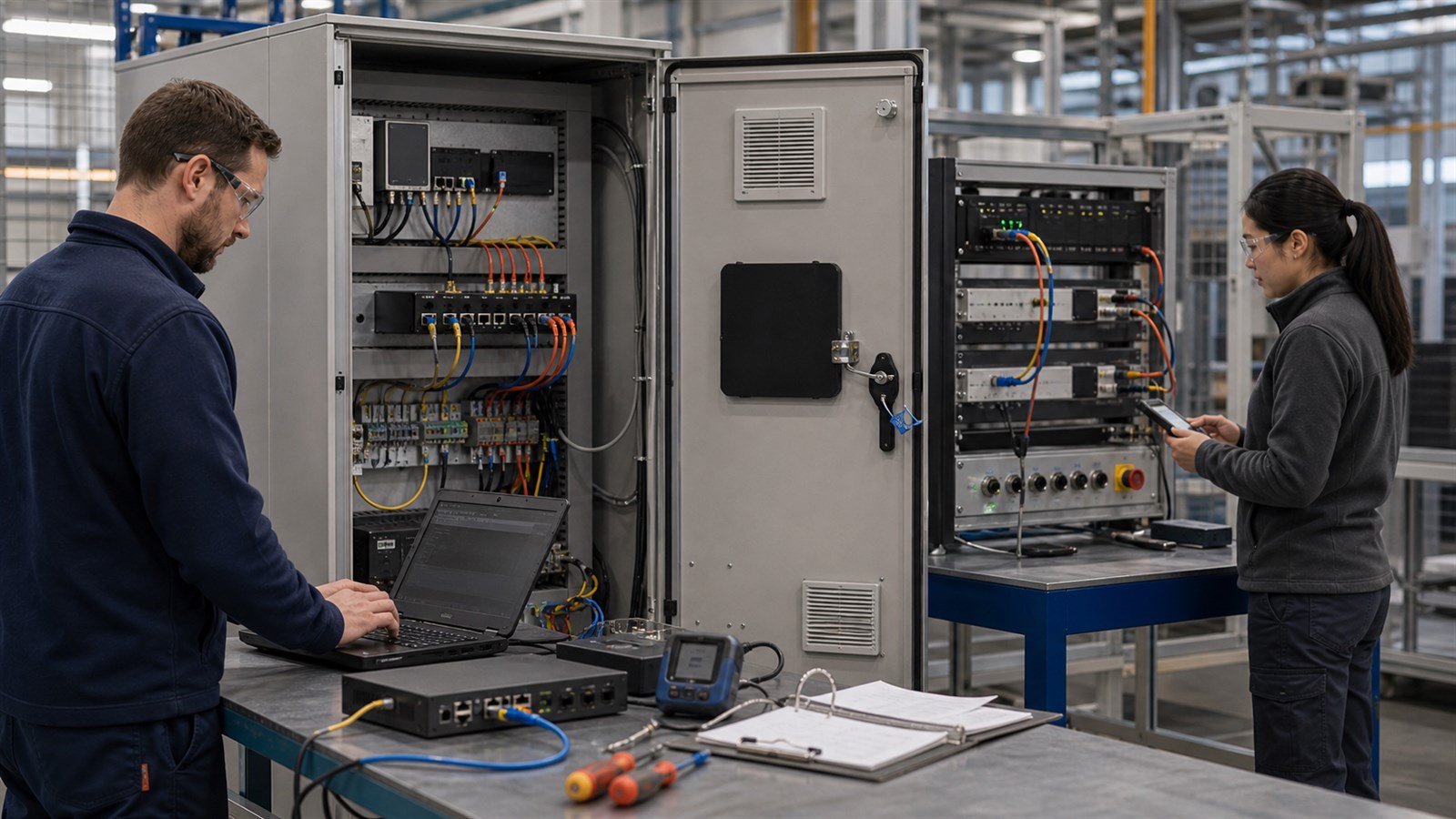
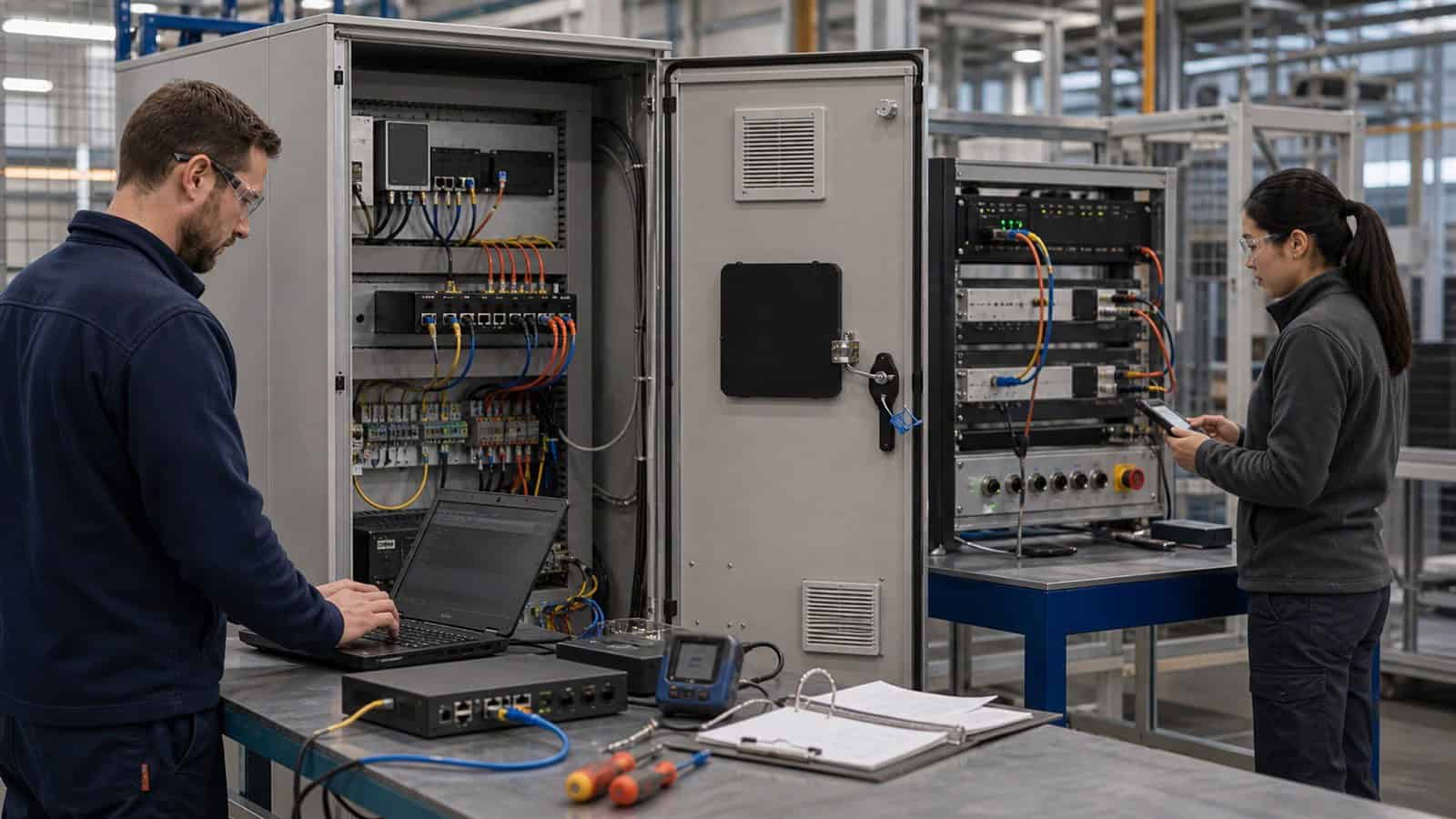
The Robustel R5020 Industrial 5G Router fits industrial and distributed-site architectures that need 5G connectivity together with firewall, VPN, access-control and centralized management capabilities. But no router can make a deployment secure by itself: buyers should verify how identity, network boundaries, software integrity, monitoring and lifecycle controls work together before approving a device for production.
A procurement team may see all the expected words on a datasheet:
- Firewall
- VPN
- HTTPS
- Remote management
Access controlThat is not yet a security assessment. A better question is: What evidence shows that each control can be configured, maintained and audited throughout the router’s operating life? The following 18 controls turn a generic security feature list into a practical vendor review.
A Security Feature List Is Not a Security Architecture
An industrial 5G router often sits at a sensitive boundary. On one side are PLCs, controllers, cameras, payment systems or other operational devices. On the other side is a public or private cellular network, remote users, headquarters infrastructure or cloud services.
That means security has several layers:
- Who can administer the router?
- Which networks can communicate through it?
- How is remote traffic encrypted?
- How are firmware changes trusted?
- How are incidents detected?
- Who maintains the device five years later?
A router can have a strong VPN implementation and still be poorly secured if unnecessary services remain exposed. It can have a restrictive firewall and still become difficult to maintain if firmware is never patched.
Security should therefore be reviewed as a control system rather than a collection of isolated features. Robustel’s Security Centre follows the same lifecycle-oriented principle, covering secure development, authentication, encrypted communication, vulnerability handling, firmware/software updates and fleet management rather than treating one feature as complete protection.
Require Evidence for Identity, Access and Network Boundaries
The first nine controls define who can reach the router and what traffic can cross it.
Controls 1–4: Protect Management Access
1. Credential control
The deployment should not rely indefinitely on generic or shared administrative credentials. Require a documented process for establishing production credentials and changing them when staff, contractors or ownership changes.
2. Least-privilege administration
Ask whether operational users can be given only the permissions required for their role rather than sharing one unrestricted administrator account.
If centralized management is involved, confirm how platform roles and permissions are assigned. RCMS documents role-based permissions as part of its security model.
3. Encrypted management paths
Administration should use encrypted protocols such as HTTPS and SSH where remote management is required. Plaintext management services should not remain enabled simply because they are available.
4. Unused-service reduction
List every management and network service enabled in the production profile. If Telnet, remote Web access, SNMP or another service is not required, the security review should ask why it is exposed at all.
Controls 5–9: Define the Network Boundary
5. Inbound firewall policy
The router should explicitly control traffic arriving from WAN and cellular interfaces rather than relying on the assumption that carrier NAT makes the site unreachable.
6. Outbound traffic policy
Security reviews often focus only on inbound connections. Industrial equipment should also be limited to the destinations and services it genuinely needs where the architecture requires that control.
7. Network segmentation
Separate operational equipment, maintenance access, staff devices and guest traffic where they have different trust requirements.
VLANs, routing and firewall policies should express those boundaries.
8. VPN protection
Traffic crossing untrusted networks should use an appropriate encrypted tunnel where the application requires private connectivity.
The protocol alone is not enough. Authentication, key ownership, allowed subnets and tunnel lifecycle also need definition.
9. Exposure and addressing model
Document whether the router receives public addressing, private carrier addressing or sits behind CGNAT. Do not create inbound port forwarding simply to make remote support convenient if an outbound VPN or managed remote-access architecture can achieve the same objective with a smaller exposure surface.
A vehicle shows why these controls need to work together. Robustel’s Emergency Services and Public Safety Vehicle application example separates operational devices, crew connectivity and peripherals while using encrypted backhaul and centralized fleet operations. The important security lesson is the separation of traffic with different trust levels—not simply the presence of a 5G router.
Separate Software Integrity from Remote Update Capability
The next four controls cover software trust.
A statement such as: Supports OTA firmware updates, answers only one question: Can software be transferred remotely?
It does not answer: How is the software authenticated? or Who can authorize the change?
What happens when an update fails?Controls 10–13: Protect the Software Lifecycle
10. Secure boot or equivalent boot-chain assurance
If secure boot is a project requirement, ask the vendor to provide model-specific evidence showing how the boot chain is verified. Do not accept a general security statement as proof that a particular router implements a specific secure-boot mechanism.
This distinction matters for the Robustel R5020: current Robustel public documentation supports a broad security and signed-update story, but buyers requiring secure boot should obtain explicit model-level confirmation rather than infer it from other Robustel security controls.
11. Signed or authenticated firmware
Require evidence that production software and remote updates are authenticated before deployment. Robustel describes signed OTA updates across its operating-system portfolio, while its RCMS security material covers signed firmware and application updates.
12. Controlled update and downgrade
Ask who can initiate an update, whether versions are checked for compatibility and what recovery path exists after a failed deployment.
“Remote update” should never mean “any user can push any image.”
13. Vulnerability and patch process
A router may operate for many years.
The vendor should therefore provide a clear process for:
- Publishing firmware releases
- Documenting security fixes
- Handling reported vulnerabilities
- Advising customers when action is required
- Supporting affected product generations
Robustel RobustOS documentation describes regular security updates, core-package refreshes, independent penetration testing and published release tracking.
The control being evaluated is not whether the router is “secure today.” It is whether the organisation can keep it acceptably secure later.
Make Logging, Monitoring and Patch Ownership Testable
The final five controls determine whether security remains manageable after deployment.
Controls 14–18: Operate Security Over Time
14. Event and system logging
Security-relevant events should leave usable evidence. Ask what can be logged locally, exported or reviewed remotely, and how those logs fit into incident investigation.
15. Alerts and fleet visibility
A central operations team should be able to detect important conditions such as devices going offline, configuration problems or other defined events rather than waiting for users to report them.
16. Configuration backup and version control
A known-good configuration should be recoverable. More importantly, the team should know which configuration is supposed to be installed on each device class.
17. Controlled fleet change and recovery
Firmware and configuration changes should be staged rather than pushed blindly to every production router.
The process should define: Pilot group → limited deployment → validation → wider rollout → recovery if required
18. End-of-life and decommissioning
Security does not end when the router stops carrying traffic. The lifecycle plan should cover:
- Removal from management platforms
- Revocation of VPN access and credentials
- SIM handling
- Configuration/data removal
- Retirement of certificates or keys
- Replacement before unsupported software becomes a long-term risk
This is where procurement and operations meet. A device that satisfies a security checklist at purchase but cannot be maintained consistently across a fleet creates a different risk several years later.
How the Robustel R5020 Industrial 5G Router Fits a Layered Security Architecture
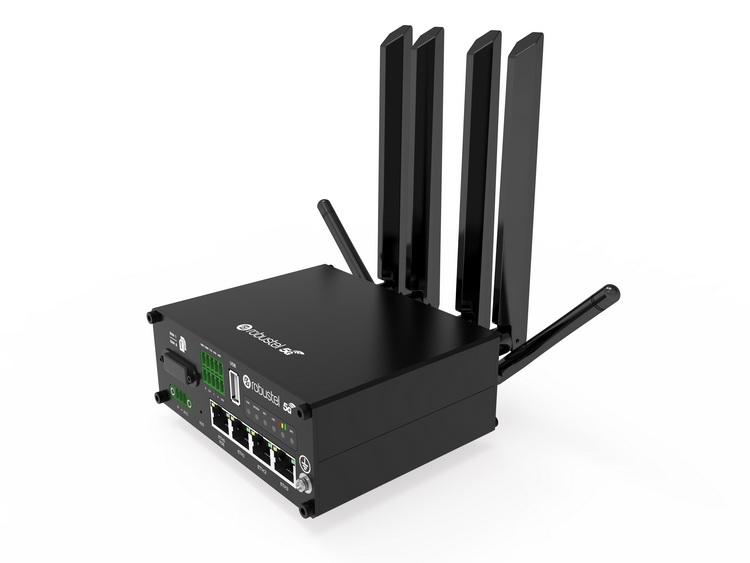
The Robustel R5020 Industrial 5G Router provides several controls relevant to this layered architecture.
Current product documentation lists firewall functions including filtering and access control, VPN options including IPsec and OpenVPN, VLAN-capable networking, HTTPS/SSH management and centralized management through RCMS. The router runs RobustOS, which adds certificate/key management, security-update processes and detailed diagnostics across the broader software environment.
A branch architecture might therefore use:
Corporate devices
→ segmented LAN
→ R5020 firewall
→ VPN
→ 5G
→ enterprise network
A different project may use the R5020 only as one element behind another security appliance. Both can be valid.
Robustel’s branch-office R5020 application example uses segmentation, a VPN overlay and centralized Zero-Touch and update workflows as separate parts of the design. That separation is useful because it avoids treating “VPN enabled” as the complete security architecture.
RCMS adds another security layer when centralized management is required, including permissions, device identity, secure provisioning, signed updates and platform-level controls.
None of these controls eliminates the buyer’s responsibility to configure them correctly. The secure deployment is the combination of:
Router capability + network policy + operating process + software lifecycle
Turn the 18 Controls into a Vendor Acceptance Record
Do not finish the review with eighteen ticks. Record the evidence.
| Control area | Buyer should ask | Evidence to retain |
|---|---|---|
| Credentials | How are production credentials controlled? | Configuration/security documentation |
| Access | Can permissions be limited by role? | Role model or platform guide |
| Firewall | What traffic can be restricted? | Product/manual configuration evidence |
| Segmentation | Can trust zones be separated? | VLAN/routing/firewall design |
| VPN | Which protocols and topologies are supported? | Product/software documentation |
| Secure boot | Is it implemented on this exact model? | Explicit model-specific evidence |
| Firmware integrity | How are updates authenticated? | Vendor security/update documentation |
| Patch lifecycle | How are vulnerabilities handled? | Security policy/release process |
| Logging | What evidence remains after an event? | Log/diagnostic documentation |
| Fleet changes | How are updates staged and recovered? | Management-platform workflow |
| Retirement | What is removed or revoked? | Decommissioning procedure |
The final procurement question becomes more useful: Can the organisation demonstrate how this router will be secured from commissioning to retirement? That is much harder to answer with marketing terminology alone.
Preguntas frecuentes
Q1. Is a VPN enough to secure an industrial 5G router?
No. A VPN protects selected traffic between defined endpoints, but router security also depends on management credentials, firewall policy, segmentation, software updates, logging, monitoring and operational practices. A poorly administered router can remain vulnerable even when all remote traffic uses encryption.
Q2. Does the Robustel R5020 Industrial 5G Router support firewall and VPN functions?
Yes. The Robustel R5020 Industrial 5G Router provides firewall controls and multiple VPN technologies, including IPsec and OpenVPN. The final security posture still depends on how those features are configured and how access, updates and credentials are managed throughout the deployment.
Q3. Should secure boot be mandatory for every industrial router?
That depends on the organisation’s threat model, procurement policy and regulatory requirements. Where secure boot is mandatory, request explicit evidence for the exact model and hardware/firmware version. Do not assume the presence of signed updates or other security features automatically proves a secure-boot implementation.
Q4. How often should industrial 5G router firmware be updated?
There is no universal interval. Teams should review vendor advisories and release notes, assess the security and operational impact, validate new firmware on representative devices and then roll it out according to change-control policy. Critical vulnerabilities may require a different schedule from routine feature releases.
Q5. What is the most important security requirement for a large router fleet?
Consistency is one of the most important operational requirements. Security rules lose value if each router gradually develops different credentials, firewall policies or firmware versions. A known baseline, centralized visibility and controlled change process make security easier to verify across the estate.
Conclusión
An industrial 5G router security checklist should measure more than the number of security features on a datasheet. The Robustel R5020 Industrial 5G Router can contribute firewall, VPN, access-control and centralized management capabilities to a layered security architecture, but effective protection still depends on configuration, software integrity, monitoring and lifecycle discipline.
Evaluate all 18 controls as evidence: Identity → network boundary → software integrity → monitoring → lifecycle
And treat unsupported assumptions carefully. If secure boot, rollback, a specific authentication method or another control is mandatory, require explicit evidence for the exact product and software version. Security becomes defensible when every important control has an owner, a configuration and evidence that it remains effective after the router leaves the lab.
Explore more articles about Robustel industrial 5G routers:

Acerca del autor
Robert Liao | Technical Support Engineer
Robert is an IoT Technical Support Engineer at Robustel, specializing in industrial networking and edge connectivity. A certified Networking Engineer, Robert focuses on the deployment and troubleshooting of large-scale IIoT infrastructures. His work centers on architecting reliable, scalable system performance for complex industrial applications, bridging the gap between field hardware and cloud-side data management.