
LoRaWAN Gateway Guide 2026: Types, Range, Capacity and Selection Criteria
The Robustel R1520LG LoRaWAN Gateway shows why choosing a LoRaWAN gateway should begin with its role in the network rather than with a claimed range or maximum sensor count. A simple packet-forwarding gateway, a gateway with an embedded LoRaWAN Network Server, and an edge gateway that also processes field data may all use LoRaWAN radio, but they solve different architectural problems.
For industrial deployments, four questions usually determine the right gateway class: how the LoRaWAN traffic will reach the application, where the LNS will run, what IP backhaul is available, and whether the gateway must do more than forward packets. Range and capacity matter, but neither is a fixed product number that can be separated from the site.
LoRaWAN Gateways Can Have Very Different Roles
At the simplest end, a gateway receives LoRaWAN traffic and forwards it over IP to an external network server. This architecture keeps network-server ownership centralized and can be efficient when an organization already operates ChirpStack or another LNS platform.
Other projects need the LNS closer to the site. This may be useful where local control of the LoRaWAN network is preferred, where the site should remain operational through an upstream outage, or where the project does not want to maintain a separate server infrastructure.
A third category adds edge computing. The gateway may receive LoRaWAN traffic while also handling wired industrial data, running local logic, normalizing selected information or presenting a local dashboard. At that point, the gateway is no longer only part of the radio network; it has become part of the application architecture.
LoRaWAN Gateway Roles and Robustel Product Fit
| Gateway role | Main responsibility | Architecture question | Robustel example |
|---|---|---|---|
| Packet-forwarding gateway | Receive LoRaWAN packets and forward them to an external LNS | Is the LNS already hosted centrally? | Robustel R1320LGe LoRaWAN Gateway |
| Flexible gateway with external or embedded LNS | Support different LNS deployment models | Should network-server ownership stay external or local? | Robustel R1520LG LoRaWAN Gateway |
| Edge-integrated LoRaWAN gateway | Combine LoRaWAN with local processing and other field data | Does the site need local application logic or data integration? | Robustel LG3120e LoRaWAN Gateway |
| Building automation gateway | Combine LoRaWAN with building protocols and local automation | Does LoRaWAN need to coexist with KNX, BACnet, M-Bus or other facility systems? | Robustel LG5120 LoRaWAN Gateway |
The Robustel LoRaWAN Gateway Portfolio webinar follows the same distinction, moving from packet forwarding through embedded LNS options to edge-integrated gateway architectures. That difference is more useful for selection than treating every LoRaWAN gateway as the same radio appliance.
LoRaWAN Range Is a Property of the Site
LoRaWAN is often associated with long range, but a gateway datasheet cannot tell an engineer exactly how far a particular sensor will communicate inside a real building, factory or outdoor network.
The radio path is affected by gateway height, antenna position, walls, reinforced concrete, metal structures, endpoint antenna design, regional frequency plan, interference and the LoRaWAN device configuration. A sensor in an open field and another inside a metal plant room may therefore produce very different results even when they use the same gateway.
Robustel’s Voytech Systems LoRaWAN BMS case study provides useful real-world evidence of this distinction. Voytech used R1520LG gateways in building automation environments where sensors had to reach through floors, occupied spaces and plant areas. The case demonstrates that strong in-building performance is possible, but its project-specific results should not be converted into a universal R1520LG range specification.
The engineering lesson is to survey the actual building and treat additional gateways as a normal network-design option when one receiving point does not provide sufficient coverage.
Capacity Depends on Traffic, Not Only the Number of Sensors
The same caution applies to capacity. The R1520LG, R1320LGe, LG3120e and LG5120 support up to eight simultaneous LoRa receive channels according to their current datasheets. That is a useful radio specification, but it is not equivalent to saying that each gateway supports a fixed number of endpoints.
A network of sensors sending a short message several times per day places a very different load on the radio channel from hundreds of devices sending larger payloads frequently. Spreading factor, retransmissions, downlink requirements, packet size and the regional radio rules all influence the practical capacity of the deployment.
What Determines Practical LoRaWAN Capacity?
| Design variable | Why it changes capacity | Robustel deployment implication |
|---|---|---|
| Message frequency | More transmissions consume more airtime | Do not size a Robustel gateway fleet from endpoint count alone |
| Payload size | Longer packets occupy the channel for longer | Model the actual sensor payload |
| Spreading factor / data rate | Slower transmissions use more airtime | Include difficult RF locations in capacity planning |
| Retransmissions | Poor links create additional traffic | Coverage quality and capacity influence each other |
| Downlink demand | Downlinks consume network resources and can affect scheduling | Confirm the real application behaviour |
| Gateway density | More receiving points can improve radio coverage and reception diversity | Add Robustel gateways where RF or traffic design requires them |
A useful capacity plan therefore starts from the endpoint behaviour. “500 sensors” is not yet a network requirement. “500 sensors sending a defined payload every five minutes with a known downlink pattern” is much closer to one.
Backhaul Is Part of the LoRaWAN Architecture
A gateway can receive LoRaWAN packets successfully while the overall application remains unavailable because its IP backhaul has failed.
A building may use Ethernet. A remote installation may rely on cellular. Another site may use Wi-Fi as the available uplink. If the LNS is external, loss of that path separates the radio network from the network server even though the gateway itself is still hearing sensors.
This becomes particularly important in cold-chain and other distributed monitoring applications. Robustel’s KoolZone LoRaWAN cold-chain case study shows a real deployment in which R1520-LG gateways support LoRaWAN sensing around demanding refrigeration environments while mixed cellular connectivity forms part of the wider service architecture.
The case should not be used to claim that every freezer, laboratory or mobile network will behave identically. Its relevance here is that successful LoRaWAN sensing and dependable IP backhaul are two separate responsibilities that both need to work.
How the Robustel R1520LG LoRaWAN Gateway Supports Flexible LNS and Backhaul Architectures
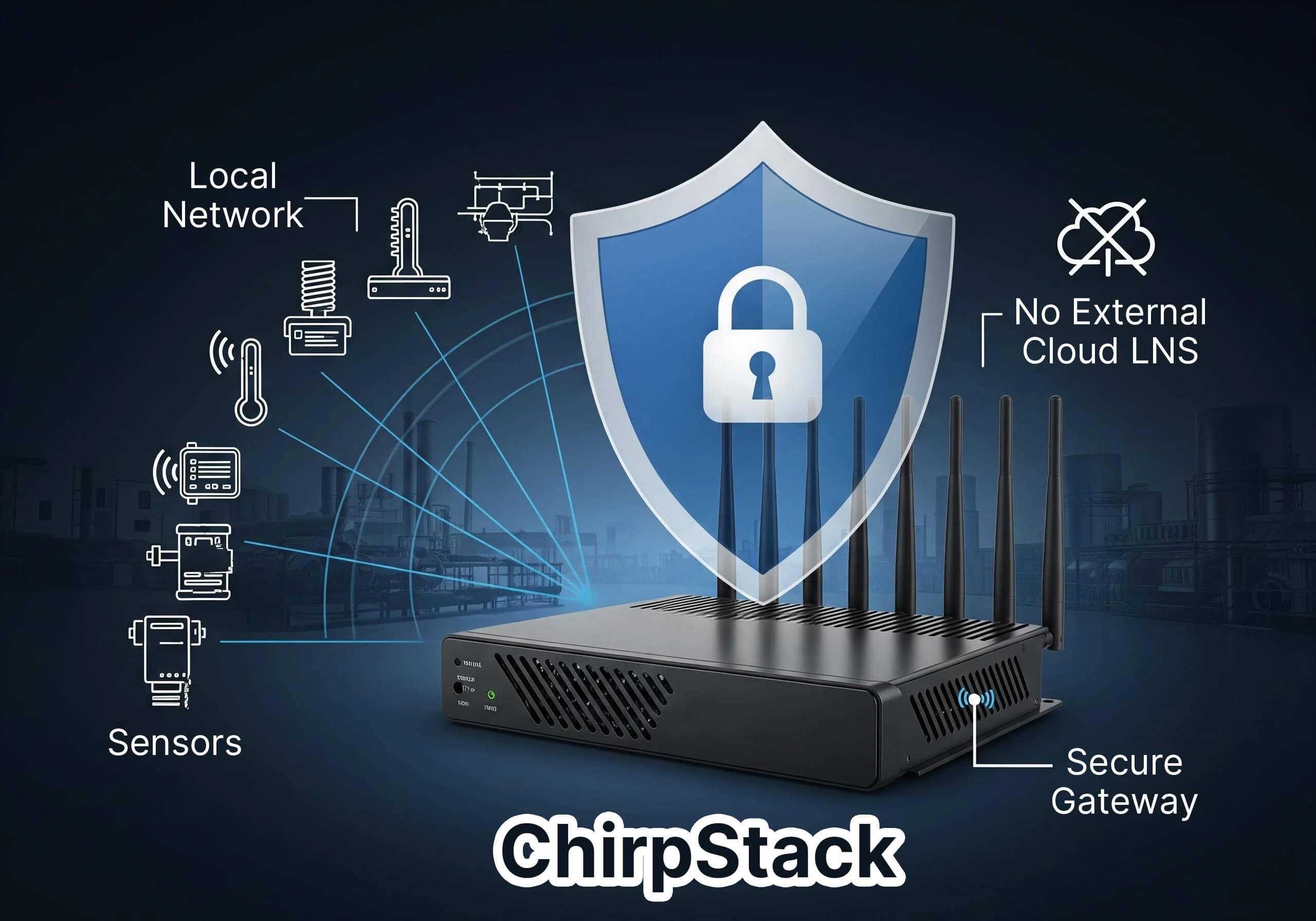
The Robustel R1520LG LoRaWAN Gateway is particularly useful when a project has not reduced the gateway role to simple packet forwarding. It supports external LNS architectures using UDP, LoRa Basics Station and LORIOT, while an embedded ChirpStack option allows the network server to run locally where that design is appropriate.
The gateway also provides two Fast Ethernet ports, dual Mini SIMs, Wi-Fi in AP or client mode, separate RS-232 and RS-485 interfaces and optional PoE-PD on ETH0. These interfaces allow the unit to fit different physical sites without assuming that every project will use all of them.
Its current datasheet specifies LoRaWAN V1.0.4 Class A and Class C support. Class B should not be inferred simply because it belongs to the wider LoRaWAN specification.
The R1520LG can also use E2C ChirpStack to connect LoRa data toward cloud environments and provide buffering within that documented software architecture. Buffering can reduce the impact of temporary upstream connectivity loss, but it should not be translated into a guarantee that no data can ever be lost under every failure condition.
Match the Robustel LoRaWAN Gateway to the Required Application Layer
The wider Robustel portfolio covers several different deployment models.
The Robustel R1320LGe LoRaWAN Gateway is positioned as a compact forwarding gateway that collects LoRaWAN data and forwards it to ChirpStack. It combines 4G LTE Cat 4, Fast Ethernet and 2.4 GHz Wi-Fi backhaul, together with a physical Mini SIM and MFF2 eSIM.
The Robustel LG3120e LoRaWAN Gateway moves further into edge computing. Its integrated LNS, more than 300 pre-built sensor codecs, E2C Field Suite and local Node-RED environment make sense where LoRaWAN data needs to participate in a wider edge workflow alongside supported Modbus, OPC UA or BACnet data.
The Robustel LG5120 LoRaWAN Gateway is more specialized again. It combines LoRaWAN with building-automation interfaces including KNX, M-Bus, P1, RS-485 and building-oriented software through the E2C Facility Suite.
Robustel LoRaWAN Gateway Selection Matrix
| Project requirement | Robustel best-fit direction | Why |
|---|---|---|
| Existing ChirpStack LNS and straightforward packet forwarding | R1320LGe | Focused forwarding architecture |
| Need external LNS flexibility or embedded ChirpStack | R1520LG | Supports both LNS approaches |
| LoRaWAN plus local edge processing and mixed field data | LG3120e | Integrated LNS, E2C Field and local compute |
| Building automation integrating LoRaWAN with facility protocols | LG5120 | KNX, BACnet, M-Bus, P1 and local automation capabilities |
| Outdoor exposed installation using R1520LG | R1520LG plus a suitable outdoor enclosure | The gateway itself is IP30 and should not be treated as an exposed outdoor product |
The table is a starting point rather than a ranking. The best-fit gateway is the one whose radio, LNS, backhaul, software and local-interface responsibilities match the architecture.
Fleet Management Should Be Designed Before the Rollout Becomes Large
One or two gateways can be configured locally without much operational difficulty. A geographically distributed fleet creates a different problem.
The Robustel RCMS platform provides centralized device visibility, configuration and update workflows for supported Robustel gateways. Operations teams can compare network state, carrier conditions, firmware and alerts across sites instead of treating each gateway as an isolated appliance.
That does not make a remote installation maintenance-free. Power failures, damaged antennas, environmental ingress or complete loss of backhaul can still require physical intervention. Remote management is valuable because it gives the team more evidence before that visit is made.
Preguntas frecuentes
Q1. How many devices can a LoRaWAN gateway support?
There is no reliable universal endpoint count. Practical capacity depends on message frequency, payload size, spreading factor, retransmissions, downlink behaviour and RF conditions. The number of LoRa channels is one input to the design, not a guaranteed sensor limit.
Q2. How far can a LoRaWAN gateway reach?
Range varies greatly by environment. Open rural sites, high-rise buildings, basements and industrial plants produce different radio paths. Antenna position and endpoint conditions usually matter more than a generic distance claim.
Q3. Does a LoRaWAN gateway need internet access?
Not always in the same way. If the LNS and application are hosted elsewhere, the gateway needs a working IP path to reach them. Architectures with local network-server or application functions may continue some local operations during upstream outages.
Q4. What LoRaWAN device classes does the Robustel R1520LG support?
The Robustel R1520LG LoRaWAN Gateway current datasheet specifies LoRaWAN V1.0.4 Class A and Class C. Class B should not be added unless a later model-specific Robustel source explicitly documents it.
Q5. What is the difference between R1320LGe and R1520LG?
R1320LGe is primarily a forwarding gateway for sending LoRaWAN traffic to ChirpStack, while R1520LG offers greater LNS flexibility with both external forwarding options and embedded ChirpStack. The correct choice depends mainly on where the network-server responsibility should sit.
Conclusión
The Robustel R1520LG LoRaWAN Gateway is a strong fit where a project needs flexible LNS architecture, several backhaul options and an industrial gateway that can sit between LoRaWAN sensors and either local or remote network services. Its value comes from that architecture flexibility rather than from a universal range or sensor-count claim.
A robust LoRaWAN design starts by defining the gateway role, validating RF coverage at the real site, estimating capacity from actual endpoint behaviour and deciding where the LNS and application responsibilities belong. Once those decisions are clear, product selection becomes considerably more defensible.
Explore more articles about Robustel’s LoRaWAN gateways in industrial IoT:

Acerca del autor
Robert Liao | Technical Support Engineer
Robert is an IoT Technical Support Engineer at Robustel, specializing in industrial networking and edge connectivity. A certified Networking Engineer, Robert focuses on the deployment and troubleshooting of large-scale IIoT infrastructures. His work centers on architecting reliable, scalable system performance for complex industrial applications, bridging the gap between field hardware and cloud-side data management.