
Indoor vs Outdoor LoRaWAN Gateway: Which Type Fits Your Site?

The Robustel R1520LG LoRaWAN Gateway is an IP30 industrial gateway designed for protected installation, but it can participate in outdoor LoRaWAN infrastructure when the complete enclosure, antenna, power and environmental design provides the protection the site requires. Choosing between an indoor and outdoor gateway is therefore not simply a radio-range decision; it is an environmental-engineering decision.
A gateway may need to serve sensors outdoors without the active electronics themselves being exposed to rain, dust or direct sunlight. In other deployments, the best RF location is on a mast or pole, making a purpose-designed outdoor enclosure part of the network architecture.
“Outdoor Gateway” Means More Than a Wide Temperature Range
Temperature is only one environmental constraint. An exposed installation may face rain, dust, UV, condensation, wind-driven moisture, lightning-related surge conditions, insects, cable-gland problems and physical impact. A gateway that operates over a wide temperature range but carries an IP30 ingress rating should not be described as weatherproof.
The current R1520LG datasheet lists IP30. The same applies to the R1320LGe, LG3120e and LG5120 datasheets available for the current portfolio.
Indoor vs Outdoor LoRaWAN Design Requirements
| Design factor | Protected indoor installation | Exposed outdoor installation | Robustel implication |
|---|---|---|---|
| Ingress protection | Building/cabinet provides protection | Enclosure must protect against weather and dust | Robustel R1520LG itself is IP30 |
| Temperature | Room or cabinet conditions | Solar heating and seasonal extremes matter | Check gateway and enclosure limits together |
| Antenna | Can often be mounted inside or nearby | Outdoor antenna, cable and connector sealing become important | Treat antenna as part of the Robustel RF system |
| Potencia | Building PSU or PoE may be available | Remote PSU, surge and cable routing may dominate | Verify complete power design |
| Mantenimiento | Physical access may be easy | Mast, roof or field access may be costly | Remote monitoring becomes more valuable |
| Mounting | DIN rail, wall or desktop | Pole/wall enclosure hardware may be required | Outdoor node is more than the gateway alone |
This difference is easy to miss when procurement begins with “we need long range.” The location that gives the best RF performance may also be the location with the hardest environmental conditions.
Indoor Sites Can Still Be Difficult Radio Environments
Indoor does not mean easy. Plant rooms, basements, lift shafts, utility spaces and reinforced concrete structures can attenuate radio signals significantly. A gateway placed in a convenient IT room may therefore give worse coverage than one installed closer to the sensor estate.
Robustel’s Voytech Systems case study demonstrates this point in real building automation projects. R1520-LG gateways were placed into an architecture serving LoRaWAN devices distributed through difficult building environments.
The case supports the principle that gateway placement should follow RF evidence. Its reported project results should not be converted into a standard range promise for every building.
Outdoor Coverage Can Improve While Installation Risk Increases
Moving a LoRaWAN gateway higher or into a more open position can improve the radio path. That does not automatically make the location a better installation.
The gateway may now be harder to power, harder to reach and more exposed to weather. Long antenna or Ethernet cable runs introduce their own losses and protection requirements. The design should therefore compare the RF improvement against the operational cost of maintaining the node.
Robustel’s Cibicom nationwide LoRaWAN case study provides a real example of this trade-off. The original deployment used the now-legacy R3000-LG inside an IP67 enclosure at difficult-to-access locations such as masts and third-party sites.
The important evidence is the system architecture: the outdoor solution was not simply a bare industrial gateway installed in the rain. The enclosure, antennas, backhaul, power and maintenance model formed the outdoor node.
How the Robustel R1520LG LoRaWAN Gateway Can Be Used in a Protected Outdoor Node
The Robustel R1520LG LoRaWAN Gateway provides an appropriate radio and backhaul platform for many distributed LoRaWAN sites, but its IP30 rating means the gateway itself requires environmental protection when installed in an exposed location.
Robustel’s OTD6710 IP67 Enclosure is documented as compatible with R1520LG. It adds an IP67 housing, cable glands, thermal management and outdoor mounting options around the active gateway.
That distinction should remain explicit: R1520LG = active LoRaWAN gateway
OTD6710 = environmental enclosure around the gatewayThe combination can form an outdoor LoRaWAN node, but the R1520LG itself does not become an IP67 product.
The outdoor design still needs a suitable antenna configuration, grounding strategy, surge protection, power supply, thermal validation and final RF commissioning. An enclosure rating does not prove that the complete installation has been engineered correctly.
Outdoor Gateway Selection Should Include Operations
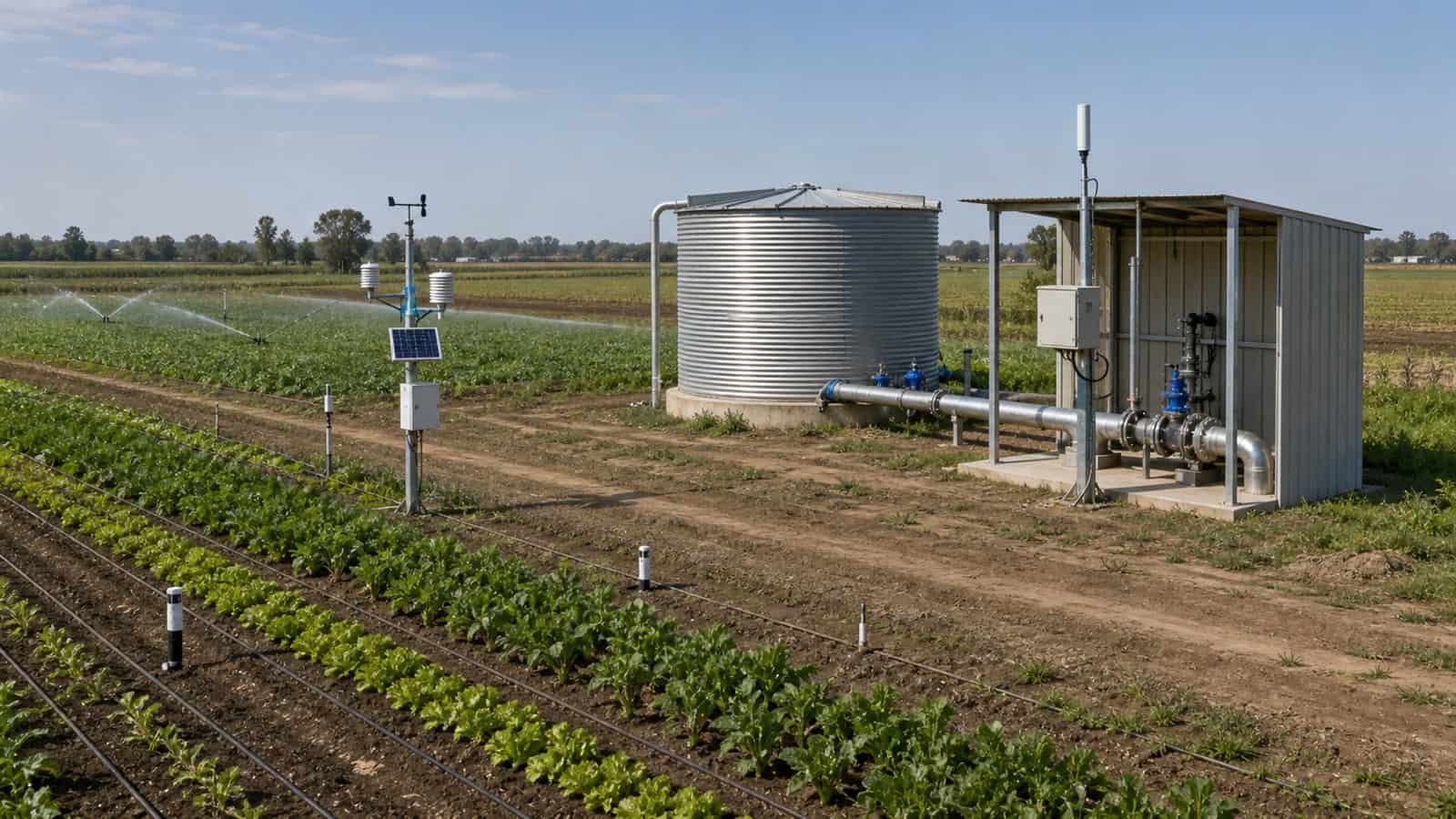
A remote agricultural site may be easy to cover with radio but expensive to visit. A roof-mounted urban gateway may be close geographically while still requiring access permits or specialist equipment for maintenance.
This changes the value of remote diagnostics. The Robustel RCMS platform can provide centralized gateway status, connectivity and device-management information for supported deployments.
If a node becomes unreachable, remote management cannot tell an engineer everything. Complete loss of power or backhaul can remove the management path itself. However, when communication remains available, fleet information can help distinguish a gateway condition from a cellular, configuration or wider network problem before someone travels to the site.
Outdoor LoRaWAN Acceptance Checklist
| Test | Por qué es importante | Robustel outdoor-node expectation |
|---|---|---|
| Verify final enclosure seal | Incorrect glands or assembly defeat environmental protection | Inspect R1520LG + enclosure installation |
| Measure internal thermal conditions | Enclosures can run hotter than ambient | Validate expected load and climate |
| Test antenna from final position | Bench RF does not represent mast or cabinet installation | Record actual LoRaWAN coverage |
| Test cellular/Ethernet backhaul | Good LoRa reception is useless without required upstream connectivity | Verify R1520LG backhaul |
| Simulate power recovery | Remote nodes may experience power interruption | Confirm gateway and application recovery |
| Confirm remote visibility | Site visits may be expensive | Establish RCMS operational baseline |
The LoRaWAN Gateway Applications video illustrates why LoRaWAN is commonly considered for agriculture, buildings and environmental monitoring. The outdoor design question that follows is where the gateway itself can be installed safely while still producing the required radio coverage.
An Indoor-Rated Gateway Can Still Serve Outdoor Sensors
The sensors and the gateway do not need to share the same environmental category. A gateway may remain inside a protected communications room or cabinet while its LoRaWAN coverage extends to outdoor meters, tanks or environmental sensors. If that position gives sufficient coverage, it can be simpler to maintain than putting the entire gateway outside.
Robustel’s Private LoRaWAN for Smart Farm Sensors Application Example illustrates this wider architecture. Distributed farm sensors communicate through LoRaWAN while the R1520-LG provides the gateway and upstream path.
As an Application Example, it shows how the architecture can be arranged; it is not proof that one gateway will cover a particular farm size or that every agricultural installation should use the same antenna or enclosure configuration.
Other Robustel LoRaWAN Gateways Also Need Environmental Qualification
The Robustel R1320LGe LoRaWAN Gateway, Robustel LG3120e LoRaWAN Gateway and Robustel LG5120 LoRaWAN Gateway are also specified as IP30 in their current datasheets. This matters because “industrial” and “outdoor” are not synonyms.
If one of these products needs to be installed in an exposed environment, the project must provide a suitable environmental enclosure and validate thermal, RF, power and cable requirements. The OTD6710 should not be assumed compatible with those models unless Robustel documentation explicitly lists them.
Preguntas frecuentes
Q1. Can an indoor LoRaWAN gateway receive signals from outdoor sensors?
Yes. The gateway can remain in a protected indoor or cabinet location while receiving outdoor sensors if the RF path is adequate. A site survey should verify the real coverage.
Q2. What IP rating does an outdoor LoRaWAN gateway need?
There is no single rating that replaces environmental design, but exposed equipment generally needs appropriate protection against dust and water. The complete installation should also address temperature, UV, cable glands, surge protection and mounting.
Q3. Is the Robustel R1520LG an outdoor LoRaWAN gateway?
The Robustel R1520LG LoRaWAN Gateway itself is IP30 and should not be presented as weatherproof. Robustel documents the OTD6710 IP67 enclosure as a compatible outdoor enclosure for R1520LG.
Q4. Is outdoor LoRaWAN range always better than indoor range?
No. An open elevated position may improve the RF path, but terrain, antenna design, interference and endpoint conditions still affect performance. Outdoor placement should be justified by survey data rather than assumed to produce a specific distance.
Q5. Should the gateway or only the antenna be mounted outside?
Either architecture can be valid. Keeping the gateway protected and using a suitable external antenna can simplify maintenance in some projects, while another site may require the full gateway node closer to the desired radio position. Cable loss, power, access and environmental protection should be compared before deciding.
Conclusión
The Robustel R1520LG LoRaWAN Gateway can serve both protected indoor networks and properly engineered outdoor LoRaWAN nodes, but its IP30 rating means exposed installations require an appropriate environmental solution rather than relying on the gateway housing itself.
The better indoor-versus-outdoor decision starts with RF placement and then tests whether that location can be powered, protected, cooled and maintained throughout the deployment life. Range matters, but outdoor reliability depends on the whole node.
Explore more articles about Robustel’s LoRaWAN gateways in industrial IoT:


Acerca del autor
Robert Liao | Technical Support Engineer
Robert is an IoT Technical Support Engineer at Robustel, specializing in industrial networking and edge connectivity. A certified Networking Engineer, Robert focuses on the deployment and troubleshooting of large-scale IIoT infrastructures. His work centers on architecting reliable, scalable system performance for complex industrial applications, bridging the gap between field hardware and cloud-side data management.