
How to Measure 5G Router Failover Time Without Breaking Production Traffic
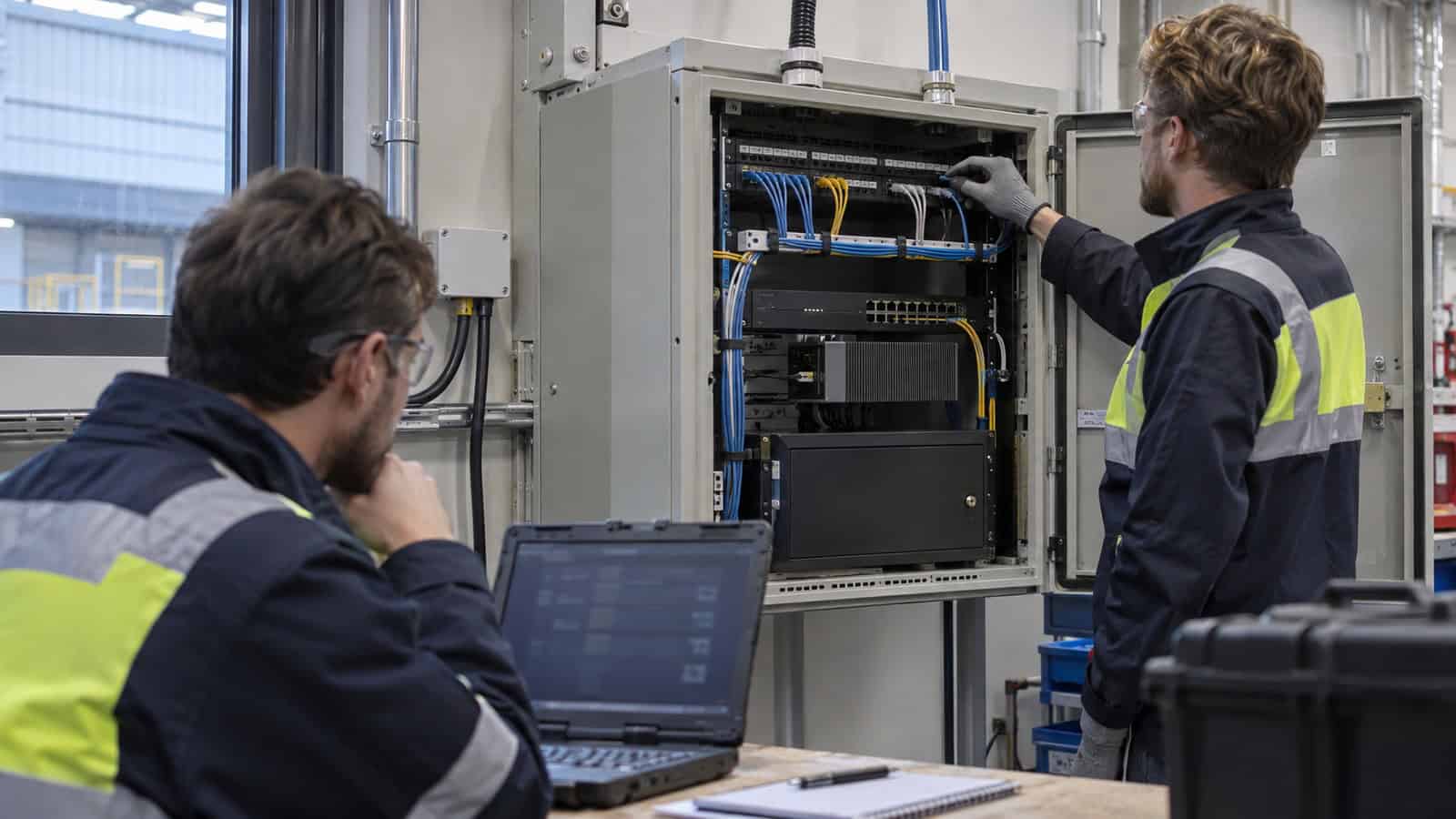
The Robustel R5020 Industrial 5G Router can use Ethernet or Wi-Fi as a primary path with cellular failover, but a useful failover time is the interval until the required application transaction succeeds again, not merely the moment the backup interface reports up. DNS caches, IPsec renegotiation, NAT state and application retry timers can extend the outage after routing has changed.
Production testing should therefore begin with observation, then move through a low-risk laboratory replica and a controlled maintenance window. This procedure records each recovery layer on one clock so the team can state what was measured without publishing a universal number.
Define the recovery endpoint before touching a link
Write one acceptance sentence: “Failover is complete when the test client successfully performs the named application transaction through the backup path for three consecutive probes.” A ping can be one probe, but it should not be the endpoint for a VPN-hosted API, camera stream or PLC telemetry connection.
Synchronize the router, test client, VPN endpoint and application logger. Record firmware, carrier, SIM, signal condition, health-check thresholds, DNS method, VPN profile, payload size and application timeout. If those variables are absent, two failover figures cannot be compared.
The Robustel video “What Is an Industrial 5G Router and When Do You Need One?” below is useful for aligning the team on the router’s primary/backup WAN role before the test plan is written. Model capability and actual recovery time remain separate questions.
Build a timestamp ledger across every recovery layer
Use a continuous probe stream with unique sequence numbers. The failure event must have a known timestamp, such as disabling the upstream test port in the lab. Avoid pulling power or antennas in production unless the method statement explicitly covers the resulting risks.
| Timestamp | Layer | Evidence | Interpretation |
|---|---|---|---|
| T0 | failure introduced | switch-port event or controlled upstream isolation | start of measured incident |
| T1 | failure detected | router health-check or interface log | detection delay |
| T2 | route changed | route table and egress observation | forwarding path selected |
| T3 | cellular usable | registration, data session and assigned address | backup WAN ready |
| T4 | VPN restored | tunnel state plus protected-endpoint probe | encrypted path ready |
| T5 | DNS usable | fresh lookup from test client | name resolution ready |
| T6 | application restored | successful transaction with expected response | service recovery endpoint |
Report each delta, not just T6−T0. A long T1 points to detection settings; a long T4 points to tunnel recovery; a long T6 may be an application retry or stale-session problem.
Rehearse the failure in four increasingly realistic stages
Start with a passive baseline. Run the probes without introducing a fault and confirm that packet loss, latency and application errors are already within an agreed range. This prevents normal instability being attributed to failover.
Next, isolate the primary upstream in a lab replica while leaving the router powered. Repeat with an active IPsec tunnel and with the actual application protocol. Only after those runs are repeatable should the team test a production unit during a maintenance window, with an immediate abort condition and a separate management path.
Robustel’s high-speed branch-office R5020 application example illustrates the architecture in which 5G carries a site after fixed-WAN loss. For acceptance, add the site’s real DNS, tunnel and transaction probes; the application example does not set a recovery time.
How Robustel R5020 Industrial 5G Router supports staged failover measurement
Robustel R5020 Industrial 5G Router provides the relevant path choices—Ethernet or Wi-Fi primary access, 5G/4G cellular, multiple VPN options and RCMS fleet visibility. In a test, those capabilities let the engineer observe distinct interface, route and tunnel states while a separate client measures service behaviour.
| Site question | Verified Robustel R5020 capability | Test effect | Acceptance evidence |
|---|---|---|---|
| Did the egress path change? | configurable Ethernet/Wi-Fi and cellular WAN roles | compare route and external address before/after T0 | route snapshot and controlled endpoint log |
| Did the secure path return? | IPsec, OpenVPN and DMVPN options | probe inside the selected tunnel | tunnel event plus protected transaction |
| Can the event be reviewed remotely? | RCMS monitoring and logs | correlate device events with probes | exported incident timeline |
The router’s dual SIM can be tested in a separate scenario, but it changes the failure domain. SIM switching is not the same event as fixed-WAN-to-cellular failover and should have its own run, carrier conditions and acceptance threshold.
Protect production traffic and preserve rollback
Use a dedicated test VLAN, synthetic endpoint or small set of explicitly approved clients. Do not generate high-rate traffic against a PLC or safety system. Rate-limit probes, identify the change owner, preserve the starting configuration and keep a local recovery route if the management plane follows the path being interrupted.
Robustel’s R5020 emergency-services vehicle application example is a reminder that mobility and radio changes introduce additional variables. For a fixed production site, hold location, antennas and power stable while testing path logic; investigate radio mobility in a separate campaign.
Interpret the result without hiding residual outage
Publish the median and worst observed time for every layer, the number of runs, and any lost or duplicated transactions. Include failback as a second event. A system that recovers on 5G but breaks again when the preferred WAN returns has not completed a stable recovery test.
The incident closes only after application health remains stable for the agreed observation period, routes and tunnels match the intended state, queued data is reconciled, and the operator can explain every missing sequence number.
Preguntas frecuentes
Q1. What is failover testing?
Failover testing deliberately removes or degrades a primary path and measures whether the backup path restores the required service. A complete test includes detection, transition, application recovery and stable failback.
Q2. How do you perform a failover test safely?
Define the service endpoint, synchronize clocks, establish a baseline, use a lab replica first and introduce one controlled failure at a time. In production, work inside an approved maintenance window with rollback and abort criteria.
Q3. How can you tell whether a router is causing packet loss?
Run simultaneous probes on the LAN side, the active WAN, the tunnel endpoint and the application. Packet loss beginning only after the router hop points to the router path or its configuration; loss already visible upstream needs carrier or access-network investigation.
Q4. Is internet latency the same as failover time?
No. Latency measures delay while a path is working. Failover time includes fault detection, route change, addressing, tunnel recovery, DNS and the application’s own retry behaviour.
Q5. What should be measured on a Robustel R5020 Industrial 5G Router failover test?
Measure health-check detection, the active route, cellular registration and data session, public addressing, VPN state, DNS and an application transaction. Record the exact firmware, carrier, thresholds and payload for every run.
Conclusión
The Robustel R5020 Industrial 5G Router is best suited to this staged method when Ethernet or Wi-Fi is the normal path and 5G/4G is the controlled backup. Its path and management capabilities make the layers observable, but the application and its dependencies still determine when service has truly recovered.
Keep the timestamp ledger with the change record, repeat the test after material firmware, carrier, VPN or application changes, and set acceptance on T6 rather than the first green interface indicator.
Explore More Articles About Robustel 5G Routers

Acerca del autor
Robustel Editorial Team
The Robustel Editorial Team publishes practical articles on industrial connectivity, edge computing, LoRaWAN and device management, focusing on deployment considerations, technical limitations and long-term operation.