
How to Choose the Best 5G Router for Business and Industrial IoT: 2026 Buyer’s Guide

Two 5G routers can advertise the same cellular generation, Ethernet and WiFi yet belong to different product classes. The Robustel R5030 Industrial 5G Router is a relevant example when a business site also needs industrial mounting, dual SIM, WiFi 6 and central fleet management.
The difference may not be obvious during a short office test. It appears when the fixed WAN fails, the router is installed inside a cabinet, several local devices compete for bandwidth or a network team must update hundreds of sites without sending staff to each location.
In this buyer’s guide, “best 5G router” means the best fit for the application, operating environment and cost of failure. It does not mean the market leader or the product with the longest specification list.
Start with the Cost of Losing Connectivity
A small office using cloud email and general web access does not face the same risk as a production site payment environment or remote infrastructure cabinet.
Before comparing 5G speed WiFi standards or Ethernet ports define what happens when the router becomes unavailable.
A short interruption may be inconvenient when employees temporarily lose internet access. The same interruption may stop transactions disconnect monitoring equipment interrupt video transmission or make an unmanned site unreachable.
Decision makers should establish:
- Which business processes depend on the connection
- How long those processes can remain offline
- Whether a wired WAN is also available
- Whether staff are present to restart or replace equipment
- How much an emergency site visit would cost
- How many routers will be deployed
- How long the hardware is expected to remain in service
This assessment changes the buying category. A standard business router may be sufficient when the site is accessible and short outages are acceptable. Industrial features become more valuable as downtime physical access and fleet size create greater operational risk.
The Robustel industrial 5G router portfolio reflects this distinction through different product architectures. A site that only needs a cellular handoff to an existing firewall does not require the same device as a branch vehicle or edge site where the router must also serve local Ethernet and WiFi equipment. The appropriate Robustel product direction should follow the operational role rather than a general preference for the highest specification.
Robustel’s Real-world example: when connectivity becomes an operating risk
In a Robustel case study with UK managed service provider Jones Technology, 5G connectivity was deployed across a large quick-service restaurant estate where WAN outages and delayed leased-line installations could affect POS systems, ordering kiosks, kitchen displays and guest Wi-Fi. Robustel R5010 5G Routers were integrated with the existing SD-WAN architecture, while RCMS supported centralised deployment and management. The project shows why router selection changes when connectivity directly affects store opening, transactions and multi-site support.
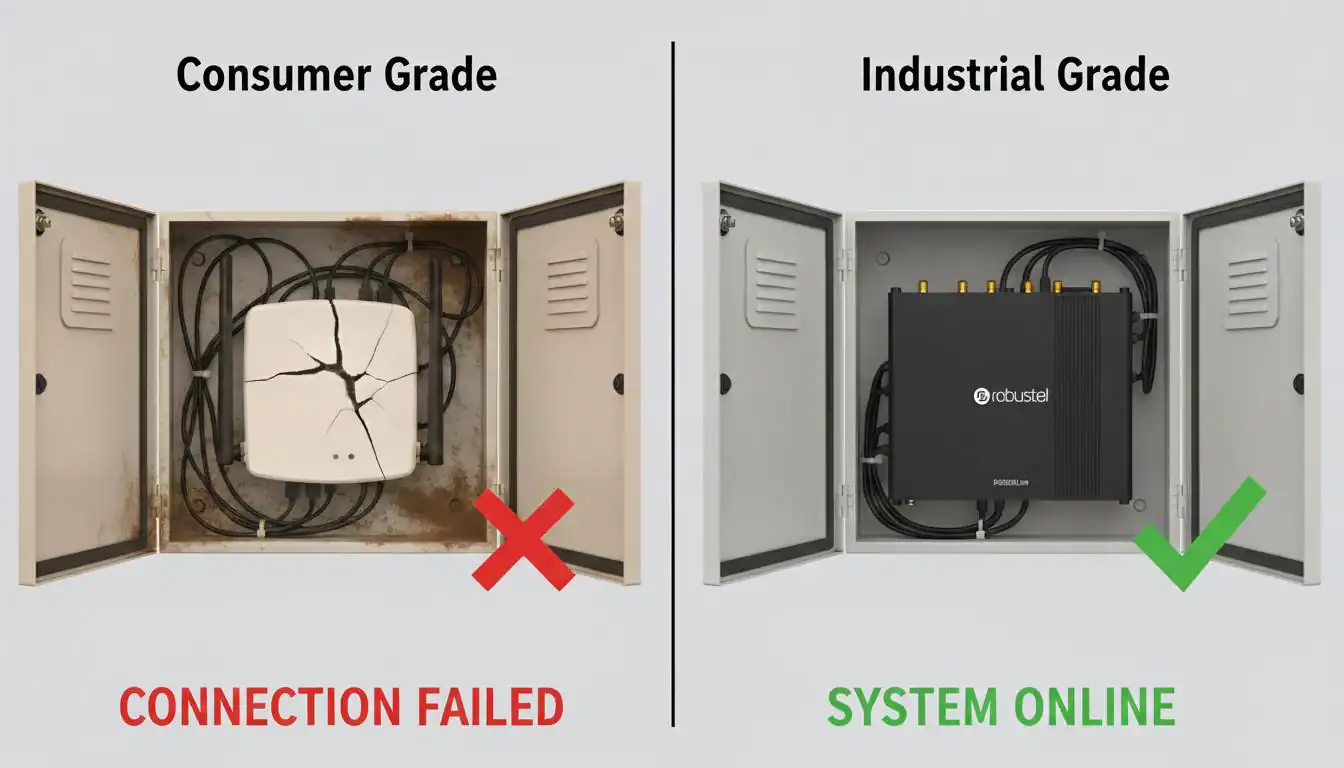
Consumer Business and Industrial 5G Routers: What Actually Changes
Product labels are not applied consistently across the market. A router described as “business grade” may provide strong VPN and WiFi capabilities, while an industrial router may focus more heavily on cellular resilience, mounting, power input and remote fleet operations.
The categories should therefore be treated as purchasing frameworks rather than fixed technical standards.
| Selection area | Consumer or home router | Business 5G router | Industrial 5G router |
| Primary role | Internet access for one home or small location | Managed connectivity for an office branch or venue | Connectivity for operational equipment distributed sites or demanding installations |
| Installation | Desktop indoor environment | Office rack wall or desktop installation | Cabinet wall DIN rail vehicle or controlled industrial enclosure |
| WAN recovery | Basic cellular reconnect | Fixed and cellular WAN options may be available | Defined WAN priority LTE fallback dual SIM and remote recovery are commonly evaluated |
| Local network | Ethernet and general WiFi clients | More users network policies and business security | IP equipment WiFi clients digital signals and model dependent industrial interfaces |
| Seguridad | Basic firewall and user controls | VPN firewall and central policy may be available | VPN access control network separation and managed configuration |
| Management | Local app or web interface | Central management may be available | Fleet onboarding configuration firmware diagnostics and remote support |
| Maintenance assumption | Someone can usually access the router | IT support can reach the site | Physical access may be slow costly or restricted |
None of these categories is automatically better. A consumer or standard business router is a proportionate choice when its operating limits match the site. An industrial router is justified when its additional resilience, interfaces or management functions solve a verified requirement.
The Robustel industrial 5G router portfolio reflects several distinct network roles. Current options include focused cellular WAN devices, multiport routers, models with serial or eSIM capability, PoE-PSE products and a WiFi 6 model for denser local access. This range allows buyers to select by architecture rather than forcing every project into one hardware design.
Compare the Features That Affect the Operating Model
Ruggedness Means Published Limits Not Marketing Language
A metal enclosure does not by itself prove that a router is suitable for an industrial site.
Check the published operating temperature, input voltage, mounting options, vibration or shock testing and ingress protection. Compare each limit with the final installation rather than the office where the router is first configured.
An IP30 router, for example, still needs a suitable enclosure when installed where dust, water or uncontrolled outdoor conditions are present. Wide temperature support does not remove the need to manage heat inside a closed cabinet.
For decision makers, the complete installation cost may include:
- Antennas and cables
- Power supply
- DIN rail or wall mounting
- Outdoor or industrial enclosure
- Electrical protection
- Installation labour
A lower router price does not create a lower project cost when the product requires extra hardware or does not fit the physical environment.
Dual SIM Is an Option Not a Continuity Guarantee
Dual SIM allows two cellular subscriptions to be installed. It does not prove that two live connections operate simultaneously that the subscriptions use independent infrastructure or that switching happens without interruption.
For compatible products in the Robustel industrial 5G router range dual SIM forms one part of the available connectivity design. The project team must still decide how the two subscriptions will be used whether they provide meaningful operator diversity and what should happen when the preferred connection returns.
A meaningful dual SIM design defines:
- Which SIM is preferred
- What condition counts as a connection failure
- How failure is detected
- When the second SIM is activated
- Which operator and APN it uses
- Whether VPNs and applications reconnect
- When the router returns to the preferred path
The two SIMs should also be reviewed commercially. They may use the same operator group roaming network or upstream private network leaving both paths exposed to the same failure.
Buyers should ask for the supported switching mechanism and test the complete application recovery process. The value of dual SIM comes from the implemented recovery policy not from the presence of two SIM slots alone.
WAN Failover Must Restore the Service Behind the Router
A business site may use fixed Ethernet or WiFi as its primary WAN and cellular connectivity as backup. An industrial site may use 5G as the main link with LTE fallback or a second cellular subscription.
In both cases, the router returning online is only one stage of recovery.
The acceptance test should confirm:
- The preferred WAN is detected as unavailable
- The alternative connection becomes active
- A usable IP connection is obtained
- VPN tunnels recover
- DNS and private networks remain reachable
- Applications reconnect
- Traffic returns correctly when the preferred WAN is restored
A status page showing an active cellular connection does not prove that payment terminals, remote monitoring or cloud applications are working again.
VPN Support Must Match the Network Architecture
A long VPN protocol list is not enough to approve a router.
Engineers need to confirm whether the selected VPN method is compatible with the existing infrastructure, addressing scheme and security policy. They should also define certificate ownership, credential renewal, reachable subnets and recovery after a WAN change.
Decision makers should look beyond initial configuration. The organisation must know:
- Who approves remote access
- Who maintains certificates and keys
- How former users lose access
- How configuration changes are audited
- What happens when credentials expire
- Whether support partners receive permanent or temporary access
The router supplies VPN functions. The organisation still owns access governance and application security.
Fleet Management Becomes Critical After the First Few Sites
A single router can be configured through a local web interface. A distributed estate needs a repeatable management process.
For supported Robustel router fleets the Robustel RCMS remote device management platform provides a central environment for monitoring configuration firmware maintenance and troubleshooting. Its relevance increases when branches vehicles or industrial sites share common settings but are too widely distributed for routine local administration.
Fleet management should be evaluated through real tasks:
- Registering devices before deployment
- Applying approved configurations
- Monitoring cellular and WAN status
- Updating firmware
- Reviewing configuration differences
- Troubleshooting remote sites
- Controlling administrator permissions
- Replacing a failed unit
- Confirming that a fleet change succeeded
The business value is not simply having a cloud dashboard. It is reducing uncontrolled local configuration and determining whether a fault can be resolved remotely before a technician travels to the site.
RCMS does not remove the need for physical maintenance. Damaged antennas power supplies cables and unsuitable local coverage may still require field intervention. Its role is to make the router estate more visible and manageable rather than to replace the complete support process.
When a Standard Business 5G Router Is Enough
An industrial router should not be purchased merely because it appears more durable or capable.
A standard business 5G router may be sufficient when:
- The device is installed in a controlled indoor office
- Staff or IT support can access it easily
- One cellular subscription is acceptable
- Short outages do not stop a critical operation
- The router serves general office users rather than operational equipment
- Local Ethernet and WiFi requirements are modest
- Configuration can be managed site by site
- The expected deployment is small
- Product replacement is straightforward
In this situation, paying for DIN rail mounting, dual SIM, digital I O or industrial fleet functions may not improve the business outcome.
The important point is evidence. The organisation should choose a simpler product because the operational requirement is simple, not because all 5G routers are assumed to behave similarly.
When Industrial Requirements Change the Buying Decision
An industrial 5G router becomes easier to justify when several of the following conditions apply:
- The router supports revenue producing or operational systems
- A failed connection triggers costly downtime
- The installation is remote mobile or difficult to access
- 5G must coexist with LTE fallback or another WAN
- Two cellular subscriptions form part of the recovery plan
- Several IP devices connect directly
- Industrial interfaces or digital signals are required
- The product must fit a cabinet vehicle or controlled industrial enclosure
- VPN and firewall policies must be standardised
- Many sites require common firmware and configuration
- The deployment is expected to remain in service for several years
These conditions affect both engineers and decision makers. Engineers need a product that integrates and recovers correctly. Decision makers need a deployment that can be operated without uncontrolled support cost.
The decision can be summarised as follows:
| Project condition | Standard business router may fit | Industrial 5G router is more likely to fit |
| Site access | Easy and inexpensive | Remote restricted or costly |
| Failure impact | Temporary inconvenience | Operational or revenue impact |
| WAN design | One connection | Primary backup or multi path design |
| Local equipment | General office clients | Cameras controllers terminals or industrial devices |
| Environment | Controlled office | Cabinet vehicle or demanding installation |
| Fleet size | A few sites | Distributed multi site estate |
| Support model | Local intervention | Central monitoring and remote maintenance |
Robustel’s Application example: when wireless connectivity becomes production infrastructure
A factory AGV deployment shows how industrial requirements can change the router decision. As AGVs move across production halls, loading areas and adjacent spaces, Wi-Fi coverage gaps, congestion and handovers can interrupt communications and create operational delays. A Robustel 5G Industrial Router or Gateway can provide each vehicle with a managed cellular path, while RCMS gives operations teams visibility into connectivity and gateway status across the fleet. The communications layer supports telemetry and supervision; onboard AGV control and safety responsibilities remain with the appropriate vehicle systems.
How the Robustel R5030 Industrial 5G Router Fits Business and Industrial IoT Sites
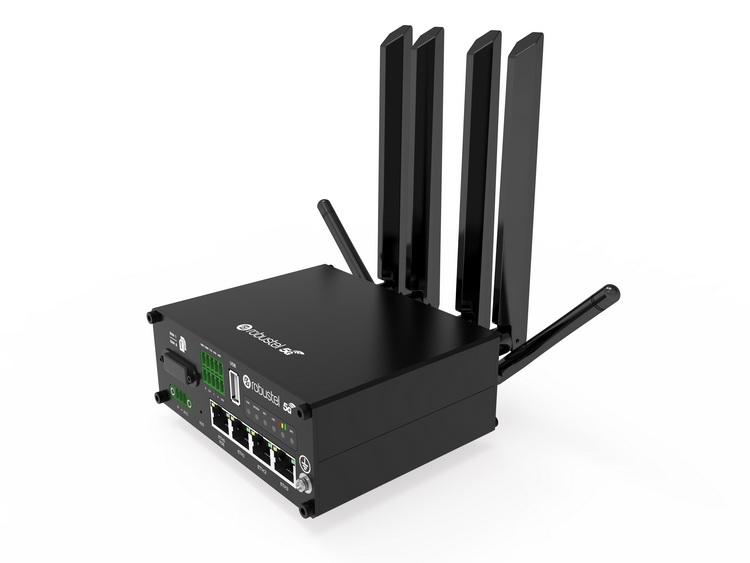
The Robustel R5030 Industrial 5G Router fits the point where business networking and industrial operating requirements overlap. Typical sites may need WiFi for users, several Ethernet connections for local equipment, cellular failover and central management across a distributed estate.
Support Branch Venues and Mobile Environments
A branch, transport environment or public venue may connect POS equipment, cameras, recorders, controllers and user devices through one local network. The business problem is not only obtaining 5G. It is serving local equipment while keeping the router manageable across many sites.
Robustel R5030 provides five Gigabit Ethernet ports that can be configured as one WAN plus four LAN ports or as five LAN ports. Dual-band WiFi 6 supports AP and client modes, while captive portal capability can support suitable authenticated user-access deployments.
This combination makes the R5030 relevant where local WiFi and multiple wired devices are part of the same site architecture rather than optional additions.
Robustel’s Application example: 5G backhaul is only one part of a mobile network
Robustel’s passenger Wi-Fi application example illustrates the wider networking requirements behind a transport deployment. The architecture combines 5G backhaul with centrally managed passenger access, usage policies and separation between guest traffic and operational systems such as ticketing and vehicle telemetry. RCMS supports fleet-wide configuration and monitoring. The example uses the Robustel R5020 5G Router, but the selection lesson is broader: a mobile router should be evaluated for its local network, Wi-Fi, segmentation and fleet-management responsibilities as well as cellular performance.
Manage a Distributed Router Estate Through RCMS
Robustel RCMS supports central monitoring, configuration and updates across deployed Robustel routers. This is relevant to businesses operating multiple branches, vehicles, venues or edge sites where local changes would be difficult to control consistently.
A repeatable deployment can use common configuration standards while still allowing site-specific operator, WAN and WiFi settings where required.
RCMS cannot repair damaged antennas, power supplies or cables. Its value is in improving visibility and reducing unnecessary site visits when the fault can be diagnosed or corrected remotely.
Understand the R5030 Selection Boundaries
The Robustel R5030 is not the best fit for every 5G project.
It does not provide physical RS232 or RS485 ports, so sites requiring direct serial integration should evaluate another Robustel industrial router. Its PoE capability is PoE-PD input for powering the router; it is not PoE-PSE output for powering several cameras.
Its IP30 enclosure also does not make it an exposed outdoor router. Outdoor or dusty installations still require a suitable enclosure.
Robustel R5030 is strongest where the project genuinely needs its combination of five Gigabit Ethernet ports, WiFi 6, dual SIM, GNSS, WAN failover and RCMS fleet management. Selecting it for those reasons creates a clear solution. Selecting it only because it has 5G and WiFi 6 does not.
Preguntas frecuentes
Q1. What is the difference between a business 5G router and an industrial 5G router?
A business 5G router usually focuses on office connectivity, WiFi, VPNs and branch networking. An industrial router places greater emphasis on installation conditions, power, mounting, WAN resilience, equipment interfaces and fleet operations. The categories overlap, so buyers should verify published specifications and management workflows rather than relying only on the product label.
Q2. Does a business need an industrial router for 5G backup?
Not always. A standard business router may be sufficient when the site is accessible, outages have limited impact and the router serves only general office traffic. An industrial model becomes more relevant when backup connectivity protects transactions, operational systems or remote equipment and when recovery, dual SIM and central management need to be tested across many sites.
Q3. Is dual SIM necessary in the best 5G router?
Dual SIM is useful when a project requires another cellular subscription, but it is not automatically necessary. One well-performing operator may be sufficient for an accessible and non-critical site. When dual SIM is selected, buyers should verify operator independence, failure detection, switching time, APN configuration and recovery of VPNs and applications.
Q4. When is the Robustel R5030 Industrial 5G Router a suitable choice?
The Robustel R5030 Industrial 5G Router suits branches, venues, vehicles and edge sites that need five Gigabit Ethernet ports, dual-band WiFi 6, dual SIM, GNSS and RCMS fleet management. It is particularly relevant when one router supports both local users and wired IP equipment. Projects requiring physical serial ports or PoE output for downstream devices should select another architecture.
Q5. What should decision makers compare beyond the 5G router price?
Compare antennas, enclosures, power equipment, installation, SIM plans, configuration labour, fleet management and expected site visits. Also review firmware access, documentation, support and replacement processes. A lower-priced router may create a higher lifecycle cost when it requires additional hardware, cannot be managed centrally or fails to meet the site’s recovery requirements.
Conclusión
The Robustel R5030 Industrial 5G Router is a practical fit for business and industrial IoT sites that need more than a basic cellular connection. Its combination of multiport Ethernet, WiFi 6, dual SIM, WAN failover and RCMS management supports branches, venues, vehicles and distributed edge environments where local connectivity and fleet operations must work together.
The best 5G router is not the device with the highest advertised speed or the largest feature list. It is the product class that matches the cost of failure, installation conditions, local equipment, recovery design and long-term support model.
A standard business router remains the correct choice when the requirement is straightforward. An industrial router becomes worth the additional investment when it prevents an identified integration gap, recovery risk or operating cost. That evidence-based distinction is more useful than any general ranking of 5G router brands.
Explore more articles about Robustel industrial 5G routers:


Acerca del autor
Robert Liao | Technical Support Engineer
Robert is an IoT Technical Support Engineer at Robustel, specializing in industrial networking and edge connectivity. A certified Networking Engineer, Robert focuses on the deployment and troubleshooting of large-scale IIoT infrastructures. His work centers on architecting reliable, scalable system performance for complex industrial applications, bridging the gap between field hardware and cloud-side data management.