
Edge Server vs Edge Gateway: A Practical Selection Matrix
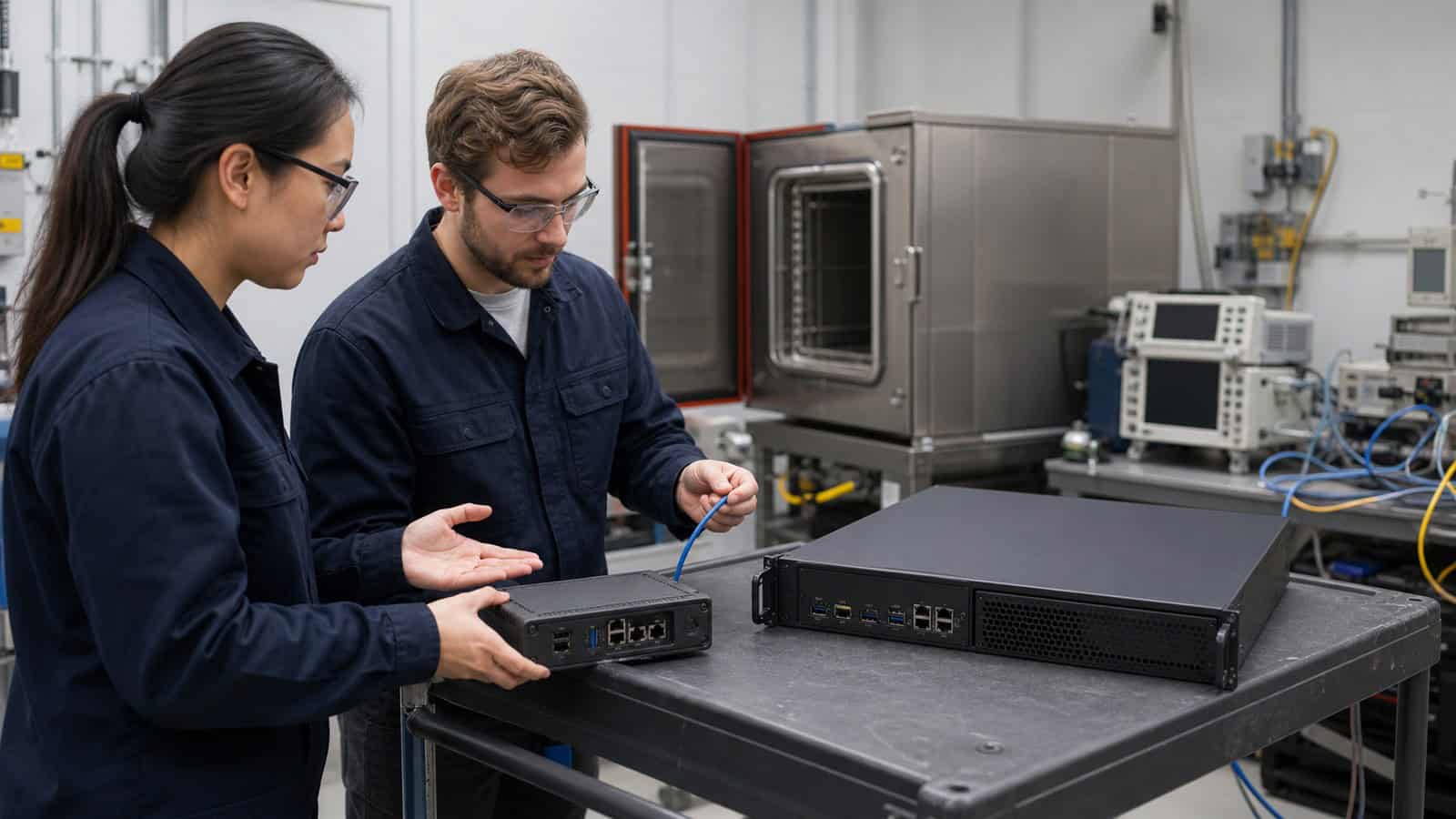
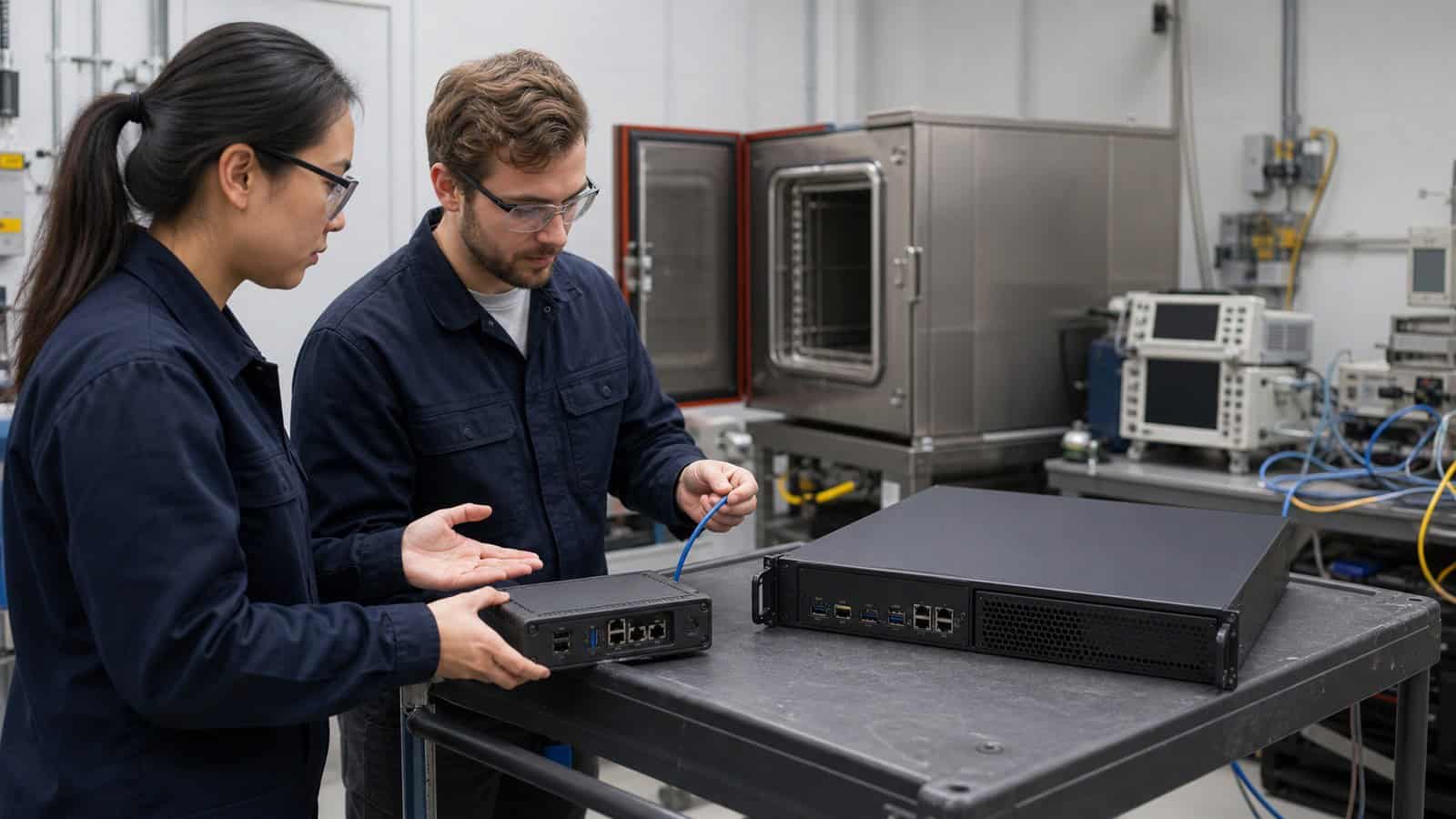
The Robustel EG5200 edge computing gateway fits the machine-to-site layer where industrial interfaces, local applications and multiple Ethernet devices need to connect into a wider architecture. An edge server usually solves a different problem: providing larger shared compute or storage for several machines or applications. The practical selection question is therefore where each compute layer should sit, not which product category is universally more powerful.
Consider a factory with six production cells. Each cell contains controllers, serial equipment and IP devices, while a server room already provides site-wide applications. One approach is to replace every local compute requirement with a central server. Another is to place a powerful gateway at every cell and eliminate the site-level compute layer. Neither approach is automatically correct.
Edge Servers and Edge Gateways Often Belong at Different Layers
An industrial site can contain several levels of compute. Field controllers perform machine control. Edge gateways connect directly to field equipment and may host selected local applications. Site-level servers can then aggregate data from multiple cells, run heavier shared services or maintain larger local databases before information moves to enterprise or cloud infrastructure.
The Robustel Edge Computing Gateway portfolio is designed for the gateway layer of this hierarchy. The models combine industrial connectivity with local compute rather than attempting to replace every possible server workload.
This distinction is important because specifications increasingly overlap. A modern edge gateway can run containers and substantial local applications, while a compact industrial server may also be rugged enough for a plant environment. The category should therefore be defined by architectural responsibility, not CPU performance alone.
Put Protocol and Physical Integration Close to the Equipment
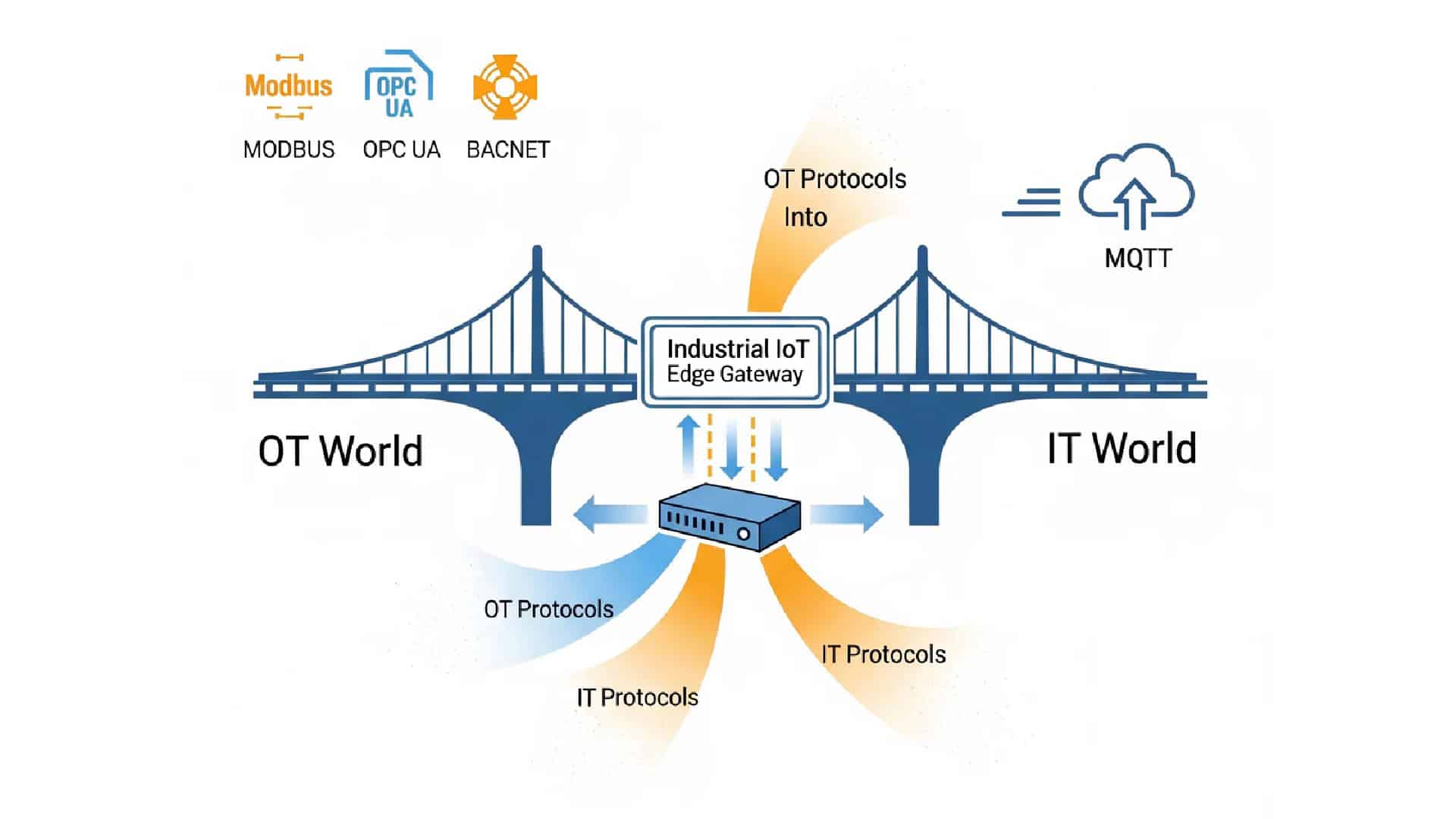
The gateway layer becomes valuable where physical access to OT equipment matters.
Serial devices, digital I/O, CAN, Ethernet controllers and application-specific protocols are usually easier to integrate close to the machine than through a central server located elsewhere on the plant network.
Robustel’s Connected CNC Machines Application Example illustrates this machine-side role. In this architecture, an EG-series edge gateway can collect selected machine-status or diagnostic data through supported industrial interfaces and protocols, then make that information available to upstream systems without changing the existing CNC controller architecture. This should not be interpreted as native support for proprietary CNC controller protocols; integration still depends on the interfaces and protocols exposed by the machine or its PLC/control layer.
A central server can process the resulting information, but it does not remove the need for a clean way to acquire data from the machine.
The RobustOS Pro edge computing operating system adds a Debian application environment to supported Robustel gateways, allowing protocol connectors, local preprocessing and other site applications to run close to those interfaces.
The benefit is architectural proximity: the integration logic can remain beside the equipment it understands.
Move Shared Compute and Site-Wide Data Up the Hierarchy
Some workloads become inefficient when duplicated across every machine-side gateway. A factory-wide historian, shared database, large analytics service or application that compares several production lines may fit better on a site-level edge server. The server can concentrate CPU, memory and storage for functions that do not need a direct physical interface to each PLC or meter.
This creates a useful division of responsibility. The gateway can convert and normalize machine data, buffer short interruptions and expose an approved upstream interface. The server can then aggregate that information across cells, maintain longer local history and run applications that benefit from a wider site context.
A Robustel edge gateway can therefore coexist with a server rather than compete with it.
This layered model also creates flexibility. A small site may have no need for the server layer, while a larger plant may use many gateways feeding one or several local servers.
Compare Failure Radius, Not Only Processing Power
Hardware comparisons often focus on CPU, RAM and storage. Industrial architecture should also ask what stops working when a device fails.
If one edge gateway serves one production cell, a gateway failure may affect the data integration for that cell while other lines continue operating. If a central server provides every protocol and application service for the plant, a server failure may have a larger data-system failure radius.
The opposite trade-off is operational overhead. Ten independent gateways require ten application instances to maintain, while one central server may simplify certain updates.
Robustel’s Smart Parking Application Example provides a useful distributed-infrastructure parallel. Cameras, sensors, meters and local processing requirements can be distributed across the site rather than forcing every data source through one physically central compute box.
This does not prove that distributed gateways are always safer. It shows why location, failure radius and maintenance ownership should be evaluated together.
How the Robustel EG5200 Edge Computing Gateway Fits the Machine-to-Site Layer
The Robustel EG5200 edge computing gateway is particularly relevant where the gateway layer must connect several IP devices while also providing local compute.
Its five Gigabit Ethernet ports, industrial connectivity and local application environment make it suitable for peripheral-dense architectures such as multi-camera or multi-device sites. Cellular options also allow the same gateway layer to provide WAN connectivity where required.
Robustel’s EG5000 Series Quick Pitch video provides a compact view of how the family combines industrial connectivity and local processing. In the context of an edge-server comparison, the important point is that application capability does not remove the gateway’s machine-facing networking role.
An EG5200 may therefore collect from several devices, run local connectors or analytics and publish selected information to a site server.
It should not be described as an edge server simply because it can run substantial applications. The architectural distinction remains useful when deciding where shared databases, site-wide orchestration or heavier compute should live.
Choose One Layer or Two Based on the Site Architecture
Three common patterns cover many projects:
| Deployment pattern | Best fit condition | Main trade-off |
|---|---|---|
| Gateway only | Few local assets and moderate local applications | Limited shared site-level compute |
| Edge server only | Devices are already IP-ready and field integration is simple | May still need separate OT/interface integration |
| Gateway + server | Distributed OT equipment plus heavier shared compute | More components and lifecycle responsibilities |
A small machine may only need the gateway. A plant with many already-networked assets may use a server without a dedicated gateway at every device. A larger brownfield site can justify both layers because field integration and site-wide compute solve different problems.
The selection matrix should therefore begin with device location, interfaces, workload sharing, failure radius and operational ownership. The product category follows the architecture.
Preguntas frecuentes
Q1. What is the main difference between an edge server and an edge gateway?
An edge gateway usually sits closer to field equipment and emphasizes industrial connectivity, protocol integration and selected local applications. An edge server generally provides larger shared compute or storage for several systems. Actual capabilities overlap, so architectural role is more useful than the product label alone.
Q2. Is the Robustel EG5200 edge computing gateway an edge server?
No. The Robustel EG5200 edge computing gateway is a gateway platform with substantial local compute and multiple Ethernet interfaces. It can host industrial edge applications, but its role remains focused on connecting field and local network assets into the wider architecture.
Q3. Can an industrial site use both an edge gateway and an edge server?
Yes. Gateways can handle machine-side interfaces, protocol processing and short-term local functions, while a site server handles shared databases, aggregation or heavier applications. This layered architecture can be useful in larger plants.
Q4. When is an edge gateway alone enough?
A gateway may be sufficient when the site has a manageable number of assets and the required applications fit within its compute and storage resources. Adding a server is unnecessary if no workload benefits from shared site-level infrastructure.
Q5. Does centralizing applications on an edge server simplify maintenance?
It can reduce the number of software instances, but centralization may also increase the failure radius and require field devices to depend more heavily on site networking. Maintenance should be evaluated together with availability and integration requirements.
Conclusión
The edge server vs edge gateway decision is best treated as a site-compute placement question rather than a hardware contest. The Robustel EG5200 edge computing gateway fits the machine-to-site layer where industrial connectivity, several Ethernet devices and local applications need to converge. A separate edge server becomes useful when workloads benefit from larger shared compute, storage or site-wide context.
Some projects need only one layer; others benefit from both. Select the architecture by determining where field integration must occur, which applications are shared and how much failure radius the site can accept.
Related Reading on Edge Computing in Industrial IoT:
Acerca del autor
Robert Liao | Technical Support Engineer
Robert is an IoT Technical Support Engineer at Robustel, specializing in industrial networking and edge connectivity. A certified Networking Engineer, Robert focuses on the deployment and troubleshooting of large-scale IIoT infrastructures. His work centers on architecting reliable, scalable system performance for complex industrial applications, bridging the gap between field hardware and cloud-side data management.