
APN, IPsec and NAT Troubleshooting for Industrial 5G Remote Access
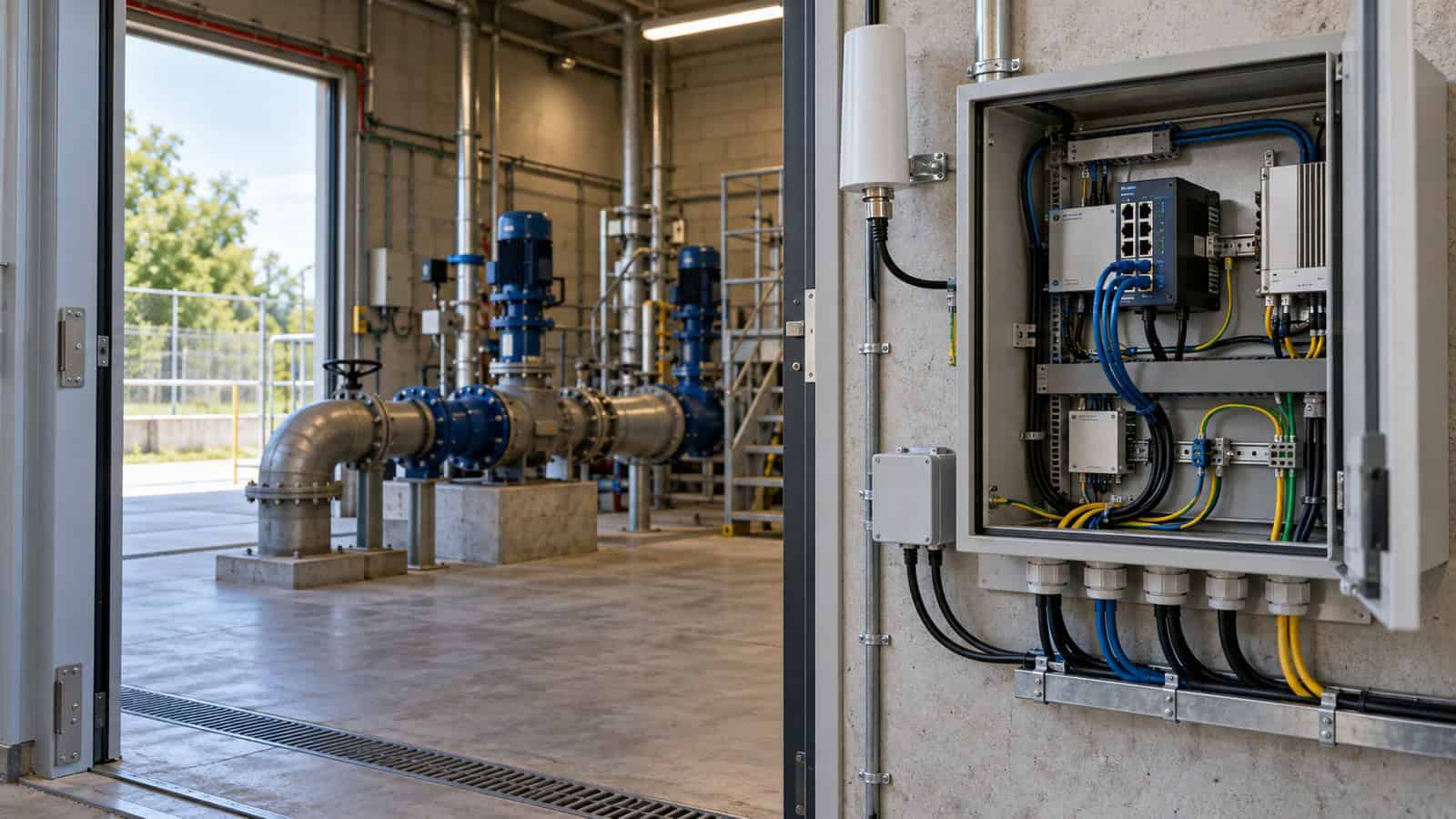
The Robustel R5020 Industrial 5G Router provides cellular connectivity, four Gigabit Ethernet ports and industrial serial interfaces, but remote access works only when mobile addressing, firewall policy, IPsec parameters and NAT direction agree. The quickest diagnosis follows the packet through those layers instead of changing them together.
Start with the Address the Mobile Network Actually Gives You
Record the APN, assigned address, default route and DNS information after registration. Compare the router WAN address with the address visible to an approved external test service. If they differ, carrier NAT is probably present and unsolicited inbound traffic cannot simply be forwarded to the site.
That is not automatically a fault. Many industrial designs deliberately use an outbound VPN, a private APN or a managed remote-access service. The problem begins when the commissioning plan assumes a public inbound address while the subscription supplies a private one.
| Access model | Session initiator | Address requirement | First evidence |
|---|---|---|---|
| Outbound IPsec | site router | reachable VPN peer | IKE exchange and tunnel route |
| Private APN | agreed design | provider-routed private space | APN assignment and route table |
| Public fixed IP | remote hub/user | inbound-reachable address | WAN address and firewall log |
| Managed access | site agent/router | service-specific outbound path | registration and user audit event |
Diagnose IPsec in Two Phases
For IKE, compare peer address, IKE version, proposals, identifiers, credentials, lifetimes and NAT traversal. Capture which negotiation step fails. Re-entering every field may make the tunnel work once, but removes the evidence needed to prevent the same error at the next site.
After IKE, inspect the data-plane security association. Traffic selectors must match the real local and remote subnets. Overlapping address ranges are common in replicated machine cells; two sites using the same private subnet cannot be routed cleanly through one hub without explicit translation or redesign.
Robustel’s 5G connectivity and remote access for autonomous systems application example shows why support is an end-to-end operating path rather than a radio feature. Define who initiates access, how identity is checked and what continues when the mobile path changes.
Read NAT and Firewall Rules in Packet Order
Confirm tunnel traffic is exempted from general internet source NAT where original addresses are required. Check that the VPN route wins over the default route and that return traffic follows the same security boundary. A tunnel counter increasing in one direction only is often more useful than a green status icon.
Use one named host and one permitted protocol. Observe the packet on the LAN side, IPsec counters and remote endpoint, then reverse the direction if bidirectional initiation is required. Broad “allow any” rules can hide routing faults and leave a difficult security cleanup later.
Robustel’s fixed-line backup over 5G application example adds an operational point: changing WAN paths can change addressing and session state. Acceptance should include failover and return to the preferred path, not only a steady-state tunnel.
How the Robustel R5020 Industrial 5G Router Supports Layered Remote Access
The Robustel’s R5020 industrial 5G router combines dual SIM, 5G/4G/3G support, four Gigabit Ethernet ports and RS-232/RS-485 connectivity. Those interfaces suit a compact site that needs one managed cellular boundary between local equipment and a remote service network.
Robustel RCMS platform can reduce unnecessary visits by giving authorised teams fleet and router visibility. Used well, an engineer can separate registration, addressing and configuration problems before requesting physical access. The site record should still include firmware, SIM/APN, address type, tunnel selectors, approved subnets and recovery result.
Prove Recovery, Not Just Initial Access
Break one dependency at a time: disconnect the preferred SIM or WAN, make the VPN peer unavailable, remove a route and restart the target. Confirm monitoring identifies the correct layer, access returns within the accepted window and stale sessions do not leave a misleading connected state.
The Robustel video “What Is an Industrial 5G Router and When Do You Need One?” helps IT, OT and service teams align on the router role before agreeing the detailed remote-access boundary.
Preguntas frecuentes
Q1. What is an APN?
An Access Point Name selects the mobile packet-data service and addressing context. The operator and subscription determine which APNs and routing models are available.
Q2. How do I find the correct APN for a SIM card?
Obtain it from the operator or managed provider for the exact subscription. A consumer APN may register but provide the wrong addressing or policy.
Q3. Why is my IPsec VPN connected but not passing traffic?
Common causes include wrong selectors, overlapping subnets, a missing route, NAT before encryption, firewall policy or an asymmetric return path.
Q4. Does carrier-grade NAT block remote access?
It blocks unsolicited public inbound connections. Outbound VPNs, private APNs and managed remote-access designs can still provide controlled access.
Q5. How should remote access be tested on the Robustel R5020 Industrial 5G Router?
Verify the SIM/APN and address, establish the approved tunnel, test one permitted end-to-end service, then repeat during the intended SIM or WAN recovery sequence.
Conclusión
The Robustel R5020 Industrial 5G Router gives industrial sites a useful combination of cellular, Ethernet and serial connectivity for controlled remote access. Its value is realised when APN addressing, IPsec selectors, NAT, routes and firewall ownership are documented as one service path.
Start with the mobile address, follow one packet in both directions and preserve failure evidence before changing configuration. A reproducible layered test is more valuable to a fleet than a one-off tunnel that happens to show green.
Explore More Articles About Robustel 5G Routers

Acerca del autor
Robustel Editorial Team
The Robustel Editorial Team publishes practical articles on industrial connectivity, edge computing, LoRaWAN and device management, focusing on deployment considerations, technical limitations and long-term operation.