
5G PoE Router Selection Guide: Power Budget, Port Design and Remote Recovery
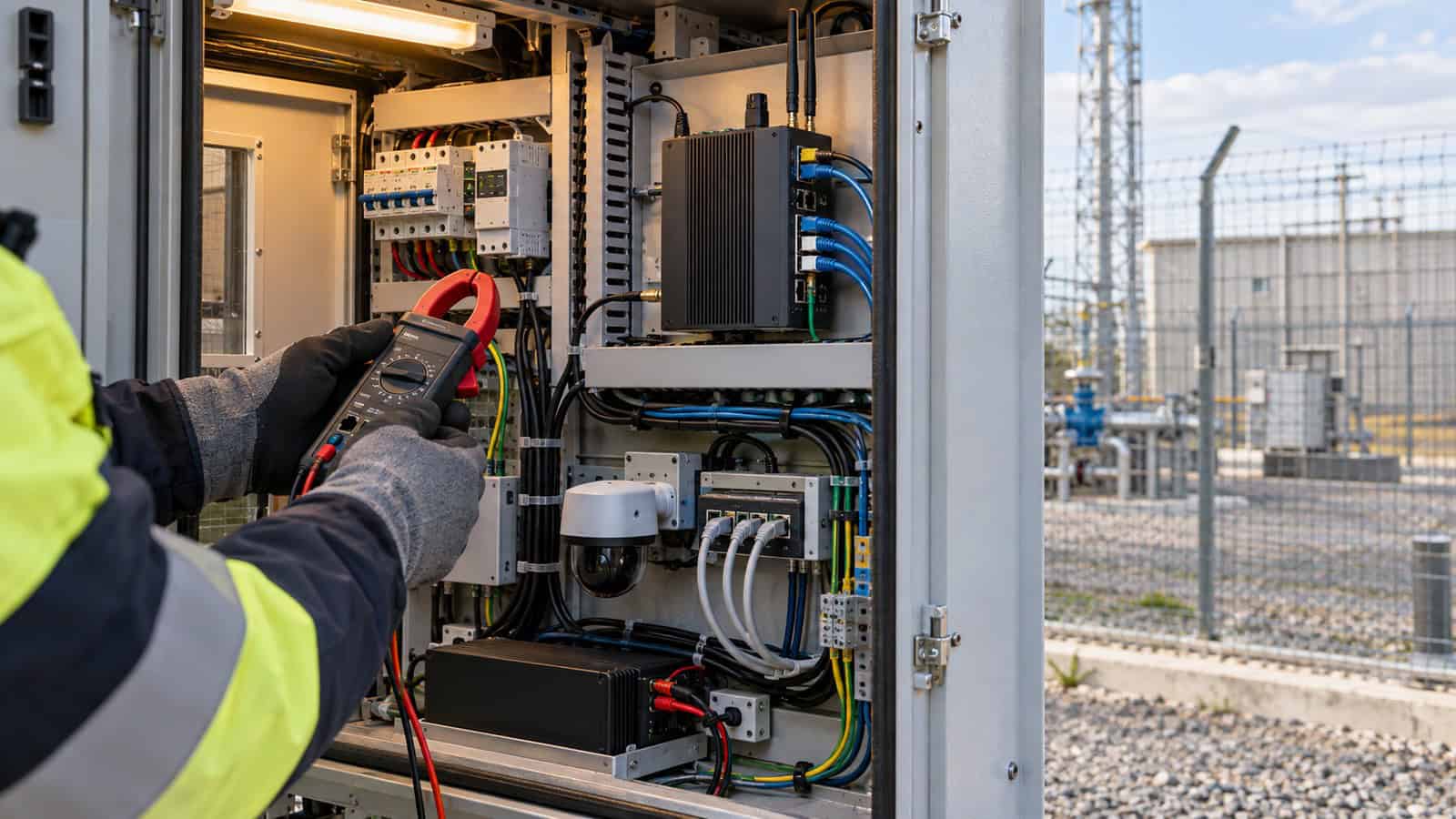
The Robustel R2120-5G Industrial 5G PoE Router is a strong fit when a remote site needs one managed device to power up to four Ethernet endpoints, carry their traffic and recover a failed PoE load without an immediate visit. The buying decision is not simply “four PoE ports”. It is whether the source supply, cable run, endpoint demand, backhaul and recovery workflow still work together on the worst credible day.
Start With Watts, Not Port Count
A PoE budget has three layers: the router’s own consumption, the power available at its PSE ports and the power that reaches each powered device after cable loss. The R2120-5G supports 802.3af/at on ETH1–ETH4, with up to 30 W per port, but its total PoE budget depends on the external power supply. Robustel recommends a 48 VDC, 1.25 A, 60 W supply for system power and typical PoE loads, and advises considering 54 VDC for 100 m runs carrying 30 W loads.
That wording matters. Four endpoints marked “PoE+” do not prove that a 60 W supply can sustain four simultaneous 30 W peaks. Record the endpoint’s normal draw, startup peak, heater or illuminator load and cable length. Then add the router’s documented maximum consumption and a design margin appropriate to the site. If the sum is too close to the supply limit, reduce the load, use a larger suitable supply within the documented input range, or move some devices to a dedicated switch.
| Design input | Evidence to collect | Failure seen in service |
|---|---|---|
| Endpoint steady draw | Measured watts after warm-up | Random brownout under normal load |
| Startup or night-mode peak | Boot trace with heaters/IR active | Reboot loop after power restoration |
| Cable length and conductor | As-built length and voltage at load | Device links but behaves erratically |
| Simultaneous recovery | All ports restarted together | PSU foldback or router reset |
Give Every Ethernet Port a Job
The R2120-5G has five Gigabit Ethernet ports. They can be configured as one WAN plus four LAN ports or as five LAN ports. A clean design names each port before installation: camera, access controller, local recorder, service connection or upstream WAN. It also states which ports provide power and which traffic belongs in each VLAN or firewall zone.
This prevents a common commissioning mistake: using the available sockets first and trying to reconstruct the security boundary later. Video, maintenance and control traffic can share the physical router while remaining separate policy domains. Robustel’s traffic camera and road signage application example shows that separation as an architecture pattern using the R2120 series; it is not a throughput guarantee for a particular R2120-5G site.
Treat 5G as a Variable Backhaul
Calculate upstream traffic from the real endpoint settings, not from the camera count. Codec, resolution, frame rate, scene activity, event uploads and remote viewing all change the load. Run a sustained test during the representative busy period and include management traffic and any store-and-forward burst after an outage.
The Ethernet and PoE sides can remain healthy while the mobile path is congested or unavailable. Record 5G and LTE service at the installed antenna position, verify the selected regional order code, bands and carrier acceptance, and test the fallback policy. Do not use a successful speed test as proof that an alarm clip will arrive during peak-hour contention.
Design Remote Recovery as a Sequence
Remote power cycling is valuable only if the team can still reach the router. Use Robustel RCMS platform to monitor the gateway and perform supported PoE-device management, including scheduled restart or power-cycle actions. Before rollout, decide what triggers a reboot, how long the endpoint is allowed to recover and when the ticket becomes a site visit.
A practical sequence is: confirm the router is reachable; check Ethernet link state and endpoint traffic; capture the last useful log or alarm; power-cycle only the affected port; wait for the endpoint’s full boot time; then verify application service, not just link LEDs. Repeated cycling without evidence can erase the symptom or stress a failing power path.
Robustel’s smart parking application example illustrates why recovery ownership matters across cameras, meters and an upstream platform. Use it for the operating pattern, while the R2120-5G datasheet remains the authority for this router’s PoE and interface limits.
How the Robustel R2120-5G Industrial 5G PoE Router Simplifies Remote Sites
The Robustel R2120-5G industrial 5G PoE router combines four PoE-PSE ports, a fifth Gigabit Ethernet port, RS-485, two digital inputs, two digital outputs, dual SIM, Wi-Fi and RCMS management in an IP30 DIN-rail, wall or desktop enclosure. That can remove a separate PoE switch at a compact site, but it does not remove the need for a suitable industrial power supply, enclosure thermal design or surge and earthing plan.
Its best fit is a named set of endpoints whose combined load and traffic have been measured. If the project needs more than four powered devices, fibre switching, ring redundancy or a much larger shared power budget, keep those functions in dedicated infrastructure and use the router as the cellular edge.
The Robustel video “Where Are Industrial 5G Routers Used in Real IoT Deployments?” below provides useful application context before the team assigns PoE loads and recovery responsibilities. The R2120-5G order code, power supply and endpoint test still determine the actual port and load decisions for this design.
Acceptance Test Before Handover
Run the cabinet at the highest credible ambient temperature with every endpoint active. Remove and restore WAN service, power-cycle one PoE port, then cycle all intended loads together. Confirm that the router remains reachable, endpoints regain application service, clocks and configuration survive, and queued traffic does not overwhelm the mobile link.
Keep the results with the port map, PSU specification, cable lengths, SIM details and recovery owner. That evidence is what makes remote recovery repeatable for the next engineer.
Record the first failed recovery step as carefully as the final pass. If a camera powers up but never rejoins its application, the next action belongs with addressing, authentication or the upstream service rather than with the PoE budget. A handover sheet that preserves that distinction prevents the remote team from cycling power repeatedly and hiding the original fault.
Preguntas frecuentes
Q1. Do routers support PoE?
Some do, but the direction matters. PoE-PD allows the router to receive power; PoE-PSE allows it to power downstream devices. A project that needs cameras powered from the router must specify PSE ports and the total available budget.
Q2. How do I calculate a PoE power budget?
Add the worst-case draw of every powered device, include startup or heater peaks, cable loss and the router’s own demand, then compare the result with the chosen supply and PSE limits. Validate the calculation by starting all loads together.
Q3. Does PoE lose power over distance?
Yes. Cable resistance causes voltage drop and heat, especially on long runs and higher loads. Cable category alone is not enough; conductor material, termination quality, length and delivered voltage should be checked.
Q4. Can a PoE device be rebooted remotely?
It can when the PSE and management system support controlled port power cycling. The recovery procedure should also verify that the device returns to application service rather than stopping at an active Ethernet link.
Q5. When is the Robustel R2120-5G Industrial 5G PoE Router a good fit?
It suits compact sites with up to four verified 802.3af/at loads, a measured cellular backhaul requirement and a need for central visibility or remote PoE recovery. Larger switching or power systems should retain dedicated infrastructure.
Conclusión
The Robustel R2120-5G Industrial 5G PoE Router earns its place when consolidation makes the site easier to power, diagnose and recover. Approval should follow a power calculation and a full-load test, not the number printed beside the Ethernet sockets.
If the handover record shows what every port serves, how much power it draws, which traffic path it uses and who owns recovery, the next incident starts with evidence rather than a blind reboot.
Explore More Articles About Robustel 5G Routers
Acerca del autor
Robustel Editorial Team
The Robustel Editorial Team publishes practical articles on industrial connectivity, edge computing, LoRaWAN and device management, focusing on deployment considerations, technical limitations and long-term operation.