
Dual-SIM 5G Router vs eSIM Router: Which Deployment Model Fits Global Fleets?
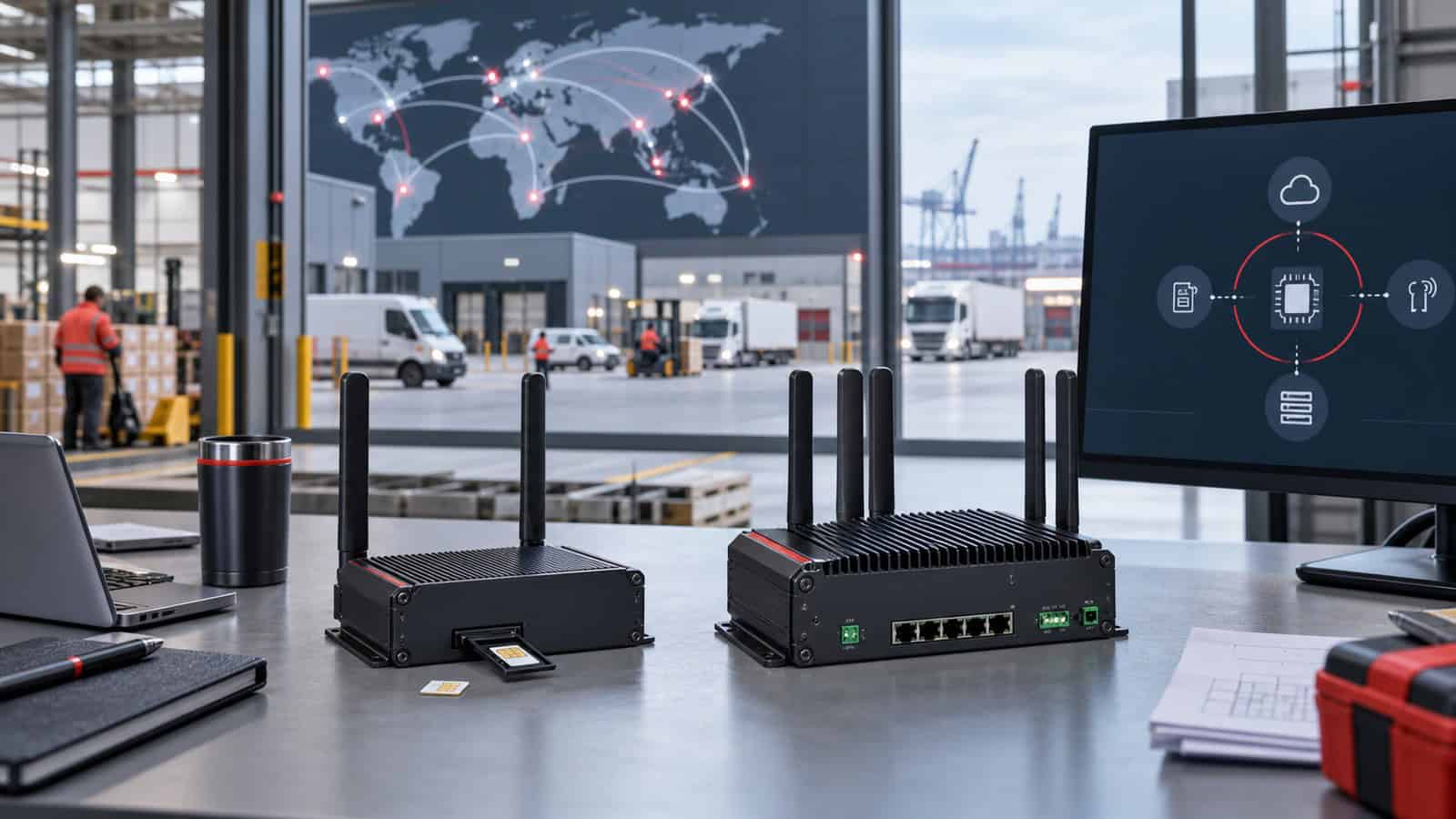
The Robustel R5020e 5G eSIM Router combines one embedded eSIM/eUICC with one removable 2FF SIM slot. That makes it useful for global fleets, but it also illustrates a point that is often lost in procurement: eSIM and dual-SIM are not opposite categories.
eSIM describes how a subscription profile is installed and managed. Dual-SIM describes the availability of two SIM paths in a device. A fleet can need both, one, or neither. The correct decision begins with the operating model—who procures connectivity, who changes it, and how a failed site is recovered—not with the fashionable term on a shortlist.
Separate Provisioning from Resilience
A physical dual-SIM router can hold two removable subscriptions. That is straightforward when a local installer can fit the correct cards before dispatch and the planned carriers remain suitable for the life of the deployment. It also gives technicians a familiar physical recovery path.
An eSIM-capable router changes the subscription workflow. On Robustel R5020e industrial 5G router, GSMA SGP.22 support allows profiles to be downloaded and removed rather than requiring every change to involve opening the cabinet and replacing a card. The product page states that the eSIM typically stores up to eight profiles. That is profile storage, not eight simultaneous cellular links, and carrier profile availability still needs to be confirmed for each country and contract.
The operational gain is clearest after deployment. A fleet team can prepare a different approved profile for a destination, replace a commercial arrangement, or recover from a provisioning error without automatically sending a technician to handle plastic SIMs. The physical SIM remains available as a second path where the design calls for it.
| Fleet question | Dual physical SIM | Hybrid physical SIM + eSIM |
|---|---|---|
| Initial provisioning | Cards installed locally | Profile can be downloaded; physical slot remains available |
| Changing provider after installation | Usually a site visit or pre-positioned card | Remote profile operation may remove the visit |
| Local break-glass recovery | Swap or reseat a physical card | Physical slot can still provide this path |
| Cross-border deployment | Requires the right cards in the logistics flow | Can simplify profile preparation where supported |
| Main dependency | Physical stock and access | Profile entitlement, platform process and carrier support |
Global Fleets Fail at the Process Boundaries
The awkward failures are rarely “the modem has no second SIM.” A shipment reaches a country with the wrong subscription, a profile has not been entitled, an installer cannot reach the locked enclosure, or the operations team cannot tell whether the fault belongs to radio coverage, the SIM, the APN or the upstream application.
This is why the subscription inventory should be designed like any other managed asset. Record the profile or card assigned to each router, its permitted networks, the intended primary and fallback role, and the person allowed to make changes. A downloaded profile is only useful if the team can prove that the change was authorized and that the router can still reach the management path needed to complete it.
Robustel’s Jones Technology retail case study records the practical variation found across a distributed cellular estate: individual sites still present different RF and installation conditions. That matters to an eSIM programme because subscription changes solve only one part of the recovery chain. A fleet design must still tell the support team whether a failed location needs a profile change, an operator escalation or physical work on the antenna and installation. The case does not choose eSIM for every store or country; it shows why one central provisioning policy must leave room for local diagnosis.
Choose the Router Around the Site Role
Robustel R5020e industrial 5G router provides four Gigabit Ethernet ports, RS-232 and RS-485, DI/DO, dual-band Wi-Fi, and optional GNSS and PoE-PD. Those interfaces make it a general industrial site router as well as an eSIM endpoint. If the location only needs to hand a cellular WAN to an existing firewall, however, buying a larger local interface set may add no operational value.
Robustel Model Fit by Site Responsibility
| Site responsibility | Best-fit Robustel direction | Why it changes the deployment |
|---|---|---|
| Hand cellular WAN to an existing firewall | Robustel R5010 Industrial 5G Router | One 2.5GbE interface and USB modem mode keep LAN policy in the existing appliance; two physical SIMs suit a locally prepared subscription model. |
| Own a broader industrial LAN and serial boundary | Robustel R5020 Industrial 5G Router | Four Gigabit Ethernet ports, RS-232, RS-485 and DI/DO give the router a larger site role; subscriptions remain on two removable SIMs. |
| Provide local Wi-Fi 6 as part of the router role | Robustel R5030 Industrial 5G Router | Five Gigabit Ethernet ports and Wi-Fi 6 fit sites where the cellular router also owns local user or device access. |
| Power several Ethernet endpoints from the router | Robustel R2120-5G Industrial 5G Router | Four PoE-PSE ports can simplify a compact powered-device cabinet when the verified power budget and segmentation design fit. |
This comparison is deliberately based on responsibility rather than feature count. A global eSIM requirement does not make local Wi-Fi or PoE useful, and a strong local interface fit does not remove the subscription logistics. If neither remote profile change nor post-deployment carrier flexibility solves a recurring problem, the physical dual-SIM models may be the more straightforward fleet standard.
Robustel R5020 5G router overview video provides a useful view of the physical-interface platform shared by this deployment discussion. Treat it as a product introduction, not evidence of coverage or carrier acceptance in a particular country.
How the Robustel R5020e 5G eSIM Router Simplifies Global Fleet Provisioning
The Robustel R5020e industrial 5G eSIM router is strongest when the fleet has recurring subscription work after installation and still values a removable SIM path. Its hybrid arrangement can reduce the number of visits made solely to replace a subscription, while the four Ethernet ports and serial/I/O interfaces let the same router connect the local industrial estate.
The practical improvement is an aligned hardware and operations workflow. Procurement can standardize one router architecture; the connectivity team can assign suitable profiles where commercial support exists; field engineers can retain a physical recovery option; and network operations can manage the router through Robustel RCMS platform. That combination is more useful than eSIM alone because it connects subscription change to device visibility and configuration control.
There are still external dependencies. An eSIM profile must be available for the required operator and region, the commercial agreement must permit the intended use, and the provisioning path must be tested before dispatch. If a compact domestic estate has stable carrier contracts and easy physical access, a dual-physical-SIM R5020 may be simpler. The R5020e earns its place when remote profile operations remove a genuine logistics or service burden.
Prove Recovery Before Scaling the Fleet
Bench acceptance should include an incorrect or unavailable primary subscription, a profile change, loss of the preferred network, management access over the fallback path, and restoration to the approved state. Record the time and human steps required, not just whether the router eventually reconnects.
Robustel’s Fixed-Line Backup over 5G with the R5010 Application Example places a cellular path beside an established WAN appliance, which makes the ownership boundary visible: the modem can restore an IP route while the firewall, VPN and application still have their own recovery work. Apply that sequence to the eSIM pilot. Change or remove the preferred subscription, confirm that the router remains manageable, and then measure when the business application becomes usable again. The example defines an architecture to test; it is not measured proof for a particular operator or country.
FAQs
Q1. What is the difference between eSIM and dual SIM?
eSIM is a way to provision a cellular subscription electronically. Dual SIM means a device provides two SIM paths. A router can therefore support eSIM and dual-SIM operation at the same time.
Q2. Can a router use eSIM?
Yes, when the router hardware and software explicitly support eSIM and the required carrier profile is available. A generic SIM slot or a 5G label does not establish eSIM support.
Q3. Is eSIM better for international travel or global deployments?
It can reduce physical SIM handling and make subscription changes easier, but “better” depends on profile availability, roaming policy, commercial terms and the fleet’s recovery process. These should be confirmed country by country.
Q4. Can an eSIM and physical SIM work together?
They can in a hybrid device designed for both. The two paths still share the router’s cellular architecture, so switching behaviour and recovery should be tested with the intended networks.
Q5. When is the Robustel R5020e 5G eSIM Router a good fit?
It fits distributed industrial fleets that need remote eSIM profile operations, a removable SIM alternative, four Gigabit Ethernet ports and serial or I/O connectivity in one managed router. Fleets with fixed local contracts and easy site access may not need the added provisioning flexibility.
Conclusion
The Robustel R5020e 5G eSIM Router fits fleets that need remote profile operations without giving up a removable-SIM recovery path. That hybrid design is valuable only where it removes recurring provisioning or service work; a stable domestic estate with easy site access may be better served by conventional dual SIM.
Before standardising, verify profile availability country by country and rehearse a failed profile change from the operations desk. Record router reachability, application recovery and the human steps needed to return the site to its approved state. The resulting runbook—not the presence of eSIM by itself—is the evidence for a fleet decision.
Explore More Articles About Robustel 5G Routers
About the Author
Robert Liao | Technical Support Engineer
Robert is an IoT Technical Support Engineer at Robustel, specializing in industrial networking and edge connectivity. A certified Networking Engineer, Robert focuses on the deployment and troubleshooting of large-scale IIoT infrastructures. His work centers on architecting reliable, scalable system performance for complex industrial applications, bridging the gap between field hardware and cloud-side data management.