
Industrial 5G Router Guide: Building Resilient, Low-Latency Networks for 2026
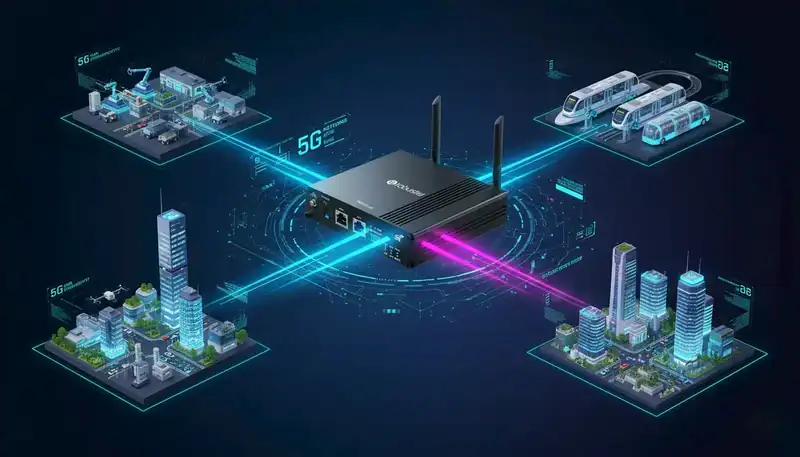
The transition to a 5G Router is no longer a matter of “speed”—it is a strategic pivot toward operational resilience and low-latency intelligence. In this definitive guide, we move beyond consumer-grade hype to explore how industrial-grade 5G connectivity is redefining the backbone of modern enterprise infrastructure.
From ensuring unbreakable business continuity to orchestrating smart city grids, we break down the critical architecture that makes 5G an indispensable asset for the next industrial revolution.
Key Insights:
- Beyond the Speed Trap: Why uRLLC (Ultra-Reliable Low-Latency Communication) is the real “secret sauce” for automation, robotics, and real-time V2X systems.
- Industrial-Grade Reliability: A deep dive into the hardware and software redundancies—like Dual-SIM Failover and proactive link management—that guarantee 99.999% uptime.
- Security as a Foundation: How Hardened OS (RobustOS) and enterprise-grade VPN suites (IPsec, WireGuard) protect mission-critical OT data from the edge to the cloud.
- The Scalability Engine: Why cloud orchestration via RCMS is the key to lowering Total Cost of Ownership (TCO) through Zero-Touch Provisioning and remote fleet management.
- Strategic Selection: A professional checklist for choosing a 5G router that supports the latest standards (3GPP Release 16+) to ensure long-term ROI.
Introduction: 5G Routers—The Pulse of the Next Industrial Revolution
Let’s cut through the noise: when we discuss the 5G Router in a professional context, we are looking at something far more significant than just “faster downloads.” For enterprises and industrial leaders, 5G is not an incremental update—it is a monumental leap in connectivity architecture. It is the catalyst for real-time automation, the guarantee of uptime for mission-critical operations, and the bedrock of a truly resilient, software-defined network.
In my years of working with field engineers, the real “aha!” moment never comes from a simple speed test. It happens when they realize a 5G Industrial Router delivers the sub-10ms responsiveness and carrier-grade reliability required to replace wired lines in environments where Wi-Fi and 4G simply fail.
It’s time to look past the consumer hype and focus on the industrial-grade reality. This guide explores how the 5G Router has moved from a “future technology” to the essential backbone of modern industrial transformation.
Beyond the Speed Trap—What Makes a 5G Router “Industrial Grade”?
While the transition from 4G to 5G is often marketed through the lens of peak speed, the true “game-changer” for mission-critical applications lies in Deterministic Performance. An Industrial 5G Router is not just a faster gateway; it is a hardened intelligence hub designed to maintain a resilient, secure, and manageable network under conditions that would paralyze consumer hardware.
The Low-Latency Advantage: Real-Time Decision Making
The true “secret sauce” of 5G is the radical reduction in latency—often down to sub-10 milliseconds. This near-instantaneous response is the difference between a successful operation and a costly failure.
- Smart Cities: Traffic grids adjusting signals in milliseconds to prioritize emergency vehicles.
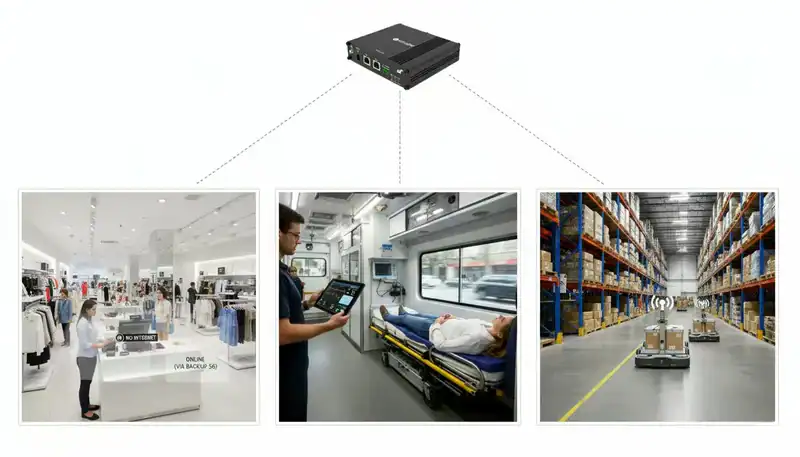
- Smart Warehousing: Autonomous Guided Vehicles (AGVs) making split-second decisions to avoid collisions without pausing the entire production line.
Engineered for 99.999% Uptime
In the industrial world, “good enough” connectivity doesn’t exist. To ensure constant uptime, top-tier 5G Industrial Routers are built with specific redundancy layers:
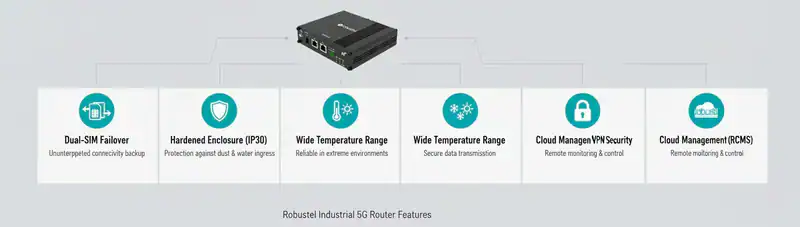
- Dual-SIM Failover & Cold/Hot Backup: By housing two SIM cards—ideally from competing carriers—the router provides a safety net. If the primary carrier’s tower goes offline, the device seamlessly switches to the backup, ensuring your data flow remains uninterrupted.
- Proactive Link Management: Advanced firmware doesn’t just wait for a total blackout. It continuously monitors link health (signal-to-noise ratio, jitter, and latency). If the primary link degrades, the router proactively negotiates a better connection to maintain peak performance.
- Ruggedized for the Edge: These devices are built to survive where humans can’t. With hardened metal enclosures and an operational temperature range of -40°C to +75°C, they are designed for the vibration of a moving bus, the heat of a desert solar farm, or the electrical noise of a high-voltage substation.
Built-in Defense—Security as a Foundational Requirement
Connecting mission-critical infrastructure to the cellular network shouldn’t mean increasing your attack surface. In a professional deployment, a 5G VPN Router treats security not as an optional “add-on,” but as a baseline requirement baked into its hardware and software DNA.
Hardened OS: The First Line of Defense
Security starts at the kernel level. Leading industrial routers run on specialized, Linux-based operating systems—such as RobustOS—that have been stripped of unnecessary vulnerabilities and “hardened” for industrial use. These platforms undergo rigorous third-party penetration testing to ensure they can withstand the evolving landscape of 2026 cyber threats.
Comprehensive VPN Suite: Creating Secure Tunnels
To protect data as it travels across public and private 5G spectrums, these routers act as a secure gateway, supporting a full suite of enterprise-grade encryption protocols:
- IPsec: For robust, high-stability site-to-site tunnels.
- OpenVPN: For flexible, widely-compatible secure access.
- WireGuard: For high-performance, lightweight encryption that maximizes 5G’s high-throughput potential.
By establishing these encrypted tunnels, a 5G Industrial Router ensures that sensitive OT (Operational Technology) data remains invisible to the public internet, providing a seamless “private pipe” from the remote edge all the way to your corporate data center or cloud.
Vertical Impact—Where the 5G Router Redefines the Possible
The synergy of gigabit speeds, sub-10ms latency, and industrial-grade reliability makes the 5G Router a catalyst for a new generation of demanding applications. From my observations in the field, these devices don’t just “improve” operations—they fundamentally redefine the boundaries of organizational efficiency.
Enterprise Resilience: The Ultimate Failover Strategy
For retail and branch offices, internet downtime is a direct hit to the bottom line.
- The Scenario: A high-traffic retail flagship loses its primary fiber connection during a peak holiday promotion. In a pre-5G era, this meant offline POS systems, failed transactions, and frustrated customers.
- The 5G Solution: By integrating an Industrial 5G Router into the Business Continuity Plan (BCP), this potential disaster becomes a “non-event.” The router automatically detects the primary link failure and orchestrates a sub-30-second transition to a high-speed 5G network.
- The Outcome: Credit card processing remains instant, cloud-based inventory stays synced, and thousands of dollars in revenue are protected without the customer ever noticing a glitch.
Smart Cities & Urban Mobility (V2I)
Municipalities are utilizing high-speed 5G connectivity to build “living” infrastructure that responds in real-time.
- Intelligent Traffic Management: By connecting HD sensors and traffic signals via 5G, cities can implement dynamic signal timing. This has been proven to reduce peak-hour congestion by up to 25%, significantly lowering the urban carbon footprint.
- Telehealth-Enabled Ambulances: A ruggedized 5G Router transforms an ambulance into a mobile ER. By streaming real-time patient vitals and ultra-HD video to specialists at the hospital, doctors can begin life-saving interventions en route—reducing “door-to-treatment” times for critical stroke patients by 30%.
- Public Transit Modernization: Transit authorities are moving beyond basic “Passenger Wi-Fi.” Modern 5G gateways provide stable, high-capacity connectivity that supports both passenger satisfaction and back-office telematics for real-time fleet maintenance.
The Strategic Checklist—Selecting Your Industrial 5G Infrastructure
Not all 5G routers are engineered to the same standard. When selecting a device for a mission-critical application, you aren’t just procuring hardware; you are investing in a long-term operational solution.
To ensure your network is both resilient and future-proof, use the following checklist—benchmarked against industry-leading standards like the Robustel R5020 Lite:
1. Connectivity & Future-Proofing
- Standard Compliance: Does the router support 3GPP Release 16 or higher? This ensures compatibility with the latest network slicing and power-saving features.
- Redundancy: Does it offer true Dual-SIM Failover with sub-minute switching times to ensure unbreakable connectivity?
2. Cyber Resilience & Enterprise Security
- Hardened Firmware: Is the device powered by a penetration-tested, Linux-based OS (like RobustOS)?
- Encryption Agility: Does it support high-performance VPN protocols like WireGuard alongside traditional IPsec and OpenVPN to match your corporate security architecture?
3. Industrial-Grade Reliability
- Environmental Tolerance: Is it housed in a rugged metal enclosure capable of operating between -40°C and +75°C?
- Physical Integration: Does it offer versatile mounting options (DIN-rail or wall mount) and industrial-grade terminal blocks for power and I/O?
4. Scalable Management: The “Secret” to Lower TCO
In a large-scale deployment, hardware cost is just the tip of the iceberg. The real expense lies in long-term management.
- Cloud Orchestration: A platform like RCMS (Robustel Cloud Manager Service) is non-negotiable. It allows for Zero-Touch Provisioning (ZTP), remote batch configuration, and real-time health monitoring of your entire global fleet from a single dashboard.
- The ROI: By eliminating manual site visits and enabling remote troubleshooting via RobustVPN, you drastically reduce your OpEx and simplify the management of even the most complex IoT ecosystems.
Conclusion: 5G is No Longer the Future—It’s the Foundation
The era of evaluating 5G as a “trial technology” has ended. In 2026, the 5G Router has evolved into the foundational layer of the modern industrial stack. As we’ve explored, the transition to 5G isn’t merely about chasing peak speeds; it’s about achieving operational certainty through ultra-low latency, robust cyber-resilience, and the massive scalability afforded by cloud orchestration.
Whether you are securing a retail branch with an unbreakable failover strategy or orchestrating a fleet of autonomous robots in a smart factory, your choice of hardware will dictate your ceiling for growth. By prioritizing industrial-grade reliability and integrated management platforms like RCMS, you aren’t just solving today’s connectivity issues—you are building a future-proof architecture that eliminates technical debt and maximizes your long-term ROI.
The question is no longer if your organization needs 5G, but how quickly you can deploy the infrastructure to lead your industry. It’s time to move beyond the hype and start building on the backbone of the next industrial revolution.
Curious about the global 5G rollout? Discover how Robustel and GSL are paving the way for 5G adoption in Türkiye.
FAQs
Q1: Can a 5G router completely replace my wired broadband internet?
A1: Yes, absolutely. For many businesses, 5G wireless broadband is now a viable primary internet connection. Cellular operators can offer unlimited 5G tariffs at competitive prices, and the speed and reliability can often match or exceed traditional wired options, allowing you to “cut the cord” and simplify your setup.
Q2: What is the main difference between an industrial 5G router and a consumer 5G hotspot?
A2: The key differences are reliability, security, and ruggedization. An industrial 5G router is designed for harsh environments with a wide temperature range and durable housing. It includes enterprise-grade security features like advanced VPNs and a hardened OS. Finally, it’s built for “always-on” connectivity with features like dual-SIM failover and is manageable at scale through a cloud platform, which consumer devices lack.
Q3: Is a 5G network secure for my business data?
A3: Yes, when implemented correctly. The 5G standard itself has enhanced security features. When you use an industrial 5G VPN router, you add multiple extra layers of protection. By forcing all traffic through a secure and encrypted VPN tunnel, you ensure that your data is protected from the device to your private network or cloud, making it suitable even for sensitive financial or public safety applications.
About the Author
Jens Zhou | Technical Support Engineer
Jens is a Technical Support Engineer at Robustel, specializing in industrial IoT and edge gateway applications. He is experienced with the configuration and deployment of EG series devices, and well-versed in network communication, industrial protocols, and common wireless technologies. He is dedicated to providing practical tutorials to help engineers efficiently build smart systems.