
Industrial Data Timestamp Synchronization Guide: Source Time, Gateway Time and NTP
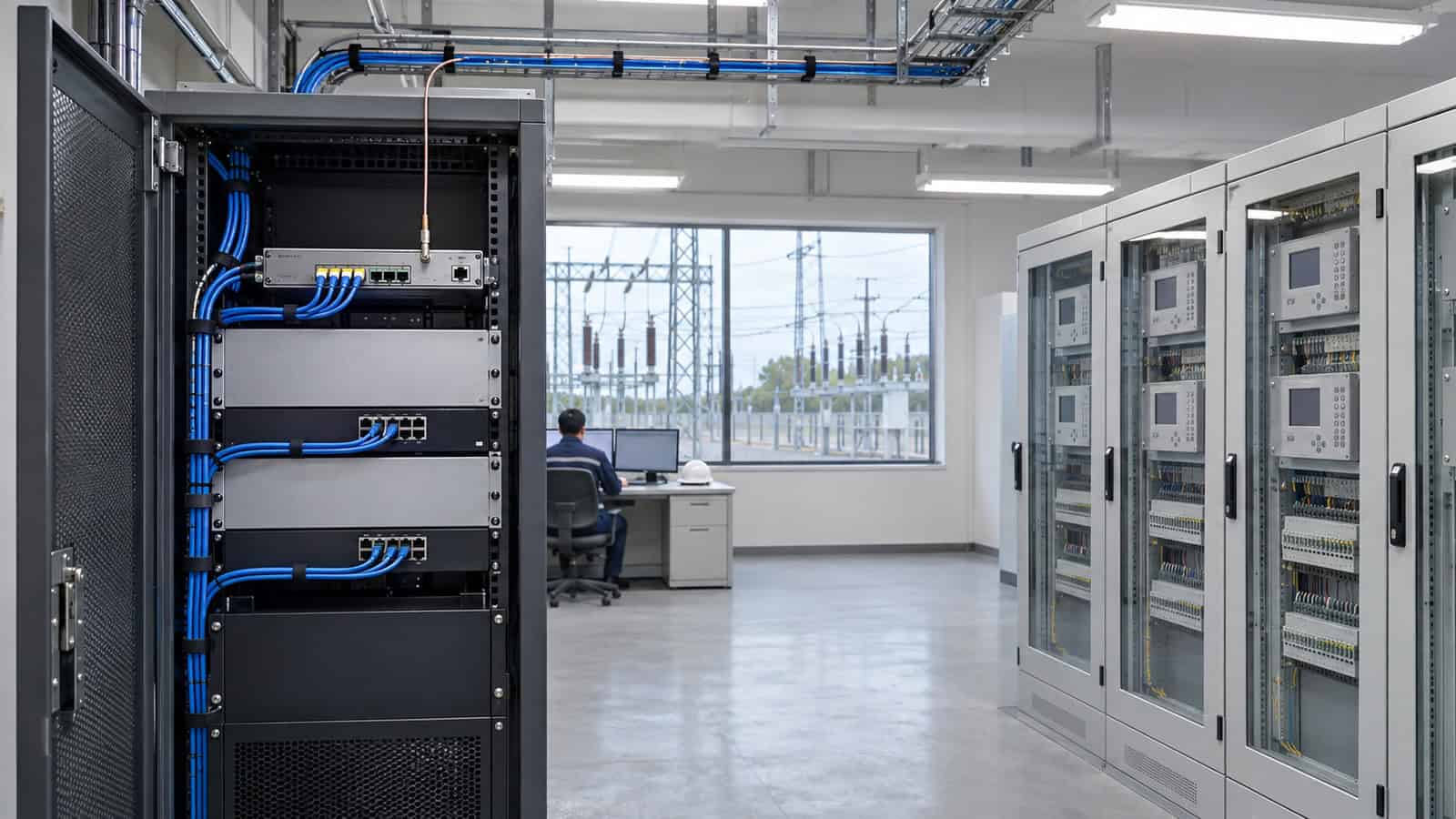
The Robustel EG5120 Edge Computing Gateway supports NTP and local data-processing applications, but synchronized gateway time cannot correct an inaccurate source timestamp or prove event order after buffering. Assign a timestamp authority for every tag, record clock quality and preserve measurement time separately from gateway receipt and cloud ingestion time.
The design goal is a timeline that remains interpretable when a PLC clock drifts, the WAN fails, the gateway reboots or queued data is replayed. Do not claim PTP or sub-millisecond accuracy unless the selected hardware, network and application have been verified for it.
Define the three times a record may carry
| Timestamp | Created by | What it means | Common failure |
|---|---|---|---|
| Source time | PLC, meter, sensor or server | when the source says the value was measured/changed | unsynchronised or unknown clock quality |
| Gateway time | acquisition application | when the gateway received or sampled it | mistaken for physical event time |
| Ingestion time | broker, historian or cloud | when the upper system accepted it | changes during WAN outage and replay |
The Robustel video “What Is Edge Computing, and Where Exactly Is “The Edge” in Industrial IoT?” helps assign ownership across device, gateway and cloud layers. The actual clock source and timestamp fields still require project evidence.
Choose authority per source class
Use source time when the source clock is synchronized, its timestamp represents the measurement, and the acquisition driver preserves it. Use gateway time for polled registers that have no source timestamp, while documenting that it represents read completion rather than the underlying physical transition.
For event logs from multiple machines, compare clock design before relying on sequence. A PLC timestamp and a gateway timestamp may appear in order even when their clocks differ by seconds. Keep quality fields such as clock-unsynchronised, substituted time or estimated time when the source provides them.
Monitor NTP as an operating service
Configuring an NTP server is only the starting state. Monitor reachability, selected peer, offset, last successful update, drift and step events. Define what the acquisition application does when time moves backwards or jumps forward.
| Check | Pass condition | Failure response |
|---|---|---|
| server reachability | approved peers reachable through intended path | alert and use documented holdover behaviour |
| offset | within project tolerance | mark clock quality and investigate path/source |
| last sync age | below the maximum holdover interval | prevent silent “good time” status |
| time step | recorded and correlated with data | flag affected records and preserve original order key |
| timezone | storage uses agreed UTC convention | convert only for display/reporting |
Robustel’s secure robot access application example illustrates why controller and gateway logs may need correlation during a stoppage. Time agreement must be tested before an incident if those logs are expected to support diagnosis.
How Robustel EG5120 Edge Computing Gateway supports timestamp governance
The Robustel EG5120 Edge Computing Gateway provides NTP in its network software features, local storage, industrial interfaces, RobustOS Pro and an application environment. These capabilities let it synchronize its own clock, acquire local data and retain queued records, but source-clock quality remains an external dependency.
On compatible EG5120 configurations, Robustel E2C Factory provides a documented industrial data path with collection, data management, alarms and forwarding. The gateway/application pairing can preserve a consistent operational layer when the project explicitly maps source, gateway and northbound timestamp fields.
| Site problem | Verified role | Workflow change | Acceptance evidence |
|---|---|---|---|
| source lacks timestamp | Robustel EG5120 acquisition application | apply gateway receipt time with declared semantics | source vs gateway comparison |
| WAN outage reorders arrival | local storage/application buffering | retain measurement sequence before upload | outage/replay trace |
| fleet clocks drift | NTP plus RCMS-managed operations | standardise servers and monitor versions/configuration | offset report and configuration audit |
Test buffering and replay without losing event order
Disconnect the WAN while sources continue changing. Record source events locally, restore the path and compare measurement time, gateway time, ingestion time, sequence and duplicates at the consumer. Replay should not overwrite measurement time with the later upload time.
Robustel’s smart-parking application example includes local preprocessing and timestamps as part of an illustrated data path. In an industrial acceptance test, use the selected source and historian to prove the actual fields and ordering.
Also restart the gateway with the NTP service temporarily unavailable. Confirm how the application marks records before synchronization returns and whether a time step changes file names, queue order or retention.
Publish pass/fail criteria for every consumer
Different decisions tolerate different errors. Maintenance trending may accept seconds; sequence-of-events analysis may require much tighter evidence. State the tolerance, field used, quality response and rejection rule for each consumer without implying accuracy the system has not demonstrated.
The handover pack should contain NTP servers, network path, authentication if used, source clock owners, time zones, timestamp mapping, monitoring thresholds, outage behaviour and a replay test. That pack lets operations investigate false event order without guessing which clock was trusted.
Preguntas frecuentes
Q1. What is NTP time synchronization?
NTP is a network protocol that allows a device to align its clock with selected time servers. The resulting accuracy depends on server quality, network path, client behaviour and monitoring.
Q2. How do you synchronize time with an NTP server?
Configure approved primary and secondary servers, permit the required network path, set a consistent timezone policy and verify selected peer, offset and last successful update on the device.
Q3. How often does NTP synchronize time?
The interval depends on the client implementation and configuration. Operations should monitor the age of the last successful update rather than assume a fixed interval proves health.
Q4. How accurate is NTP time synchronization?
Accuracy varies with the server, network delay/asymmetry, client and operating conditions. Measure offset in the deployed environment and state the acceptance tolerance; do not assume sub-millisecond performance.
Q5. What timestamp role does the Robustel EG5120 Edge Computing Gateway provide?
It can synchronize its own clock using NTP and timestamp or preserve data through approved local applications. The project must distinguish that gateway time from source measurement time and upper-system ingestion time.
Conclusión
The Robustel EG5120 Edge Computing Gateway is best suited to timestamp-governed edge pipelines where local clock health, storage and data processing can be monitored explicitly. It can provide a consistent gateway clock, but it cannot repair unknown source time by assumption.
Name the authority for every tag, retain all relevant times and quality fields, and test clock loss, reboot, WAN outage and replay. Event order becomes trustworthy when the uncertainty is visible and bounded.
Explore More Articles About Robustel Edge Computing Gateways




Acerca del autor
Robustel Editorial Team
The Robustel Editorial Team publishes practical articles on industrial connectivity, edge computing, LoRaWAN and device management, focusing on deployment considerations, technical limitations and long-term operation.