
Edge Gateway for Building Automation: BACnet, Modbus and MQTT Selection Guide
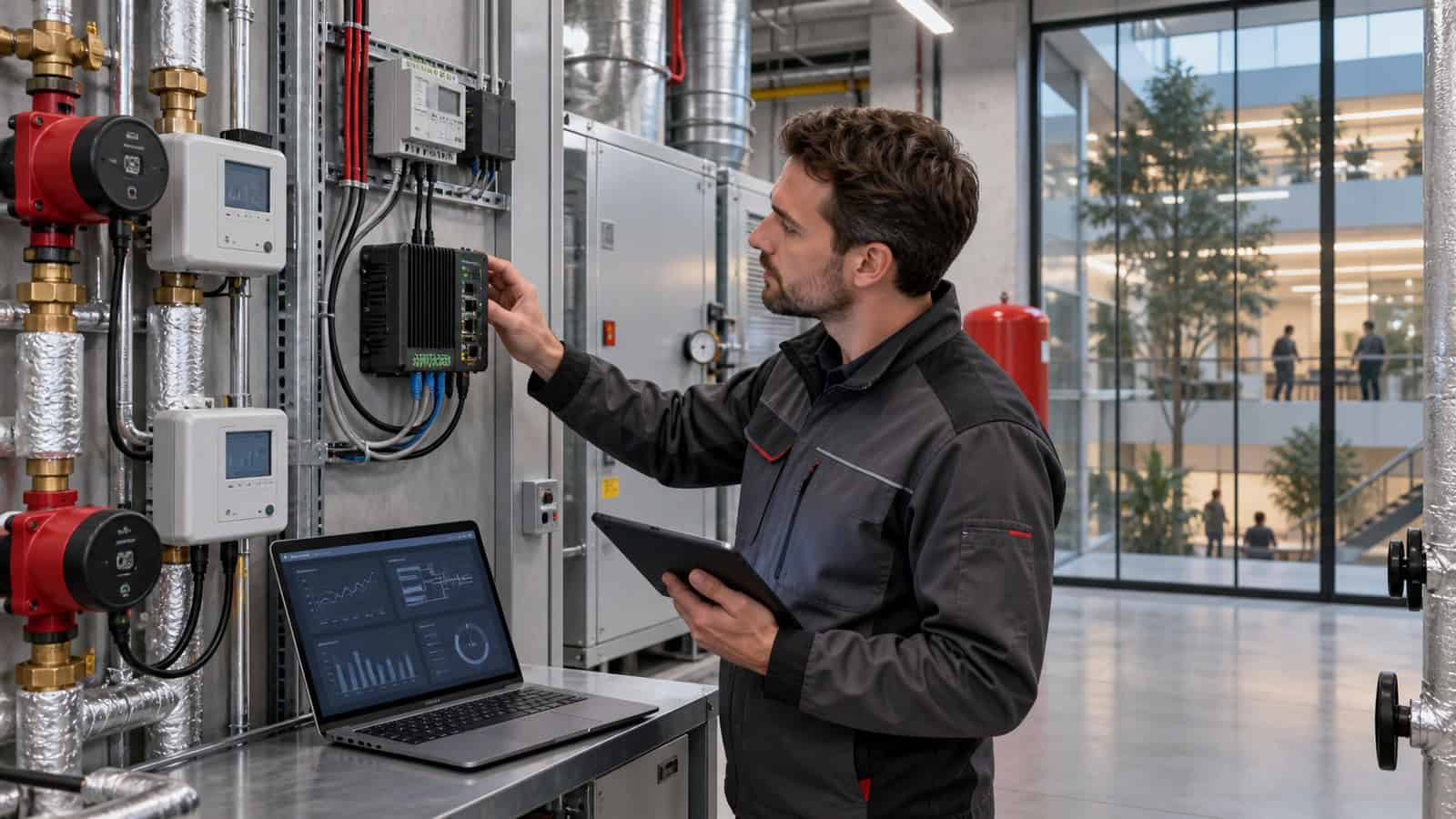
The Robustel EG5100 Edge Computing Gateway provides a managed Linux edge platform with Ethernet, configurable serial interfaces and local I/O. It can host verified building-integration applications, but physical interfaces do not prove BACnet, Modbus or MQTT behaviour on their own.
Selection starts by naming protocol roles. Which device is queried, which system publishes, what data model crosses the boundary, and what continues when the WAN is unavailable? A gateway chosen from a list of acronyms will usually leave these questions for commissioning.
Draw the Protocol Responsibility Map
| Interface or protocol | Questions to settle | Common boundary error |
|---|---|---|
| BACnet/IP | Who is client/server? Which objects and properties? | Assuming network reachability creates usable objects |
| BACnet MS/TP | Baud, addressing, bus ownership and loading? | Adding another master without a bus design |
| Modbus TCP/RTU | Client/server direction, registers, units and polling? | Treating a register map as self-describing |
| MQTT | Broker location, topics, payload, QoS and identity? | Calling it a protocol conversion without a data contract |
| Local I/O | Electrical type, state semantics and safety role? | Using general I/O as a safety function |
Maintain this map as configuration changes. Building systems often outlive the project team, so point names, scaling, timestamps and alarm ownership need to be understandable years later.
Decide What Runs Locally
Local collection, normalization, filtering, dashboards or alarms can reduce dependence on a remote platform. They also make the edge gateway an application host with storage, update and recovery responsibilities. Define which functions continue during WAN loss and how queued data returns.
Robustel’s Smart Buildings, Sensors and BMS Integration Application Example shows the wider path from field sensing into a BMS. It is useful for deciding where translation, point naming, alarms and northbound ownership should sit before an edge gateway is selected. Build the point list against that path and identify which component provides each required interface. The example does not prove that EG5100 contains a particular building driver.
Keep safety and deterministic control in the approved control system. A Debian-based gateway can host useful applications but should not be described as a PLC or safety controller without exact product evidence and system certification.
How the Robustel EG5100 Edge Computing Gateway Supports Building-Automation Integration
Robustel EG5100 edge computing gateway offers two Fast Ethernet ports, two configurable serial interfaces, 2 DI and 2 DO, Bluetooth, dual-SIM 4G and a Debian 11-based RobustOS Pro environment with Docker support. This gives integrators a compact platform for compatible applications near plant equipment, with an independent cellular path where the project needs it.
The architectural value is separation. The gateway can acquire data through the exact supported application and publish a controlled northbound view, while the BMS remains responsible for building control. Docker can help package and maintain a compatible integration; protocol support still comes from the verified application, driver and hardware configuration.
Robustel EG5100 is also a proportionate choice for lighter workloads. If the site requires more compute, storage or a documented NPU, Robustel EG5120 Edge Computing Gateway may be a better benchmark. E2C Facility is forthcoming, so it is not presented here as an available building-automation application.
Test the Brownfield Bus, Not a Lab Substitute
Legacy serial networks may contain undocumented addressing, long cable runs, mixed grounding and devices that respond slowly. Capture the existing configuration before adding a gateway. Verify electrical mode, termination, biasing, polling interval and the effect of timeouts on other masters.
Robustel’s Voytech BMS LoRaWAN case study provides deployment evidence that building integration is shaped by the physical estate and the operating service, not protocol labels alone. For a brownfield bus, inspect termination, addressing, polling load and legacy device behaviour in the occupied building; a clean lab sample may miss the constraints that dominate commissioning. Voytech’s R1520LG architecture supplies context for the operating problem. EG5100 compatibility must still come from the selected application and exact product evidence.
Commission Data Meaning and Recovery
For each selected point, compare the value at source, gateway and destination. Test units, byte order, scaling, timestamps, stale-data flags and alarm thresholds. Then remove the building LAN or cellular path and verify what continues locally.
An EG5100 integration is ready for site commissioning only when the following evidence exists:
- the exact application or container and its supported protocol role are named;
- each Ethernet and serial connection has a direction, owner and electrical configuration;
- every exported point has a source, unit, scaling rule, timestamp and stale-data policy;
- WAN loss, gateway restart and application restart each produce an agreed BMS state; and
- the facilities team can restore the configuration without relying on the original developer.
These checks make the EG5100 role concrete without implying that RobustOS Pro or Docker supplies a building protocol by itself.
The Robustel EG5000 Series Quick Pitch video introduces the broader edge gateway family. Use the exact EG5100 datasheet and chosen application documentation for final integration approval.
Preguntas frecuentes
Q1. What is a building automation gateway?
It connects building systems or field devices to another network or application, often translating selected data formats and providing a controlled integration boundary.
Q2. What is the difference between BACnet and Modbus?
BACnet is designed around building-automation objects and services. Modbus exposes coils and registers with meaning supplied by the device map. Their data models and operating roles are different.
Q3. Can MQTT be used in building automation?
Yes, commonly as a northbound messaging layer when topics, payloads, security and broker ownership are defined. MQTT does not replace the field protocol automatically.
Q4. Why use an edge gateway in a BMS?
It can isolate integrations, process selected data locally, buffer during outages and provide an independent remote path. The value depends on the verified application and a clear responsibility boundary.
Q5. When is the Robustel EG5100 Edge Computing Gateway suitable for building automation?
It suits protected plant locations needing a compact Debian-based edge platform with Ethernet, configurable serial, I/O and 4G connectivity for verified integration applications. Confirm every protocol role and driver before deployment.
Conclusión
The Robustel EG5100 Edge Computing Gateway provides a flexible boundary for a building-integration application that has already been defined. Its serial and Ethernet connectivity can support the physical path, while the selected software must prove the exact BACnet, Modbus or MQTT role required by the point list.
Commission the brownfield bus with real devices and normal polling load, then remove the upstream system and observe what remains local. Record point direction, ownership and recovery instead of marking protocols as present or absent. That responsibility map is what makes the gateway choice maintainable after handover.
Explore More Articles About Robustel Edge Computing Gateways

Acerca del autor
Robert Liao | Technical Support Engineer
Robert is an IoT Technical Support Engineer at Robustel, specializing in industrial networking and edge connectivity. A certified Networking Engineer, Robert focuses on the deployment and troubleshooting of large-scale IIoT infrastructures. His work centers on architecting reliable, scalable system performance for complex industrial applications, bridging the gap between field hardware and cloud-side data management.