
Can Node-RED Support Industrial Control? Edge Gateway Recommendation

Robustel EG5120 edge computing gateway fits Node-RED industrial control projects where the objective is data collection, protocol integration, monitoring, dashboards, and lightweight edge logic—not PLC-level deterministic control. Its Docker-based runtime, industrial interfaces, Modbus support, cellular or Ethernet backhaul, VPN options, and RCMS remote management provide a practical site-side gateway layer around the existing control system.
Node-RED can support 4 non-control tasks particularly well: data collection, data transformation, event routing, and monitoring message publishing. These workflows can improve operational visibility without moving machine safety, interlocks, or timing-critical control out of the PLC layer.
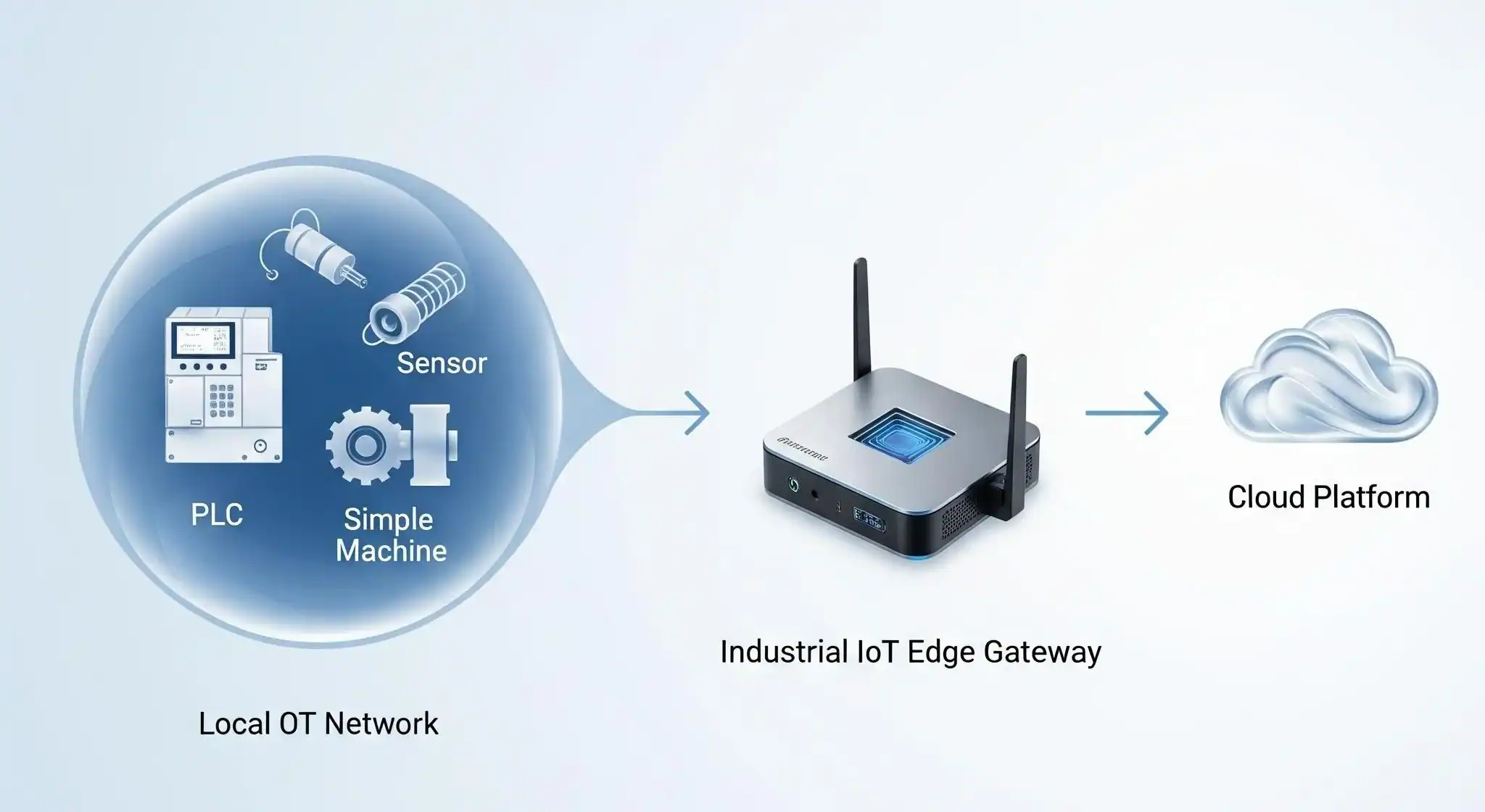
A safe architecture separates machine control from edge data workflows. PLCs or dedicated controllers remain responsible for deterministic sequences and safety-related behavior, while Node-RED and the Robustel EG5120 industrial edge gateway handle selected data, integration, and monitoring tasks around that control layer.
Before deployment, project teams should evaluate at least 6 areas: timing requirements, failure impact, data source, output permissions, gateway runtime, and maintenance ownership. A visual flow that works in a test environment is not automatically suitable for industrial operations.
Why “Industrial Control” Needs a Narrow Definition
The question “Can Node-RED be used for industrial control?” is too broad for a safe engineering decision. Industrial control can mean many things, from switching a non-critical indicator to controlling a safety-related machine sequence.
A clearer question is this: which part of the system is being controlled, how fast must it respond, and what happens if the logic fails? These 3 questions decide whether Node-RED belongs in the workflow.
Node-RED is officially described as a low-code tool for collecting, transforming, and visualizing real-time data. That makes it relevant for edge workflows, but it does not automatically make it the right layer for deterministic machine control.
Distinguish monitoring logic from control logic
Monitoring logic observes equipment state. It may collect values, compare thresholds, publish events, or update a dashboard. If it fails, the system should lose visibility, not machine safety.
Control logic directly changes machine behavior. It may start motors, stop processes, manage interlocks, or execute sequences. If it fails, the impact can be operational, mechanical, or safety-related.
This distinction matters because Node-RED can be useful for monitoring and integration, but that does not mean it should sit inside the critical control path.
Treat “light edge logic” as a limited category
Light edge logic can include non-critical filtering, message routing, data validation, threshold-based notifications, or simple event handling. These tasks may improve responsiveness because they happen near the equipment.
However, light edge logic should not be confused with PLC-level automation. If the task requires deterministic timing, certified safety behavior, validated interlocks, or real-time sequencing, the PLC or dedicated control layer should remain responsible.
For Robustel customers, this distinction defines the product role clearly: EG5120 can host and connect selected edge applications without being presented as a replacement for the PLC controlling the machine.
Where Node-RED Can Safely Add Value Around Control Systems
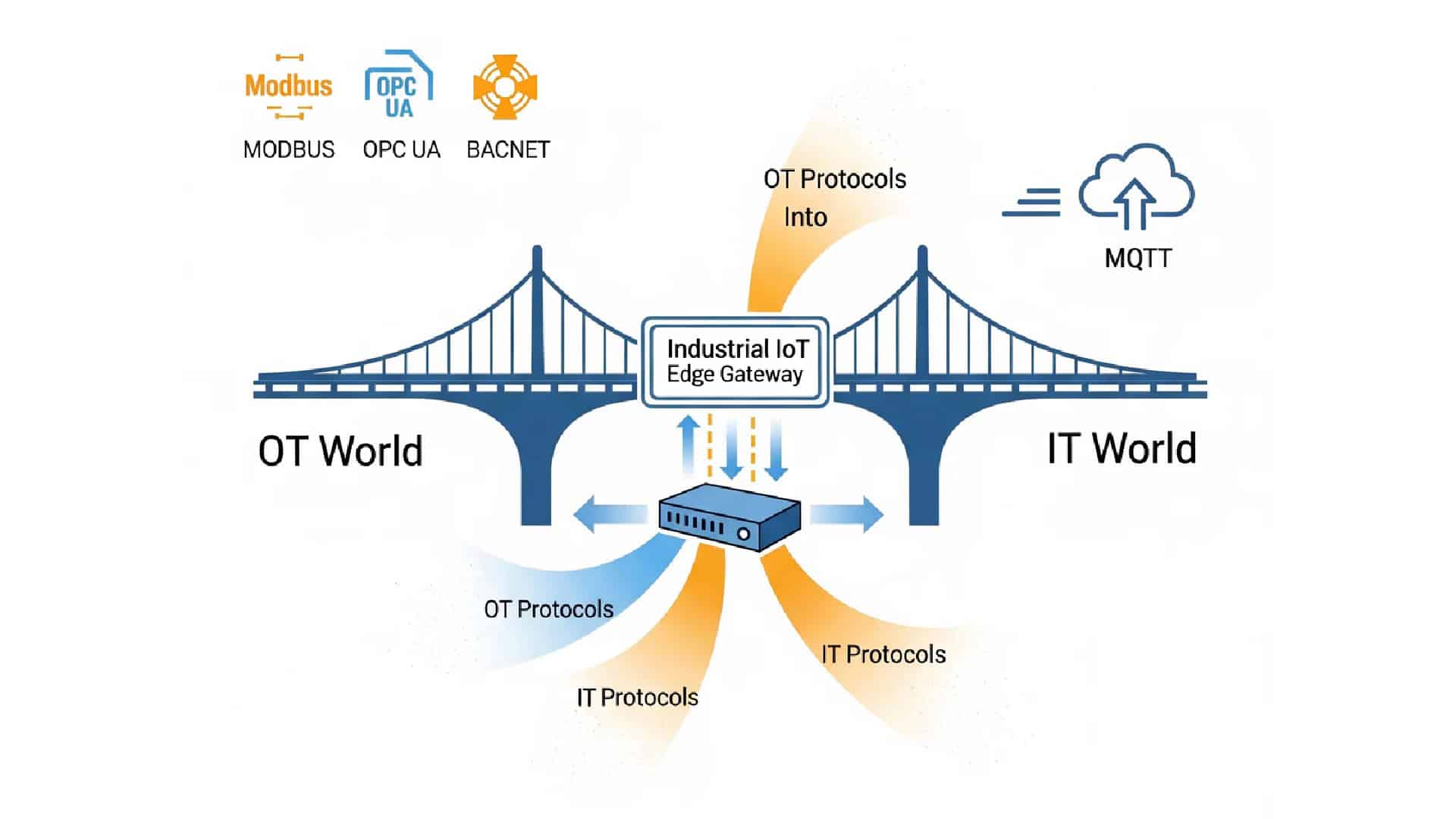
Node-RED is often most useful around an industrial control system rather than inside its most critical control loop. It can help system integrators and equipment builders connect PLC data to dashboards, brokers, databases, APIs, and remote monitoring systems.
A practical architecture keeps the PLC responsible for equipment behavior while using Robustel EG5120 and Node-RED for selected read-side and integration workflows.
Useful tasks beside the PLC layer
Node-RED can support status collection, alarm forwarding, Modbus-to-MQTT mapping, simple event routing, dashboard data preparation, and API integration. These are valuable because they improve visibility and integration without changing PLC control logic.
| Node-RED task | Safer role in industrial projects |
| Machine status collection | Read selected values for visibility |
| Alarm forwarding | Send non-control alerts to dashboards or systems |
| Data formatting | Convert raw values into readable payloads |
| Event routing | Forward selected events to MQTT, HTTP, or APIs |
| Local dashboard support | Show site-side values for observation |
| Threshold notification | Trigger non-critical monitoring messages |
For a broader view of Node-RED’s role in industrial applications, Robustel’s Node-RED benefits article can be inserted here because it discusses protocol integration, visual programming, customization, and maintenance-friendly workflow design.
Tasks that should stay in the control layer
PLC or dedicated controller logic should remain responsible for:
- Emergency stops
- Safety functions
- Deterministic sequences
- Motion control
- Timing-critical outputs
- Machine interlocks
- High-speed closed-loop control
- Actions where delayed or incorrect execution could create harm
A useful boundary is based on failure consequences. If a stopped or incorrect Node-RED flow could cause unsafe operation, equipment damage, or uncontrolled process movement, Node-RED should not be the primary control layer.
This boundary allows Robustel EG5120 edge gateway to contribute meaningful edge-computing value without overstating the role of the gateway. The product supports integration, monitoring, application hosting, and secure communication around the controller; the PLC remains responsible for critical machine behavior.
How to Design Node-RED Edge Logic Without Creating Control Risk
A good Node-RED architecture begins by deciding what the flow is allowed to do. The safest projects define permissions before building flows, not after a prototype starts working.
The project team should separate 3 categories: read-only monitoring, advisory logic, and output actions. Read-only monitoring is usually the safest. Advisory logic needs review. Output actions require the most caution.
Use a permission model for edge flows
A simple permission model can reduce risk. Each flow should be classified before deployment.
| Flow category | Example | Risk level |
| Read-only | Read PLC values and publish MQTT messages | Lower |
| Advisory | Compare values and send maintenance alerts | Moderado |
| Non-critical output | Toggle an indicator or send a reset request | Más alto |
| Direct control | Start/stop machine sequence or safety-related action | Not suitable for casual Node-RED use |
This table helps project teams avoid vague claims. Node-RED may be acceptable for one kind of automation while still being inappropriate for another.
Validate failure behavior before connecting outputs
A Node-RED flow should be tested under failure conditions before it interacts with equipment. This includes gateway reboot, network loss, field-device timeout, MQTT broker outage, duplicated messages, stale values, and wrong data types.
A minimum validation plan should include 5 failure checks: communication loss, gateway restart, bad input value, output conflict, and recovery after interruption. These checks help confirm whether the flow fails visibly and safely.
The practical conclusion is that a working demo is not enough. Industrial environments need documented behavior when the flow does not work as expected.
Robustel EG5120 Edge Gateway for Read-Side and Non-Control Edge Workflows
Robustel EG5120 edge computing gateway is useful as a product reference because it provides the gateway layer around Node-RED. It is a 5G-ready industrial edge gateway built on RobustOS Pro based on Debian 11, and it supports Docker containers and Debian packages for protocol bridges, data buffering, and edge workloads.
For Node-RED-related workflows, the relevant point is not only compute power. The gateway also needs field interfaces, secure backhaul, remote management, and a maintainable runtime environment.
Product fit table: EG5120 for low-code edge logic
| Project need | Robustel EG5120 reference |
| Host edge applications | RobustOS Pro, Debian 11, Docker containers |
| Connect field equipment | 2× software-configurable RS-232/RS-485 |
| Read simple site signals | 2× DI and 2× DO |
| Handle industrial data paths | Native Modbus TCP/RTU and MQTT-to-cloud bridging |
| Maintain connectivity | Dual-SIM 5G/4G/3G/2G and Ethernet WAN link backup |
| Secure traffic | IPsec, OpenVPN, GRE, L2TP, PPTP, and DMVPN |
| Manage gateways remotely | RCMS monitoring, configuration, and updates |
This table should not be read as a claim that EG5120 turns every Node-RED flow into a control-grade system. It means EG5120 can provide an industrial gateway layer for selected data, monitoring, and lightweight edge application workflows where the project is properly designed.
Runtime readiness matters more than visual flow design
Node-RED flows can look simple, but production deployment still needs runtime discipline. Teams should control editor access, user permissions, installed nodes, port exposure, backups, logging, updates, and restart behavior.
For implementation validation, Robustel’s how-to article on installing Node-RED on EG Series devices via Docker can be inserted here because it lists prerequisites such as RobustOS Pro 2.4.0 or higher, SSH access, Docker Engine, internet access, sudo user setup, Docker command usage, port mapping, and container status checks.
What to Check Before Allowing Node-RED Near Operations
Project teams should use a pre-deployment checklist before allowing a Node-RED flow to influence operational behavior. The checklist should focus on risk, not only functionality.
A useful test is this: would the site remain safe and understandable if the Node-RED flow stops, restarts, publishes the wrong value, or loses access to an upstream platform?
Control-boundary checklist for project teams
| Check area | What to confirm |
| Timing requirement | Does the task need deterministic millisecond response? |
| Failure impact | What happens if the flow stops or sends a wrong output? |
| Data quality | Are stale, bad, or uncertain values clearly flagged? |
| Output permission | Can the flow write to equipment, or only read and publish? |
| Runtime control | Who manages Docker, nodes, ports, credentials, and backups? |
| Security exposure | Is editor access protected by firewall, VPN, and credentials? |
| Recovery behavior | What happens after gateway reboot or network loss? |
| Ownership | Who approves changes and reviews flow versions? |
If a task fails this checklist, it should not be handled casually in Node-RED. It may need PLC logic, a dedicated control platform, or a formally validated industrial runtime.
FAQs
Q1. Can Node-RED be used for industrial control?
Node-RED can support some industrial automation-adjacent tasks, but it should be used carefully. It is better suited to monitoring, data collection, integration, dashboards, MQTT publishing, API workflows, and lightweight edge logic. It should not be used as a casual replacement for PLC-level deterministic control, safety functions, interlocks, or timing-critical machine sequences. The safer approach is to keep PLCs responsible for control behavior while using Node-RED beside the control layer for selected data and integration workflows.
Q2. What is the safest role for Node-RED in industrial automation?
The safest role for Node-RED is usually read-side or advisory logic. It can collect values from PLCs or field devices, format data, add equipment context, send messages to MQTT or APIs, and support dashboards or notifications. These workflows can improve visibility without directly controlling machinery. Once Node-RED starts writing outputs or influencing equipment behavior, the risk level changes. Project teams should review timing, failure impact, output permissions, security, and maintenance ownership before using Node-RED near operational processes.
Q3. Which Robustel gateway fits cautious Node-RED edge logic?
Robustel EG5120 is a suitable reference for cautious Node-RED edge logic because it provides RobustOS Pro, Docker containers, 2× RS-232/RS-485, 2× DI/DO, native Modbus TCP/RTU, MQTT-to-cloud bridging, dual-SIM 5G/4G/3G/2G, Ethernet WAN link backup, VPN options, and RCMS remote management. These features make it relevant where Node-RED is used for data flows, monitoring messages, and edge-side integration. Final suitability still depends on the workflow, runtime setup, security policy, and validation process.
Q4. Can Node-RED replace a PLC?
No. Node-RED should not replace a PLC for deterministic control, safety logic, interlocks, motion control, or timing-critical automation. PLCs are designed for stable industrial control responsibilities, while Node-RED is better positioned as a flexible flow layer for integration and data handling. A clear architecture should separate the control path from the data path. Node-RED can read selected PLC data, process messages, and forward information, but critical control should remain in the appropriate control system.
Q5. What should teams check before deploying Node-RED near operations?
Teams should check at least 6 areas before deploying Node-RED near operations: timing requirements, failure impact, output permissions, data quality handling, runtime security, and maintenance ownership. They should also test gateway reboot, communication loss, bad input values, stale data, and recovery behavior. A working flow in a lab does not prove production readiness. If a flow can affect equipment behavior, the team should document the logic, restrict access, define rollback steps, and confirm whether a PLC or dedicated control runtime is more appropriate.
Conclusion: Control Boundary Takeaway
Node-RED can be useful in industrial automation projects, but the safer positioning is clear: use it for data flows, integration, monitoring, dashboards, and selected lightweight logic. Do not position it as a direct replacement for PLC-level deterministic control.
Robustel EG5120 edge computing gateway can serve as the site-side edge gateway layer for these workflows because it supports industrial interfaces, Docker-based applications, cellular or Ethernet backhaul, VPN options, and RCMS remote management. The gateway can host selected edge applications, while PLCs or dedicated control systems remain responsible for critical control behavior.
The final decision should be based on 2 questions: First, does the flow only support visibility, routing, or non-critical logic? Second, would the equipment remain safe if the flow failed? If the answer to the second question is unclear, Node-RED should stay out of the control path.
Related Reading on Edge Computing in Industrial IoT:


Acerca del autor
Robert Liao | Technical Support Engineer
Robert is an IoT Technical Support Engineer at Robustel, specializing in industrial networking and edge connectivity. A certified Networking Engineer, Robert focuses on the deployment and troubleshooting of large-scale IIoT infrastructures. His work centers on architecting reliable, scalable system performance for complex industrial applications, bridging the gap between field hardware and cloud-side data management.