
4G vs VoIP Lift Phone: Best-Fit Architecture for Australian Buildings
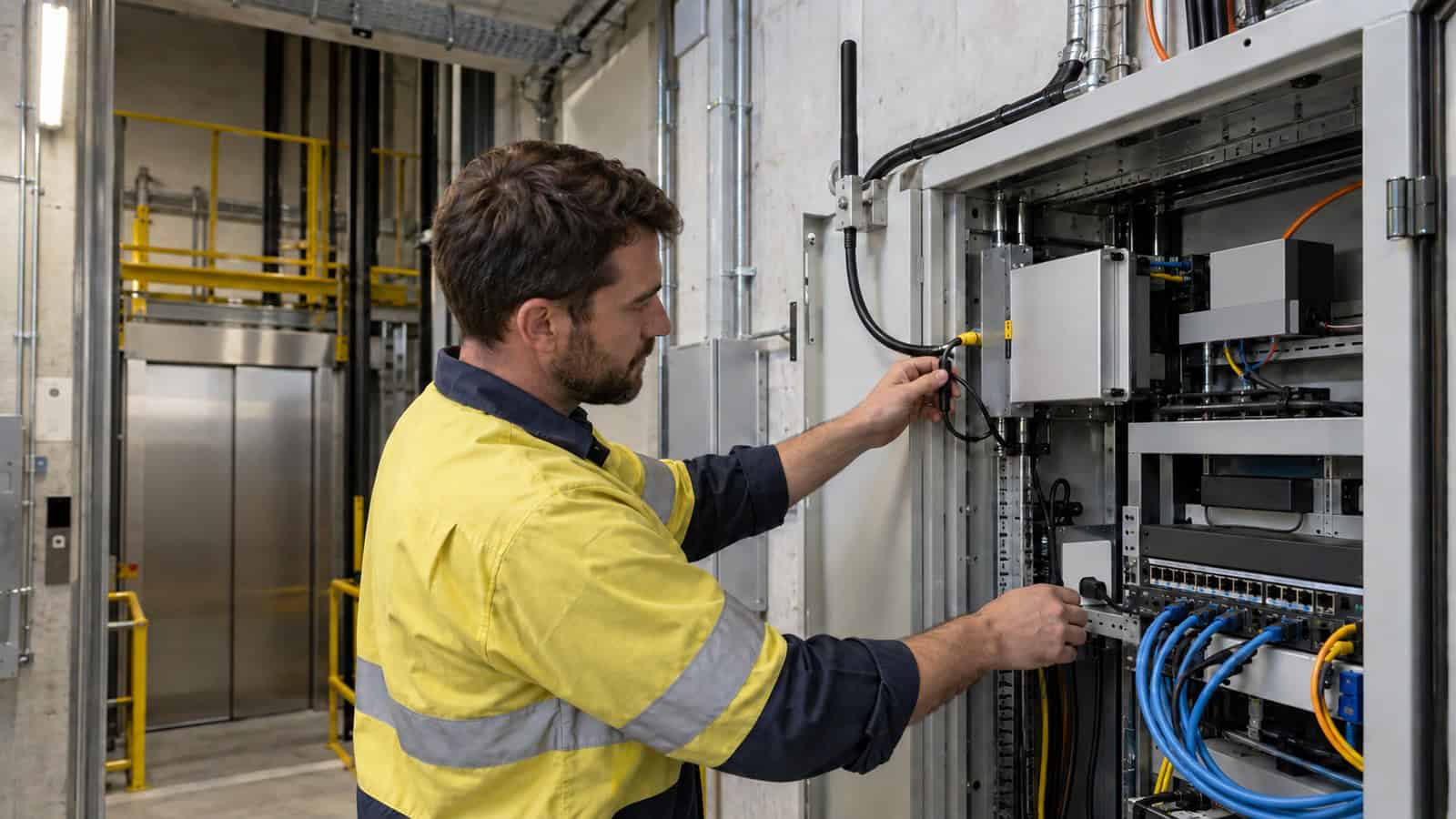
The Robustel EV8100 Industrial VoIP Gateway supports both VoLTE and SIP/VoIP, allowing a lift project to select a direct cellular voice path, a building IP path or a deliberately engineered hybrid. The best fit depends less on the label “4G” or “VoIP” than on coverage, monitoring-centre acceptance, network ownership, backup power and the failures the site can actually support.
This is an architecture comparison, not a contest between two universal technologies. A well-surveyed cellular service can be simpler than extending a building LAN into lift plant; a well-operated SIP environment can be easier to integrate with an IP monitoring platform. Either can fail when its less visible dependencies are ignored.
Define the Three Practical Architectures
In a direct 4G/VoLTE design, the analogue lift phone connects to the gateway and the call uses the mobile operator’s voice service. The building LAN is not part of the call path. The antenna, SIM, mobile service, gateway and local power are central dependencies.
In a SIP/VoIP design, the gateway registers or connects through an IP service to the monitoring environment. That path may use the building WAN or another IP bearer. It introduces dependencies such as Ethernet, addressing, firewall policy, SIP credentials and the availability of upstream network equipment.
A hybrid design keeps two defined routes—for example, an intended SIP service with a documented VoLTE backup path. Hybrid should mean tested service logic, not merely that the device supports both technologies.
| Architecture | Main advantage | Main dependencies | Best-fit condition |
|---|---|---|---|
| Direct 4G/VoLTE | limited reliance on building IT | mobile coverage, voice-capable SIM/operator, antenna, gateway power | building LAN is absent or not supportable for the lift service |
| SIP/VoIP over managed WAN | alignment with IP voice and monitoring workflows | LAN/WAN, power to network devices, SIP service, firewall and credentials | building and monitoring teams already operate the full IP path |
| Hybrid | alternative route across selected failures | both service stacks plus explicit changeover logic | added complexity is justified and regularly tested |
Compare Failure Domains Before Monthly Cost
A direct cellular design can avoid the switch, router and NBN service used elsewhere in the building. It still depends on RF at the installed antenna, the mobile subscription and the operator’s voice service. Basements and lift cores require measurement rather than coverage-map assumptions.
SIP/VoIP can create a clean integration where the monitoring centre already supports SIP and the building has managed, protected network infrastructure. In smaller properties, however, the lift service can inherit a consumer-grade router, undocumented firewall changes and an internet account that no one in the lift contract owns.
Hybrid adds resilience only for failures that the alternative route truly bypasses. If both routes share the same gateway, antenna system or DC supply, those remain common points. Write a failure table before paying for the extra service.
Ask the Monitoring Centre What It Can Accept
The monitoring centre needs to receive the call, identify the building and car, communicate clearly and start the correct response. Confirm whether it accepts ordinary mobile voice, SIP, particular DTMF behaviour or another defined workflow.
For SIP, test registration and recovery, audio, DTMF, identity and any session-timeout behaviour. For VoLTE, confirm the SIM is provisioned for the required voice service and that calling and identity work as expected. Use the production destination rather than a temporary mobile number.
Robuste’s PSTN elevator emergency-phone replacement Application Example explains how both paths can preserve the analogue phone interface while changing upstream transport. Its architecture still needs to be qualified with the selected Australian service providers and site.
Include the Whole Power Chain
In a direct cellular design, emergency power may need to support the lift phone and gateway. In a SIP design, the relevant switch, router, NBN termination or other IP equipment may also need protected power. That difference can outweigh a small subscription saving.
EV8100 provides a holder for compatible flat-top 18650 lithium batteries; batteries are not included by default. The project should specify the cells, environmental limits, inspection and replacement process, then test the assembled service after the required loss-of-power period.
Do not infer autonomy from battery capacity alone. Actual operating load, battery age, temperature and the other equipment in the call path affect the result.
How the Robustel EV8100 Industrial VoIP Gateway Supports 4G, VoIP and Hybrid Lift Phone Designs
Robustel EV8100 Industrial VoIP Gateway supplies one FXS interface for a suitable analogue device and supports VoLTE plus SIP/VoIP. Its published SIP capabilities include SIP RFC 3261 over UDP, SIPs, SRTP and multiple DTMF methods. This allows one hardware platform to be evaluated against different monitoring-centre architectures.
Dual SIM can support an alternative mobile subscription, and two 10/100 Ethernet ports support an IP design. The exact configuration, changeover behaviour and service availability must be tested. Do not describe dual SIM or VoLTE backup as guaranteed call continuity under every fault.
For Australian and New Zealand projects, the official ordering table lists A34AU variants with RCM. Variant B includes the documented Wi-Fi and Bluetooth option. Model selection should follow the required interfaces and approved order code, not an assumption that all variants are identical.
Robustel RCMS platform can help a service team observe and manage gateway devices across sites. It improves operational visibility but does not prove audio quality or monitoring-centre response. End-to-end calls and site records remain essential.
The Robustel EV8100 Quick Pitch video provides a compact overview of the product. Use it to brief stakeholders, then put the proposed 4G, SIP or hybrid path through the same site acceptance scorecard.
Run One Scorecard for All Options
Avoid testing the preferred option thoroughly while judging the alternative from a diagram. Use the same criteria:
- calls originate from every relevant lift car;
- the monitoring centre receives the correct site/car identity;
- speech and DTMF behaviour meet the accepted workflow;
- the final antenna position or WAN path is documented;
- normal-power loss is tested after the defined hold-up period;
- a mobile, SIP or LAN interruption produces the expected alarm and recovery;
- remote status is understood but not treated as a substitute for a call; and
- a replacement gateway can be restored from controlled configuration records.
Robustel’s IoT-enabled smart elevators Application Example adds another consideration: a project may also want approved lift telemetry. Keep that data service separate in the scorecard so a useful dashboard does not mask weakness in the emergency voice route.
Make the Selection by Site Type
A small building with no managed network near the lift may favour direct cellular voice after a satisfactory RF survey. A large commercial portfolio with protected WAN infrastructure and an established SIP monitoring platform may gain more from a controlled IP path. A hybrid can suit sites where the monitoring provider supports both routes and the additional test burden is justified.
Do not force one architecture across an estate when the failure domains vary materially. Standardise the decision method, approved gateway models, evidence pack and support workflow; allow the selected route to follow the site’s actual infrastructure.
The choice should be revisited when an NBN service, monitoring provider, mobile operator, building-network owner or lift maintenance contract changes. These commercial changes can alter technical responsibility even if the gateway remains in place.
Preguntas frecuentes
Q1. Is a 4G lift phone the same as a VoIP lift phone?
Not necessarily. A 4G lift phone may use the mobile operator’s voice service, while a VoIP design carries SIP voice over an IP connection. Some gateways support both paths.
Q2. Does a VoIP lift phone need the NBN?
It needs a suitable IP path, which may use an NBN service or another managed WAN. Every upstream network and power dependency should be included in the emergency-call design.
Q3. Is 4G more reliable than VoIP for lift emergency calls?
There is no universal answer. Direct 4G depends heavily on installed RF and mobile service; VoIP depends on the LAN, WAN, SIP platform and their power. Compare measured and supportable failure domains at the site.
Q4. Can a lift phone use VoIP with 4G backup?
It can when the gateway and services support a defined hybrid design. The changeover, call identity, monitoring-centre handling and recovery need specific testing rather than being inferred from feature support.
Q5. Which lift phone architectures does the Robustel EV8100 Industrial VoIP Gateway support?
EV8100 documents VoLTE and SIP/VoIP support with an FXS interface, dual SIM and Ethernet. The chosen carrier, SIP service, monitoring centre, antenna and site network still determine the approved deployment.
Conclusión
The Robustel EV8100 Industrial VoIP Gateway lets Australian lift projects evaluate direct 4G/VoLTE, SIP/VoIP and hybrid voice designs on one industrial platform rather than allowing the transport choice to dictate an improvised analogue adapter. Its FXS, cellular, Ethernet and management capabilities make the comparison practical, but they do not make the three architectures operationally equivalent.
Choose direct cellular where the installed RF and mobile voice service are strong and building IT should stay outside the call path. Choose SIP/VoIP where the monitoring and building teams already own a protected, supportable IP service. Choose hybrid only when its alternative route removes meaningful failure domains and the organisation will maintain the additional configuration and tests.
The defensible decision is the architecture that passes the same witnessed scorecard from the lift car to the monitoring operator, through power and network failures, and through a gateway replacement. That evidence is more valuable than a universal claim about whether 4G or VoIP is better.
Explore More Articles About Robustel Lift Connectivity


Acerca del autor
Robert Liao | Technical Support Engineer
Robert is an IoT Technical Support Engineer at Robustel, specializing in industrial networking and edge connectivity. A certified Networking Engineer, Robert focuses on the deployment and troubleshooting of large-scale IIoT infrastructures. His work centers on architecting reliable, scalable system performance for complex industrial applications, bridging the gap between field hardware and cloud-side data management.