
4G vs 5G Edge Gateway: Backhaul Selection Guide for Industrial Sites
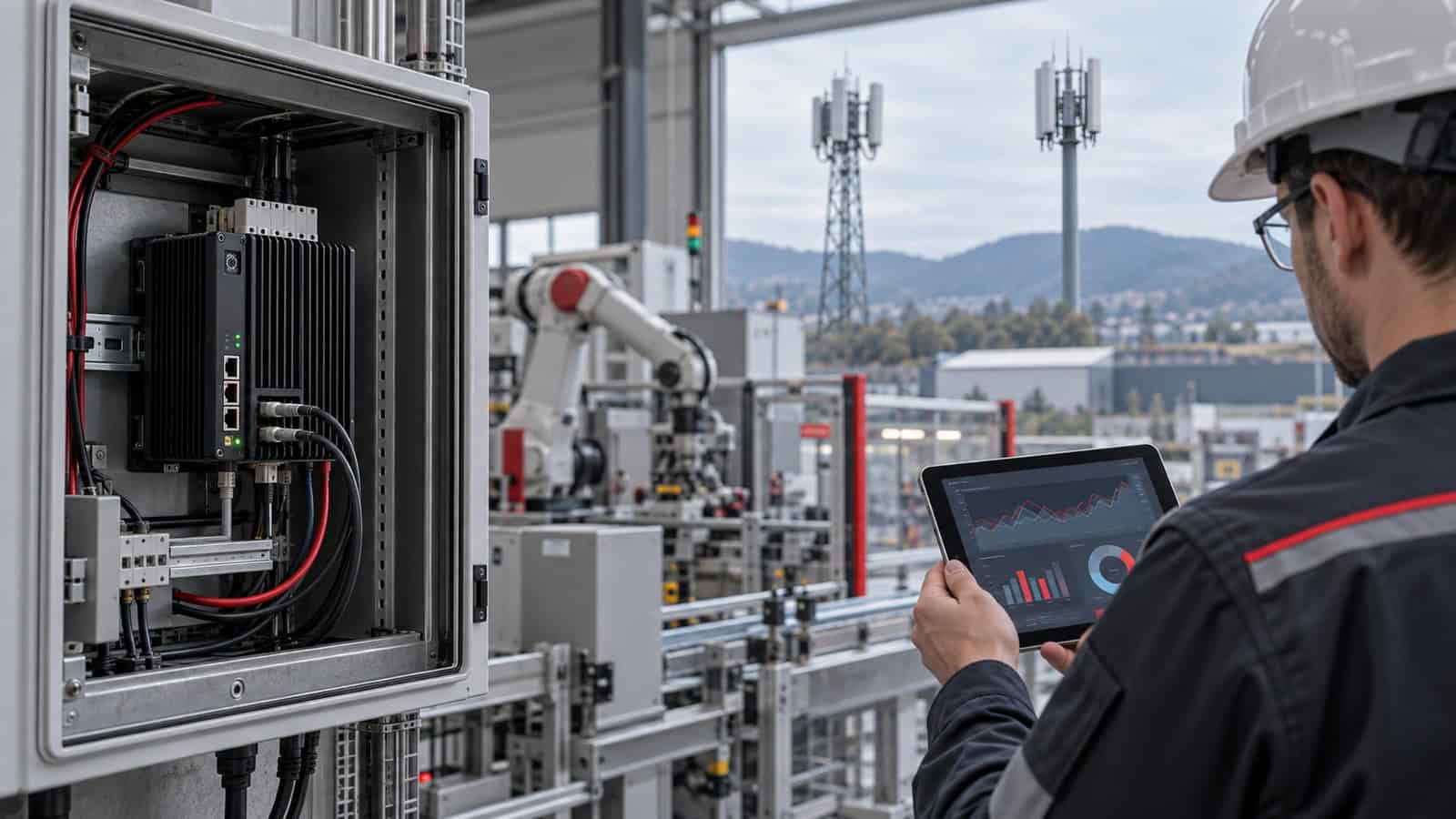
The Robustel EG5120 Edge Computing Gateway is available in cellular variants that let buyers match the gateway to the site. Some workloads justify 5G; many remain well served by a qualified 4G design.
Edge computing changes the WAN workload. Raw machine data may be filtered locally, while software updates, exception images or backlog replay can create occasional peaks. Select 4G or 5G from that measured traffic pattern, local coverage and operational consequence.
Put Every Workload on One Side of the WAN Boundary
List acquisition, filtering, inference, dashboards, alarms, remote access, software updates and central analytics. Mark which functions continue locally and which require the remote service. Then estimate normal, peak and recovery traffic for the functions that cross the WAN.
Robustel’s Reliable 5G Connectivity for AGVs on the Factory Floor Application Example places vehicle traffic, the radio path and the factory application in separate roles. That boundary is useful when choosing 4G or 5G: classify steady control or telemetry, larger updates and recovery traffic separately, then measure the busiest credible interval rather than the daily average. A modest stream may fit LTE comfortably, while a concentrated transfer may justify testing 5G. The example supplies an intended architecture, not a cellular benchmark or proof that 5G is required.
5G Adds Potential, Not a Service Guarantee
5G can provide greater network capability where suitable service, spectrum and signal are available. The usable result still depends on operator deployment, indoor penetration, antenna position, subscription and cell load. A “5G available” map cannot replace measurement inside the final cabinet.
4G remains a rational option for many control-room and telemetry workloads. It may offer mature coverage and lower commercial cost in a target area. If the application has a strict latency or availability target, neither generation label proves compliance; test the complete service and recovery path.
| Workload characteristic | 4G may be proportionate | 5G deserves evaluation |
|---|---|---|
| Small periodic telemetry | Sí | Only for another stated reason |
| Remote administration | Often | Where sessions and update traffic demand it |
| Exception images | Depends on size and frequency | For larger or frequent transfers |
| Continuous video | Limited by actual service and design | Test realistic aggregate stream |
| Backlog replay | Schedule/rate-limit where possible | Useful if measured recovery window requires it |
| Future workload uncertainty | Keep architecture modular | Validate headroom, not marketing peak |
How the Robustel EG5120 Edge Computing Gateway Fits 4G and 5G Backhaul Decisions
Robustel EG5120 provides two Gigabit Ethernet ports, configurable serial interfaces, DI/DO, 2 GB or 4 GB LPDDR4 configurations, 64 GB eMMC and a documented 2.3 TOPS NPU. Those local resources can support substantial edge workloads; the selected cellular variant determines how the site reaches upstream systems.
On Robustel EG5120 edge computing gateway, E2C Factory gives the compatible gateway a documented operational layer for supported machine-data collection, local processing, continuity, visualization, alarms, workflows and northbound integration. The combination can keep routine operational handling close to the equipment and make the data path more visible, allowing the WAN to carry selected information rather than every raw signal.
That can reduce backhaul demand, while remote services and unsupported integrations still rely on the wider architecture. Confirm each protocol and treat E2C Factory as a separately specified application rather than bundled software.
Test the Failure and Replay Surge
Disconnect the WAN while the local application is under normal load. Confirm what continues, what is stored, what alarms remain local and how operators learn about the fault. Restore the link and measure replay traffic alongside live data. That combined peak is often more important than the normal average.
Before choosing the EG5120 cellular variant, close this gateway-specific checklist:
- measure the normal northbound traffic after local filtering, not the raw machine-side total;
- capture the largest update, exception-image or backlog-replay burst expected during operations;
- survey 4G and 5G at the final antenna position during representative production periods;
- run the same local workload on the intended EG5120 memory configuration while the WAN is removed and restored; and
- assign an owner for carrier escalation, SIM policy, E2C Factory operation and the upstream data contract.
A 5G variant earns its place when that evidence exposes a constraint that the qualified 4G design cannot meet. Otherwise, the additional radio capability has not yet changed the operating result.
Robustel’s Secure Remote Access to Industrial Robots Application Example makes remote service a chain of identities, network paths and application sessions rather than a raw-speed problem. Use that chain in the failure test: remove the WAN while a local workload is active, restore it, and observe authentication, VPN recovery and the replay burst alongside live data. This reveals whether 5G removes a real bottleneck or merely raises the link ceiling. The example is not a measured cellular benchmark.
Robustel’s EG5120 Quick Start Guide video is useful after hardware selection for setup preparation. Production approval comes later, after sustained workload, thermal, coverage and recovery testing in the final enclosure.
Preguntas frecuentes
Q1. What is a 5G edge gateway?
It is an edge computing gateway with 5G backhaul capability. It can connect local equipment and run supported applications close to the data source while using 5G for selected remote traffic.
Q2. Is 5G required for edge computing?
No. Edge applications can use Ethernet, Wi-Fi, 4G, 5G or operate locally for defined periods. Backhaul should follow the workload and availability design.
Q3. What is the difference between 4G and 5G for industrial IoT?
5G can offer additional network capability where deployed, while 4G may remain sufficient and widely available for modest traffic. Real coverage, subscription and application tests determine the useful difference.
Q4. Can edge computing work without internet access?
Selected local functions can, if the application is designed for it. Remote management, cloud analytics and northbound services remain unavailable until the required path returns.
Q5. Should I choose a 4G or 5G Robustel EG5120 Edge Computing Gateway?
Choose the variant by measured site coverage, the traffic crossing the WAN, outage behaviour and lifecycle cost. The same local compute does not make 5G necessary for every workload.
Conclusión
The Robustel EG5120 Edge Computing Gateway lets a project qualify 4G or 5G around the same broader edge role. The workload and WAN boundary remain constant. Radio generation therefore does not have to become a proxy for the whole gateway.
Capture normal traffic, the largest credible transfer and the replay surge after an outage while local services remain active. Choose 5G when those measurements expose a constraint that 5G service at the actual site can remove; where qualified 4G already meets the timing and recovery requirement, retaining it is a defensible engineering decision.
Explore More Articles About Robustel Edge Computing Gateways
Acerca del autor
Robert Liao | Technical Support Engineer
Robert is an IoT Technical Support Engineer at Robustel, specializing in industrial networking and edge connectivity. A certified Networking Engineer, Robert focuses on the deployment and troubleshooting of large-scale IIoT infrastructures. His work centers on architecting reliable, scalable system performance for complex industrial applications, bridging the gap between field hardware and cloud-side data management.