
LoRaWAN Gateway for Smart Metering: Coverage and Backhaul Buying Checklist
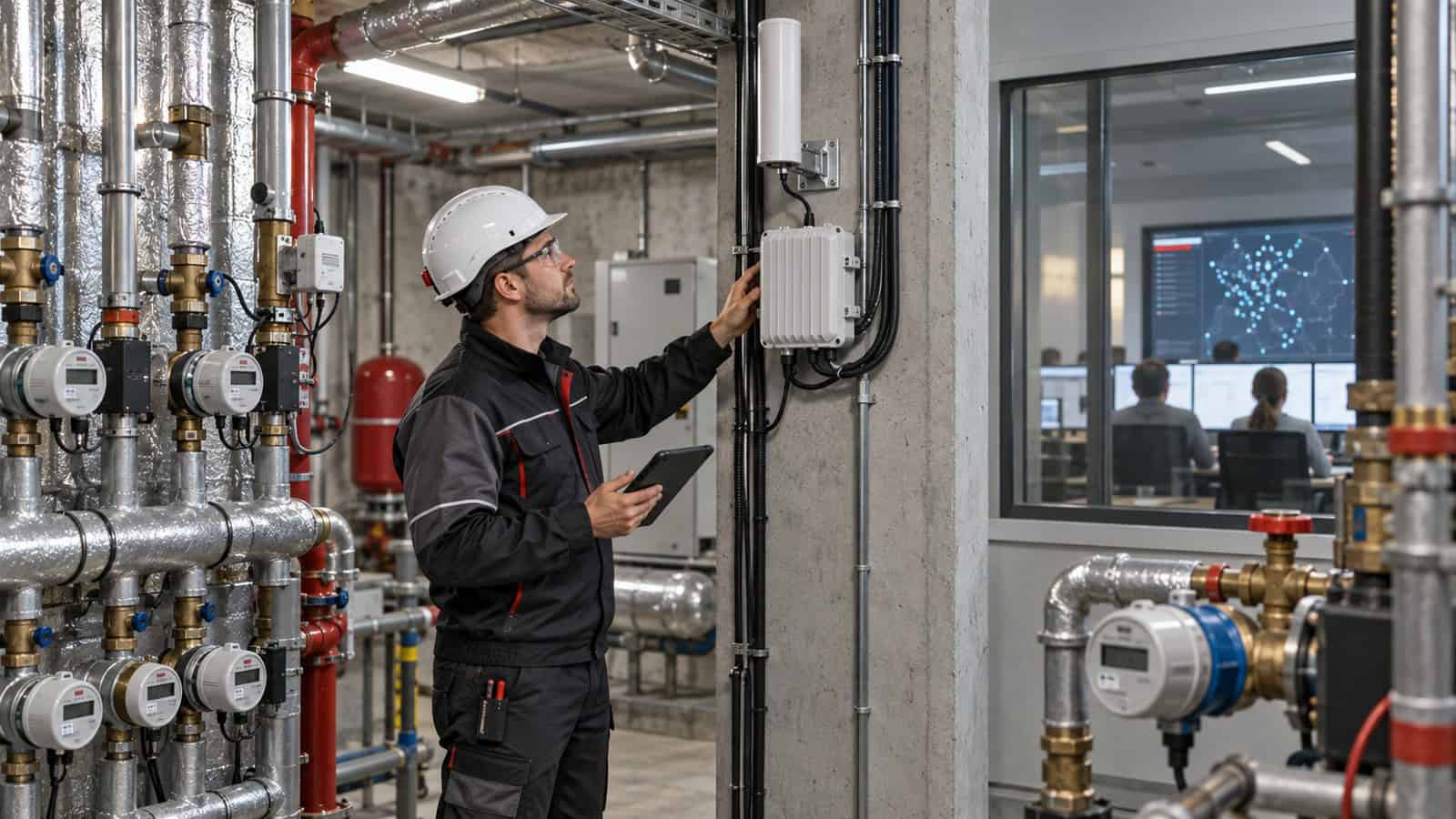
The Robustel R1520LG LoRaWAN Gateway combines an eight-channel LoRaWAN gateway with cellular, Ethernet and Wi-Fi backhaul choices and both external and embedded LNS options. Those capabilities make it relevant to smart metering, where the difficult path is often not the open-air distance but the final metres into a basement, riser or metal meter cabinet.
Buying should begin with the meter estate. Record location, message size, reporting interval, downlink need, installation access and consequence of missing data. Then design gateway placement and backhaul around the worst credible group of meters.
Map Meter Density and Failure Consequence
Ten meters sending a daily reading create a different network from thousands reporting frequently or requesting downlinks. Airtime depends on payload, spreading factor, retransmissions and channel plan. Capacity cannot be reduced to a single “devices per gateway” figure.
Classify data by consequence. Billing, leakage alarms, energy optimization and general trend data may tolerate different delays. This determines how much missing data can be buffered elsewhere, how quickly backhaul must recover and whether a second gateway or connection is justified.
The Robustel LoRaWAN Gateway Applications video is useful for introducing the range of monitoring architectures. Capacity for the planned meter estate must be calculated from its own payloads, intervals and RF conditions.
Survey Basements and Plant Rooms as Separate Zones
Concrete slabs, below-ground walls, pipework, switchgear and closed metal cabinets can dominate the RF path. Survey with the actual meter or a representative device at its installed height and enclosure state. A gateway on the roof may serve outdoor assets and still miss a basement directly below it.
Robustel’s KoolZone LoRaWAN monitoring case study provides deployment evidence from monitoring operations across demanding facilities. The relevant lesson for metering is that the service is only complete when radio reception, backhaul and the application record agree. During the pilot, compare a meter reading at source with its timestamp at the application after a weak-signal period and a WAN interruption. Smart-meter range and data-recovery behaviour remain results for the new site, not values transferred from the case.
Where one zone remains marginal, compare a second gateway near the meters with higher antenna gain or more repeated traffic. The extra gateway may create a cleaner capacity and maintenance outcome.
Choose Backhaul for the Site, Not the Head Office
Ethernet is attractive where the building network owner can provide an approved and supported port. Cellular can make the metering estate more independent of tenant IT, while adding subscription and coverage work. Wi-Fi may suit controlled sites but can become difficult when credentials and access-point policies change.
Dual SIM adds an alternate subscription path, not complete resilience. Power, antenna, the cellular modem and upstream application may still be shared failure points. Test loss and restoration of each backhaul path, including queued data and LNS reconnection.
| Metering-site condition | R1520LG design direction | Commissioning evidence |
|---|---|---|
| Approved building Ethernet is available | Use the managed Ethernet path to the selected external LNS | Port ownership, DNS, time and LNS reconnect test |
| Tenant or utility IT cannot provide a WAN | Use the qualified cellular path and an approved subscription | Final-position survey plus staged carrier-path loss |
| Controlled local Wi-Fi is the only site network | Use Wi-Fi only with an owner for credentials and access-point change | Rejoin after credential and access-point maintenance |
| A small site needs a local network server | Evaluate embedded ChirpStack and define local backup ownership | Restore the gateway and device records from the documented procedure |
This matrix can vary by building without changing the metering data contract. What should remain consistent is the LNS identity, device profile and recovery evidence retained for each site.
How the Robustel R1520LG LoRaWAN Gateway Supports Metering Coverage and Backhaul Choices
Robustel R1520LG LoRaWAN gateway gives metering integrators Ethernet, Wi-Fi and dual-SIM cellular options around the same LoRaWAN gateway. It supports external UDP, LoRa Basics Station and LORIOT paths and an embedded ChirpStack option, so the project can choose a central or local server boundary.
That combination helps where building ownership varies. One site may permit Ethernet, another may require independent cellular backhaul, and a small local system may justify an embedded LNS. The same gateway family can retain a familiar operational model while the approved backhaul and server design changes by site.
The limits should stay explicit. R1520LG is IP30 and needs protected installation. Its two Fast Ethernet ports and serial interfaces do not prove compatibility with a meter protocol or BMS. For a building-wide platform with documented KNX, BACnet or M-Bus roles, Robustel LG5120 Intelligent Building Control Center is a separate architecture to evaluate.
Turn the Buying List into Site Acceptance
- Confirm regional frequency plan and exact gateway variant.
- Survey representative meters in the hardest cabinets, basements and risers.
- Calculate traffic from real payloads, intervals, retries and downlinks.
- Prove the selected LNS connection and gateway identity.
- Remove backhaul and verify buffering or loss behaviour in the complete application.
- Test SIM switching only where two subscriptions are part of the design.
- Record replacement, credential and firmware procedures.
- Repeat after a building or plant change that materially affects RF.
The Robustel’s Cibicom nationwide LoRaWAN backhaul case study shows backhaul being operated across a large LoRaWAN estate. That scale makes replacement, alarm ownership and remote diagnosis part of gateway selection rather than later support details. A metering acceptance plan should therefore include a lost backhaul path, an unreachable gateway and restoration without corrupting the application record. Cibicom’s LTE450 design and results remain specific to its network.
Häufig gestellte Fragen
Q1. Is LoRaWAN suitable for smart metering?
Yes, particularly for low-power meters sending modest payloads over long periods. Confirm the meter protocol, reporting pattern, regional plan and application integration before deployment.
Q2. How far can a LoRaWAN smart meter transmit?
There is no universal distance. Building materials, antenna position, frequency plan, data rate, interference and installation quality determine the usable result.
Q3. Does LoRaWAN work in basements?
It can, but basements are often among the hardest locations because of concrete, soil, metalwork and meter cabinets. A site survey may show that a nearer gateway is preferable.
Q4. Does a LoRaWAN gateway need cellular backhaul?
No. Ethernet or Wi-Fi may be used where supported and appropriate. Cellular is valuable when the site needs an independent WAN or when fixed infrastructure is unavailable.
Q5. Why choose the Robustel R1520LG LoRaWAN Gateway for smart metering?
It offers several backhaul paths and a choice between supported external LNS connections and embedded ChirpStack. That suits estates whose site connectivity varies, provided RF, capacity and application recovery are validated.
Schlussfolgerung
The Robustel R1520LG LoRaWAN Gateway gives a metering project several choices for backhaul and network-server ownership. That flexibility is useful only after the team has defined where meter data is received, retained, decoded and handed to the operational system.
Use the hardest meter as the pilot, but do not stop at a successful uplink. Remove backhaul, restore the path and reconcile the source reading with the final application record. A gateway design that preserves that traceable flow gives the wider rollout a credible foundation.
Explore More Articles About Robustel LoRaWAN Gateways
Über den Autor
Robert Liao | Technical Support Engineer
Robert is an IoT Technical Support Engineer at Robustel, specializing in industrial networking and edge connectivity. A certified Networking Engineer, Robert focuses on the deployment and troubleshooting of large-scale IIoT infrastructures. His work centers on architecting reliable, scalable system performance for complex industrial applications, bridging the gap between field hardware and cloud-side data management.