
EU Cyber Resilience Act (CRA): Robustel Readiness
Robustel is progressing a structured readiness programme for Regulation (EU) 2024/2847, covering secure product development, vulnerability handling, software and component transparency, lifecycle support, product security requirements and conformity assessment across products intended for the European Union market.
Our Product Security Incident Response Team (PSIRT) and Article 14 reporting arrangements are already operational, while product-level security improvements, independent assessment and supporting conformity documentation continue toward the CRA’s full application on 11 December 2027.
Need help understanding CRA readiness for a specific Robustel product, software version or deployment? Please contact us below.
Understanding Robustel’s CRA Readiness
What the Cyber Resilience Act is for and what it changes
The Cyber Resilience Act (CRA), Regulation (EU) 2024/2847, establishes a horizontal European Union (EU) cybersecurity framework for hardware and software products with digital elements made available on the Union market. Article 1 of the Regulation establishes rules for placing these products on the market, essential cybersecurity requirements for their design, development and production, requirements for manufacturers’ vulnerability-handling processes throughout the period products are expected to remain in use, and provisions for market surveillance and enforcement. Under Article 2, the CRA applies broadly to products with digital elements whose intended purpose or reasonably foreseeable use includes a direct or indirect logical or physical data connection to a device or network, subject to the exclusions and sector-specific provisions defined by the Regulation.
For manufacturers, the CRA places cybersecurity within a defined regulatory product lifecycle. Article 13 requires manufacturers to assess the cybersecurity risks associated with a product and take the outcome of that assessment into account throughout its planning, design, development, production, delivery and maintenance. Products placed on the market must meet the applicable essential cybersecurity requirements in Part I of Annex I, while manufacturers must operate vulnerability-handling processes in accordance with Part II of Annex I during the applicable support period. In practical terms, product architecture, secure configuration, access control, protection of data and communications, security updates, vulnerability management and software-component visibility become connected parts of an ongoing product security responsibility rather than isolated technical activities.
The CRA also brings cybersecurity into the formal conformity framework for products placed on the EU market. Manufacturers must maintain the required technical documentation, follow the applicable conformity assessment procedure, provide the information and instructions required by the Regulation, and demonstrate conformity before drawing up the European Union Declaration of Conformity (EU DoC) and applying the CE marking. The applicable conformity route depends on the product and its classification under the CRA, with additional assessment requirements applying to certain products designated as important or critical because of their cybersecurity relevance.
These obligations are being introduced in stages. The CRA entered into force on 10 December 2024 and, under Article 71, applies in full from 11 December 2027. However, the manufacturer reporting obligations in Article 14 have applied since 11 September 2026, including requirements concerning actively exploited vulnerabilities and severe incidents affecting the security of products with digital elements. This distinction is central to Robustel’s current readiness position: regulatory reporting processes are already operational, while product-level security implementation, technical documentation, conformity assessment and lifecycle preparations continue toward the CRA’s full application.
Robustel’s Cyber Resilience Act Readiness at a Glance
Robustel’s Cyber Resilience Act (CRA) programme combines regulatory processes that are already operational with product-level security, assessment and conformity work that remains in progress. The summary below reflects the current programme position for Robustel products intended for the European Union (EU) market and should be read as a readiness overview rather than a declaration of full CRA conformity.
Cyber Resilience Act Article 14 reporting
Status: Operational
Robustel’s Product Security Incident Response Team (PSIRT), vulnerability-handling process and CRA reporting arrangements are established and operating. Article 14 reporting obligations have applied since 11 September 2026 and require manufacturers to report qualifying actively exploited vulnerabilities and severe incidents affecting the security of products with digital elements. Robustel maintains a dedicated Article 14 Reporting & User Protection Statement covering its reporting process, escalation arrangements and communication with affected users.
Secure development & security governance
Status: Established & Operating
Robustel operates a defined cybersecurity development process certified to IEC 62443-4-1:2018 Maturity Level 2. The certification covers the Robustel Cyber Security Development Process V1.0 and assesses security management, specification of security requirements, secure design, secure implementation, security verification and validation testing, management of security-related issues and security update management. These organisational and engineering controls provide the foundation for the product-specific CRA work now progressing across the portfolio.
Product security & conformity programme
Status: In Progress
Robustel is progressing product-specific security improvements, component and product traceability, Software Bill of Materials (SBOM) and Hardware Bill of Materials (HBOM) activities, technical documentation, independent assessment and conformity work across the planned European Union (EU) product scope. Readiness is being managed by product family and depends on the specific model, hardware configuration, software branch and applicable conformity-assessment route. Status should be confirmed against the product and software version being supplied.
Planned CRA
readiness
Programme target: 30 October 2027
Robustel’s current programme targets 30 October 2027 for completion of the applicable conformity assessments and preparation of the required certificates, European Union Declarations of Conformity (EU DoCs), CE marking and supporting technical documentation for the planned EU product scope. The CRA applies in full from 11 December 2027. Programme dates are planning targets rather than product-specific contractual warranties and should be confirmed against the applicable product roadmap and delivery documentation.
Robustel Product Scope
Robustel’s Cyber Resilience Act (CRA) readiness programme covers products with digital elements intended for placement on the European Union (EU) market. Because conformity under the CRA is assessed against the product actually supplied, readiness cannot be determined from the product family name alone. The applicable hardware configuration, software branch, product functionality, cybersecurity classification and conformity-assessment route must all be considered together.
The current roadmap therefore works at two levels: first, defining the planned software and assessment path for each product family; and second, setting programme milestones for implementation, customer validation, conformity assessment and compliant delivery. The dates below are Robustel programme targets and should not be interpreted as product-specific contractual commitments.
Important: The product scope, classifications, conformity routes, software versions and target dates shown reflect Robustel’s current CRA readiness plan. They may change as applicable CRA standards are finalised, published or cited in the Official Journal of the European Union, and as draft technical requirements or assessment expectations evolve.
Current product scope and planned software branches
Robustel’s current Cyber Resilience Act (CRA) programme covers products with digital elements intended for placement on the European Union (EU) market. The tables below follow Robustel’s established product portfolio structure so that customers can identify the current CRA plan for the products they use.
The information reflects the 30 September 2026 programme baseline. Classification, conformity-assessment route, software branch and release timing remain subject to the actual product functionality, hardware configuration and final assessment scope.
Modems
Robustel’s current modem portfolio consists of the M1200 and M1000-MP industrial cellular modems. Under the current CRA programme, the modem series is not planned to receive a CRA-compliant release and will therefore be withdrawn from future EU market placement in accordance with Robustel’s product roadmap.
| Product / Series | CRA Class | Assessment Route | Planned CRA Software | Preview Target | Release Target | EU Market Plan |
|---|---|---|---|---|---|---|
| M1200 / M1000-MP | — | — | No CRA-compliant release planned | — | — | EU sales to cease under the current CRA programme |
Existing deployments should continue to be managed in accordance with the applicable product lifecycle, security advisories and support arrangements. The absence of a future CRA-compliant release should not be interpreted by itself as immediate end-of-support for devices already deployed.
Router
Robustel’s current CRA roadmap treats the router portfolio at product-series level, with planned RobustOS (ROS) software branches, preview targets and conformity routes defined for each series. The table below follows the controlled CRA roadmap rather than listing every regional, eSIM or connectivity variant separately.
| Product series | CRA Class | Current assessment route | Planned software branch | Preview target | Release target | Current plan |
|---|---|---|---|---|---|---|
| R1510 / R1511 / R1520 / R1315 | Class I | Notified-body assessment* | ROS v5.8 | ≈ June 2027 | October 2027 | Upgrade planned |
| R2010 / R2011 | Class I | Notified-body assessment* | ROS v5.8 | ≈ June 2027 | October 2027 | Upgrade planned |
| R2110 / R2111 / R2120 | Class I | Notified-body assessment* | ROS v5.8 | ≈ June 2027 | October 2027 | Upgrade planned |
| R3000 / R3000L / R3000Q | Class I | Notified-body assessment* | ROS v5.8 | ≈ June 2027 | October 2027 | Upgrade planned |
| R5010 | Class I | Notified-body assessment* | ROS v5.8 | To be confirmed | To be confirmed | Upgrade planned; dependent on the applicable cellular module compliance plan, currently under discussion |
| R5020 / R5020L / R5030 | Class I | Notified-body assessment* | ROS v5.8 | ≈ June 2027 | To be confirmed | Upgrade planned |
| R1312 | — | — | No CRA-compliant release planned | — | — | EU sales to cease under the current CRA programme |
* Current Robustel assessment plan: the roadmap presently uses a notified-body conformity-assessment route for Class I router products. The final conformity route will be confirmed against the applicable CRA requirements and conformity mechanisms available at the time of assessment.
The CRA roadmap is maintained at series level. Individual regional variants, eSIM models and other derivatives shown in Robustel’s commercial router portfolio are not separately identified in the current controlled roadmap and should therefore be confirmed against the exact model, hardware configuration and software version being supplied.
Edge-Computing-Gateways
Robustel’s Edge Computing Gateway portfolio uses RobustOS Pro, with CRA-ready software branches planned across both the existing Debian 11-based architecture and the newer Debian 13-based platform. The current roadmap provides customers with two migration paths where applicable, allowing existing deployments to move toward a supported security baseline while newer projects can validate the next-generation software branch ahead of the CRA’s full application.
| Product / Series | CRA Class | Current Assessment Route | Planned Software Branch | Preview Target | Release Target | Current Plan |
|---|---|---|---|---|---|---|
| EG5100 / EG5101 | Class I | Notified-body assessment* | RobustOS Pro v2.6 (Debian 11) / v3.0 (Debian 13) | v2.6: ≈ June 2027 • v3.0: ≈ February 2027 | October 2027 | Upgrade planned |
| EG3120e | Class I | Notified-body assessment* | RobustOS Pro v2.6 / v3.0 | v2.6: ≈ June 2027 • v3.0: ≈ February 2027 | October 2027 | Upgrade planned; final branch subject to change based on Rockchip (RK) kernel requirements |
| EG5120 / EG5200 | Class I | Notified-body assessment* | RobustOS Pro v2.6 / v3.0 | v2.6: ≈ June 2027 • v3.0: ≈ February 2027 | October 2027 | Upgrade planned |
| EG5200AI | Class I | Notified-body assessment* | RobustOS Pro v3.0 only | ≈ February 2027 | October 2027 | Upgrade planned |
* Current Robustel assessment plan: the roadmap presently uses a notified-body conformity-assessment route for these Class I products. The final conformity route will be confirmed against the applicable CRA requirements and conformity mechanisms available at the time of assessment.
The two planned RobustOS Pro branches allow Robustel to maintain a security path for existing product architectures while also moving the portfolio onto the newer Debian 13-based platform. The applicable branch for a specific deployment should be confirmed against the product hardware revision, application compatibility and final release documentation.
LoRaWAN-Gateways
Robustel’s current LoRaWAN gateway portfolio spans two software architectures. The R1320LGe follows the RobustOS (ROS) compliance path, while the R1520LG, LG3120e and LG5120 follow the RobustOS Pro roadmap. All four product families are included in the current CRA programme as Class I products with upgrade paths planned ahead of the CRA’s full application.
| Product / Series | CRA Class | Current Assessment Route | Planned Software Branch | Preview Target | Release Target | Current Plan |
|---|---|---|---|---|---|---|
| R1320LGe | Class I | Notified-body assessment* | ROS v5.8 | ≈ June 2027 | October 2027 | Upgrade planned |
| R1520LG | Class I | Notified-body assessment* | RobustOS Pro v2.6 (Debian 11) / v3.0 (Debian 13) | v2.6: ≈ June 2027 • v3.0: ≈ February 2027 | October 2027 | Upgrade planned |
| LG3120e | Class I | Notified-body assessment* | RobustOS Pro v2.6 (Debian 11) / v3.0 (Debian 13) | v2.6: ≈ June 2027 • v3.0: ≈ February 2027 | October 2027 | Upgrade planned |
| LG5120 | Class I | Notified-body assessment* | RobustOS Pro v2.6 (Debian 11) / v3.0 (Debian 13) | v2.6: ≈ June 2027 • v3.0: ≈ February 2027 | October 2027 | Upgrade planned |
* Current Robustel assessment plan: the roadmap presently uses a notified-body conformity-assessment route for these Class I products. The final conformity route will be confirmed against the applicable CRA requirements and conformity mechanisms available at the time of assessment.
The planned software branch should be confirmed against the exact product, hardware revision and final release documentation before deployment.
VoIP/Elevator Gateways
Robustel’s current VoIP Gateway portfolio consists of the EV8100, which follows the RobustOS Pro CRA readiness path used across Robustel’s Debian-based gateway platforms. The current roadmap provides both a maintenance path based on RobustOS Pro v2.6 and a newer RobustOS Pro v3.0 branch.
| Product / Series | CRA Class | Current Assessment Route | Planned Software Branch | Preview Target | Release Target | Current Plan |
|---|---|---|---|---|---|---|
| EV8100 | Class I | Notified-body assessment* | RobustOS Pro v2.6 (Debian 11) / v3.0 (Debian 13) | v2.6: ≈ June 2027 • v3.0: ≈ February 2027 | October 2027 | Upgrade planned |
* Current Robustel assessment plan: the roadmap presently uses a notified-body conformity-assessment route for the EV8100 as a Class I product. The final conformity route will be confirmed against the applicable CRA requirements and conformity mechanisms available at the time of assessment.
The applicable RobustOS Pro branch should be confirmed against the product hardware revision, deployment requirements and final release documentation.
Maritime Vernetzung und Cybersicherheit
Robustel’s maritime portfolio follows several Cyber Resilience Act (CRA) readiness paths reflecting the different functions and software architectures within the range. The MG460 Gateway, Forwarder and Switch are currently classified as Important Class II products and follow mandatory third-party conformity-assessment routes, while the maritime computer platform follows the CRA default product category and a self-declaration route under the current programme.
| Product | CRA Class | Current Assessment Route | Planned Software Branch | Preview Target | Release Target | Current Plan |
|---|---|---|---|---|---|---|
| MG460-Gateway | Class II | Notified-body assessment* | MG Core v2.1.x (Debian 11) / v2.5.x (Debian 13) | v2.1.x: ≈ June 2027 • v2.5.x: ≈ February 2027 | October 2027 | Upgrade planned |
| MG460 Forwarder | Class II | Notified-body assessment* | MG Core v12.1.x (Debian 11) / v12.5.x (Debian 13) | v12.1.x: ≈ June 2027 • v12.5.x: ≈ February 2027 | October 2027 | Upgrade planned |
| MG460-Schalter | Class II | Notified-body assessment* | MG Core v22.1.2 | ≈ June 2027 | October 2027 | Upgrade planned |
| MG460 Computer | Default | Self-declaration | Standard Linux OS | ≈ June 2027 | October 2027 | Upgrade planned |
The applicable software branch and conformity documentation should be confirmed against the specific maritime product and configuration being supplied.
* Current Robustel assessment plan: the roadmap presently uses a notified-body conformity-assessment route for these Class II products. The final conformity route will be confirmed against the applicable CRA requirements and conformity mechanisms available at the time of assessment.
RCMS – Device Management Software
Robustel Cloud Manager Service (RCMS) is available in two deployment models: RCMS Cloud, Robustel’s hosted Software-as-a-Service (SaaS) platform, and RCMS Stack, which can be deployed within a customer-controlled private environment or private cloud. Both deployment models are included in Robustel’s current Cyber Resilience Act (CRA) programme and follow the same RCMS v3.6 readiness path.
| Product | CRA Class | Current Assessment Route | Planned Software Branch | Preview Target | Release Target | Current Plan |
|---|---|---|---|---|---|---|
| RCMS-Cloud | Class I | Notified-body assessment* | RCMS v3.6 | ≈ June 2027 | October 2027 | Upgrade planned |
| RCMS-Stack | Class I | Notified-body assessment* | RCMS v3.6 | ≈ June 2027 | October 2027 | Upgrade planned |
* Current Robustel assessment plan: the roadmap presently uses a notified-body conformity-assessment route for RCMS Cloud and RCMS Stack as Class I products. The final conformity route will be confirmed against the applicable CRA requirements and conformity mechanisms available at the time of assessment.
The applicable RCMS release and supporting conformity documentation should be confirmed against the deployment model and version being supplied.
Robustel CRA Readiness Roadmap
Robustel’s Cyber Resilience Act (CRA) programme is structured around a series of controlled milestones leading to the CRA’s full application on 11 December 2027. The roadmap covers product scoping, security implementation, customer validation, third-party conformity assessment, technical documentation and preparation for compliant product delivery.
The dates below are Robustel programme targets, not product-specific contractual warranties. Product-level timing should always be confirmed against the applicable model, software branch and release documentation.
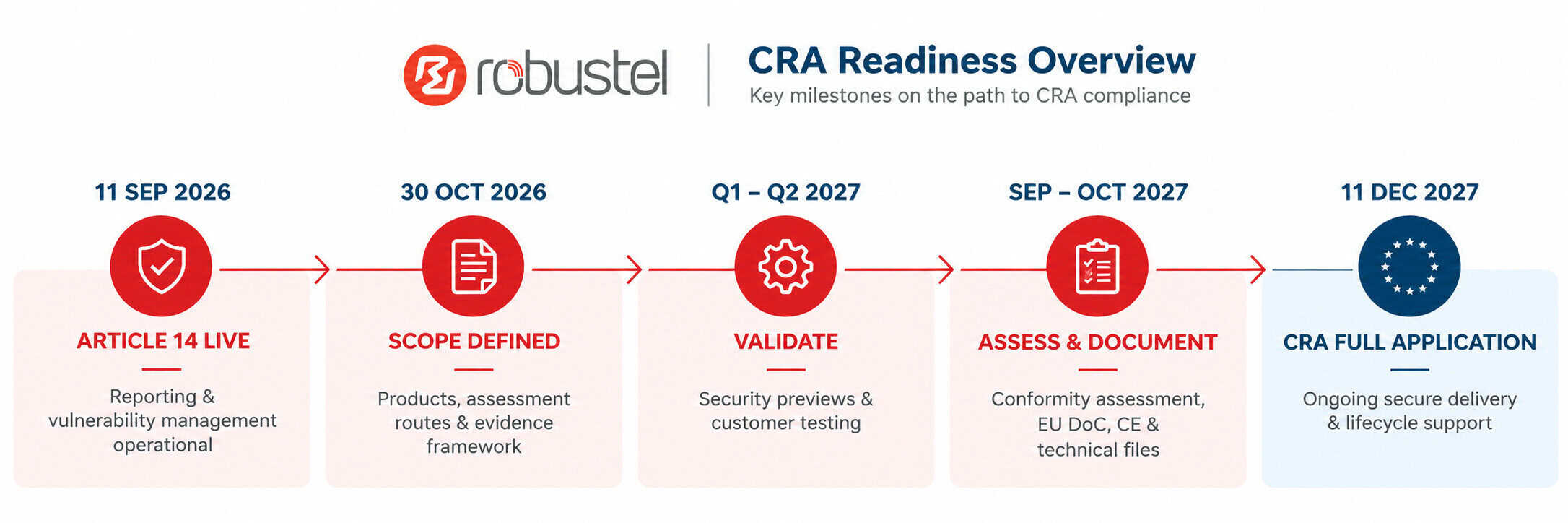
| Target date | Robustel programme milestone | What is happening | What customers can plan |
|---|---|---|---|
| 11 September 2026 | Article 14 reporting operational | Robustel’s Product Security Incident Response Team (PSIRT), vulnerability-handling procedures and CRA Article 14 reporting process are operational for qualifying actively exploited vulnerabilities and severe security incidents. | Continue reporting suspected vulnerabilities through Robustel’s established security channels and follow published security advisories and remediation guidance. |
| 30 October 2026 | Product scope and assessment framework defined | Product scope, classifications and planned assessment routes are being formalised, alongside selection of the conformity-assessment body and further development of Software Bill of Materials (SBOM) and Hardware Bill of Materials (HBOM) evidence. | Confirm whether planned or deployed products are covered by the current roadmap and request model-specific security or component information where required. |
| February–March 2027 | First security-feature previews and assessment review | CRA feature preview builds are targeted for RobustOS Pro v3.0 and MG Core v2.5.x. Security gap analysis and supporting documentation are targeted for review with the assessment body by 30 March 2027. | Edge Computing Gateway, LoRaWAN Gateway, VoIP Gateway and maritime customers can begin validating applicable security features, applications and interfaces against the newer software architecture. |
| 30 June 2027 | Wider preview programme | CRA feature preview builds are planned for RobustOS v5.x, RobustOS Pro v2.x and MG Core v2.1.x, extending validation across a larger proportion of the product portfolio and installed base. | Pilot software upgrades, configuration migration, custom applications and critical operational functions before production deployment. |
| 30 September 2027 | Conformity assessments targeted for completion | Applicable product conformity assessments are targeted for completion across the planned product batches, including remediation and closure of issues identified during assessment. | Confirm final assessment coverage and prepare procurement, acceptance testing and deployment plans against the assessed product configurations. |
| 30 October 2027 | Conformity documentation targeted for completion | Applicable certificates, European Union Declarations of Conformity (EU DoCs), CE marking and supporting technical documentation are targeted for completion for the planned EU product scope. | Review final product and conformity documentation and prepare production procurement, logistics and staged deployment. |
| From November 2027 | CRA-compliant product delivery begins | Robustel plans to begin shipment of products prepared for CRA-compliant EU market placement ahead of full application of the Regulation. | Coordinate product availability, software versions and delivery documentation with the applicable Robustel sales or distribution channel. |
| 11 December 2027 | CRA applies in full | The CRA’s main product cybersecurity requirements become applicable. Robustel’s programme transitions from readiness implementation into ongoing vulnerability management, security-update support, lifecycle management and maintenance of conformity documentation. | Maintain deployed products within their applicable support arrangements and continue security-update and lifecycle management throughout the declared support period. |
What the Cyber Resilience Act means for Robustel and its customers
What the Cyber Resilience Act means for Robustel
For Robustel-branded products with digital elements placed on the European Union (EU) market, Robustel acts as the manufacturer under the Cyber Resilience Act (CRA). This places the primary responsibility for product cybersecurity, vulnerability handling and demonstration of conformity with Robustel rather than transferring those responsibilities to customers or channel partners. Under Article 13 of Regulation (EU) 2024/2847, manufacturers must ensure that products within scope are designed, developed and produced in accordance with the applicable essential cybersecurity requirements in Annex I, supported by a documented cybersecurity risk assessment that is considered throughout planning, design, development, production, delivery and maintenance.
For Robustel, this means maintaining a product-security programme that addresses the full lifecycle of products placed on the EU market, including:
- Cybersecurity risk assessment: assessing product-specific cybersecurity risks and using those findings throughout product planning, design, development, production, delivery and maintenance.
- Secure product development: implementing the applicable essential cybersecurity requirements in Part I of Annex I and maintaining appropriate technical and organisational security controls.
- Vulnerability handling: identifying, documenting, assessing and remediating vulnerabilities in accordance with Part II of Annex I throughout the applicable support period.
- Security updates and lifecycle support: providing security updates and maintaining defined support arrangements for products within scope.
- Technical documentation and conformity assessment: maintaining the evidence required to demonstrate conformity and completing the applicable conformity assessment procedure.
- EU market documentation: providing the prescribed information and instructions, drawing up the European Union Declaration of Conformity (EU DoC) and applying the CE marking once conformity has been demonstrated.
Article 14 adds a separate set of manufacturer reporting obligations for actively exploited vulnerabilities and severe incidents affecting the security of products with digital elements. Those obligations have applied since 11 September 2026 and are already incorporated into Robustel’s security response processes through its Product Security Incident Response Team (PSIRT) and regulatory reporting arrangements.
Robustel’s CRA readiness programme therefore combines obligations that are already operational with product security, conformity assessment, technical documentation and lifecycle work progressing toward the Regulation’s full application on 11 December 2027.
What the Cyber Resilience Act means for EU importers, distributors and channel partners
The CRA assigns responsibilities according to the role an organisation performs in the supply chain. A commercial description such as “channel partner”, “reseller” or even “distributor” does not by itself determine that organisation’s legal status under the Regulation. Depending on how a Robustel product is brought to and supplied within the EU market, a partner may act as an importer, a distributor, or, in particular circumstances, may assume the obligations of a manufacturer.
The principal distinctions are:
- EU importers: Under Article 19, an importer placing a product with digital elements manufactured outside the Union on the EU market must verify that the manufacturer has completed the applicable conformity assessment and technical documentation, that the product bears the CE marking, and that the required European Union Declaration of Conformity and user information are available. An importer must not place a product on the market where it considers or has reason to believe that the product, or the manufacturer’s relevant processes, do not conform to the Regulation.
- Distributors: Under Article 20, distributors making products with digital elements available on the EU market must act with due care and verify specified conformity information before supplying the product. Where a distributor has reason to believe that a product or the manufacturer’s relevant processes are not in conformity with the applicable requirements, it must not continue making the product available until conformity has been restored.
- OEM, ODM and private-label partners: Under Article 21, an importer or distributor is considered to be a manufacturer for the purposes of the CRA where it places a product on the market under its own name or trademark or substantially modifies a product already placed on the market. In these circumstances, the corresponding manufacturer obligations under Articles 13 and 14 apply.
These distinctions are particularly important for Original Equipment Manufacturer (OEM), Original Design Manufacturer (ODM) and private-label projects. Robustel therefore works with partners to establish the applicable product configuration, branding, technical evidence, change-control responsibilities and vulnerability-notification arrangements for the actual route by which the product will be placed on the EU market.
What the Cyber Resilience Act means for customers and system integrators
For customers purchasing and operating Robustel products, the CRA is intended to provide greater transparency about product cybersecurity, available support and the responsibilities of organisations placing products on the EU market. An end customer does not automatically assume the manufacturer obligations in the CRA simply by purchasing, installing or operating a product. Robustel remains responsible for the manufacturer obligations applicable to Robustel products that it places on the market under its own name and trademark.
In practical terms, customers and system integrators should consider:
- Product and software identification: ensuring that the relevant model, hardware revision and software version are known so that applicable security information, updates and conformity evidence can be correctly matched to the deployment.
- Security and conformity evidence: obtaining the product-specific documentation appropriate to procurement, technical assurance and regulatory review.
- Lifecycle and update planning: understanding the applicable support period and incorporating relevant security updates into ongoing maintenance activities.
- Deployment security: maintaining appropriate local access controls, network architecture, configuration and operational security within the customer environment.
- Application responsibility: managing the security of customer-installed applications, software components and configuration changes that sit outside the supplied Robustel product baseline.
- Validation of change: testing significant firmware, software or security changes against the applications, interfaces and operational requirements of the deployed system before wider rollout.
- Security reporting: ensuring that suspected vulnerabilities or security incidents affecting Robustel products can be reported promptly through the published Robustel security and technical-support channels.
System integrators require additional consideration because their role can vary significantly between projects. Installing, configuring or integrating a product does not in itself mean that the integrator becomes its manufacturer under the CRA. However, Article 22 provides that a person other than the original manufacturer, importer or distributor can be treated as a manufacturer where that person carries out a substantial modification of a product with digital elements and subsequently makes that product available on the market.
Article 3 defines a substantial modification as a post-market change that affects conformity with the essential cybersecurity requirements in Part I of Annex I or changes the intended purpose for which the product was assessed. Where a project involves significant product modification, rebranding or redistribution, the applicable regulatory role and responsibility boundary should therefore be established during project planning rather than inferred from the parties’ commercial titles.
CRA Roles and Responsibility Boundary
Responsibilities under the Cyber Resilience Act (CRA) depend on the role an organisation performs in placing, making available, modifying or operating a product with digital elements. Commercial descriptions such as reseller, channel partner, Original Equipment Manufacturer (OEM) or Original Design Manufacturer (ODM) do not by themselves determine an organisation’s regulatory status.
The matrix below summarises the typical responsibility boundaries for Robustel-branded products. Different obligations may apply where a partner markets a product under its own name or trademark, substantially modifies a product, or otherwise assumes the role of manufacturer under the CRA.
|
Responsibility |
Robustel |
EU importer |
EU distributor |
OEM / ODM / |
End Customer / |
|---|---|---|---|---|---|
|
Product security design and development |
Primary responsibility. Design, develop and produce the product in accordance with the applicable essential cybersecurity requirements in Part I of Annex I. |
Verify before market placement. Place only compliant products on the market and verify that required manufacturer conformity activities have been completed. |
Due-care and verification role. Must not make a product available where there is reason to believe that the applicable requirements are not met. |
Role dependent. If the partner is the manufacturer of the product placed on the market under its own name or trademark, manufacturer obligations apply. |
Normally not a manufacturer obligation. Responsible for the security of the deployment and additions under its control. Manufacturer obligations may arise if Article 22 applies following substantial modification and subsequent making available on the market. |
|
Cybersecurity risk assessment and technical documentation |
Primary responsibility. Assess and document product cybersecurity risks and maintain the technical documentation required to demonstrate conformity. |
Verification and document-availability responsibility. Ensure the technical documentation has been drawn up and can be made available to market surveillance authorities. |
Verification and cooperation responsibility. Ensure required documents have been supplied and provide relevant information to market surveillance authorities when requested. |
Primary responsibility where acting as manufacturer. Otherwise the allocation depends on the commercial and regulatory role. |
Project responsibility only in the normal case. Maintain appropriate deployment and integration records; CRA manufacturer documentation is not automatically transferred to the customer. |
|
Third-party component due diligence, vulnerability records and Software Bill of Materials (SBOM) |
Primary responsibility. Exercise due diligence when integrating third-party components and maintain vulnerability/component information, including a machine-readable SBOM covering at least top-level dependencies as required by Annex I, Part II. |
No general duty to create the manufacturer’s SBOM. Must ensure that the manufacturer’s vulnerability-handling processes conform and support regulatory verification when required. |
No general duty to create the manufacturer’s SBOM. Must exercise due care and cooperate where conformity concerns arise. |
Manufacturer responsibility where the partner is the manufacturer. |
No general CRA duty to create the product manufacturer’s SBOM. Responsibility remains for software and components independently introduced into the customer-controlled deployment. |
|
Conformity assessment, EU Declaration of Conformity and CE marking |
Primary responsibility. Complete the applicable conformity assessment and, once conformity has been demonstrated, draw up the European Union Declaration of Conformity (EU DoC) and apply the CE marking. |
Verify before placement on the market. Confirm that the required conformity assessment, technical documentation, CE marking, EU DoC and user information are in place. |
Verify before making available. Check the CE marking and specified manufacturer/importer information and documentation. |
Primary responsibility where the partner places the product on the market as its manufacturer. |
Normally not applicable. Can become relevant where the organisation itself becomes the manufacturer under the CRA. |
|
Product identification, contact information, security instructions and support-period information |
Primary responsibility. Provide product identification, manufacturer contact information, a user-accessible security contact, required information and instructions, and the end date of the support period. |
Importer identification required. Add importer contact information and verify the manufacturer information required by the CRA. |
Verification responsibility. Confirm that specified manufacturer and importer information, instructions, support-period information and conformity documentation are present. |
Manufacturer obligations apply where the partner is the manufacturer. |
Operational use. Retain and use the applicable product, security and support information when planning deployment and maintenance. |
|
Vulnerability handling and coordinated vulnerability disclosure |
Primary responsibility. Identify, document, assess and remediate vulnerabilities; perform security testing; maintain a coordinated vulnerability disclosure process; and provide a route for vulnerability reporting. |
Escalation and corrective-action responsibility. Inform the manufacturer without undue delay when a vulnerability becomes known and act where non-conformity or significant cybersecurity risk is identified. |
Escalation and corrective-action responsibility. Inform the manufacturer without undue delay when a vulnerability becomes known and act where non-conformity or significant cybersecurity risk is identified. |
Manufacturer obligations apply where the partner is the manufacturer. Otherwise cooperate under the agreed channel and support arrangement. |
Report suspected vulnerabilities promptly. Customers do not normally perform the manufacturer’s statutory vulnerability-handling function, but should preserve relevant evidence and use the published reporting route. |
|
Security updates and lifecycle support |
Primary responsibility. Handle vulnerabilities throughout the applicable support period, provide security updates where required, distribute them securely and maintain issued security updates for the period required by the CRA. |
Support corrective action and information flow. Does not normally develop the manufacturer’s security updates. |
Support corrective action and information flow. Does not normally develop the manufacturer’s security updates. |
Manufacturer responsibility where the partner is the manufacturer; otherwise responsibilities depend on the agreed delivery model. |
Deployment responsibility. Evaluate and deploy applicable updates within the managed environment in accordance with operational and change-control requirements. |
|
Article 14 regulatory reporting and affected-user communication |
Primary regulatory responsibility. Report qualifying actively exploited vulnerabilities and severe incidents in accordance with Article 14 and inform affected users as required. |
Not the manufacturer’s Article 14 reporter unless manufacturer status applies. Importers have separate duties to notify the manufacturer of vulnerabilities and, in specified circumstances, market surveillance authorities. |
Not the manufacturer’s Article 14 reporter unless manufacturer status applies. Distributors have separate vulnerability-escalation and market-surveillance notification duties. |
Article 14 applies where the partner is the manufacturer, including where Article 21 or Article 22 results in manufacturer status. |
Report suspected issues to the responsible manufacturer or supplier. Ordinary customers do not inherit the manufacturer’s Article 14 reporting obligation simply by operating the product. |
|
Post-market non-conformity, corrective action, withdrawal and recall |
Primary responsibility for products placed on the market. Take corrective action where the product or manufacturer processes are non-conforming, including withdrawal or recall where appropriate. |
Direct statutory responsibility. Take necessary corrective action for products placed on the market, including withdrawal or recall where appropriate. |
Direct statutory responsibility. Ensure necessary corrective measures are taken for products already made available, including withdrawal or recall where appropriate. |
Manufacturer responsibilities apply where the partner is the manufacturer. |
Cooperate with corrective actions affecting deployed equipment. Ordinary customers do not normally exercise the economic operator’s market withdrawal or recall function. |
|
Market-surveillance cooperation and supply-chain traceability |
Cooperate with market surveillance authorities and provide information and documentation required to demonstrate conformity. |
Maintain required documentation and cooperate with market surveillance authorities. |
Provide requested information and cooperate with market surveillance authorities. |
Economic-operator obligations apply according to the partner’s actual role. |
Normally outside the economic-operator traceability obligation unless the organisation also performs an economic-operator role. |
|
Secure deployment, configuration and operation |
Provide secure defaults, product capabilities and instructions that support secure installation, operation and use. |
Preserve and pass through required product information. |
Preserve and pass through required product information. |
Depends on the integration and supply arrangement. |
Primary operational responsibility. Configure accounts, networks, permissions, applications and other customer-controlled elements securely and maintain the deployed system appropriately. |
|
Rebranding or substantial modification |
Assess changes made within Robustel’s own product lifecycle and maintain conformity as required. |
Manufacturer status can be triggered. An importer that markets the product under its own name or trademark, or substantially modifies it, becomes subject to manufacturer obligations under Articles 13 and 14. |
Manufacturer status can be triggered. The same rule applies to distributors. |
Critical role boundary. A private-label or OEM/ODM arrangement may make the partner the manufacturer depending on branding and market placement. Substantial modification can also create manufacturer obligations. |
Potential manufacturer status. Under Article 22, another person that substantially modifies a product and subsequently makes it available on the market becomes the manufacturer for the affected part, or for the whole product where the modification affects its overall cybersecurity. |
Regulatory timing: Article 14 manufacturer reporting obligations have applied since 11 September 2026. The main manufacturer, importer, distributor and conformity obligations described above apply from 11 December 2027.
Role boundary: The actual regulatory role must be established from the route to market and the activities performed, not solely from contractual labels such as distributor, reseller, OEM, ODM or system integrator.
How Robustel is Implementing CRA Product Security Requirements
Robustel’s Cyber Resilience Act (CRA) programme builds on security processes that are already established and adds product-specific engineering work for the software branches identified in the readiness roadmap. This distinction is important: Robustel’s secure development process is already independently certified, while a number of product-level security capabilities are still being implemented, validated and assessed for the planned CRA delivery versions.
Product security requirements are being developed using product risk analysis and the technical requirements of IEC 62443-4-2 Security Level 2 (SL2) as engineering references. These requirements are applied by product model, hardware configuration and software branch, with final delivered capabilities confirmed through the applicable release and product-security documentation.
Secure development from requirements through maintenance
Robustel’s Cyber Security Development Process V1.0 is certified to IEC 62443-4-1:2018 Maturity Level 2. The certification covers security management, specification of security requirements, security by design, secure implementation, security verification and validation testing, management of security-related issues, security update management and security guidance.
In practice, this means cybersecurity requirements are incorporated throughout the development lifecycle rather than added only at final product testing:
- Requirements and risk analysis: identify product use, exposed interfaces, sensitive data and attack surfaces, then use threat analysis to define security requirements.
- Secure design: define authentication and authorisation, key protection, trusted updates, network protections and logging while reviewing hardware and software dependencies.
- Implementation and component management: review implementation and code, maintain component and version records and assess vulnerabilities affecting third-party components.
- Verification and independent assessment: test security functions, boundaries and abnormal conditions using vulnerability scanning, fuzzing and independent penetration testing where applicable.
- Release and ongoing maintenance: review unresolved security issues, release versions and deployment guidance, then feed new vulnerability information back into future requirements and updates.
Customer findings, security incidents and assessment results are also fed back into requirements, test cases and release controls so that significant software, hardware and component changes can be reassessed for security impact.
Product security baseline for CRA delivery versions
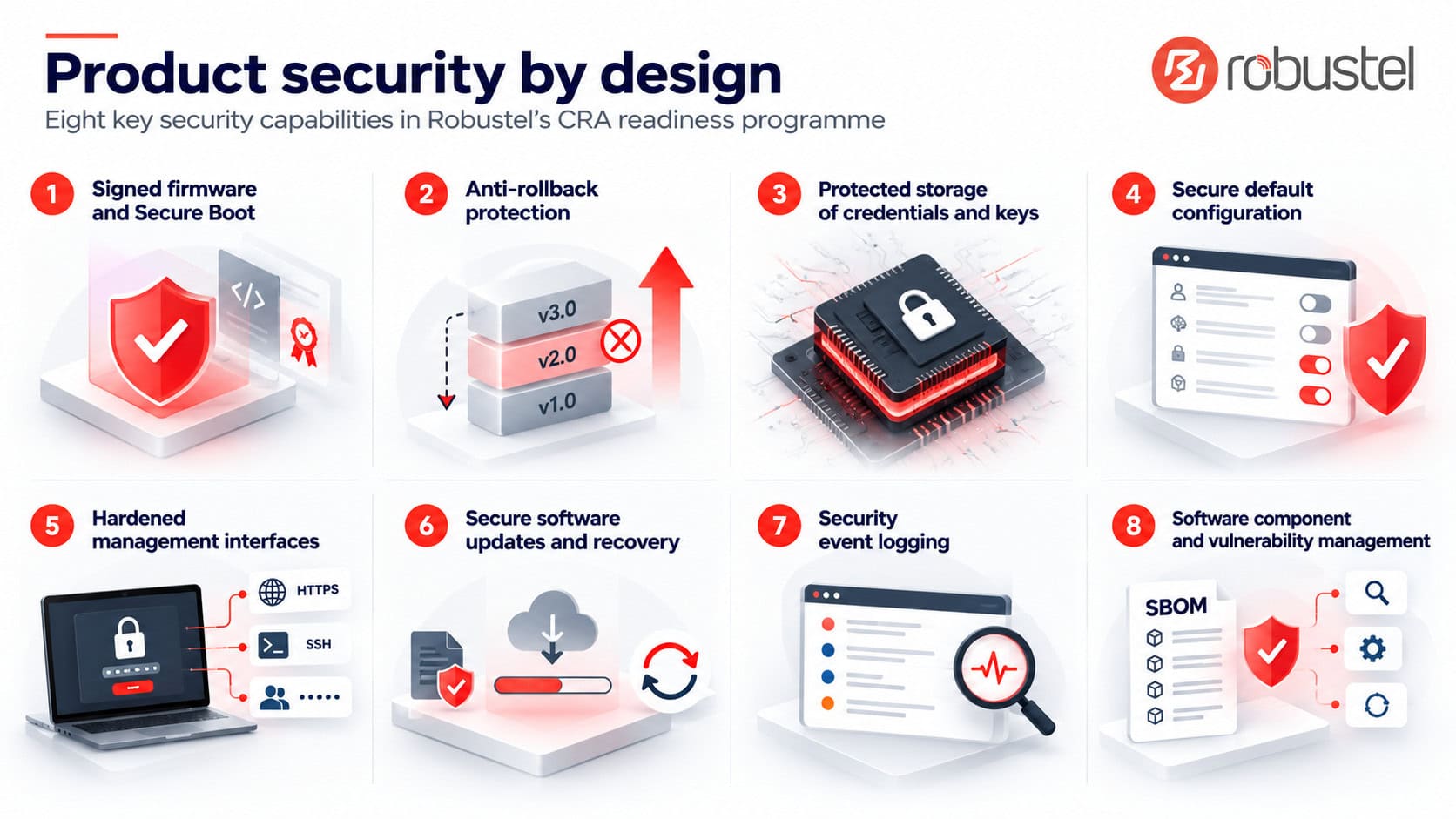
The current Robustel roadmap defines a common software-security baseline for the planned CRA delivery builds. Existing hardware platforms are expected to support these builds without a general hardware redesign, although the implementation and validation method varies by product architecture.
The planned baseline includes:
- Signed firmware and Secure Boot: Software authenticity and integrity are verified against the applicable trust anchor, with unauthorised firmware images rejected before execution.
- Anti-rollback protection: The compliance builds are designed to prevent a device from being deliberately downgraded to software versions that are no longer permitted by the security baseline.
- Protected storage of credentials and keys: Sensitive credentials and cryptographic material are protected in storage, using hardware-backed protection where the platform supports it.
- Secure default configuration: Default product configuration is being hardened to reduce unnecessary exposure, including removal of default passwords and disabling services that are not required.
- Hardened management interfaces: Management access is designed around protected protocols such as Hypertext Transfer Protocol Secure (HTTPS) and Secure Shell (SSH), together with role-based permissions and session-security controls.
- Secure software updates and recovery: Update packages are verified before installation, with the planned process including controlled installation and recovery behaviour if an update fails or is interrupted.
- Security event logging: Relevant security events are recorded and made available for review and export to support investigation and operational monitoring.
- Software component and vulnerability management: Machine-readable component inventories are combined with Robustel’s Product Security Incident Response Team (PSIRT) processes and security advisories to support identification, assessment and remediation of vulnerabilities.
These capabilities form the current engineering baseline. The roadmap itself notes that the requirements definition is based on an initial IEC 62443-4-2 benchmark and may be refined as the standards applied under the CRA become more clearly defined.
Trust anchors and software integrity
The method used to establish trust in authorised software varies between Robustel platforms.
Under the current roadmap, most R-series products use a software trust anchor, while products including the EG and MG series, EV8100, R1520LG, LG3120e, LG5120 and R5030 use a hardware chipset trust anchor. In either case, the objective is the same: establish a verifiable chain of trust so that authorised software can be validated and altered or unauthorised images can be rejected.
Validation is not limited to confirming that a legitimate firmware image installs successfully. Robustel’s product-security testing also considers rejection of tampered images, rollback behaviour, interrupted upgrades, recovery and the effect of security changes on customer applications and normal product operation.
Identity, access and network protection
Product-security requirements also address how devices and management services are accessed after deployment. Robustel’s engineering requirements include secure default settings, strong authentication, least privilege, session protection and protection of credentials and keys throughout storage, transmission, updates and device handover.
Network and remote-management validation examines exposed services, protected management connections, access controls, protocol configuration, remote-management privileges and malformed inputs. The objective is to reduce unnecessary attack surface without disrupting the industrial communications and operational functions for which the product is deployed.
For Robustel Cloud Manager Service (RCMS), security controls are assessed against the service and deployment boundaries of RCMS Cloud and RCMS Stack separately, including identity and permissions, protected communications, device identity, update management and customer account administration.
Component security and supply-chain transparency
CRA readiness also depends on understanding the software and hardware components incorporated into a product.
Robustel manages open-source components, third-party software and supplier firmware as part of its component inventory. A Software Bill of Materials (SBOM) is used to correlate known vulnerabilities with the relevant product version and determine whether a component-level issue creates an actual product-level exposure. For components maintained by external suppliers, Robustel coordinates with the supplier to obtain analysis, patches or mitigations and then assesses the impact on the complete product.
The CRA programme is also developing Hardware Bill of Materials (HBOM) evidence and uses component and supplier monitoring as part of the wider security-management process. This allows security assessments to remain tied to the hardware, software and component configuration actually being supplied rather than to a generic product-family description.
Vulnerability Management and Lifecycle Support
Robustel’s vulnerability-management process is already operational and forms part of the wider cybersecurity lifecycle supporting our Cyber Resilience Act (CRA) programme. Potential issues may be reported by customers and security researchers or identified through internal testing, independent security assessments, supplier notifications and ongoing vulnerability monitoring.
Richtlinie zur Offenlegung von Sicherheitslücken (VDP)
Robustel verpflichtet sich zur Sicherheit und Ausfallsicherheit seiner Produkte und Dienstleistungen. Unsere Richtlinie zur Offenlegung von Sicherheitslücken (VDP) fordert Forscher, Kunden und Partner dazu auf, Probleme verantwortungsbewusst zu melden, damit wir Risiken schnell mindern können. Die folgende Richtlinie erläutert, wie potenzielle Sicherheitslücken gemeldet werden und wie wir darauf reagieren.
Umfang
Dieses VDP gilt für alle offiziell veröffentlichten Robustel-Produkte, Firmware und Dienste sowie für Webanwendungen, die unter unseren offiziellen Domains gehostet werden. Es gilt nicht für Dienste von Drittanbietern, die außerhalb unserer Kontrolle liegen, Social-Engineering-Versuche gegen unsere Mitarbeiter, Partner oder Kunden oder physische Angriffe auf Eigentum oder Einrichtungen.
Eine Schwachstelle melden
Wenn Sie ein potenzielles Sicherheitsproblem entdecken, verwenden Sie bitte unser Sicherheitsmeldeformular. Geben Sie den Namen und die Version des Produkts oder der Dienstleistung an, beschreiben Sie das Problem klar und deutlich und fügen Sie, falls verfügbar, einen Proof-of-Concept oder reproduzierbare Schritte hinzu. Bitte vermeiden Sie die Weitergabe von Live-Kundendaten; redigierte Protokolle und Screenshots sind vorzuziehen.
Freiwillige Offenlegung und Entschädigung
Alle im Rahmen dieses VDP eingereichten Schwachstellenberichte werden freiwillig und ohne Erwartung einer Zahlung, Entschädigung oder Erstattung bereitgestellt. Mit der Einreichung eines Berichts erklären Sie sich damit einverstanden, keine Form der Entschädigung oder Vergütung im Zusammenhang mit der Offenlegung, Untersuchung, Behebung oder Veröffentlichung des Problems zu verlangen oder zu verfolgen, es sei denn, Robustel hat einer solchen Entschädigung zuvor ausdrücklich schriftlich zugestimmt.
Robustel-Sicherheitslücke „
“ – Reaktionsprozess
Submit vulnerabilities via the form. We will review, confirm and assign an ID.
Vulnerability Assessment and Remediation Targets
|
Severity |
Assessment criteria |
Assessment target |
Remediation target |
|---|---|---|---|
|
Critical |
A vulnerability with the potential to cause severe impact to confidentiality, integrity, availability, safety, privileged access, or control of critical services, with a credible path to exploitation. This may include widespread compromise, unauthorised administrative control, significant data exposure or serious safety consequences. |
Within 3 days |
Within 14 days |
|
Hoch |
A vulnerability with significant security impact, where exploitation is constrained by specific prerequisites such as access level, configuration, user interaction, network position, or a more limited affected scope. |
Within 5 days |
Within 30 days |
|
Medium |
A vulnerability with moderate, manageable security impact that generally depends on specific privileges, configurations, access conditions or deployment environments. Remediation remains necessary but can be prioritised according to risk. |
Set at intake |
Within 90 days |
|
Niedrig |
A vulnerability with limited security impact, restrictive exploitation conditions or minimal affected scope. Treatment may be scheduled through planned maintenance or a future update, with the rationale documented. |
Set at intake |
Within 90 days |
About these targets: These severity levels are used to guide Robustel’s vulnerability assessment and remediation priorities. Severity is determined by considering technical impact, exploitability, exposure, affected scope and relevant deployment context. These targets support Robustel’s vulnerability handling process but do not replace applicable regulatory reporting obligations.
CRA Article 14 reporting and user protection
Robustel’s CRA Article 14 reporting arrangements have been operational since 11 September 2026. The Product Security Incident Response Team (PSIRT) assesses reported and identified security issues to determine their actual product impact and whether available evidence meets the CRA criteria for an actively exploited vulnerability or a severe incident affecting the security of a product with digital elements.
These regulatory thresholds are distinct from ordinary vulnerability severity. A vulnerability can be technically serious, publicly disclosed or assigned a high Common Vulnerability Scoring System (CVSS) score without evidence that it is being actively exploited. Conversely, reliable evidence of malicious exploitation can trigger Article 14 reporting even where customer-visible consequences such as downtime or data loss have not yet occurred.
Article 14 also applies to products within the CRA’s scope that were placed on the European Union market before the Regulation’s main product requirements apply on 11 December 2027. Robustel therefore operates Article 14 reporting as part of its current security-response process rather than treating it as a future compliance activity.
Detailed reporting thresholds, statutory timelines, escalation arrangements and affected-user communication are covered in our dedicated statement.
Security advisories and customer communication
Where a vulnerability affects a Robustel product, security advisories are used to identify the relevant product and software scope, explain the assessed risk and describe the remediation or mitigation available to customers.
Depending on the circumstances, an advisory may include a software update, configuration change, temporary mitigation or other operational guidance. Where action is required before a permanent fix is available, Robustel may provide interim protections and update the advisory as further technical information becomes available.
Customers should match each advisory against the exact product model and software version in their deployment rather than assuming that a vulnerability associated with a shared component affects every Robustel product in the same way.
Security updates and lifecycle support
The CRA makes vulnerability handling an ongoing lifecycle responsibility. Under Article 13, manufacturers must determine a support period that reflects how long the product is reasonably expected to remain in use. The support period is generally required to be at least five years, except where the expected product lifetime is shorter.
For active Robustel product lines placed on the European Union market, the current programme commits to at least five years of critical security patch support from the final placement of that product line on the EU market. The applicable support scope and lifecycle are defined by product line, and a longer support period may apply where required by the product’s declared lifecycle.
Importantly, end of sale does not mean end of security support. Where a product is withdrawn from future sale, applicable vulnerability handling, security maintenance and customer communication continue throughout its declared support period.
Existing deployments and the 2027 transition
Products with digital elements placed on the European Union market before 11 December 2027 do not automatically become subject to all of the CRA’s main product requirements simply because that date is reached. Under the CRA’s transitional provisions, those products generally become subject to the main requirements if they undergo a substantial modification after that date. Article 14 reporting remains an exception and already applies to products within scope placed on the market before full application.
For customers, this means there is no blanket requirement to replace an existing Robustel fleet solely because the CRA enters full application.
Security and software upgrades should instead be planned according to:
- the exact product model and software version;
- applicable security advisories and known vulnerabilities;
- the product’s support status;
- compatibility with applications, protocols and site configuration;
- operational risk and maintenance windows; and
- whether a proposed change could affect the product’s assessed cybersecurity configuration.
Where a CRA readiness software branch is available, Robustel recommends validating it on a representative pilot group before wider fleet deployment.
Managing updates across deployed fleets
For customers managing distributed Robustel devices, Robustel Cloud Manager Service (RCMS) can support staged firmware, application and configuration deployment across device groups. Updates can be validated on a limited group first, scheduled around maintenance windows and then expanded across the intended fleet while deployment status and errors are monitored centrally.
This staged approach helps customers maintain operational control while introducing security updates or moving deployed devices toward newer security baselines.
Standards, Certification and Independent Assurance
Cybersecurity assurance is most useful when each piece of evidence is tied to a clearly defined scope. A development-process certificate, a penetration test, a product security assessment and a European Union Declaration of Conformity (EU DoC) answer different questions and should not be treated as interchangeable evidence.
Robustel therefore uses several layers of assurance across its Cyber Resilience Act (CRA) programme: certified organisational and development processes, product-security engineering requirements, independent testing, existing product and sector cybersecurity conformity evidence, and formal CRA assessment documentation as it becomes available.
| Assurance | What it demonstrates | Relevant scope |
|---|---|---|
| ISO/IEC 27001 | Information security management controls and governance | The organisation and activities covered by the applicable certificate |
| IEC 62443-4-1:2018 Maturity Level 2 | A defined and independently assessed secure product-development lifecycle | Robustel Cyber Security Development Process V1.0 |
| IEC 62443-4-2 Security Level 2 (SL2) | Technical security requirements used for product gap analysis, implementation and validation | Applied as an engineering benchmark within the CRA programme; product evidence must be checked against the specific model and version |
| Independent penetration testing | External examination of platform and software security | The tested software version, product configuration and assessment scope |
| Radio Equipment Directive (RED) / EN 18031 | Existing European cybersecurity conformity evidence for applicable radio equipment | Only the product series, standard parts and configurations identified in the applicable conformity documentation |
| Maritime cybersecurity approvals | Independent evidence against specialist maritime cybersecurity and networking requirements | Only the approved maritime products and operating conditions |
| CRA conformity evidence | Formal evidence supporting placement of the applicable product on the European Union market under the CRA | The exact product, configuration, software version and assessment scope identified in the final documentation |
Certified secure development process
Robustel’s Cyber Security Development Process V1.0 is certified to IEC 62443-4-1:2018 at Maturity Level 2 under the International Electrotechnical Commission System of Conformity Assessment Schemes for Electrotechnical Equipment and Components (IECEE).
The certificate covers security management, specification of security requirements, security by design, secure implementation, security verification and validation testing, management of security-related issues, security update management and security guidance.
This is a process capability certification. It demonstrates that Robustel operates an independently assessed secure-development lifecycle; it should not be interpreted as product-level CRA conformity or as an IEC 62443-4-2 certification covering the entire Robustel portfolio.
IEC 62443-4-2 as a product-security engineering benchmark
While IEC 62443-4-1 addresses the process used to develop and maintain secure products, IEC 62443-4-2 addresses technical security requirements for industrial components.
Robustel currently uses IEC 62443-4-2 Security Level 2 (SL2) requirements as an engineering reference for CRA product gap analysis, remediation and validation. Product capabilities are assessed against the applicable hardware, software branch and use case rather than assuming that a single generic security profile applies across the whole portfolio.
This distinction is important. Use of IEC 62443-4-2 SL2 as an engineering benchmark does not, by itself, mean that every Robustel product is IEC 62443-4-2 certified. Any product-specific certification or assessment evidence should be checked against the exact model, software version and certification scope.
Independent penetration testing
Robustel commissions recurring independent security assessments across the operating systems and cloud services supporting its industrial Internet of Things (IoT) portfolio. Current public assessment summaries include RobustOS, RobustOS Pro and Robustel Cloud Manager Service (RCMS) Cloud
Testing is tailored to the platform and can include authenticated operating-system review, web application security testing, automated scanning, manual verification, configuration analysis and security-hardening assessment. Detailed reports retain the relevant software version, configuration, methodology and findings so that customers can determine whether the evidence is applicable to their own deployment.
Independent penetration testing supplements Robustel’s internal verification and CRA conformity work, but it is not itself a CRA certificate or declaration of conformity.
Public assessment summaries are available through the Security Centre. Detailed reports, including supporting technical evidence and methodology, can be provided to qualified customers, partners and security assessors under appropriate confidentiality arrangements.
Existing European and sector-specific cybersecurity assurance
CRA readiness does not begin from a blank sheet. Applicable Robustel products already operate within other cybersecurity and sector-assurance frameworks, although each has a separate legal and technical scope.
For relevant radio equipment, EN 18031 provides cybersecurity conformity evidence under the European Union Radio Equipment Directive (RED). Robustel also maintains specialist maritime cybersecurity and networking approvals for applicable products, including evidence associated with IEC 61162-460. These approvals can provide useful supporting assurance, but neither should be presented as a substitute for CRA conformity assessment.
The applicable certificate, standard parts, product model and software or hardware scope should always be checked before relying on an existing approval for a procurement or security review.
CRA conformity evidence
Formal CRA conformity will ultimately be demonstrated at product level, not by a corporate statement that Robustel as a whole is “CRA certified”.
Under the current programme, Robustel is preparing the product-specific assessment results and supporting documentation required for the planned European Union product scope. The programme target is 30 October 2027 for the applicable certificates, European Union Declarations of Conformity (EU DoCs), CE marking and supporting technical documentation to be available for the relevant products.
The final conformity position for any product should therefore be confirmed against:
- the exact product model and hardware configuration;
- the applicable software branch and release;
- the product’s CRA classification and conformity-assessment route;
- the assessment or certificate scope where applicable;
- the European Union Declaration of Conformity;
- the relevant technical and security documentation; and
- the support and lifecycle information applicable to that release.
What evidence is available now?
Customers do not need to wait until 2027 to begin a supplier-security or CRA-readiness review.
| Review purpose | Evidence currently available | Evidence added as the CRA programme progresses |
|---|---|---|
| Supplier security review | ISO/IEC 27001 information, IEC 62443-4-1 certificate, Article 14 statement and Vulnerability Disclosure Policy | Updated governance and programme evidence |
| Technical security review | Independent assessment summaries, detailed penetration-test reports under confidentiality arrangements, applicable security guides, advisories and component information | Product-specific CRA validation and assessment evidence |
| Supply-chain review | Software Bill of Materials (SBOM) and related product information for applicable versions and agreed scope | Expanded Hardware Bill of Materials (HBOM), component and final conformity evidence |
| CRA product-delivery review | Current product classification, roadmap and planned software branch | Applicable assessment results, certificates, EU DoC, CE marking and final delivery documentation |
Robustel can work with customers, system integrators, channel partners and Original Equipment Manufacturer / Original Design Manufacturer (OEM / ODM) partners to identify which evidence is relevant to the specific product, software version and purpose of the review.
CRA FAQ: Practical Questions for Robustel Customers
The Cyber Resilience Act will change some familiar behaviours around device configuration, software updates and security management. The questions below address some of the practical issues customers are likely to encounter when planning for CRA-ready Robustel deployments.
Planning a CRA-ready Robustel deployment
Preparing for the Cyber Resilience Act does not require customers to redesign their entire estate at once. The practical starting point is to understand the products and software versions already deployed, identify the applicable CRA readiness path, and plan validation and upgrades around operational requirements.
For existing and planned deployments, Robustel recommends customers:
- confirm the exact product model, hardware configuration and software version in use;
- review the applicable CRA roadmap and planned compliance software branch;
- test preview or release software on a representative pilot group before wider deployment;
- review security advisories and lifecycle status as part of normal maintenance planning;
- maintain a current device and version inventory;
- identify a security contact for vulnerability and incident communication; and
- request the product-specific security and conformity evidence required for procurement, integration or internal assurance.
Robustel can support customers, system integrators, channel partners and Original Equipment Manufacturer / Original Design Manufacturer (OEM / ODM) partners with product mapping, security evidence, upgrade planning and CRA-related technical questions.
Need help with a specific product or deployment?
If you need to confirm the CRA status of a Robustel product, understand which software version is planned for compliance, request security documentation or discuss an existing deployment, contact our team.