
5G Router for Public Transport: Wi-Fi 6, GNSS and Vehicle Certification Guide
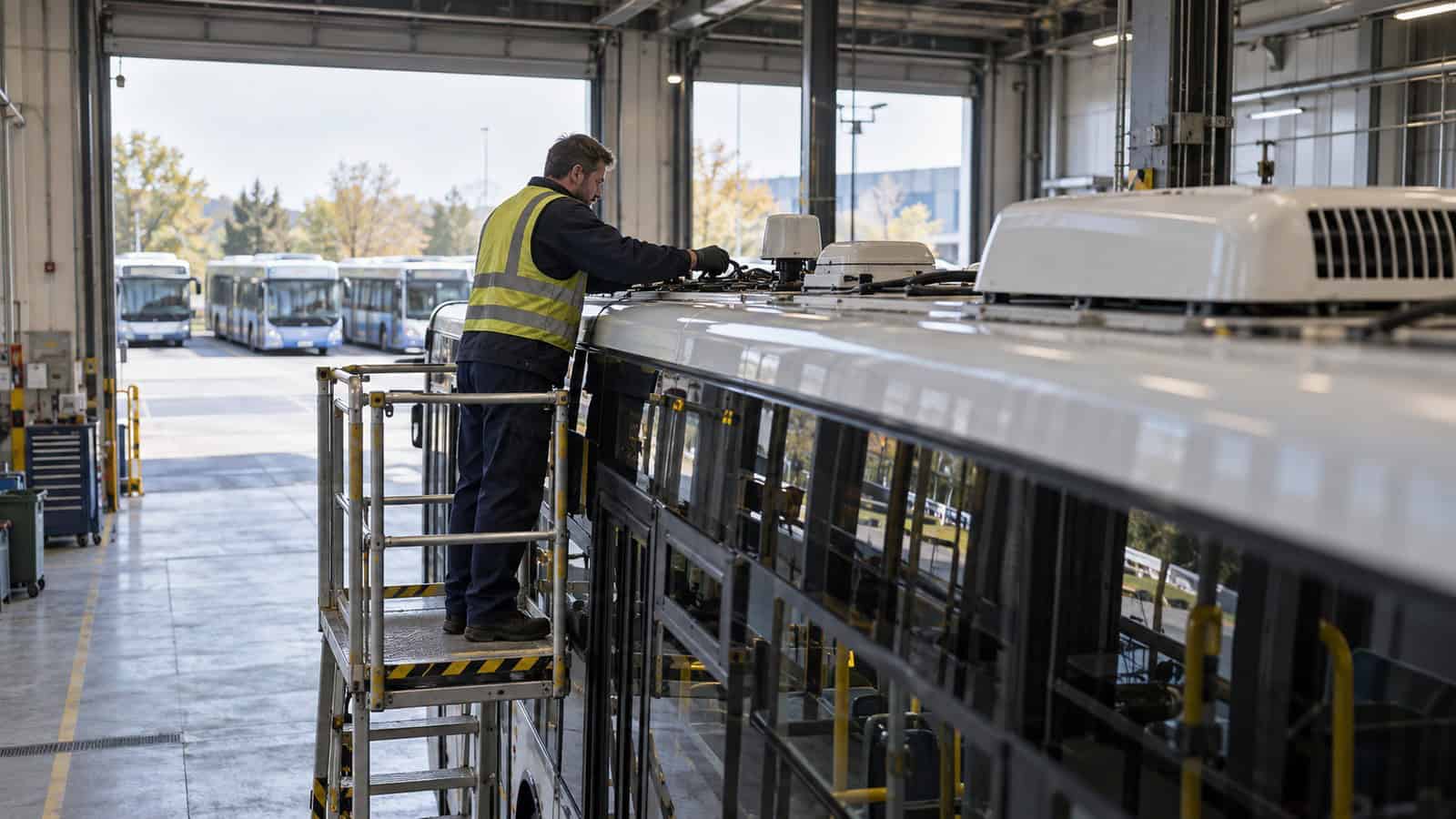
The Robustel R5030 Industrial 5G Router brings 5G, dual-band Wi-Fi 6, GNSS and five Gigabit Ethernet ports into a platform aimed at connected vehicles and edge sites. Those capabilities make it a relevant public-transport candidate, but the selection still has to separate three radio systems—cellular, passenger Wi-Fi and GNSS—and then verify the exact vehicle variant and approval status. A router that performs well on a desk can fail in service if antennas, ignition power and certification are treated as accessories.
Passenger connectivity is only one workload. Ticketing, CCTV, vehicle telemetry, driver systems and remote diagnostics may share the same gateway, and their priorities are not equal. The design should keep operational services working even when passenger demand is high or the vehicle crosses an area with poor cellular service.
Treat the Vehicle as Three RF Installations
The cellular antennas need separation, appropriate ground-plane conditions and cable routes that preserve the modem’s intended MIMO performance. Wi-Fi antennas must cover the passenger space without creating unnecessary leakage outside it. The GNSS antenna needs a usable sky view. Placing all antennas in one convenient corner can compromise all three systems.
Survey a representative vehicle, not just the depot. Window coatings, metal bodywork, roof equipment and cab partitions affect RF behaviour. Record routes through tunnels, cuttings and terminal buildings. No router can guarantee continuous 5G; the service must remain controlled when it falls back or briefly loses coverage.
Wi-Fi 6 Capacity Starts With the Service Policy
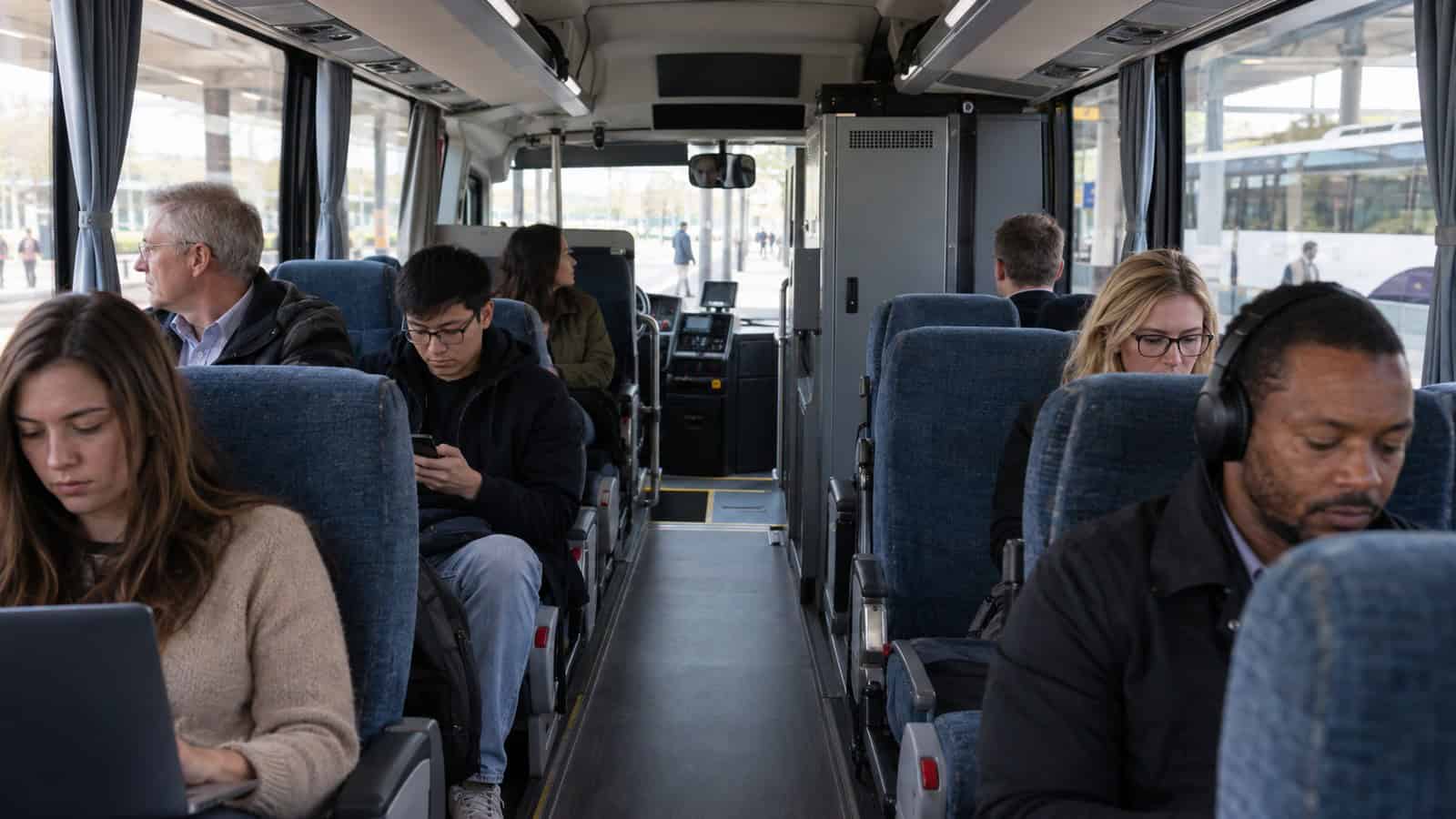
Wi-Fi 6 can improve spectrum use in dense client environments, but it does not create unlimited cellular backhaul. Define the passenger experience first: acceptable browsing, content restrictions, per-client limits, session duration and captive-portal policy. Then reserve bandwidth and network priority for operational systems.
Measure simultaneous users and traffic during the busiest part of a route. A stationary depot test misses roaming clients, interference from other vehicles and changing backhaul. Also verify what happens when the WAN disappears: does the portal fail cleanly, are onboard systems still reachable, and does the return of service create a large synchronisation burst?
Robustel’s 5G-powered passenger Wi-Fi application example is useful for understanding the service layers around onboard access. It uses the R5020 rather than the R5030, so it is an architecture reference rather than proof for a particular R5030 order code or a measured passenger count. Capacity must be tested with the intended firmware, antennas and policy.
GNSS Is an Input, Not a Fleet Application
An integrated GNSS interface can provide positioning data, but buyers should define how that information is consumed, timestamped and compared with the vehicle’s existing AVL system. Check antenna location, update requirements and the behaviour when no fix is available.
Do not assume that a GNSS-capable router replaces every existing location function. A transport platform may have regulatory, scheduling or safety requirements beyond the router’s documented output. Decide which system remains the system of record and how conflicts will be handled.
Vehicle Certification Must Match the Ordered Variant
Product families often contain multiple regional and functional variants. Bands, package contents, GNSS, ignition sensing and approvals can differ. Procurement should obtain the exact ordering information and current certification record for the market and vehicle programme.
Where a certification is marked as in progress, treat it as unavailable until the manufacturer provides the completed evidence required by the project. Do not infer an approval from another Robustel model or from the family description. RCM, CE, E-Mark and carrier approvals address different requirements and are not interchangeable.
The Always-On 5G Connectivity for Emergency Services and Public Safety Vehicles application example by Robustel uses the R5020, which demonstrates the operational importance of dual-SIM design, onboard segmentation and central fleet support. That distinction is exactly the kind of evidence discipline a vehicle programme needs.
Design Ignition and Power Behaviour Before Installation
A vehicle router must not flatten the starter battery while parked, and it must not corrupt state during repeated power transitions. Define when the device should remain awake, how long graceful shutdown is allowed, and which services must be available during layovers.
Test cold start, engine cranking, ignition removal and rapid restart with the actual vehicle supply and any converters. Include the Wi-Fi load and Ethernet peripherals because their startup behaviour can change the current profile. The router’s input range is necessary evidence, but it does not replace a vehicle power transient design.
How the Robustel R5030 Industrial 5G Router Fits Public Transport
The Robustel R5030 Industrial 5G Router documents dual-SIM cellular connectivity, five Gigabit Ethernet ports, Wi-Fi 6 in access-point or client mode, GNSS, captive-portal support and RCMS management. That mix suits a vehicle that must connect several onboard systems while also serving a managed passenger WLAN.
Its best-fit role should remain explicit. If the project does not need Wi-Fi 6 and prioritises a variant with established vehicle approval and ignition sensing, the R5020 family may be a better internal comparison. If the router only hands 5G to a separate onboard network, an R5010-style focused handoff may avoid unused functions. The answer follows the onboard architecture, not the newest radio label.
Use Robustel RCMS platform for fleet-level router visibility, configuration and updates, then integrate incidents with the transport operator’s service desk. RCMS visibility does not prove that a camera, ticket validator or passenger portal is healthy; those systems need their own monitoring.
Validate on a Route, Not Only in a Depot
Create a test route that includes known coverage transitions, busy passenger periods and depot entry. Record 5G/LTE changes, cellular loss, Wi-Fi client load, VPN recovery, GNSS continuity and the effect on each onboard service. Repeat on more than one vehicle to expose antenna and installation variation.
The Robustel R5020 product video shows a related Robustel vehicle-capable 5G platform and can help teams compare architectural roles. It should not be used as R5030 variant evidence; the R5030 datasheet and ordering information control that decision.
FAQs
Q1. Can you take a 5G router anywhere?
You can move a router between sites or vehicles, but service depends on local bands, operator coverage, SIM acceptance, antennas, power and regional approvals. A successful route in one city does not certify another deployment.
Q2. Is there a 5G portable router?
Yes, but public transport normally needs an installed industrial platform with controlled power, external antennas, secure management and appropriate vehicle evidence. A portable hotspot is a different operating model.
Q3. Will a 5G router work in a 4G area?
Many industrial 5G routers support LTE fallback, including documented Robustel models, but the exact bands and operator service must match. Test how applications behave during fallback instead of assuming the transition is invisible.
Q4. Can a 5G router replace my home Internet?
It can where service is suitable, but a vehicle design is more demanding: it moves between cells, carries multiple priority classes and must handle automotive power and approvals. Home-broadband experience is not adequate transport evidence.
Q5. When is the Robustel R5030 Industrial 5G Router a good public-transport fit?
It is a good candidate when a vehicle needs managed 5G, Wi-Fi 6 passenger access, GNSS and several Gigabit Ethernet connections in one platform. Confirm the exact regional order code, certification status, antenna plan and route performance before fleet approval.
Conclusion
The Robustel R5030 Industrial 5G Router aligns well with public transport that genuinely needs Wi-Fi 6, GNSS and a multi-port onboard edge. Its specification becomes operational value only after the three RF systems, traffic priorities and vehicle power states are engineered together.
Keep certification at order-code level and keep performance claims at route-test level. That discipline produces a network the transport team can support: passenger demand is contained, operational traffic is protected, vehicle states are understood and no approval is borrowed from a different model.
Explore More Articles About Robustel 5G Routers
About the Author
Robert Liao | Technical Support Engineer
Robert is an IoT Technical Support Engineer at Robustel, specializing in industrial networking and edge connectivity. A certified Networking Engineer, Robert focuses on the deployment and troubleshooting of large-scale IIoT infrastructures. His work centers on architecting reliable, scalable system performance for complex industrial applications, bridging the gap between field hardware and cloud-side data management.