
LoRa Basics Station vs UDP Packet Forwarder: TLS, Operations and Migration Trade-Offs
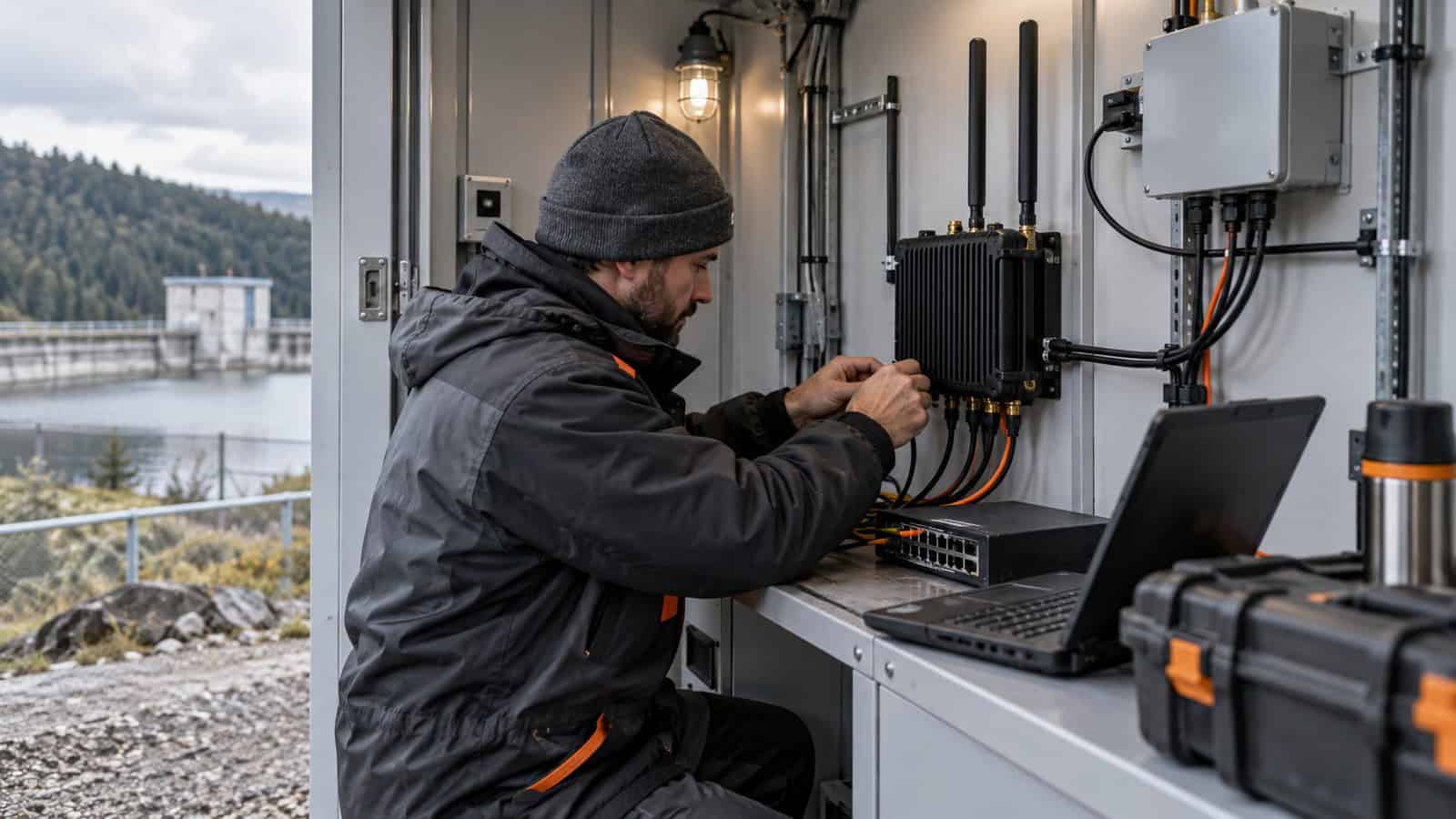
The Robustel R1520LG LoRaWAN Gateway supports both UDP and LoRa Basics Station among its external connectivity options, so it can sit on either side of a migration decision without changing the physical gateway role. The protocol change still affects credentials, configuration ownership, monitoring and rollback; it should be treated as an operations project rather than a checkbox.
Two Forwarders, Two Operating Models
The protocol comparison becomes useful only when it changes an operating decision. For an implementation team, that means tracing credential ownership, connection establishment, monitoring and rollback. A migration that changes all four at once may be technically valid, yet difficult to support when the first remote site fails to reconnect.
Traditional UDP packet forwarding uses a simple packet-forwarder path between gateway and server. Its operational appeal is familiarity and low complexity, but security and identity commonly depend on surrounding network controls. LoRa Basics Station uses secure web protocols and is designed to support authenticated, encrypted gateway-to-server operation with centralised channel-plan management.
| Decision area | UDP packet forwarder | LoRa Basics Station |
|---|---|---|
| Transport | UDP-based forwarding | Secure web-protocol architecture |
| Gateway identity | Often handled by server records and surrounding controls | Credential-based authenticated connection |
| Radio configuration | Commonly managed per gateway or deployment tooling | Can be supplied centrally through the server architecture |
| Migration burden | Existing and familiar in many estates | New certificates, endpoints, monitoring and rollback process |
The stronger architecture is the one the operations team can provision, monitor and recover correctly. A nominally secure protocol with unmanaged credentials is not a completed security design.
Credentials Decide Who Can Recover the Link
List who creates, distributes, stores, rotates and revokes gateway credentials. Decide how a replacement gateway receives them and whether an expired credential can be distinguished from a backhaul failure. Preserve time synchronisation and certificate validity checks in the commissioning record.
The Robustel’s Private LoRaWAN for Smart Farm Sensors with the R1520LG Application Example illustrates the full path from sensor to gateway, LNS and application. Use that path to identify where the protocol transition ends; the example does not prove the security or capacity of a specific server.
Treat Migration as a Reversible Operating Change
Choose representative gateways across regions, backhaul types and RF conditions. Capture a UDP baseline, configure the new server path, then compare join, uplink, downlink, timestamp and alarm behaviour. Do not change antennas, frequency plans and forwarding protocol in the same maintenance window.
| Migration gate | Evidence required |
|---|---|
| Connection | Authenticated gateway session survives restart and WAN recovery |
| Radio plan | Correct regional channel plan is active |
| Data path | Representative devices join and exchange expected traffic |
| Operations | Alarm identifies credential, server and backhaul failures separately |
| Rollback | Gateway returns to the approved former path without losing ownership records |
The Robustel’s Cibicom nationwide LoRaWAN backhaul case study demonstrates why gateway backhaul is an operational layer in its own right. A forwarding migration must therefore include carrier and IP-path failures, not only a clean laboratory server connection.
Staging the Cutover on a Robustel R1520LG LoRaWAN Gateway
Robustel R1520LG LoRaWAN gateway documents UDP, LoRa Basics Station and LORIOT as external connectivity options, alongside an embedded ChirpStack option. It also provides cellular, Ethernet and Wi-Fi backhaul, dual SIM and RCMS management. Those choices allow a project to keep the gateway hardware stable while testing a different server boundary.
The benefit is controlled comparison, not automatic compatibility with every LNS. Confirm the exact server endpoint, credentials and regional plan. Keep the former configuration available only under an approved rollback process, because two simultaneously active paths can complicate duplicate handling and fault diagnosis.
The Robuste’s R1520LG setup video is best used to orient the commissioning team before the controlled run. The current software manual and target LNS documentation remain the configuration authority.
The New Path Still Needs an Owner
Monitor connection state, credential expiry, server reachability, clock condition, backhaul use and gateway restarts. Define an alarm that tells the operator which layer failed; “gateway offline” is too broad when the radio can still receive packets.
Keep the first cutover small enough that the same team can investigate every exception. Expansion begins when the incident process is repeatable, not when one gateway remains connected overnight.
FAQs
Q1. What is LoRa Basics Station?
LoRa Basics Station is gateway software and protocol architecture for connecting a LoRaWAN gateway to a network server using secure web technologies and managed radio configuration. Deployment still requires correct credentials, endpoints and regional settings.
Q2. Is the LoRa UDP packet forwarder secure?
The basic UDP transport does not provide the same authenticated TLS session model as LoRa Basics Station. Security therefore depends more heavily on network isolation, VPNs, server controls and disciplined gateway management.
Q3. Can a LoRaWAN gateway connect to any network server?
Only when the gateway and server share a supported forwarding protocol, configuration and regional plan. Credentials, endpoint format and server-specific requirements must also match.
Q4. Why migrate from UDP to LoRa Basics Station?
Common reasons include authenticated encrypted transport, centralised radio configuration and clearer gateway session management. The migration is worthwhile only when the operating team can manage credentials and recovery reliably.
Q5. How does the Robustel R1520LG LoRaWAN Gateway support a Basics Station migration?
It supports UDP and LoRa Basics Station external paths on the same gateway platform, allowing a staged comparison. Test the selected LNS, credentials, backhaul and rollback procedure before a fleet cutover.
Conclusion
The Robustel R1520LG LoRaWAN Gateway is a practical fit for projects that want to move from UDP forwarding to LoRa Basics Station without replacing the physical gateway as the first step. The migration still changes credential, connection and operating responsibilities.
Success is a cutover the owning team can observe, reverse and recover. Keep the old path available until the new one has survived loss of connectivity and a controlled credential failure.
Explore More Articles About Robustel LoRaWAN Gateways
About the Author
Robert Liao | Technical Support Engineer
Robert is an IoT Technical Support Engineer at Robustel, specializing in industrial networking and edge connectivity. A certified Networking Engineer, Robert focuses on the deployment and troubleshooting of large-scale IIoT infrastructures. His work centers on architecting reliable, scalable system performance for complex industrial applications, bridging the gap between field hardware and cloud-side data management.