
Industrial Edge Gateway Buyer’s Guide: 15 Requirements for 2026 Projects

The Robustel EG5120 edge computing gateway is a useful reference for industrial gateway selection because it combines compute, industrial interfaces, cellular connectivity, application hosting and fleet management, but a buyer should approve an edge gateway only after the workload and operating model are defined. CPU, RAM and interface count are evidence inputs, not the specification by themselves.
The 15 requirements below are grouped into five procurement gates so that compute, field integration, networking, physical installation and lifecycle operations are evaluated as different responsibilities rather than flattened into one long checklist.
Gate 1: Define the Local Workload
The first three requirements establish what the gateway must actually run.
- Define the application responsibility. Record whether the gateway will only bridge data, host custom software, run local rules, maintain a database or execute compatible inference.
- Calculate the production resource envelope. CPU average is not enough. Include memory peaks, container concurrency, data volume, storage retention and workload growth.
- Define local-data retention. State which records must be buffered, for how long and what happens when storage fills. “Gateway has eMMC” is not a retention policy.
Workload Procurement Gate
| Requirement | Evidence required | Robustel implication |
|---|---|---|
| Local application role | Named services/containers and owners | Determines whether EG5101-class or higher compute is required |
| Compute envelope | CPU, memory, concurrency, input volume | Size Robustel EG model from production workload |
| Storage | Application footprint + retention calculation | EG5120 has more eMMC than EG5200, but storage needs still require sizing |
A lightweight serial-collection site and an edge-vision site should not enter procurement with the same compute specification.
Gate 2: Map the Southbound Equipment
Requirements four to six concern the equipment below the gateway.
- Inventory every physical interface. Ethernet, RS-232, RS-485, RS-422, CAN, digital and analog I/O should be mapped against real installed equipment.
- Verify protocol support separately from the port. An RS-485 connector does not establish support for every device connected to an RS-485 network. Confirm the actual software driver or application path.
- Calculate bus and polling load. A serial interface that works with one meter or controller may become a bottleneck when more devices are added, especially if polling intervals are short, register maps are large or multiple software services share the same gateway resources.
For brownfield projects, the existing PLC, controller or field device will often remain in place while the edge gateway adds a separate data-integration layer. That architecture is only valid when the equipment exposes an interface and protocol that the gateway can actually use. Physical connectivity should therefore be treated as the first compatibility check, not the final one.
A practical procurement record should capture three things for every southbound asset: physical interface, protocol/software path and expected traffic load. If any one of those remains undefined, the gateway fit has not yet been proven.
Gate 3: Design the Northbound Network
Requirements seven to nine define how information leaves the site.
- Decide whether cellular, Ethernet or both are required. WAN architecture should follow the real site rather than a desire to maximize interfaces.
- Define security ownership. VPN support is only one tool. Firewall rules, credentials, certificates, reachable subnets and remote-access ownership must also be specified.
- Test outage and recovery behaviour. If local applications must continue when WAN access disappears, document that behaviour and define how buffered data returns after connectivity recovers.
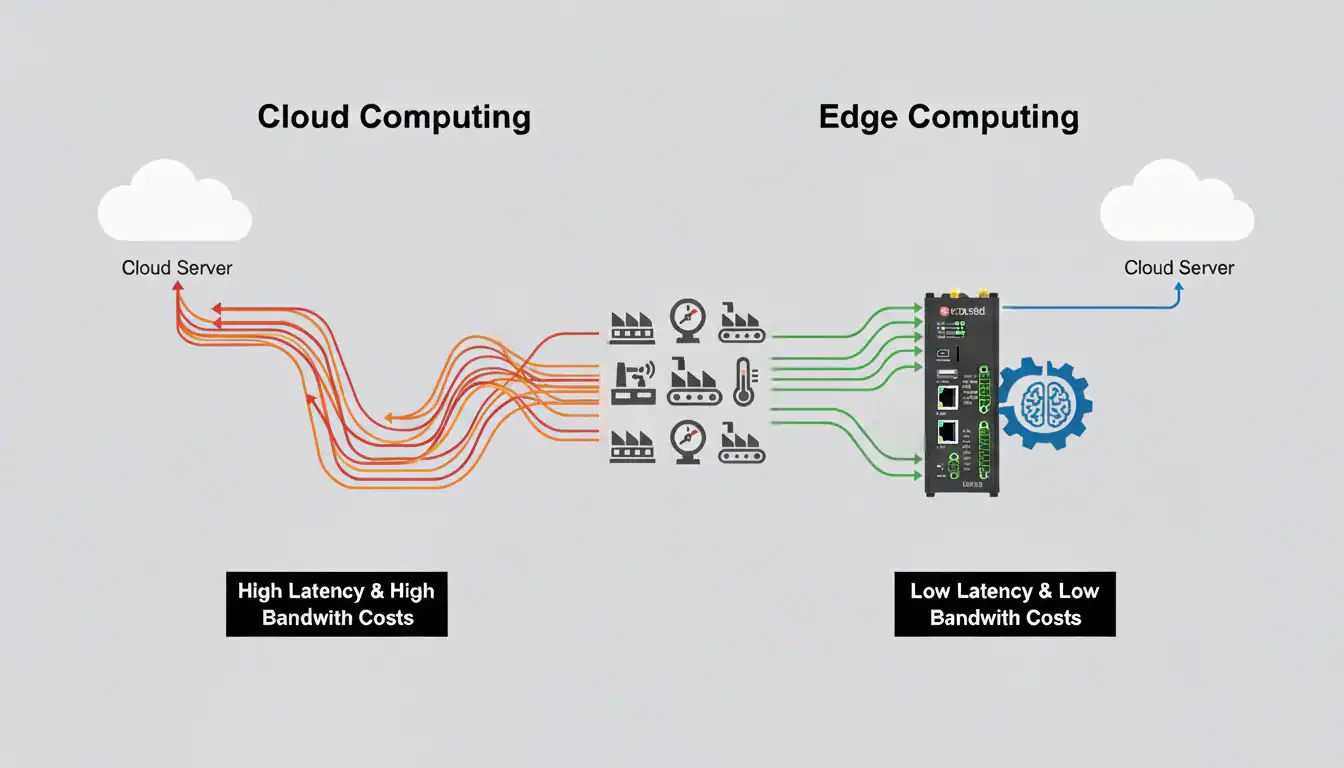
Robustel’s Smart Parking Application Example illustrates why these boundaries become important in distributed infrastructure. The example assigns different equipment classes to different networking roles rather than making one device responsible for cameras, meters, sensors, WAN access and application processing indiscriminately.
That is the procurement lesson: define ownership before counting features.
How the Robustel EG5120 Edge Computing Gateway Fits a Mixed Industrial Workload
The Robustel EG5120 edge computing gateway combines a quad-core 1.6 GHz Cortex-A53, 2 GB or 4 GB LPDDR4, 64 GB eMMC and a 2.3 TOPS NPU with two Gigabit Ethernet ports, configurable RS-232/RS-485 interfaces and DI/DO.
Those specifications make it a useful middle point in the EG portfolio for projects that need meaningful local compute without the five-Ethernet-port and peripheral-heavy architecture of EG5200.
Its NPU is relevant only where the project has a compatible and validated inference workload. Its 64 GB storage is relevant only when the planned applications and retention policy can make practical use of it. The product therefore belongs in a shortlist because its resources align with the workload—not because it scores highly on a generic feature table.
Robustel EG Portfolio Fit by Workload
| Requirement profile | More proportionate Robustel direction | Why |
|---|---|---|
| One serial network + lightweight preprocessing | EG5101 | Focused hardware and LTE Cat-1 |
| Lightweight mixed Ethernet/serial/I/O | EG5100 | More field interfaces without higher-compute platform |
| Serial-dense retrofit and eSIM requirement | EG3120e | Multi-serial/I/O architecture and eSIM |
| Compact higher-compute or edge-AI workload | EG5120 | Higher RAM/storage and 2.3 TOPS NPU |
| Several Ethernet devices/peripherals | EG5200 | Five Gigabit Ethernet, RS-422, HDMI/USB/relay |
There is no single ascending “better” path through the table. The site architecture determines which resources have value.
Gate 4: Qualify the Physical Deployment
Requirements ten to twelve concern the cabinet rather than the application.
- Verify power and environmental limits. Compare the exact model specification with the real DC supply, temperature and enclosure conditions.
- Check mounting and cable access. DIN-rail compatibility is useful only if antenna, Ethernet and serial cables can still be installed and maintained correctly.
- Include peripheral and driver requirements. USB devices, local displays or other peripherals may require Linux drivers, power and architecture support beyond the presence of a connector.
These checks are frequently postponed because they seem less interesting than compute. They are also among the easiest reasons for a technically correct proof of concept to require redesign at the real installation.
Gate 5: Treat Software Lifecycle as a Procurement Requirement
The final three requirements determine whether the hardware remains supportable.
- Define application deployment and rollback. How is the application packaged, started and restored if an update fails?
- Define fleet-management ownership. Who approves firmware or application changes, and how are exceptions identified?
- Define evidence for long-term support. Documentation, software release policy, diagnostics and replacement procedures belong in the hardware decision because edge hardware may remain deployed while its software environment changes repeatedly.
The Robustel RCMS platform supports centralized monitoring, configuration and update workflows for supported Robustel edge gateways. This becomes important once a fleet begins to diverge: one site may receive an emergency configuration, another may miss an update because it was offline, while a third may have an approved customer-specific application.
Fleet operations need to distinguish those approved differences from unknown drift.
15-Requirement Industrial Edge Gateway Procurement Matrix
| Gate | Requirement | Pass condition |
|---|---|---|
| Workload | 1. Application responsibility | Local functions are explicitly defined |
| Workload | 2. Compute envelope | Representative workload benchmark exists |
| Workload | 3. Storage | Retention/application footprint is calculated |
| Southbound | 4. Physical interfaces | Every required equipment connection is mapped |
| Southbound | 5. Protocol/software | Required integration has verified support |
| Southbound | 6. Field load | Polling/input rate has been tested |
| Northbound | 7. WAN architecture | Cellular/Ethernet roles are defined |
| Northbound | 8. Security | Access, VPN, firewall and ownership are documented |
| Northbound | 9. Recovery | WAN-loss and application-recovery behaviour is tested |
| 物理的 | 10. Power/environment | Exact Robustel model fits site conditions |
| 物理的 | 11. Mounting | Final cabinet/cabling layout is validated |
| 物理的 | 12. Peripherals | Driver and power compatibility is confirmed |
| Lifecycle | 13. Application updates | Upgrade and rollback process exists |
| Lifecycle | 14. Fleet operations | Responsible team and approved baseline are defined |
| Lifecycle | 15. Support evidence | Documentation and maintenance path are available |
The EG5120 Quick Start Guide is useful once the hardware has passed these earlier gates, because installation and setup are operational steps after architecture approval—not a substitute for the selection process itself.
Reject Requirements That Cannot Be Verified
Procurement documents often contain phrases such as: “supports all PLCs,” “future-proof,” “AI-ready,” or “zero downtime.” These are difficult to accept because they do not define a test.
A better requirement names the PLC interface and protocol, identifies the model/runtime expected on the NPU, defines the allowed recovery time after WAN loss, or specifies the forecast workload and expansion margin.
The stronger the requirement, the easier it is to reject unsuitable hardware before it becomes a field problem.
よくある質問
Q1. What should I look for in an industrial edge gateway?
Evaluate the local workload, field interfaces, supported protocols, WAN architecture, security, compute resources, storage, environmental fit and long-term application-management process. Hardware specifications are meaningful only when tied to these requirements.
Q2. How much RAM does an industrial edge gateway need?
It depends on the complete application stack. A lightweight protocol bridge may need far less memory than multiple containers, a local database or an inference runtime. Benchmark the intended production application and keep operating margin rather than selecting from a generic minimum.
Q3. Is Docker support important for an edge gateway?
It becomes useful when the project wants containerized applications and a controlled packaging model. Docker itself does not guarantee application compatibility, resource efficiency or reliable upgrades; those still need engineering and testing.
Q4. When is the Robustel EG5120 a good buying choice?
The Robustel EG5120 edge computing gateway is relevant where two Gigabit Ethernet ports, industrial serial connectivity, higher local compute, 64 GB eMMC or compatible NPU acceleration match the workload. Peripheral-dense sites may be better aligned with EG5200.
Q5. Should remote management influence edge-gateway procurement?
Yes, particularly for distributed fleets. Once applications and firmware evolve after deployment, operations need visibility into versions, configuration state, connectivity and exceptions. A gateway that works technically but cannot be maintained predictably can become an expensive lifecycle problem.
結論
The Robustel EG5120 edge computing gateway is a strong candidate for mixed industrial edge workloads, but it should pass the same 15 procurement requirements as any other device: workload fit, southbound integration, northbound architecture, physical deployment and lifecycle support.
The purpose of a buyer’s guide is not to identify the gateway with the most features. It is to eliminate architectures that cannot be verified and select the smallest platform that can operate the validated workload with sufficient technical and lifecycle margin.
Explore more articles about Robustel’s edge computing gateways in industrial IoT:


著者について
Robert Liao | Technical Support Engineer
Robert is an IoT Technical Support Engineer at Robustel, specializing in industrial networking and edge connectivity. A certified Networking Engineer, Robert focuses on the deployment and troubleshooting of large-scale IIoT infrastructures. His work centers on architecting reliable, scalable system performance for complex industrial applications, bridging the gap between field hardware and cloud-side data management.