
Edge Computing in Smart City Deployments: Managing Connectivity, Latency, and Distributed Infrastructure
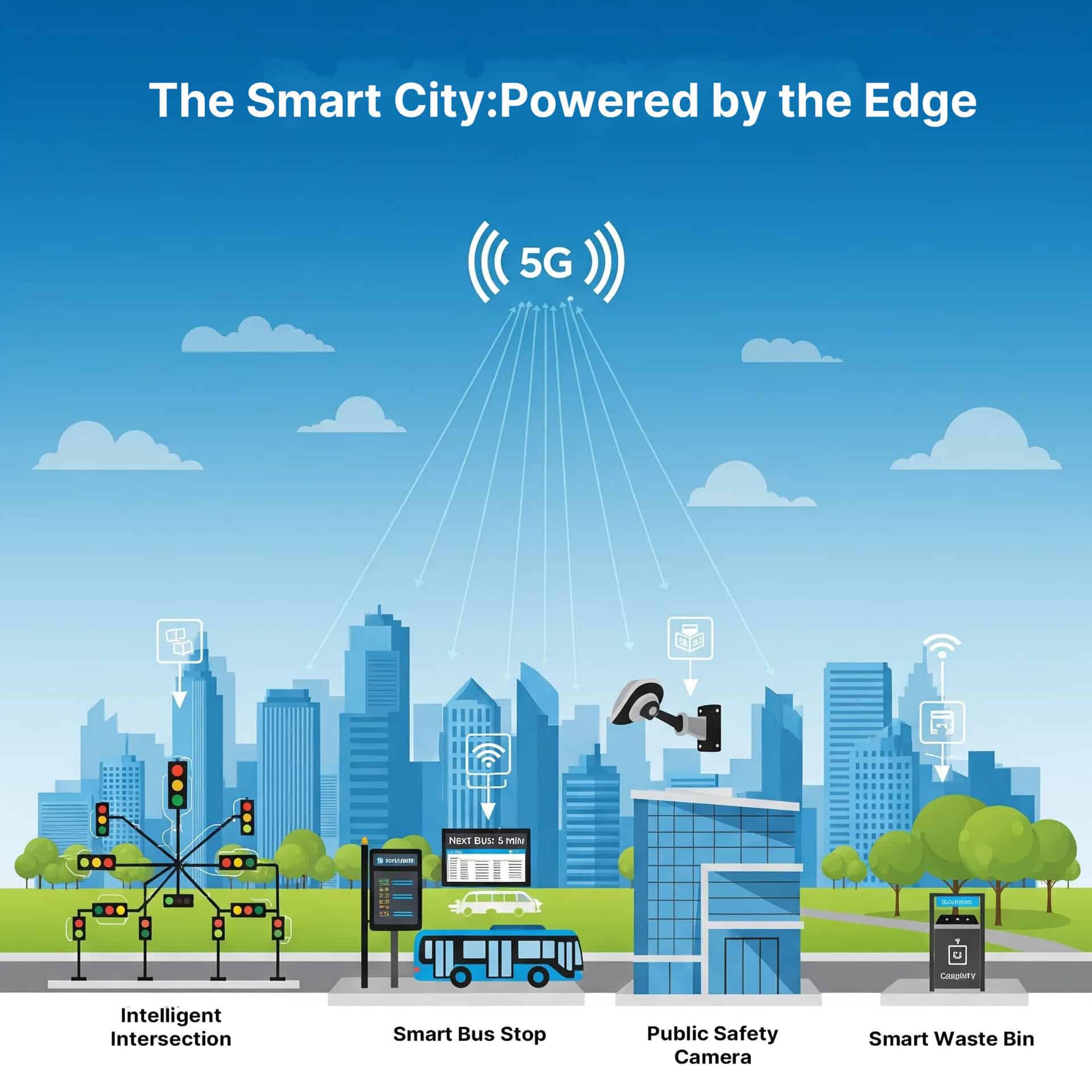
Modern smart city infrastructure is becoming increasingly distributed. Traffic intersections, roadside cabinets, surveillance systems, environmental sensors, parking infrastructure, and utility assets now generate large volumes of operational data across thousands of urban endpoints.
For city operators and system integrators, the challenge is no longer simply how to connect devices. The larger question is how to manage bandwidth, maintain responsiveness, and operate distributed infrastructure reliably over time.
Several operational challenges are driving this architectural shift:
- High-volume video traffic from distributed surveillance systems
- Variable LTE and 5G connectivity conditions across urban environments
- Increasing pressure on bandwidth efficiency
- Remote maintenance complexity across geographically distributed assets
- Integration between legacy infrastructure and modern cloud-connected platforms
In many deployments, continuously transmitting all raw data to centralized cloud systems is not always practical. This is one reason why edge computing is becoming increasingly relevant in smart city infrastructure.
Rather than replacing cloud platforms, edge computing allows selected processing tasks to happen closer to the field device, helping reduce unnecessary upstream traffic while improving local responsiveness for operational events.
The Connectivity Challenges Behind Modern Smart City Systems
Smart city systems often operate across highly distributed environments.
A single deployment may include roadside traffic controllers, public safety cameras, environmental monitoring stations, parking systems, utility cabinets, and connected transportation infrastructure spread across different locations.
This creates several practical infrastructure challenges:
- Variable LTE and 5G signal quality across urban deployments
- High-bandwidth video traffic from distributed camera systems
- Integration between serial-connected field devices and cloud applications
- Increasing operational complexity across distributed assets
In many urban environments, cellular connectivity is commonly used to connect remote or roadside infrastructure. While LTE and 5G provide flexibility for distributed deployments, network performance can still vary depending on coverage, congestion, and physical surroundings.
Video-based systems create another challenge. Applications such as traffic monitoring, public safety surveillance, and parking occupancy detection can generate substantial amounts of data traffic, particularly when multiple camera streams are transmitted continuously to centralized platforms.
At the same time, smart city deployments often involve a mixture of old and new infrastructure. Legacy field equipment, serial interfaces, Ethernet-connected controllers, and cloud-based platforms may all need to operate within the same environment.
As deployments scale, transmitting every data stream directly to the cloud can place increasing pressure on bandwidth usage, operational costs, and overall infrastructure management.
Centralized Processing vs Local Processing in Smart City Infrastructure
| Centralized Processing | Local Processing |
| Continuous upstream transmission | Event-based transmission |
| Higher bandwidth dependency | Reduced backhaul traffic |
| Greater reliance on stable connectivity | Better tolerance for intermittent network conditions |
| Centralized analysis workflows | Faster response for local operational events |
| Higher network load for distributed video systems | More selective data transmission |
Where Local Processing Becomes Practical in Urban Infrastructure
Local processing becomes most useful when transmitting all raw data continuously is less practical than filtering or processing selected information closer to the source.
Traffic Systems
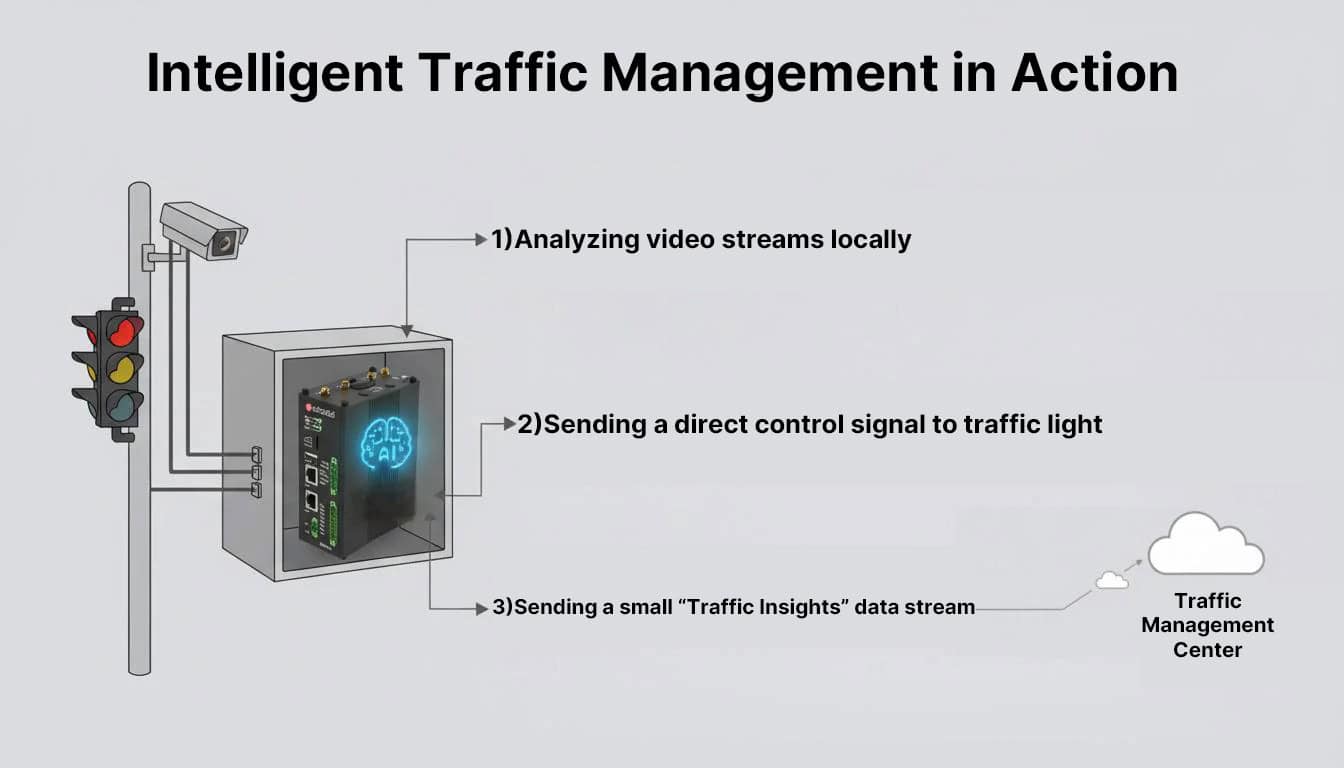
In traffic infrastructure, local edge devices may help process events from intersections, traffic sensors, or roadside cameras before forwarding selected information to centralized traffic management systems.
This does not eliminate the role of centralized coordination, but it can reduce dependency on continuous round-trip communication for every local operational event.
環境モニタリング
Environmental monitoring systems may collect large amounts of repetitive sensor data related to air quality, temperature, water levels, or noise conditions.
Edge-side processing can help prioritize abnormal readings, compress repetitive telemetry, or trigger alerts only when operational thresholds are exceeded.
Distributed Surveillance
Video-based systems are often among the most bandwidth-intensive components in urban infrastructure.
In some deployments, local processing can help reduce upstream traffic by transmitting event-based clips, metadata, or selected frames instead of continuous raw video streams. This approach can be particularly useful when multiple sites rely on cellular backhaul connectivity.
Utility Infrastructure
Utility systems such as water distribution, energy infrastructure, or public service facilities often involve distributed field assets operating across different locations.
In these environments, edge devices may support local data collection, protocol handling, or basic operational logic before forwarding selected data to supervisory platforms.
The value of local processing ultimately depends on the workload. Not every task needs to run locally. However, for bandwidth-heavy, latency-sensitive, or event-driven systems, processing closer to the field device can make distributed infrastructure more practical to operate.
Infrastructure Considerations for Smart City Edge Deployments
Deploying edge computing in urban environments requires more than computing capability alone.
In practice, smart city edge infrastructure often needs to support:
- Outdoor and roadside environmental durability
- Secure remote maintenance
- LTE and 5G connectivity resilience
- Serial and Ethernet interoperability
- Long-term distributed device management
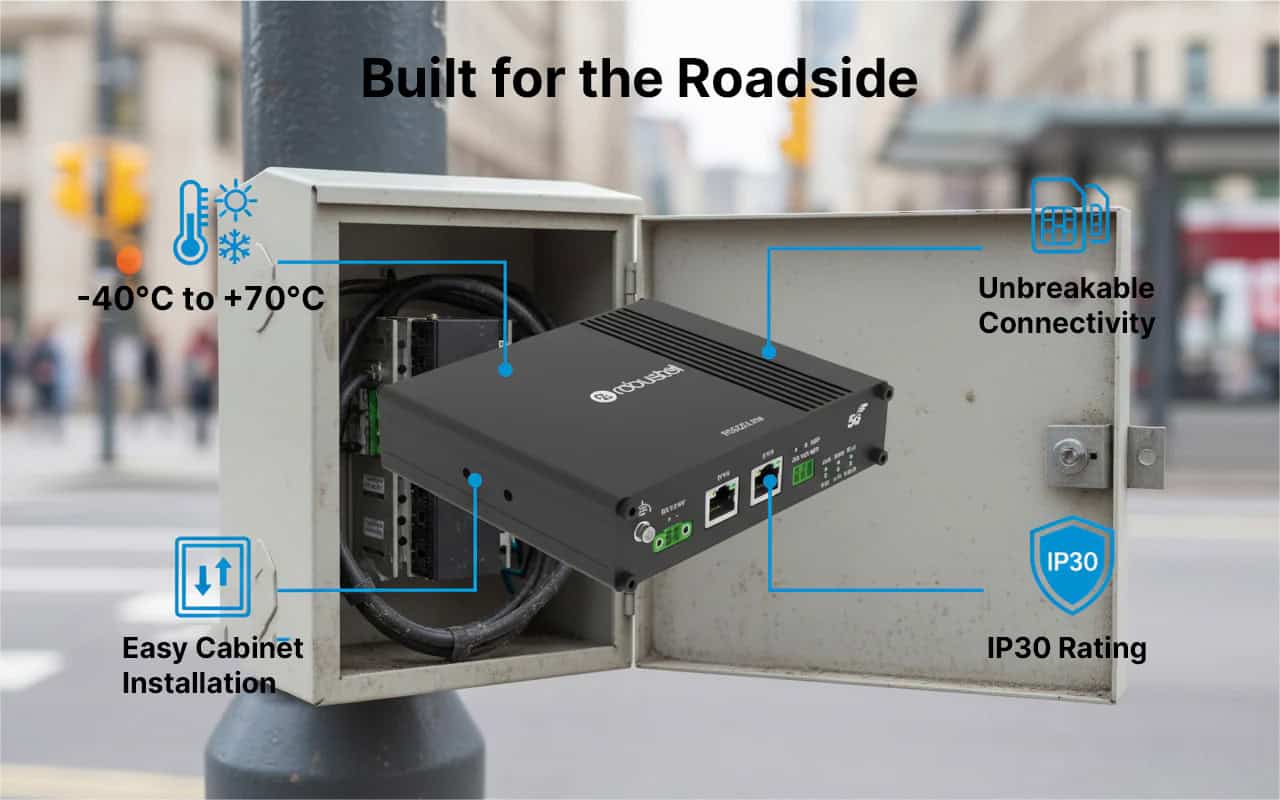
Environmental durability is one of the first considerations. Smart city devices are frequently installed in roadside cabinets, outdoor enclosures, transportation systems, or utility infrastructure exposed to temperature variation, vibration, dust, humidity, and electrical interference.
Remote maintenance also becomes increasingly important as deployments scale. Managing hundreds or thousands of distributed nodes manually can create substantial operational overhead. Remote diagnostics, centralized monitoring, and secure remote access therefore become important parts of long-term infrastructure management.
Protocol interoperability is another practical requirement. Urban infrastructure rarely consists of a single technology stack. Edge devices may need to communicate with serial-connected field equipment, Ethernet-based systems, digital I/O devices, and cloud-connected applications within the same deployment.
Connectivity resilience also requires careful planning. LTE and 5G provide flexible deployment options for distributed urban infrastructure, but long-term reliability may still depend on factors such as signal quality, network failover, VPN security, SIM management, and remote troubleshooting capabilities.
In this context, an edge gateway is not simply a connectivity device. It becomes part of the operational layer connecting field infrastructure, local processing workloads, and centralized management systems.
Why Smart City Infrastructure Requires More Than Connectivity Alone
Connectivity is only one part of operating distributed smart city infrastructure.
As deployments grow, the operational challenge often shifts from simply connecting devices to managing infrastructure reliably across many locations over long periods of time.
Several operational considerations become increasingly important:
- Remote lifecycle management
- Edge-side data filtering
- Centralized visibility across distributed assets
- Secure remote access
- Reducing unnecessary upstream traffic
For example, continuously transmitting every sensor reading or video stream may not always provide operational value. In many environments, it is more practical to transmit selected events, summarized telemetry, or operational alerts while keeping centralized platforms focused on long-term analytics and coordination.
This balanced approach allows cloud infrastructure and local processing to complement one another rather than operate as competing architectures.
Closing Perspective
Smart city infrastructure is becoming more distributed, but that does not necessarily mean it needs to become more complicated.
In many deployments, the practical value of edge computing lies in helping distributed infrastructure operate more efficiently: reducing unnecessary data transmission, improving responsiveness for local events, supporting mixed field interfaces, and simplifying long-term infrastructure management.
For city operators, system integrators, and technology providers, the key question is often not whether edge computing should replace centralized platforms. The more practical consideration is which workloads are better handled locally, which should remain centralized, and how the infrastructure can support both reliably over time.
よくある質問
Q1: Why do smart city systems generate so much network traffic?
A: Smart city deployments often include distributed cameras, environmental sensors, parking systems, and traffic infrastructure operating simultaneously across multiple locations. Video streams and continuous telemetry can significantly increase upstream bandwidth usage, particularly in large-scale deployments.
Q2: Is edge computing intended to replace cloud infrastructure in smart city deployments?
A: In most deployments, edge computing and cloud infrastructure are used together. Local processing may help reduce unnecessary upstream traffic or improve responsiveness for selected workloads, while centralized platforms remain important for analytics, coordination, and long-term data management.
Q3: Which smart city workloads are commonly handled closer to the edge?
A: Traffic event handling, environmental monitoring, event-based video processing, and selected utility monitoring tasks are often suitable for local processing, particularly when bandwidth efficiency or distributed responsiveness becomes important.
Q4: Why is remote management important in distributed urban infrastructure?
A: Smart city deployments may involve hundreds or thousands of distributed field devices across roadside or outdoor locations. Remote diagnostics, centralized monitoring, and secure remote access can help reduce operational overhead associated with on-site maintenance.
Q5: What infrastructure challenges are common in smart city edge deployments?
A: Common challenges include variable LTE or 5G signal conditions, outdoor environmental exposure, interoperability between legacy and modern systems, distributed maintenance requirements, and managing large volumes of operational data across multiple locations.
著者について
Robert Liao | Technical Support Engineer
Robert is an IoT Technical Support Engineer at Robustel, specializing in industrial networking and edge connectivity. A certified Networking Engineer, Robert focuses on the deployment and troubleshooting of large-scale IIoT infrastructures. His work centers on architecting reliable, scalable system performance for complex industrial applications, bridging the gap between field hardware and cloud-side data management.