
Industrial Edge Computing Guide 2026: Architecture, Hardware and Use Cases
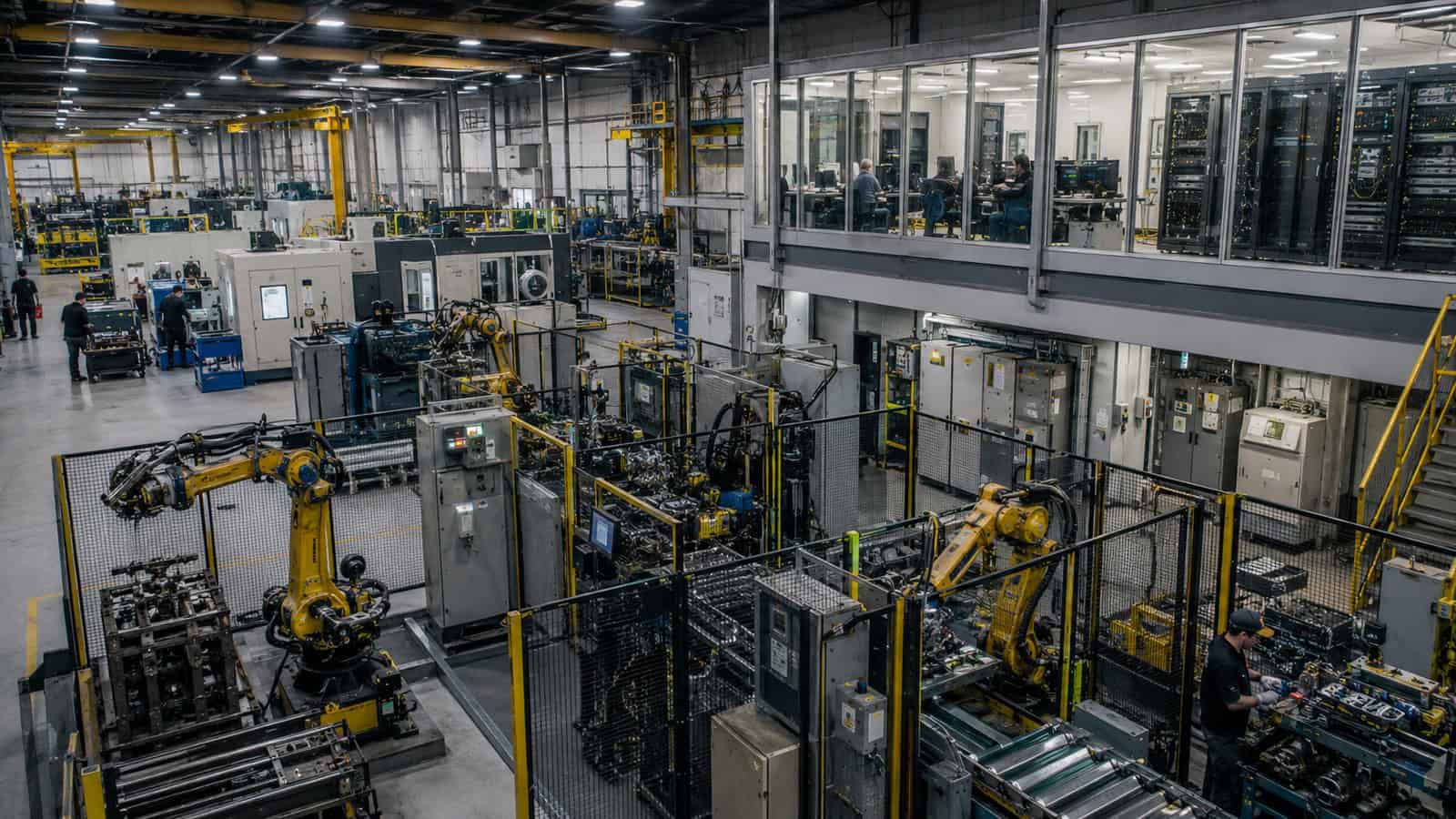
The Robustel EG5200 edge computing gateway is a strong fit for industrial sites where multiple field devices, local applications and WAN connectivity need to converge on one edge platform, but edge computing should begin with workload placement rather than processor specifications. The first decision is what genuinely needs to happen close to the equipment and what can remain in the cloud, data center or plant-level system.
That boundary is different for every project. A site may need local protocol handling because legacy equipment cannot communicate directly with the cloud, buffering because the WAN is intermittent, or event processing because sending every raw measurement upstream creates unnecessary traffic. Another site may need little more than reliable connectivity and therefore gain almost nothing from adding an application layer at the edge.
Edge Computing Starts with Workload Placement
The most useful definition of industrial edge computing is not “processing data near the source.” That is technically correct but does not tell a project team what should actually run there.
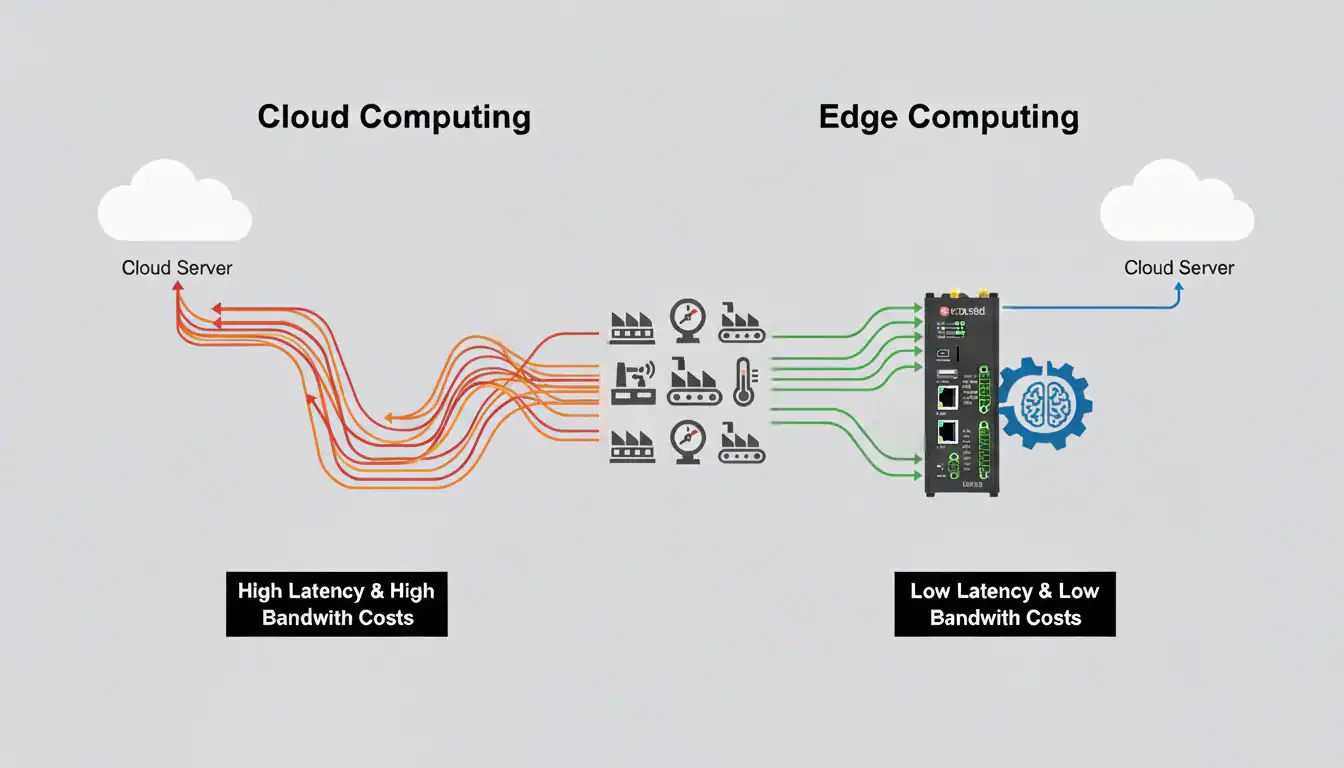
A better starting point is responsibility. If a function must continue when the WAN is unavailable, reacts to local data faster than a cloud round trip allows, reduces a large raw-data stream before transmission, or translates between field equipment and upstream applications, there is a defensible reason to consider local execution.
Functions that need long-term history, fleet-wide comparison or substantial shared compute often belong elsewhere. A gateway can identify a local event using current machine data while a central system compares that event with six months of information from several factories. These are complementary responsibilities rather than competing architectures.
Where Industrial Workloads Usually Fit
| Workload | Edge is useful when… | Central/cloud system remains useful for… | Robustel architecture implication |
|---|---|---|---|
| Protocol/data integration | Field equipment exposes supported industrial interfaces that upstream systems cannot consume directly | Enterprise integration and cross-site data models | Robustel EG-series gateway can host suitable local connectors |
| Data filtering | Raw volume is much larger than the information needed upstream | Long-term analysis and reporting | Robustel edge applications can reduce selected data locally |
| Buffering | Temporary WAN interruption should not immediately stop data collection | Long-term retention | Storage and replay behaviour must be engineered explicitly |
| Event detection | A local condition should be identified without waiting for the cloud | Cross-site correlation and historical analytics | Size the Robustel gateway to the real local application |
| AI inference | A validated model benefits from processing data close to its source | Model training, fleet comparison and model development | EG5120/EG5200 provide documented NPU resources for compatible workloads |
| Machine control and safety | Normally remains with the approved PLC/controller architecture | — | A Robustel edge gateway should not take over safety responsibility merely because it can run software |
This last boundary is particularly important. More compute does not automatically make an edge gateway the correct place for deterministic machine control, interlocking or safety functions.
Connectivity, Integration and Compute Are Separate Requirements
Industrial edge projects often become over-specified because three different requirements are merged into one phrase: “we need an edge gateway.”
The first requirement may simply be connectivity. A remote site needs cellular or Ethernet WAN, VPN access and secure routing.
The second is field integration. PLCs, meters, sensors or other equipment expose Ethernet, serial or I/O interfaces, and selected data needs to be collected through protocols supported by the deployed software.
The third is application compute. The project needs Docker containers, custom Linux applications, local analytics, a database or compatible inference.
A project can need one, two or all three. Buying substantial local compute for a routing problem wastes resources, while selecting a connectivity-focused device for several containerized applications creates the opposite failure: the architecture works in a proof of concept but runs out of memory, storage or processing margin after the production workload expands.
Industrial Edge Hardware Should Follow the Workload Envelope
Once the local responsibility is clear, CPU, RAM and storage become useful selection criteria.
The Robustel EG5101 edge computing gateway represents the lighter end of the portfolio. Its 792 MHz Cortex-A7 platform, 1 GB DDR3, 8 GB eMMC, one Fast Ethernet port and separate RS-232/RS-485 interfaces suit focused protocol bridging, buffering and preprocessing rather than heavy concurrent workloads.
The Robustel EG5100 edge computing gateway uses the same 792 MHz Cortex-A7 class but adds two Fast Ethernet ports, two software-configurable RS-232/RS-485 ports and DI/DO, providing more field-side flexibility where lightweight compute remains sufficient.
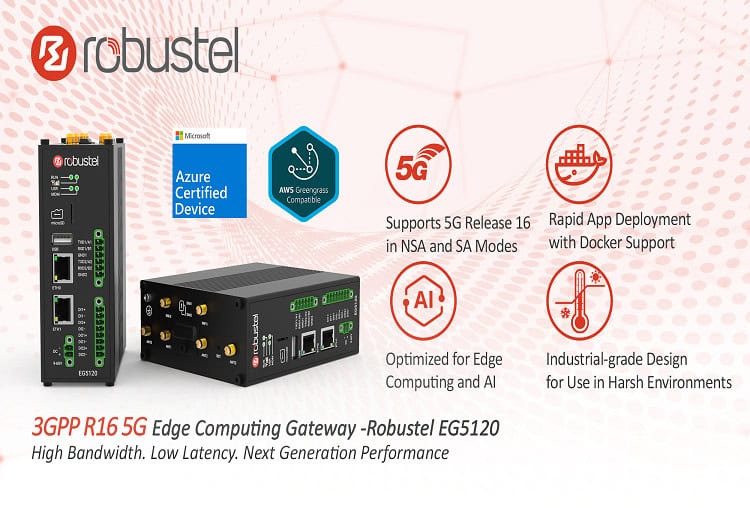
The Robustel EG5120 edge computing gateway moves into a higher resource class with a quad-core Cortex-A53 at 1.6 GHz, 2 GB or 4 GB LPDDR4, 64 GB eMMC, two Gigabit Ethernet ports and a 2.3 TOPS NPU.
For serial-heavy retrofit projects, the Robustel EG3120e eSIM edge computing gateway takes another direction: a quad-core Cortex-A53 at 2.0 GHz, 2 GB LPDDR4 and multiple industrial interfaces including four RS-485 ports, alongside LTE and SGP.22 eSIM support.
Robustel Edge Gateway Hardware Profiles
| Robustel model | Compute/storage direction | Local-interface strength | More proportionate when… |
|---|---|---|---|
| EG5101 | 792 MHz Cortex-A7, 1 GB RAM, 8 GB eMMC | 1 Fast Ethernet, RS-232 + RS-485 | Focused serial collection and lightweight applications |
| EG5100 | 792 MHz Cortex-A7, 1 GB RAM, 8 GB eMMC | 2 Fast Ethernet, 2 configurable serial ports, DI/DO | Lightweight mixed-device integration |
| EG3120e | Quad-core Cortex-A53 2.0 GHz, 2 GB RAM, 8 GB eMMC | Strong multi-serial/I/O architecture | Retrofit sites with several legacy industrial interfaces |
| EG5120 | Quad-core Cortex-A53 1.6 GHz, 2/4 GB RAM, 64 GB eMMC, 2.3 TOPS NPU | 2 Gigabit Ethernet, configurable serial, DI/DO | Compact higher-compute or compatible inference workloads |
| EG5200 | Quad-core Cortex-A53 1.6 GHz, 4 GB RAM, 32 GB eMMC, 2.3 TOPS NPU | 5 Gigabit Ethernet, RS-232/422/485, HDMI, USB, relay | Multi-device and peripheral-rich edge sites |
The table is not a performance ranking. EG5120, for example, provides more internal eMMC than EG5200, while EG5200 provides substantially more Ethernet and peripheral connectivity. The correct model depends on the entire topology.
How the Robustel EG5200 Edge Computing Gateway Supports Multi-Device Industrial Edge Workloads
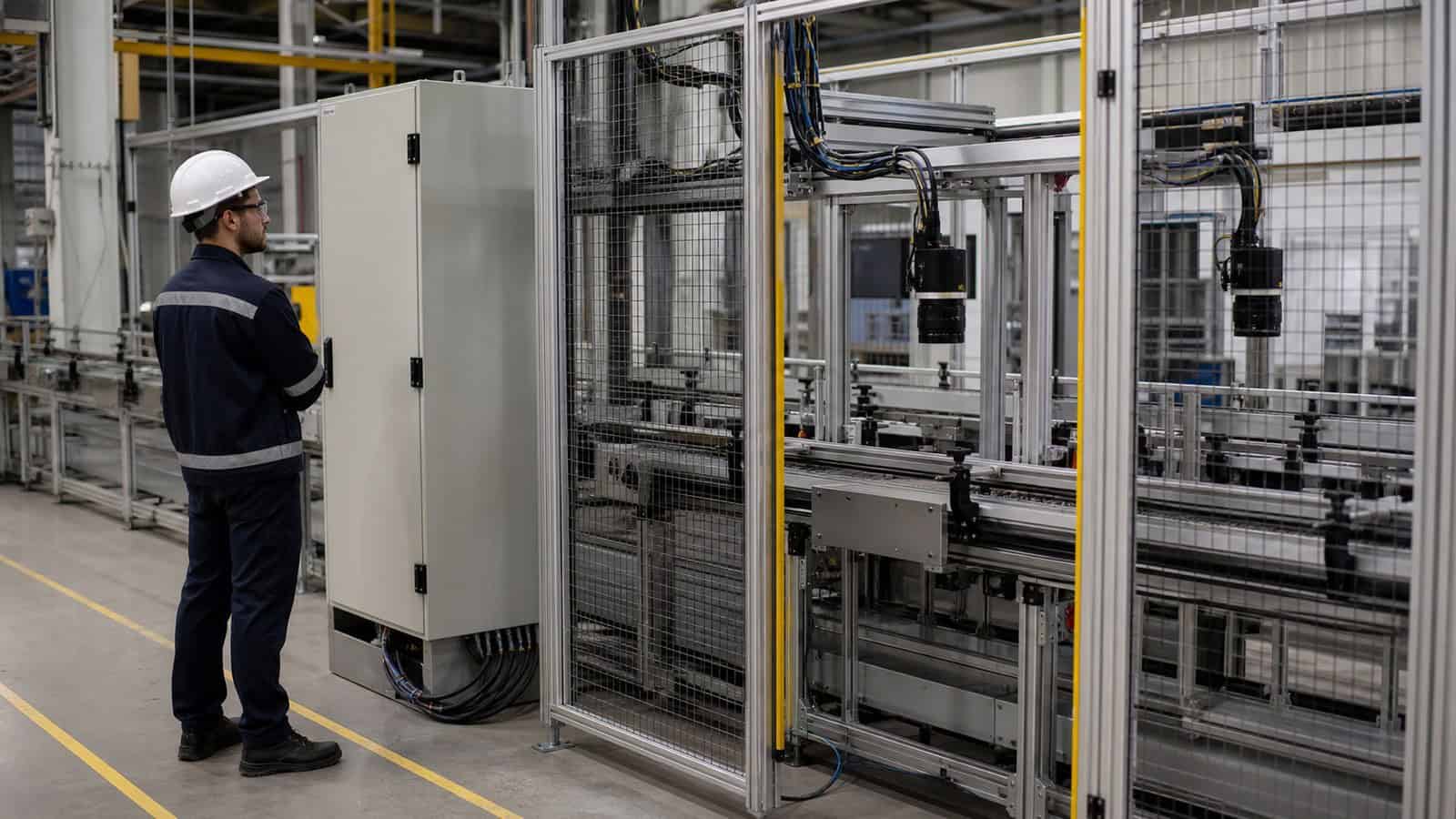
The Robustel EG5200 edge computing gateway is particularly useful where several IP devices and local applications must coexist at one site. Five Gigabit Ethernet ports allow multiple cameras, controllers or other compatible IP assets to connect without automatically requiring another Ethernet switch, while two software-configurable serial interfaces support RS-232, RS-422 or RS-485 equipment where the selected application supports the associated device protocol.
Its 4 GB LPDDR4 memory, 32 GB eMMC and 2.3 TOPS NPU provide resources for more substantial local applications than the lightweight EG5100-class platforms. HDMI, USB and relay interfaces also matter in peripheral-rich projects, for example when a local display, USB device or simple output action belongs in the edge architecture.
Those resources still need to be qualified against the actual software. A 2.3 TOPS NPU does not prove that a particular AI model will run correctly, and five Ethernet ports do not prove that the gateway can process unlimited combined camera or sensor traffic. Runtime compatibility, memory peaks, sustained input volume and application concurrency should be measured with representative production inputs.
The EG5000 Series Quick Pitch is useful here because it shows how the product family combines machine-side connectivity with local compute. The architectural point is that compute does not remove the gateway’s field-facing responsibility.
Distributed Edge Architecture Can Reduce the Failure Radius
Robustel’s Smart Parking Application Example illustrates a distributed infrastructure model where different equipment classes are assigned different connectivity and processing roles. The EG5120 is presented for local ANPR-related preprocessing rather than forcing all raw information through one central device.
The example is not evidence that every parking deployment needs edge AI. Its relevance is the placement principle: when useful processing belongs close to one device cluster, a distributed gateway can keep that responsibility local while central systems retain estate-wide analytics and operations.
Robustel’s Public Safety CCTV Application Example presents a different scale of edge workload. Here an EG5100 can combine cellular backhaul with lightweight local applications around a camera site. This is a more proportionate architecture than assuming every camera location requires an EG5200-class platform.
Together, the examples show why edge hardware should scale with site responsibility.
RobustOS Pro Makes Software Lifecycle Part of the Purchase
Once local applications are introduced, the gateway becomes part of the software lifecycle.
The RobustOS Pro edge computing operating system provides a Debian-based environment for containers, native Linux applications and familiar development tools on supported Robustel EG gateways. This allows protocol connectors, data-processing applications and custom logic to run close to field equipment.
The benefit comes with ownership. Applications need version control, logs, storage limits, restart behaviour, dependency management, update procedures and rollback planning. A container running successfully during commissioning does not prove that the same application can be maintained predictably for five years.
This is one of the clearest differences between buying an industrial router and buying an edge application platform.
Design the Failure State Before Scaling the Architecture
A normal architecture diagram shows what happens when everything works. A production design also needs to describe degraded states.
If the WAN disappears, does field collection continue? If a local application stops, does the router remain reachable? If storage fills during an extended outage, which data is retained first? If the gateway reboots, how are applications restarted and how does buffered information rejoin live data without confusing timestamps?
These questions should be answered before dozens of sites use the same deployment template.
Edge Deployment Acceptance Matrix
| Failure condition | What should continue | What must be verified | Robustel gateway evidence |
|---|---|---|---|
| WAN unavailable | Approved local collection/processing where designed | Buffer limits and application state | Test actual EG application |
| One field device fails | Other devices should remain distinguishable | Device-specific quality state | Verify protocol/application behaviour |
| Local application stops | Network behaviour may remain available | Restart, logs and alarms | Test RobustOS Pro deployment |
| Gateway reboots | Approved services should recover | Startup order and retained state | Representative power-cycle test |
| Cloud endpoint fails | Local behaviour should follow defined policy | Queue/replay/expiry | Test real publisher or application |
| Storage approaches limit | Critical behaviour must remain predictable | Retention and cleanup policy | Size against actual eMMC use |
FAQs
Q1. What is industrial edge computing?
Industrial edge computing runs selected data-processing or application functions close to industrial equipment rather than sending every task to a central system. Common workloads include protocol integration, filtering, buffering, event processing and compatible inference.
Q2. Does edge computing replace the cloud?
No. Edge and cloud usually divide responsibility. Local functions can handle time-sensitive processing and temporary connectivity loss, while central systems remain better suited to long-term storage, fleet analytics, reporting and enterprise integration.
Q3. How much computing power does an industrial edge gateway need?
There is no universal CPU, RAM or TOPS requirement. A serial protocol bridge has very different needs from several containers or a vision model. Size the gateway from the actual application, data rate, memory peak, storage requirement and required operating margin.
Q4. When is the Robustel EG5200 a good fit?
The Robustel EG5200 edge computing gateway is well suited to sites where several Ethernet or serial devices, local applications and peripheral interfaces need to converge on one platform. Its broader interface layout is unnecessary for a small deployment with one lightweight serial workload.
Q5. Can an edge gateway run industrial AI locally?
Some gateways can run compatible inference workloads. That does not mean every AI framework or model will work automatically. Runtime support, NPU compatibility, preprocessing, model size, memory use, inference frequency and production performance should all be validated before deployment.
Conclusion
The Robustel EG5200 edge computing gateway is a strong fit for multi-device industrial sites that genuinely need substantial local application resources, Gigabit networking, flexible serial interfaces and peripheral integration. Smaller workloads may be better served by EG5101, EG5100 or another more proportionate gateway.
Industrial edge computing becomes easier to design when the project first decides what must remain local, what can stay central and what should happen during a WAN or application failure. The hardware should then be sized against that responsibility rather than selected from the longest specification list.
Explore more articles about Robustel’s edge computing gateways in industrial IoT:
About the Author
Robert Liao | Technical Support Engineer
Robert is an IoT Technical Support Engineer at Robustel, specializing in industrial networking and edge connectivity. A certified Networking Engineer, Robert focuses on the deployment and troubleshooting of large-scale IIoT infrastructures. His work centers on architecting reliable, scalable system performance for complex industrial applications, bridging the gap between field hardware and cloud-side data management.