
What Is Your BMS Missing? 5 Building Problems Wireless Monitoring Can Help Solve
Your BMS says the temperature is normal, but people are still complaining.
Your electricity meter shows an overnight load, but you cannot see what is causing it.
A leak is discovered only because somebody happens to walk into the plant room.
HVAC continues running long after the people have gone home.
None of these necessarily mean your Building Management System is failing. The problem may be much simpler:
Your BMS cannot show you something it was never designed to measure.
Adding that missing measurement used to mean running more cable, opening ceilings, extending control panels or accepting that some parts of the building simply would not be monitored.
LoRaWAN® sensors give building operators another option.
But connecting a wireless sensor is only half the problem.
The real challenge is turning data from different sensors into something useful — decoding it, organising it, combining it with existing building data and getting it into the BMS in a form operators can actually use.
That is where the Robustel LG3120e with E2C Field is different from a conventional LoRaWAN gateway.
It combines LoRaWAN connectivity with industrial interfaces and edge computing, allowing wireless and wired field data to be collected, processed and integrated locally before being presented to systems such as an existing BMS through BACnet/IP.
The result is not simply more connectivity.
It is a practical way to add the missing information your building team needs to make a better decision.
Five problems worth investigating
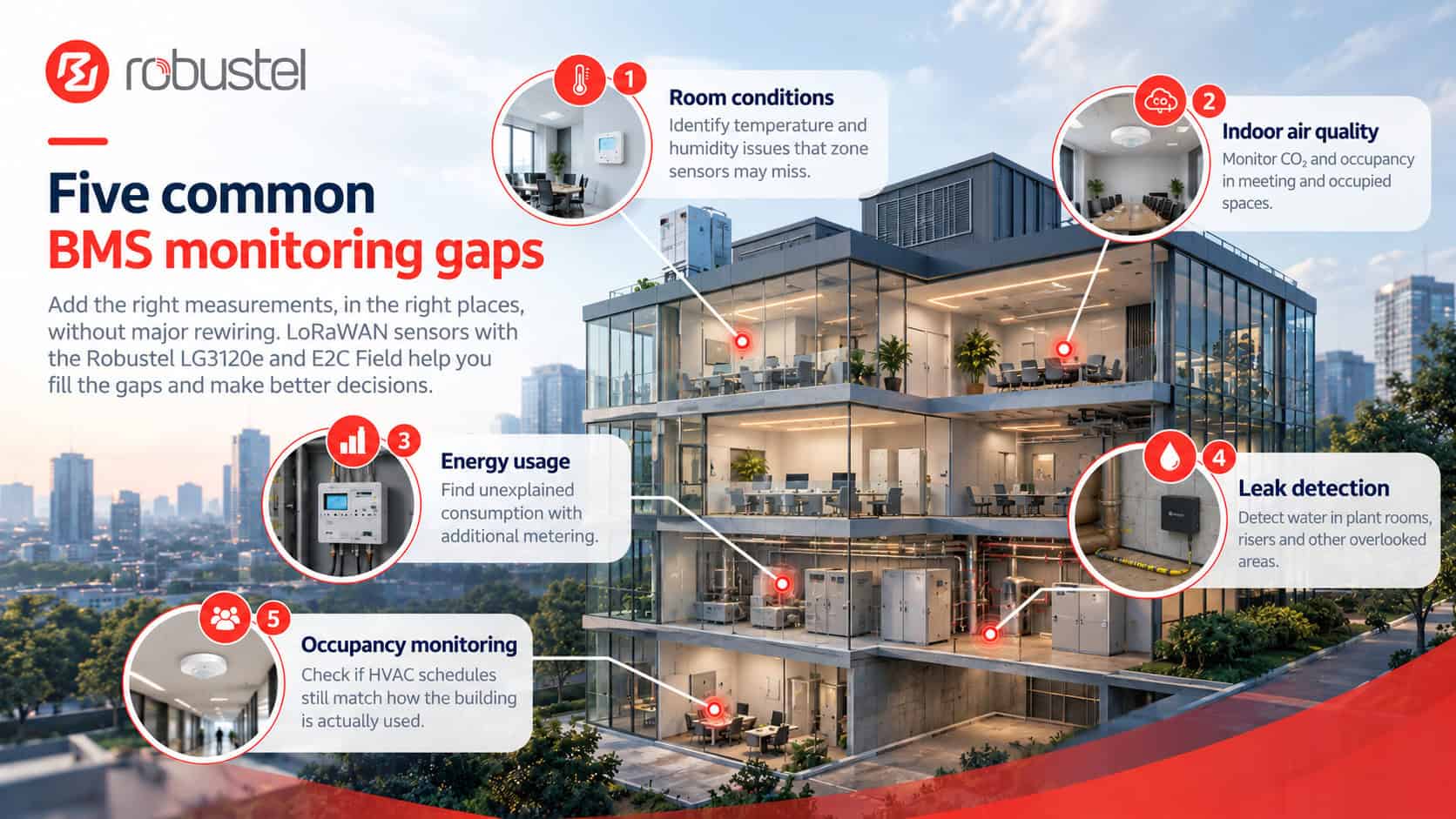
- One room is uncomfortable even though the zone temperature looks normal
- A busy meeting room regularly feels stuffy
- Energy consumption continues when the building should be quiet
- Water could leak in areas nobody routinely checks
- HVAC schedules no longer match how spaces are actually being used
If any of those sound familiar, there may be a monitoring gap worth closing.
This is more than another LoRaWAN gateway
Not every LoRaWAN project needs an LG3120e.
And that distinction matters.
If the requirement is simply to collect LoRaWAN packets and forward them to an existing external network server, the Robustel R1320LGe is designed for that job.
If the project needs a LoRaWAN gateway with an integrated network server as well as external LNS options, the R1520LG provides that architecture.
The LG3120e becomes particularly interesting when the problem goes beyond connectivity.
It combines:
- LoRaWAN
- Industrial serial interfaces
- Digital and analog I/O
- Cellular and Ethernet connectivity
- A high-performance edge computing platform
- Local application hosting
- E2C Field
That means it can sit between field devices and operational systems rather than simply forwarding packets between them.
With E2C Field, the same gateway can manage LoRaWAN devices, decode sensor payloads, create usable data points, apply local logic and make selected information available through industrial protocols such as BACnet/IP.
For a BMS retrofit, that is an important difference.
The objective is not merely to get the sensor online. It is to get useful information into the building system.
1. Your BMS says the room is fine. The people inside it disagree.
This is one of the simplest examples of a monitoring gap.
A BMS may report a perfectly reasonable zone temperature while somebody sitting in one particular office complains every afternoon that it is too warm.
Neither side is necessarily wrong.
A single zone sensor may represent a much larger area. It may not capture local solar gain, equipment heat, occupancy, poor air distribution or conditions in a room at the edge of the controlled zone.
Changing the setpoint for everybody based on one complaint is rarely a satisfying answer.
Measuring the room itself gives the facilities team evidence.
Wireless temperature and humidity sensors can be added to the affected space and, ideally, to a suitable comparison room.
Those additional measurements can then be brought into the existing BMS alongside the zone temperature and HVAC schedule.
Now the team can compare what the BMS already knows with what is actually happening where the complaint occurs.
The question changes from:
“Why are people saying this room is hot?”
to:
“Does this room consistently behave differently from the rest of the zone, and when?”
That is a much easier problem to investigate.
What you should learn
Whether there is a repeatable room-level difference that the existing BMS measurement was not showing — and whether that difference corresponds with the times occupants report discomfort.
2. The meeting room feels stuffy. What actually happens when it fills up?
A meeting room may be perfectly comfortable with two people and noticeably unpleasant with ten.
A booking calendar can tell you the room was reserved.
It cannot tell you what happened to the environment inside it.
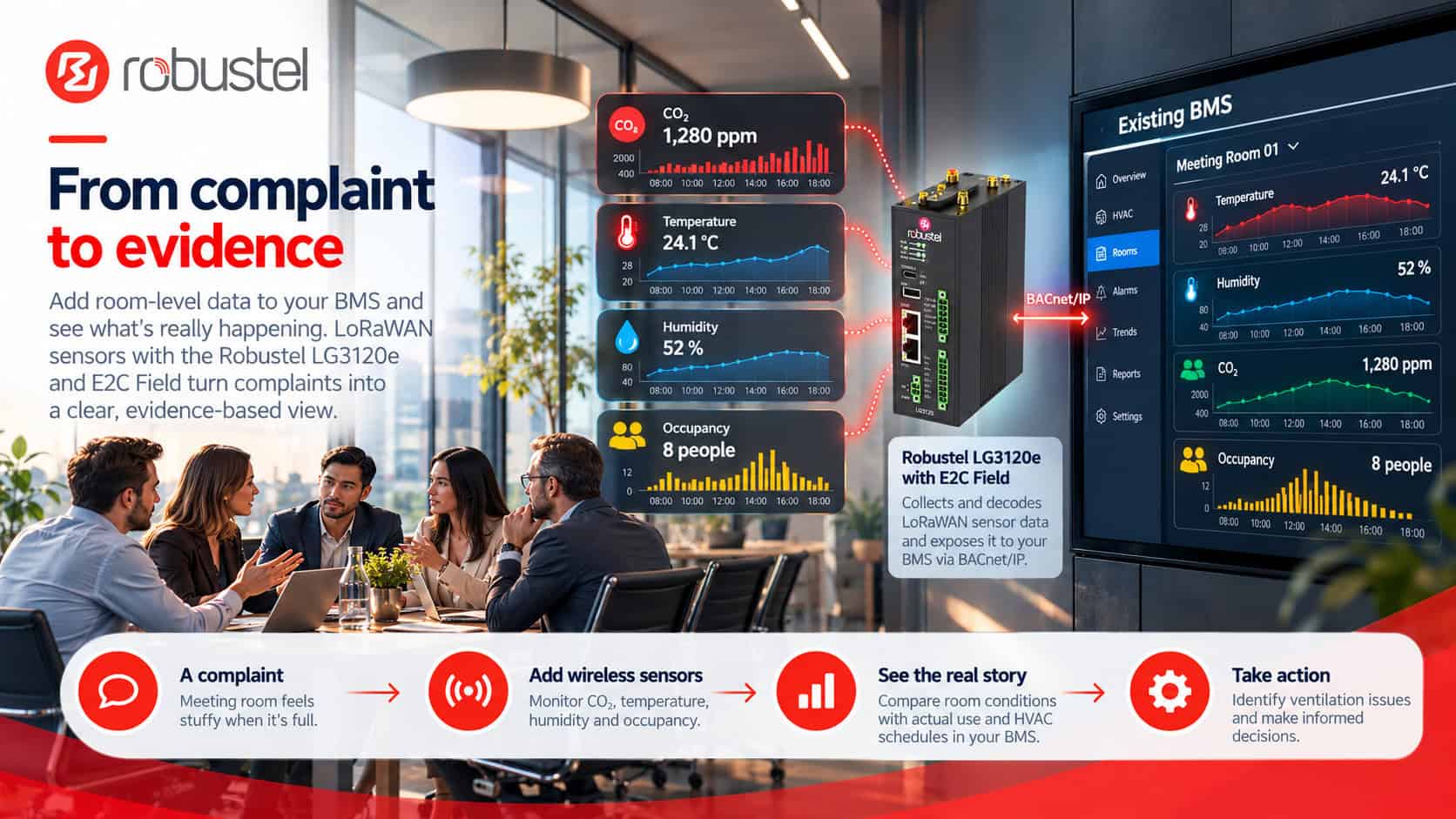
Wireless CO₂, temperature and humidity sensing can provide that missing context.
Where appropriate, anonymous occupancy sensing can add another useful dimension.
Instead of looking at CO₂ in isolation, the facilities team can compare:
- CO₂
- Temperature
- Humidity
- Actual room occupancy
- Ventilation schedules
- Available fan or damper information
- How quickly conditions recover after the room empties
This matters because one measurement rarely tells the whole story.
A CO₂ reading alone does not prove that ventilation is inadequate. But a repeated relationship between occupancy, rising CO₂ and a particular operating condition gives the building team a much stronger reason to investigate.
With the LG3120e and E2C Field, those wireless measurements can be decoded locally and made available alongside existing BMS information.
The result is a much clearer picture of what is actually happening in the room.
What you should learn
Whether changing room conditions consistently correspond with occupancy and whether a specific ventilation schedule, operating period or piece of equipment deserves closer investigation.
3. Your building is consuming power overnight. What is actually running?
A building-level electricity meter can tell you that the overnight baseline is higher than expected.
It cannot necessarily tell you why.
Something is using energy.
But is it a floor?
A piece of plant?
An override somebody forgot about?
Equipment operating outside its intended schedule?
The useful measurement is the one that narrows the search.
That might mean adding monitoring around:
- A particular floor
- HVAC plant
- A distribution board
- A group of equipment
- An existing meter with a suitable pulse output
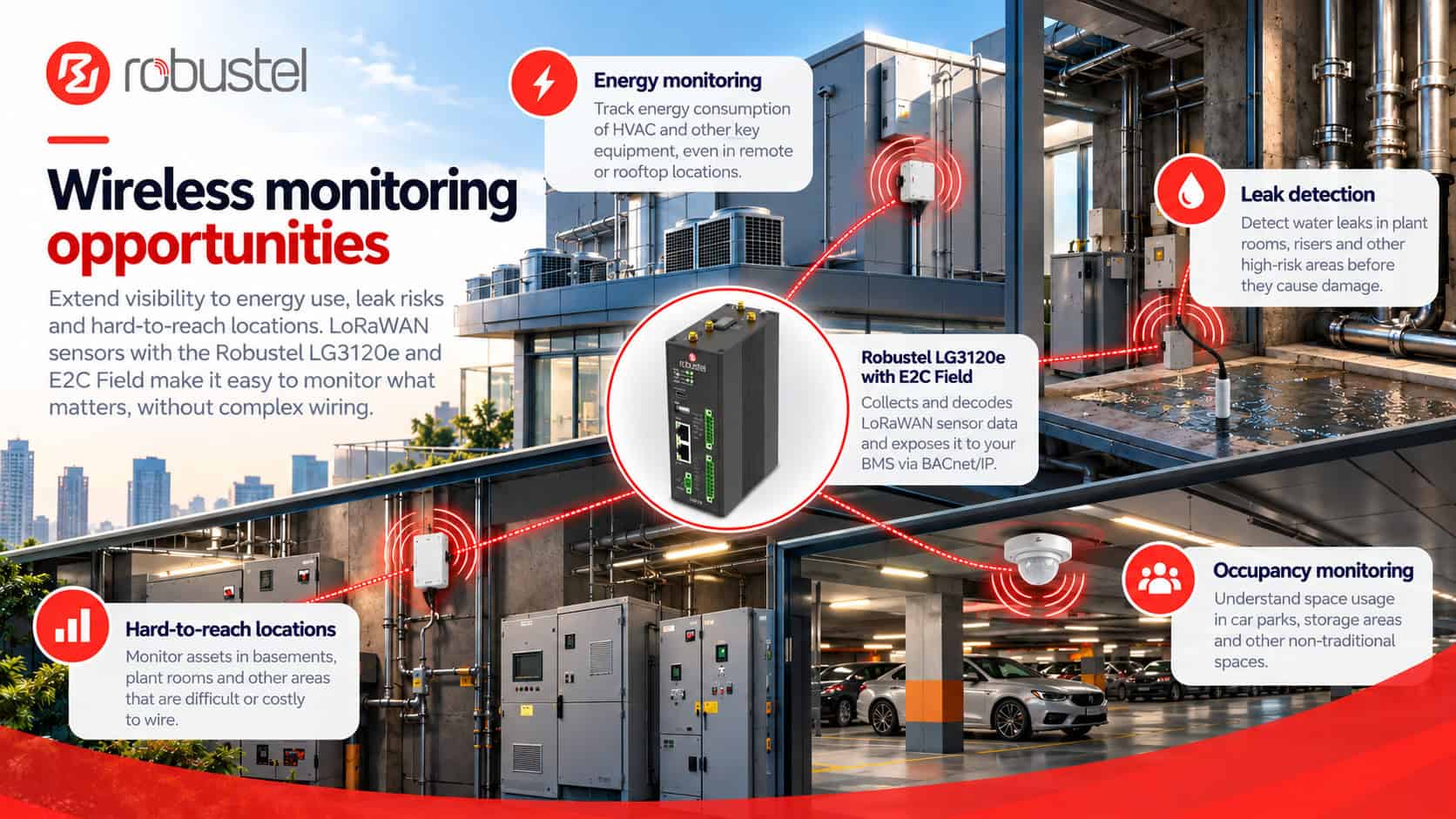
Suitable LoRaWAN meters or compatible field interfaces can add that visibility without requiring a complete redesign of the BMS.
The LG3120e is particularly useful here because the project does not have to be exclusively wireless.
Its industrial interfaces and E2C Field allow LoRaWAN devices and suitable wired field data to become part of the same edge-integration architecture.
That means the team can bring the relevant measurements together and compare them with schedules, overrides and expected essential loads.
The question changes from:
“Why is our overnight consumption high?”
to:
“Why is this equipment still consuming power at 2am?”
That is actionable.
What you should learn
Which monitored load is contributing to the unexplained consumption and whether an approved operational change creates a measurable difference.
Monitoring does not save energy by itself.
It gives the team the evidence needed to find where action may be worthwhile.
4. What happens when water appears somewhere nobody is looking?
A small leak underneath a fan-coil unit or beside a riser may be invisible to the BMS.
It may also be invisible to everybody else until the next inspection.
By that point, a small problem can have become a much larger one.
Wireless leak detection gives facilities teams a way to add monitoring in locations where no suitable BMS point exists today.
Depending on the application, that may involve a spot detector or a sensing cable installed along a likely water path.
The sensor electronics themselves remain appropriately installed while the sensing element is positioned where water is expected to travel.
The important question is not simply:
“Do we have a leak sensor?”
It is:
“Will the sensor actually detect the kind of leak we are worried about, and what happens when it does?”
Supported sensor states can be decoded through E2C Field and made available to the BMS, where the alarm can be associated with a meaningful location and response process.
That final part is critical.
A leak alarm that nobody sees until Monday morning has not solved much.
What you should learn
Whether a controlled test produces the correct BMS alarm, clearly identifies the affected location and reaches the person responsible for responding.
Automatic shutoff should be treated separately as a control function requiring appropriate engineering and commissioning.
5. Your HVAC schedule made sense five years ago. Does it still make sense today?
Buildings change.
Teams move.
Working hours change.
Meeting areas become training rooms.
Entire floors become partially occupied.
The original HVAC schedule often survives all of it.
Occupancy sensing gives facilities teams evidence to compare how a space is actually being used with how the building is being operated.
Depending on the application, that could involve:
- Motion sensing
- Occupancy detection
- Anonymous people counting
- Doorway counting
Each technique has strengths and limitations, which is why the measurement needs to be selected for the decision it is intended to support.
Supported occupancy data can be brought through the LG3120e and E2C Field and compared with HVAC enable periods and environmental conditions.
That gives operators a much better basis for asking:
“Does this floor really need to be conditioned until 9pm?”
or:
“Why is this meeting area regularly occupied outside its scheduled operating hours?”
For retrofit projects, monitoring and operator review should usually come before automated control.
The goal is to understand the building first.
Then decide what should change.
What you should learn
Whether actual usage patterns support a schedule change — and whether comfort remains acceptable after that change is made.
Connectivity is only the first step
This is where many apparently simple wireless projects become integration projects.
Getting a LoRaWAN packet from a sensor to a gateway is one problem.
Understanding what is inside the packet is another.
Different sensor manufacturers may use different:
- Payload formats
- Device profiles
- Field names
- Units
- Scaling
- Reporting behaviour
A raw LoRaWAN message is not yet a useful BMS point.
It needs to become something meaningful:
Room Temperature: 21.4°C
Humidity: 48%
Leak Status: Normal
Occupancy: 8
That translation is performed using payload codecs and device profiles.
And when a project includes multiple sensor types, repeatedly finding decoders, adapting them, testing payloads and creating BMS points can quickly become one of the most time-consuming parts of the deployment.
This is where E2C Field changes the value proposition of the LG3120e.
From proof of concept to repeatable deployment
A proof of concept should answer a business question quickly.
It should not create an integration project that has to be rebuilt from scratch when the customer says:
“Great. Now install another 200.”
E2C Field is designed to reduce that gap between pilot and deployment.
For supported LoRaWAN devices, built-in device profiles and codecs reduce the need for manual payload-decoder development.
Z-Touch onboarding can then use prepared device information to validate and create devices and tags in batches rather than commissioning every supported sensor individually.
For an integrator, that changes the economics of the project.
The first deployment establishes the pattern.
The next deployment reuses it.
A validated combination of:
- Sensor
- Device profile
- Codec
- Tags
- Naming convention
- BACnet mapping
- Reporting behaviour
- Commissioning checks
becomes a repeatable solution rather than a one-off engineering exercise.
That is particularly valuable when moving from:
One room → one floor → one building → multiple customer sites.
Wireless and wired data can belong to the same solution
Another important distinction is that the LG3120e does not force every measurement to become LoRaWAN.
Real buildings are rarely that neat.
A project might include wireless environmental sensors alongside existing meters, controllers or other equipment using industrial interfaces.
The LG3120e’s edge-computing architecture and E2C Field allow wireless and wired operational data to be handled within the same field platform.
That creates possibilities beyond simple LoRaWAN aggregation:
- Decode wireless sensor data
- Collect suitable wired field information
- Apply local processing or logic
- Generate alarms
- Visualise data locally
- Cache information during connectivity interruptions
- Present selected values to operational systems
- Forward data to BMS, SCADA or cloud environments
For a building retrofit, the gateway therefore becomes more than a radio bridge.
It becomes an integration point between the things you can now measure and the systems you already operate.
Start with one decision worth improving
The temptation with IoT projects is to begin with the technology.
Start somewhere else.
Begin with one question that somebody actually wants answered.
Why is this room uncomfortable?
What is consuming energy overnight?
Can we detect water here before somebody discovers the leak manually?
Does this floor genuinely need HVAC until 9pm?
Then work backwards.
What needs to be measured?
Where should it be measured?
What other information should it be compared with?
Who will act on the result?
How will you know whether the pilot was successful?
That keeps the project focused on an operational outcome rather than the novelty of adding sensors.
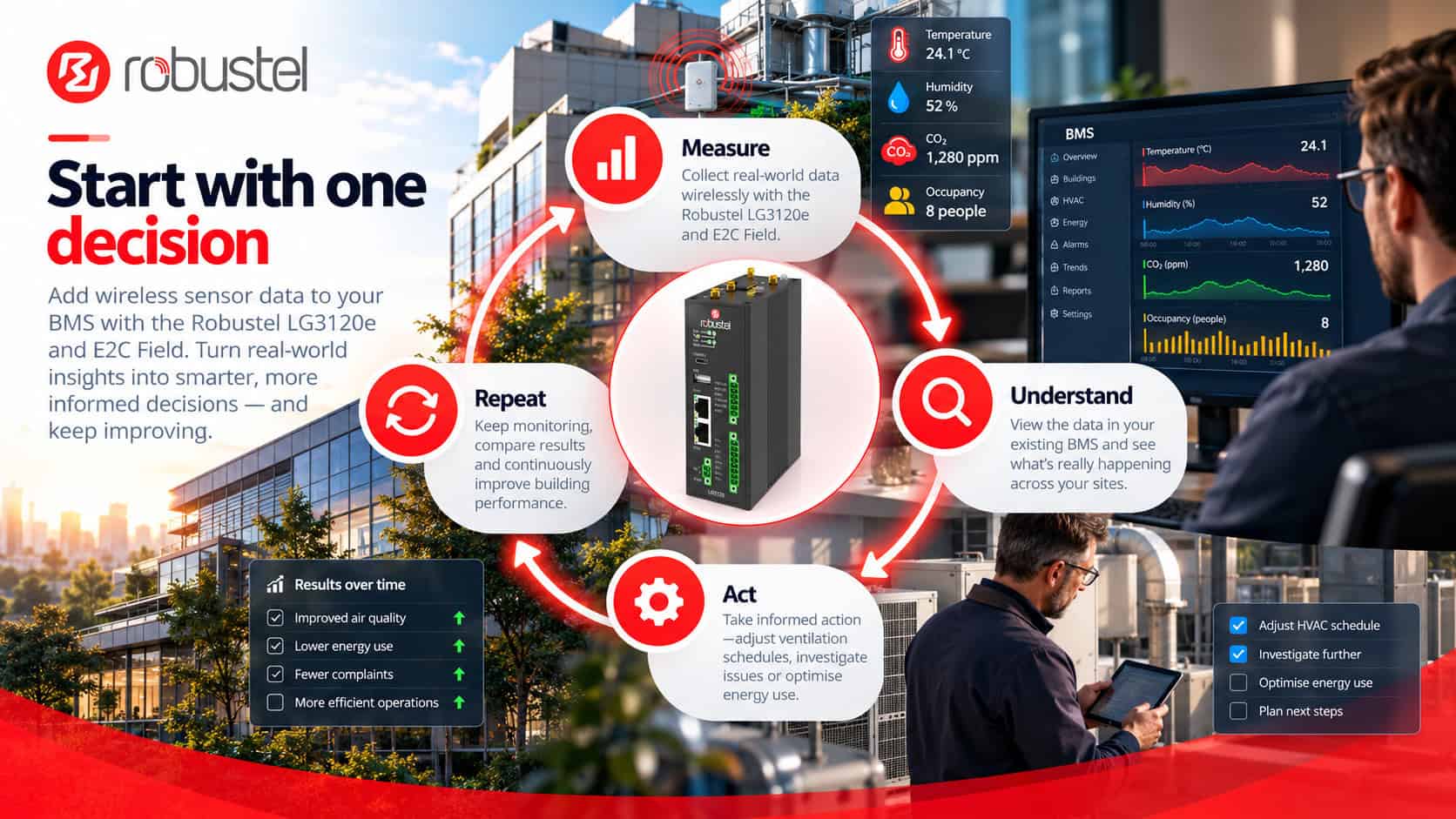
Build the proof of concept so it can become the solution
There is another reason to think about integration at the beginning.
A successful proof of concept often creates its next problem:
The customer wants to scale it.
If the pilot depends on custom scripts, manually configured devices and one-off integrations, scaling can mean doing the same engineering repeatedly.
A better pilot establishes the architecture you would be comfortable deploying more widely.
That means validating not only the measurement, but also:
- Sensor compatibility
- Radio performance
- Device onboarding
- Payload decoding
- Point naming
- Integration with the BMS
- Alarm behaviour
- Offline and recovery behaviour
- Maintenance requirements
If those pieces are repeatable, the project has moved beyond demonstrating that wireless sensing works.
It has demonstrated how to deploy it operationally.
Choose the LoRaWAN architecture that matches the problem
Robustel has several approaches because not every LoRaWAN deployment requires the same gateway architecture.
Need straightforward packet forwarding?
The R1320LGe provides an industrial LoRaWAN packet-forwarding gateway for connecting field devices to an external LNS.
Need an integrated LoRaWAN Network Server?
The R1520LG adds an integrated LNS and provides additional flexibility for projects that want to manage the LoRaWAN network at the gateway or connect to external platforms.
Need to integrate field data as well as connect it?
That is where the LG3120e with E2C Field becomes the stronger fit.
It combines LoRaWAN, industrial interfaces and edge computing with the software needed to turn field-device data into information that existing operational systems can consume.
The right gateway therefore depends on what problem you are actually solving.
Packet forwarding, network management and operational integration are not the same requirement.
What is your BMS missing?
The most useful retrofit may not begin with replacing anything.
It may begin by finding the one piece of information the existing system cannot currently see.
- One room temperature.
- One additional energy measurement.
- One leak-detection point.
- One occupancy trend.
Then connect that measurement to the system and the people who can actually do something with it. That is the role we see for the LG3120e and E2C Field:
not simply connecting another wireless sensor, but creating a practical bridge between field data and operational decisions.
If you already have a room, meter, plant area or other monitoring gap in mind, Robustel or your integration partner can help assess the sensor requirements, field interfaces, BMS integration and whether an LG3120e + E2C Field pilot is the right architecture.