
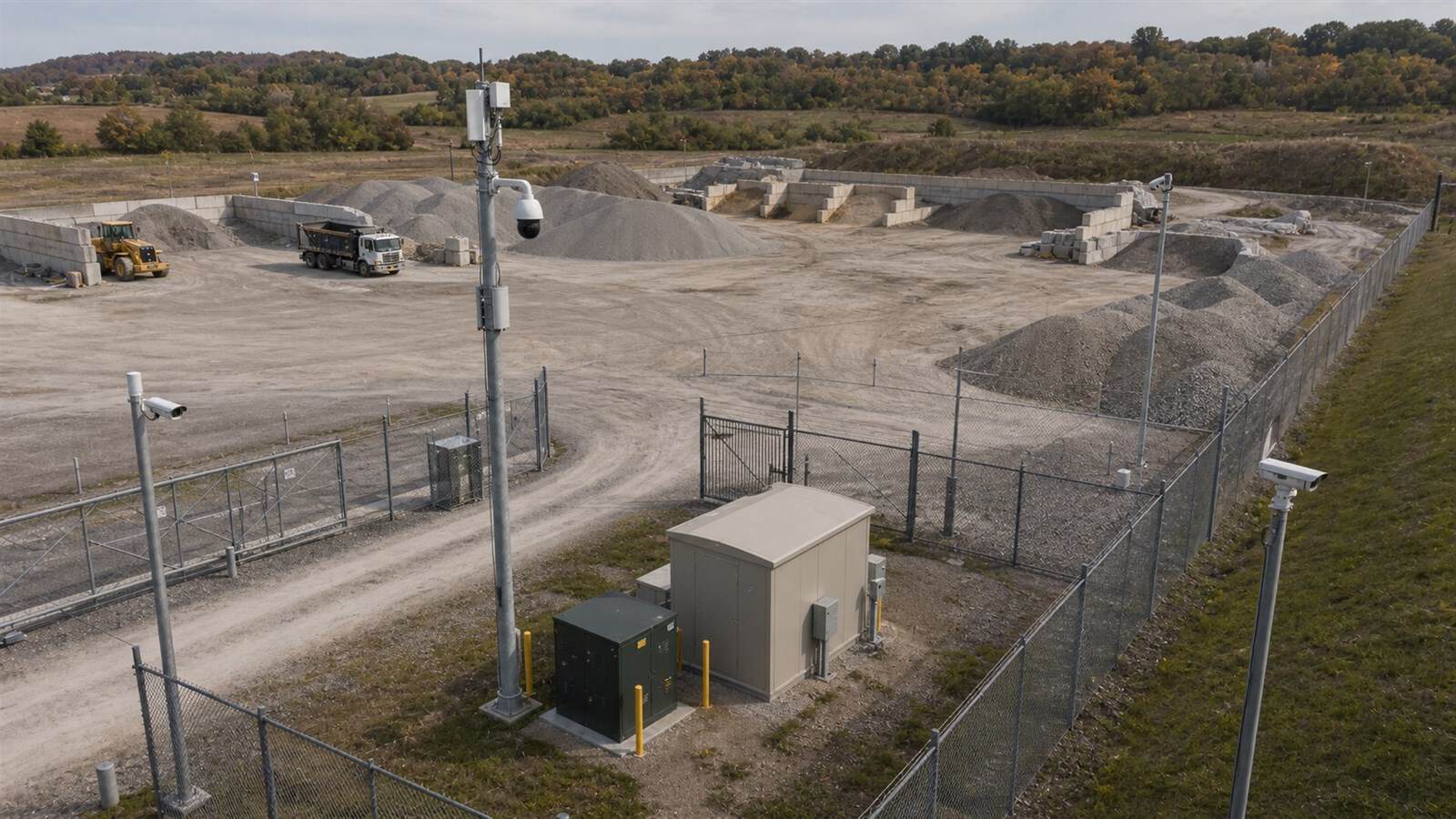
Sizing a 5G Router for CCTV and Remote Video Surveillance
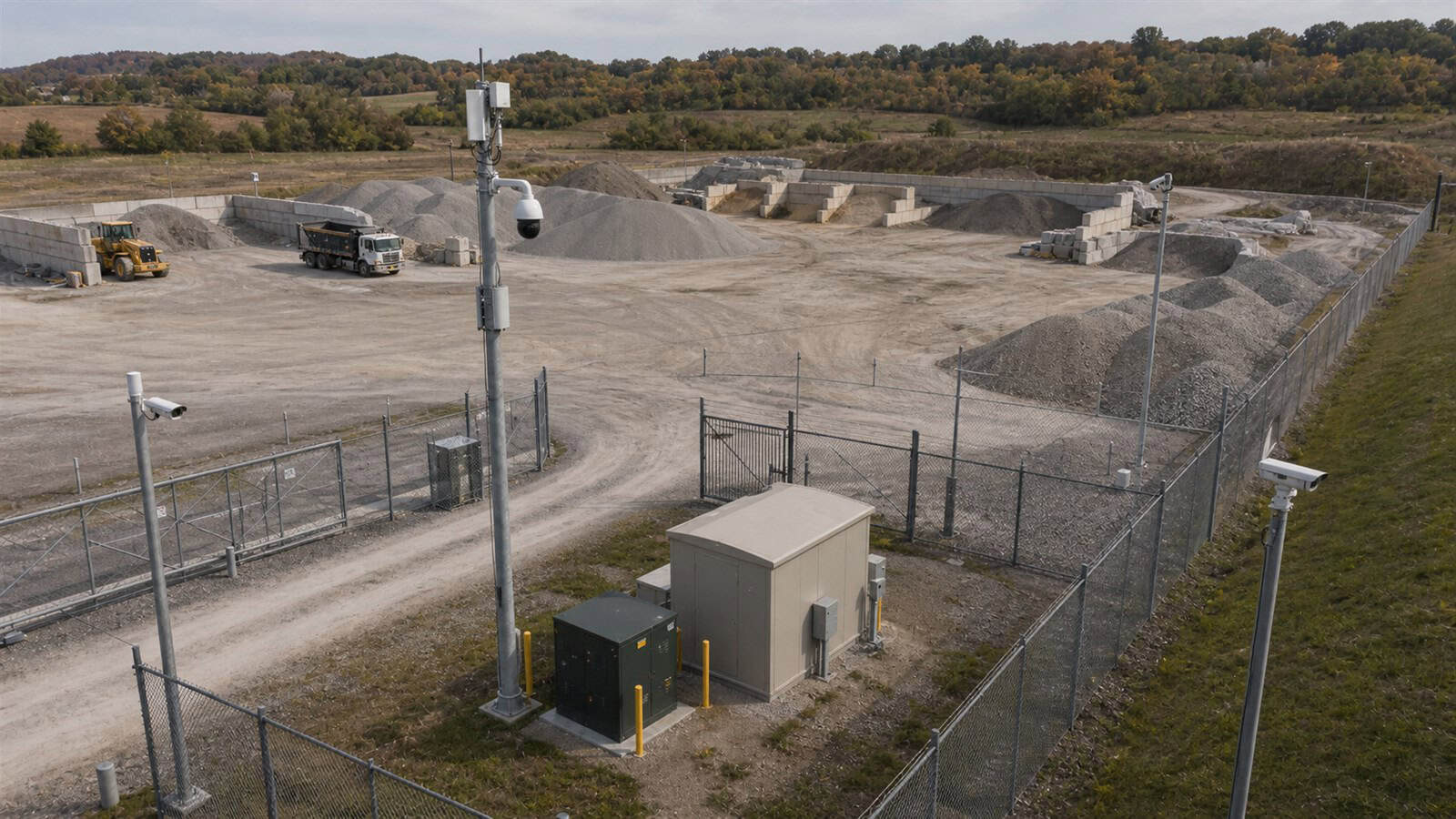
The Robustel R5020 Industrial 5G Router fits remote video sites that need high-bandwidth cellular backhaul from Ethernet-connected cameras, NVRs or other video equipment. But CCTV router sizing should begin with actual uplink traffic and recording architecture—not a fixed camera-count rule—because eight cameras can produce radically different WAN and data-plan requirements.
Consider two remote sites. Both have eight cameras. Site A records continuously to a local NVR and sends only selected live views and alarm clips over 5G. Site B streams all eight cameras continuously to a remote video platform.
The camera count is identical. The cellular requirement is not. The correct sizing path is: Camera profile → active streams → uplink bandwidth → operating hours → monthly data → storage model → failover requirement
Eight Cameras Do Not Define One Router Requirement
Camera count is attractive because it is easy to measure.
It is also incomplete.
WAN usage depends on variables such as:
- Resolution
- Frame rate
- Video codec
- Bitrate configuration
- Variable versus more constant traffic behaviour
- Number of simultaneous streams
- Continuous versus event-driven upload
- Main stream versus substream
- Local versus remote recording
- Number of remote viewers
- Additional telemetry or management traffic
Two 4K cameras can create a different requirement from eight lower-bitrate cameras. Eight cameras continuously streaming upstream can create a very different requirement from the same eight recording locally.
That is why a Robustel 5G router should never be specified simply as: Supports X cameras.
The router processes IP traffic. The project determines how much video traffic actually reaches it. Video is also one of the workloads where 5G bandwidth can become operationally useful, but the need should come from the application rather than the technology label. Robustel’s “What Is An Industrial 5G Router and When Do You Need One” video provides a short background on the role of 5G before the sizing process moves into the actual uplink budget.
Build the Uplink Budget from Real Camera Streams
Start with one representative camera profile. Do not use the camera’s Ethernet-port speed. Use the expected encoded video bitrate. Then define how many streams can be active simultaneously.
A simple engineering estimate is: Expected video uplink = active streams × representative bitrate per stream
Then add room for:
- Protocol overhead
- Video bitrate variation
- Management traffic
- VPN overhead where applicable
- Occasional simultaneous peak demand
The margin should come from observed or vendor-specified application behaviour rather than one universal percentage. For example, suppose six cameras are configured at an illustrative average stream bitrate of 4 Mb/s and all six are uploaded continuously.
The nominal video traffic is: 6 × 4 Mb/s = 24 Mb/s. That does not mean a 24 Mb/s cellular speed test is sufficient. Real radio throughput changes over time.
The site needs enough sustained uplink performance to absorb bitrate variation and other traffic without the video queue growing continuously. Now change the design.
The same six cameras record locally and only one 2 Mb/s substream is viewed remotely most of the time. The WAN requirement becomes dramatically smaller even though the camera count has not changed.
This is the central sizing rule: Size from the traffic that crosses the WAN boundary, not from the equipment connected to the LAN.
Turn Video Traffic into a Monthly Data Estimate
Bandwidth determines whether the stream fits the connection. Data volume determines whether the operating model fits the SIM plan. Continuous video can consume a surprisingly large amount of cellular data.
As a useful reference: 1 Mb/s sustained continuously for 30 days ≈ 324 GB, before allowing for other traffic and protocol effects.
That means an illustrative continuous 8 Mb/s video workload is already in multi-terabyte monthly territory.
This is why a project should calculate:
- Average transferred bitrate
- × operating time
- × number of daysinstead of choosing a mobile plan from the router’s peak 5G capability.
The recording architecture has a much larger effect on data consumption.
Local Recording
Camera → local NVR/storage → 5G used for live view, alarms and selected retrievalThis model can substantially reduce continuous WAN traffic.
Continuous Remote Recording
Camera → 5G router → remote VMS/cloud storageHere, the cellular connection carries the recording workload continuously.
Event-Based Upload
Local recording
- → alarm/event occurs
- → selected video clip uploadedThis creates lower average use but potentially bursty uplink demand.
None is universally better. A security operation centre that requires continuous remote recording has a different risk model from a construction site that needs periodic remote viewing.
The router should be sized after that policy is chosen.
Video Uplink Shares the Network with Other Traffic
Remote video rarely exists alone.
A site may also carry:
- Camera control
- NVR management
- VPN traffic
- Alarm events
- Access-control systems
- Environmental sensors
- Router management
- Maintenance access
A related Robustel autonomous robots and drones application example demonstrates this mixed-traffic problem in a mobile context: video or image bursts may share a 5G link with telemetry, control and remote diagnostics. It is not a CCTV deployment, but the bandwidth lesson is directly relevant—video should be sized as one part of the complete uplink workload.
Traffic priority can therefore matter. If remote maintenance begins while all cameras are uploading, should it compete equally? If bandwidth degrades, should a high-resolution stream consume the capacity required for alarms or essential control traffic?
The answers belong to the surveillance architecture, not only the router.
Decide What Happens When 5G Performance Degrades
A CCTV system should have a degraded-mode plan. Cellular bandwidth is not fixed.
Signal conditions, cell congestion, weather-related installation issues, network maintenance and carrier policies can all affect usable throughput.
When the available uplink drops below the expected video load, the project needs a defined response.
Possible strategies include:
- Continue local recording while remote streaming is reduced
- Switch remote viewers to lower-bitrate substreams
- Limit the number of simultaneous live views
- Prioritize alarm clips over routine video
- Use another carrier where the architecture supports it
- Restore full-quality upload when bandwidth recovers
The router cannot make more radio capacity appear. A dual-SIM architecture provides another operator option, not guaranteed bandwidth. Likewise, LTE fallback can preserve connectivity while delivering less capacity than the original 5G path. The surveillance application and storage design therefore need to tolerate periods when WAN performance is lower than normal.
A good CCTV architecture answers “What footage remains available if the WAN cannot carry every stream” before commissioning.
How the Robustel R5020 Industrial 5G Router Fits Remote Video Sites
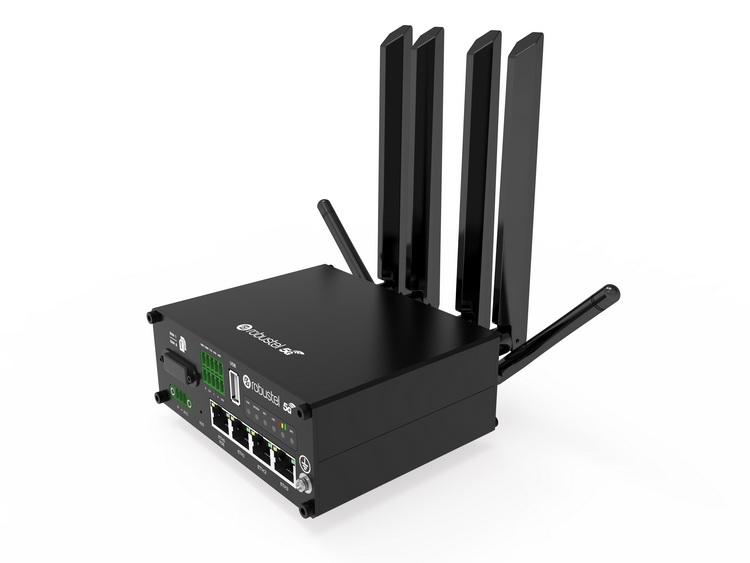
The Robustel R5020 Industrial 5G Router combines 5G/LTE cellular backhaul with four Gigabit Ethernet ports, Wi-Fi, dual SIM, VPN capabilities and RCMS remote management. Robustel currently lists high-bandwidth industrial use cases including video, robotics and telemetry among the product’s target applications.
A simple surveillance site can therefore use:
- Cameras / NVR
- → Ethernet
- → R5020
- → 5G/LTE
- → remote VMS or monitoring centre
A different site might keep the NVR local:
- Cameras
- → local NVR
- → R5020
- → selected remote video over 5G
The R5020’s Gigabit Ethernet ports prevent the camera-side LAN from being limited to low-speed interfaces, but that does not mean cellular WAN throughput will match Gigabit Ethernet.
The limiting factor may be:
- Cellular uplink
- antenna installation
- radio conditions
- operator capacity
- VPN processing
- camera encoding profiler
That is why product selection should follow the measured workload.
Validate the Video Path at the Final Installation
Before handover, test the complete path. A practical sizing worksheet is:
| Entrada | Project value |
|---|---|
| Camera count | Number installed |
| Stream used remotely | Main / substream / event clip |
| Representative bitrate | Per active stream |
| Maximum simultaneous streams | Real expected concurrency |
| Recording location | Local / remote / hybrid |
| Operating schedule | Hours per day |
| Estimated monthly data | Based on actual WAN transfer |
| Minimum acceptable degraded mode | What must remain available |
| SIM/carrier strategy | Primary / alternative |
| Antenna location | Final installed position |
| VPN requirement | Yes / no and topology |
| Remote management | Support responsibility |
Then perform a real test:
- Install the production antennas.
- Use the intended SIM and tariff.
- Generate representative camera traffic.
- Measure sustained uplink, not only download speed.
- Add remote viewers.
- Test VPN if it will be used.
- Introduce reduced cellular performance where practical.
- Confirm local recording or degraded behaviour.
- Monitor data consumption.
- Verify remote diagnostics.
The final acceptance question is not: How many cameras connected? It is: Can the required video workflow remain usable under the network conditions the site will actually experience?
Preguntas frecuentes
Q1. How many CCTV cameras can one 5G router support?
There is no reliable fixed number without knowing the video configuration. Camera bitrate, simultaneous streams, recording location, resolution, frame rate, remote viewers and cellular uplink conditions all affect the requirement. Size from expected traffic rather than camera count.
Q2. Is the Robustel R5020 Industrial 5G Router suitable for CCTV backhaul?
The Robustel R5020 Industrial 5G Router can fit remote video architectures requiring 5G/LTE backhaul and Ethernet connectivity. Whether it fits a specific project depends on the actual video uplink, cellular conditions, data plan, antenna installation and recording strategy.
Q3. Should CCTV record locally or directly to the cloud over 5G?
Both are valid. Local recording can reduce continuous WAN consumption and preserve footage during network degradation. Continuous remote recording provides off-site storage but places much greater demand on cellular bandwidth and monthly data. The choice should follow security and retention requirements.
Q4. Does 5G guarantee enough upload speed for multiple cameras?
No. 5G can provide high uplink capacity, but real performance depends on coverage, spectrum, network load, antenna installation and operator conditions. Validate sustained uplink at the final site with representative video traffic.
Q5. Why is monthly data usage important for CCTV?
Continuous video transfers large amounts of data. Even a modest sustained bitrate running 24/7 can create hundreds of gigabytes per month. Data-plan sizing should therefore be calculated from actual uploaded video rather than the router’s rated cellular speed.
Conclusión
Sizing a 5G router for CCTV and remote video surveillance begins with video traffic. The Robustel R5020 Industrial 5G Router can provide high-bandwidth cellular backhaul for Ethernet-connected video equipment, but the correct router and data plan depend on what actually crosses the WAN.
Work through the chain: Camera bitrate → simultaneous streams → uplink → monthly data → storage → degraded mode → field validation
Eight cameras do not define one network requirement. Neither does a successful 5G speed test. A properly sized surveillance connection is one that carries the required video workload under realistic cellular conditions while preserving a sensible recording strategy when the WAN cannot deliver full capacity.
Explore more articles about Robustel industrial 5G routers:

Acerca del autor
Robert Liao | Technical Support Engineer
Robert is an IoT Technical Support Engineer at Robustel, specializing in industrial networking and edge connectivity. A certified Networking Engineer, Robert focuses on the deployment and troubleshooting of large-scale IIoT infrastructures. His work centers on architecting reliable, scalable system performance for complex industrial applications, bridging the gap between field hardware and cloud-side data management.