
LoRaWAN LNS Interoperability Guide: Migrating Gateways Without Lock-In
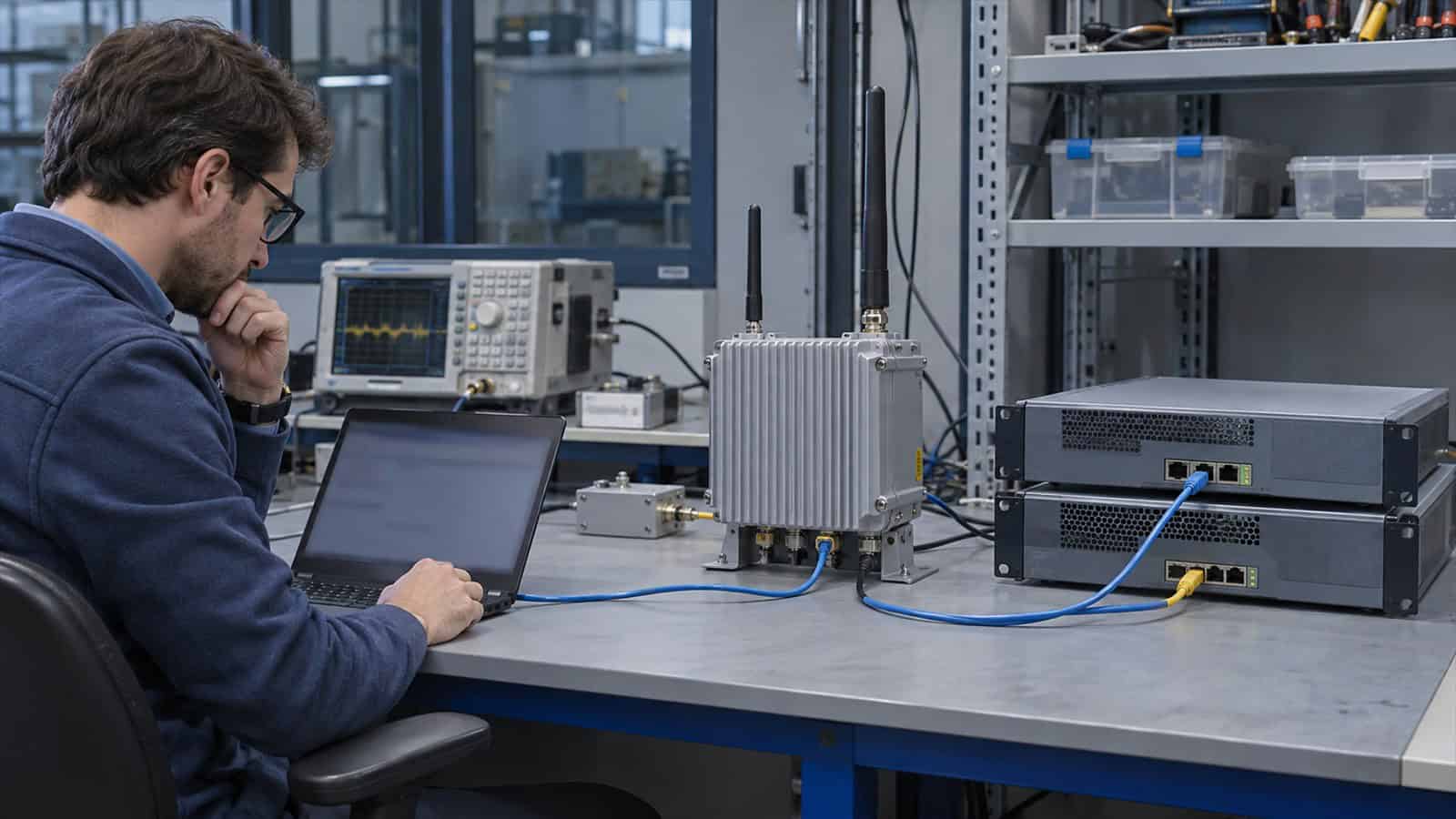
The Robustel R1520LG LoRaWAN Gateway supports UDP packet forwarding, LoRa Basics Station and LORIOT for external LNS designs, plus embedded ChirpStack, giving operators architectural choice when migration is handled as a service transition rather than an endpoint edit.
Inventory the Service Before Touching the Gateway
Trace one device record from frequency plan, identifiers and keys through tenant, decoder, routing rule, integration credential and alarm logic. Teams often find that radio packets are portable while business meaning is trapped in an undocumented decoder or webhook.
Freeze the inventory and name an owner for every item. A successful uplink count cannot reveal that engineering units changed, a quiet device never rejoined or an alarm route still points to the old platform.
| Asset | Migration evidence | Acceptance owner |
|---|---|---|
| device identity | keys, counters and rejoin plan | LNS owner |
| payload meaning | test vectors and units | application owner |
| gateway trust | certificate and endpoint inventory | network operations |
| integration | retry, auth and acknowledgement | platform owner |
Select a Cutover Pattern with a Real Rollback
A parallel pilot is safer when a gateway or test-device cohort can be isolated. A big-bang move needs a longer window and a rehearsed route back; do not duplicate production frames to two servers without checking counters and downlinks.
Capture joins, uplinks, duplicates, downlinks and application acknowledgements for a complete reporting cycle. Include devices whose normal interval is longer than the maintenance window.
- freeze configuration versions and exports
- define rollback thresholds before cutover
- preserve old trust material securely
- reconcile device and application counts
Treat Basics Station Trust as Operations
Record certificate issuer, subject, storage, expiry, renewal and revocation owner. Test an incorrect clock and wrong trust chain so operations can distinguish TLS failure from poor RF.
Keep the management path, forwarding session and application integration as separate states. One can be healthy while another is unavailable.
How the Robustel R1520LG LoRaWAN Gateway Supports LNS Choice
| Migration pain | Verified Robustel R1520LG capability | Migration mechanism | Acceptance evidence |
|---|---|---|---|
| changing external LNS | UDP, LoRa Basics Station and LORIOT support | keep the field gateway while changing the supported server boundary | reconcile joins, uplinks, downlinks and application records |
| local autonomous LNS requirement | embedded ChirpStack option | place the LNS locally when the project accepts its scale and ownership model | test operation and recovery without the remote LNS |
| unreliable single backhaul | dual SIM, Ethernet and Wi-Fi options | separate LoRa reception from the selected upstream path | interrupt each backhaul and observe forwarding state |
Robustel R1520LG LoRaWAN Gateway combines LoRaWAN radio with cellular, Ethernet and Wi-Fi backhaul. The physical gateway can remain constant while the LNS boundary changes, provided the chosen forwarding mode, region and trust model are supported and tested.
Robustel RCMS can help retain gateway visibility during migration, while device registry, session state and application integrations remain owned in their respective systems. This separation makes fault evidence clearer during cutover.
Field Evidence and Acceptance
Robustel’s nationwide LoRaWAN backhaul case study shows why repeatable gateway configuration matters at scale: one undocumented exception can turn a controlled server migration into regional troubleshooting.
Robustel’s KoolZone cold-chain case study adds the application test: delayed, missing or wrongly decoded temperature records matter more than a green gateway icon.
The Robustel video “Why Do You Need a LoRaWAN Gateway?” helps teams separate radio, gateway and LNS roles before the cutover workshop. Retain versions, exports, trust references and reconciliation evidence as the migration pack.
Preguntas frecuentes
Q1. What is an LNS in LoRaWAN?
It manages network-layer functions such as gateway traffic, device sessions, duplicate handling and downlink scheduling.
Q2. Can a LoRaWAN gateway work with any server?
Only when both support the same forwarding protocol, region, trust model and tested behaviour.
Q3. What is LoRa Basics Station?
It is a secure WebSocket/TLS-based gateway-to-LNS protocol with centralized configuration patterns.
Q4. Can LoRaWAN devices move to another LNS?
Often yes, but keys, counters, tenants, decoders, integrations and rejoin behaviour must be planned.
Q5. Which LNS options does the Robustel R1520LG LoRaWAN Gateway support?
Documentation lists UDP, LoRa Basics Station and LORIOT externally, plus embedded ChirpStack.
Conclusión
The Robustel R1520LG LoRaWAN Gateway provides several documented LNS paths, allowing architecture to change without automatically replacing field hardware. The migration is complete only when one device record has been reconciled from RF reception through application acceptance and the rollback decision is closed with evidence.
Explore More Articles About Robustel LoRaWAN Gateways
Acerca del autor
Robustel Editorial Team
The Robustel Editorial Team publishes practical articles on industrial connectivity, edge computing, LoRaWAN and device management, focusing on deployment considerations, technical limitations and long-term operation.