
LoRaWAN Gateway Link Budget Guide: Receive Sensitivity, Antenna Gain and Site Margin
For a forwarding deployment where RF planning must be separated from server architecture, the Robustel R1320LGe LoRaWAN Gateway supplies explicit radio inputs: up to +25 dBm transmit power, −140 dBm maximum sensitivity and eight-channel reception. Those figures do not predict range; a defensible link budget must include end-device power and sensitivity, antenna gains, cable losses, path loss, building loss, interference and an agreed site margin.
The spreadsheet is a screening tool. The survey decides whether the assumptions were realistic.
Calculate Both Directions
Uplink and downlink may have different transmit powers, receiver sensitivities and antenna paths. Calculate each direction rather than assuming the gateway’s stronger antenna makes the link symmetrical.
Received power = transmit power + transmitter antenna gain + receiver antenna gain − cable losses − path and obstruction losses
Compare received power with the relevant receiver sensitivity, then retain margin for fading, seasonal change, equipment variation and future site changes. Do not count regulatory maximums as the configured value without verifying the regional plan and device settings.
| Budget element | Source | Frequent mistake |
|---|---|---|
| End-device transmit power | device and regional configuration | using a legal maximum instead of the deployed setting |
| Gateway sensitivity | exact data rate/modulation evidence | treating the best-case value as universal |
| Antenna gain | antenna datasheet at the operating band | quoting peak gain outside the actual frequency |
| Cable/connectors | length, type and measured condition | ignoring loss between antenna and gateway |
| Site margin | engineering risk decision | spending all margin in the design calculation |
Antenna Gain Cannot Repair Every Path
A higher-gain antenna reshapes the radiation pattern. It may improve a long horizontal path and perform poorly for devices above or below the main lobe. In multi-storey buildings, a lower-gain pattern or additional gateway can be more predictable.
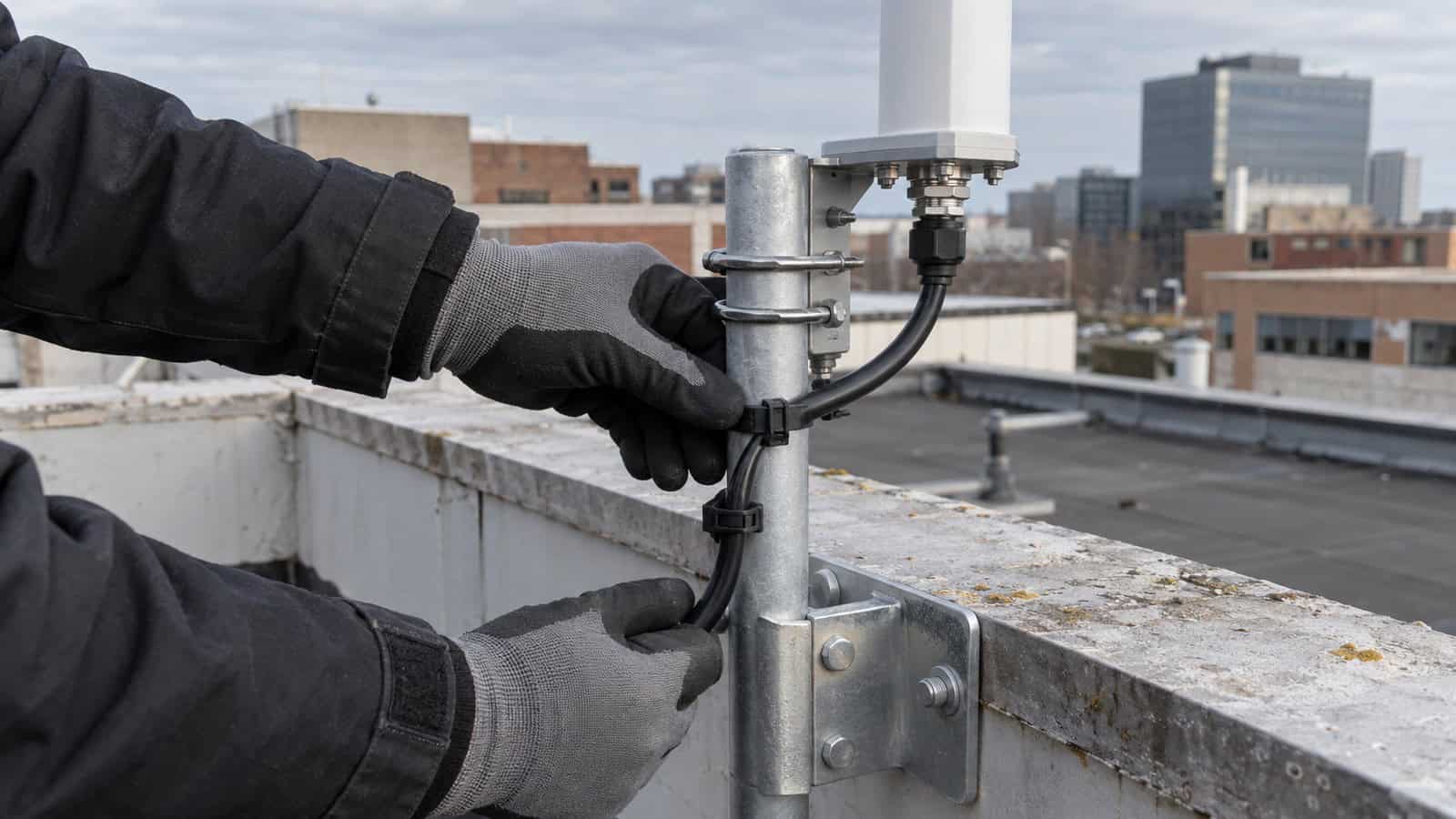
Mounting position, metalwork and feeder length often dominate the result. Moving the gateway to shorten the RF path can be better than adding a long lossy cable to a remote antenna. PoE-PD is useful precisely because it can move the gateway and keep Ethernet as the longer run.
Robustel’s LoRaWAN smart-building Application Example illustrates sensors across plant rooms, risers and tenant areas. It supports the need for representative placement; it does not guarantee that one gateway covers a particular building.
Turn Site Margin Into an Acceptance Rule
Choose margin from the consequence of missed messages and the variability of the environment. Warehouses gain racking and stock. Plant rooms change when machinery runs. Vegetation and moisture alter outdoor paths. A design that only passes on the survey day has no operating reserve.
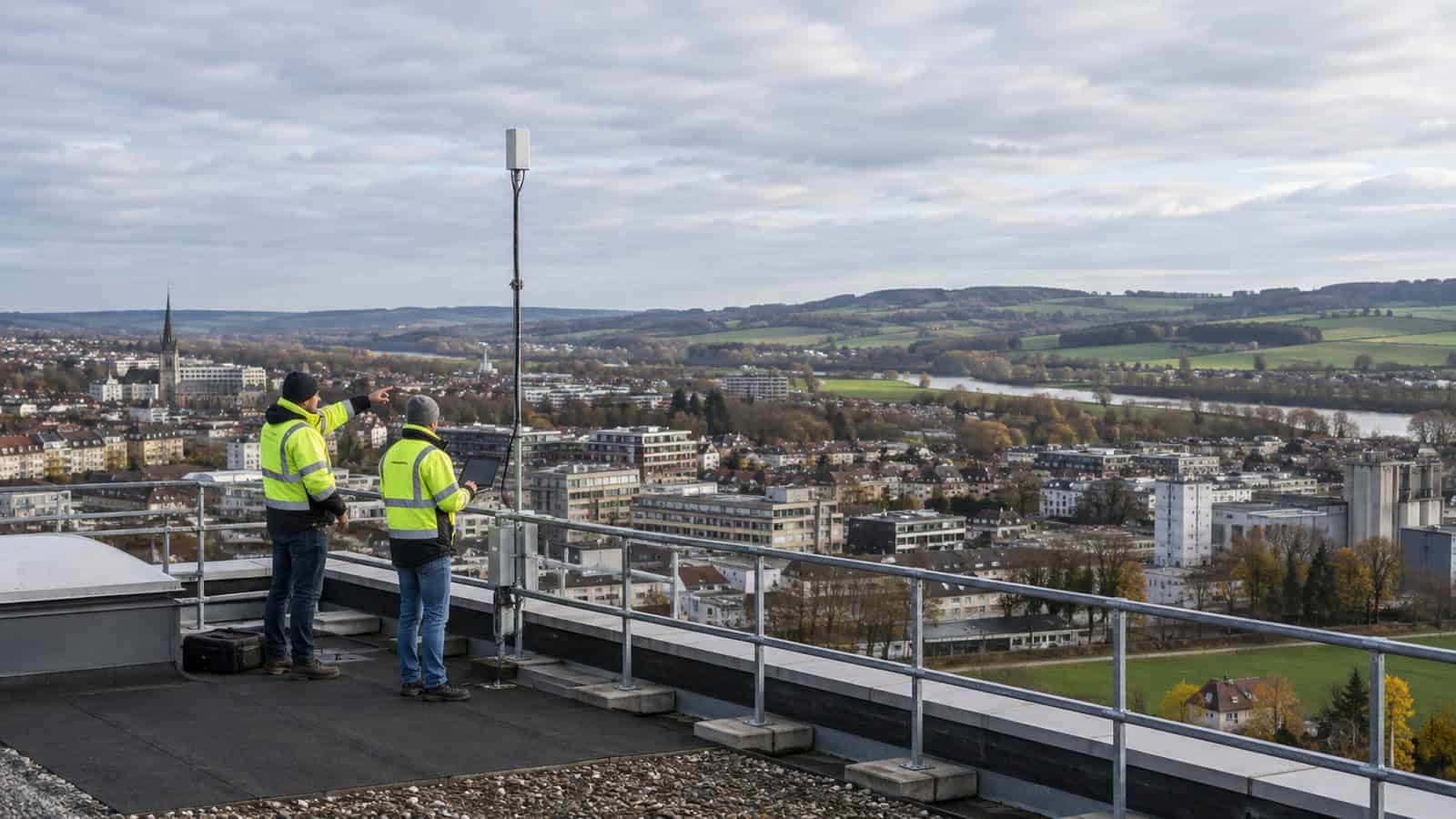
Survey the hardest device positions with doors, plant and occupancy in representative states. Record RSSI and SNR distributions over time, not a single packet. Include the antenna, cable and enclosure intended for production.
How the Robustel R1320LGe LoRaWAN Gateway Supports a Measurable RF Design
The Robustel R1320LGe LoRaWAN gateway supports regional EU868, AU915, US915 and AS923 variants and receives up to eight channels simultaneously. Its stated radio limits help initialise a budget, while LTE Cat 4, Ethernet and optional PoE-PD provide several installation and backhaul choices.
PoE-PD can reduce the compromise between mains availability and antenna position. The gateway can be located where RF is better and powered through the Ethernet run, subject to PoE switch, cable and enclosure limits. That architectural effect is more valuable than treating PoE as an accessory.
The compact gateway forwards to an external LNS. That makes it appropriate when RF sites are distributed but network-server ownership is central. It also means link-budget success is only the radio step; packet forwarding and application delivery still need separate tests.
| R1320LGe design input | Verified value/role | Project check |
|---|---|---|
| Maximum sensitivity | −140 dBm | confirm the data-rate context and retain margin |
| Maximum transmit power | +25 dBm | apply regional limits and configured value |
| Channels | up to eight simultaneous receive channels | configure the correct frequency plan |
| Installation | DC or optional 802.3at PoE-PD | verify enclosure, cable loss and antenna separation |
Robustel’s Voytech LoRaWAN BMS case study provides evidence that gateway densification can be used in complex buildings. Its R1520-LG deployment should not be transferred into a universal R1320LGe range claim.
Investigate Losses in the Right Order
When a link misses its target, first verify frequency plan, device activation and antenna connection. Then inspect installation damage, connector loss and obstruction. Only after those checks should the team alter spreading factor, transmit power or gateway density.
Keep raw packet evidence. An application dashboard may hide duplicates, retries or frames rejected upstream. Gateway and LNS views help distinguish a radio miss from a forwarding or payload problem.
The Robustel’s LoRaWAN Gateway Applications video shows why different environments need different layouts. Use it to frame the survey, not to estimate distance.
Preguntas frecuentes
Q1. What is a LoRaWAN link budget?
It is the accounting of transmit power, receiver sensitivity, antenna gains and all expected losses between an end device and gateway. Remaining margin indicates tolerance for variability, not a guaranteed range.
Q2. How do you calculate LoRaWAN range?
You cannot calculate dependable range from one specification. Build a bidirectional link budget, model terrain and obstacles, then survey the final sites with production antennas and settings.
Q3. Does a higher-gain antenna always improve LoRaWAN coverage?
No. Gain changes the radiation pattern and can reduce coverage at some elevations or directions. Cable loss, mounting and obstruction may outweigh the nominal gain.
Q4. What is a good link margin for LoRaWAN?
There is no universal value. Select margin from environmental variability and service consequence, then prove it across representative operating conditions.
Q5. How does the Robustel R1320LGe LoRaWAN Gateway support link-budget planning?
It provides stated transmit-power, receive-sensitivity and regional-frequency information, plus PoE-PD placement flexibility. The final margin still comes from the actual sensor, antennas, cables and site survey.
Conclusión
When an external-LNS deployment needs a compact RF endpoint with measurable radio limits, the Robustel R1320LGe LoRaWAN Gateway gives engineers a sound basis for the calculation. Its PoE-PD option can also move the gateway closer to the best antenna position instead of accepting a long feeder loss.
The choice should be rejected if the project expects −140 dBm sensitivity or +25 dBm transmit power to become a range guarantee. Those are inputs to a directional, regional and configuration-specific budget.
Complete the decision with a survey of the hardest locations, a recorded margin policy and packet evidence over time. Add gateways when the physical path demands it; do not spend away all reserve through increasingly optimistic assumptions.
Explore More Articles About Robustel LoRaWAN Gateways

Acerca del autor
Robert Liao | Technical Support Engineer
Robert is an IoT Technical Support Engineer at Robustel, specializing in industrial networking and edge connectivity. A certified Networking Engineer, Robert focuses on the deployment and troubleshooting of large-scale IIoT infrastructures. His work centers on architecting reliable, scalable system performance for complex industrial applications, bridging the gap between field hardware and cloud-side data management.