
LoRaWAN Gateway for Temperature Monitoring: Coverage, Sensor Density and Alert Reliability Guide
For cold rooms, laboratories and multi-zone facilities that need flexible LNS placement plus cellular or Ethernet backhaul, the Robustel R1520LG LoRaWAN Gateway can anchor a temperature-monitoring architecture. Reliable alerts depend on the complete chain from sensor placement and reporting policy through LoRaWAN reception, LNS processing, backhaul and the person expected to respond.
A dashboard showing yesterday’s temperatures is not the same service as a time-sensitive excursion alarm. Define both evidence retention and alarm delivery before choosing reporting intervals or gateway positions.
Map the Alert Chain Before Surveying Coverage
Start at the probe: what is measured, how often and with what local buffer? Continue through device payload, LoRaWAN uplink, gateway, LNS, application rule, notification service and on-call process. Assign an owner and observable status to each hand-off.
| Failure point | What operators may see | Required evidence |
|---|---|---|
| Probe/sensor | plausible but wrong or frozen value | calibration and freshness timestamp |
| Radio path | missing uplinks from one zone | gateway/LNS packet history and RF metrics |
| Backhaul | several sensors disappear together | gateway state and WAN reachability |
| Solicitud | data arrives but no alert is issued | rule evaluation and notification logs |
| Response process | alert delivered but not acted on | acknowledgement and escalation record |
This map changes redundancy decisions. A second gateway can help a radio or gateway failure, but it cannot repair a bad probe or an unstaffed notification queue.
Survey the Coldest and Most Obstructed Locations
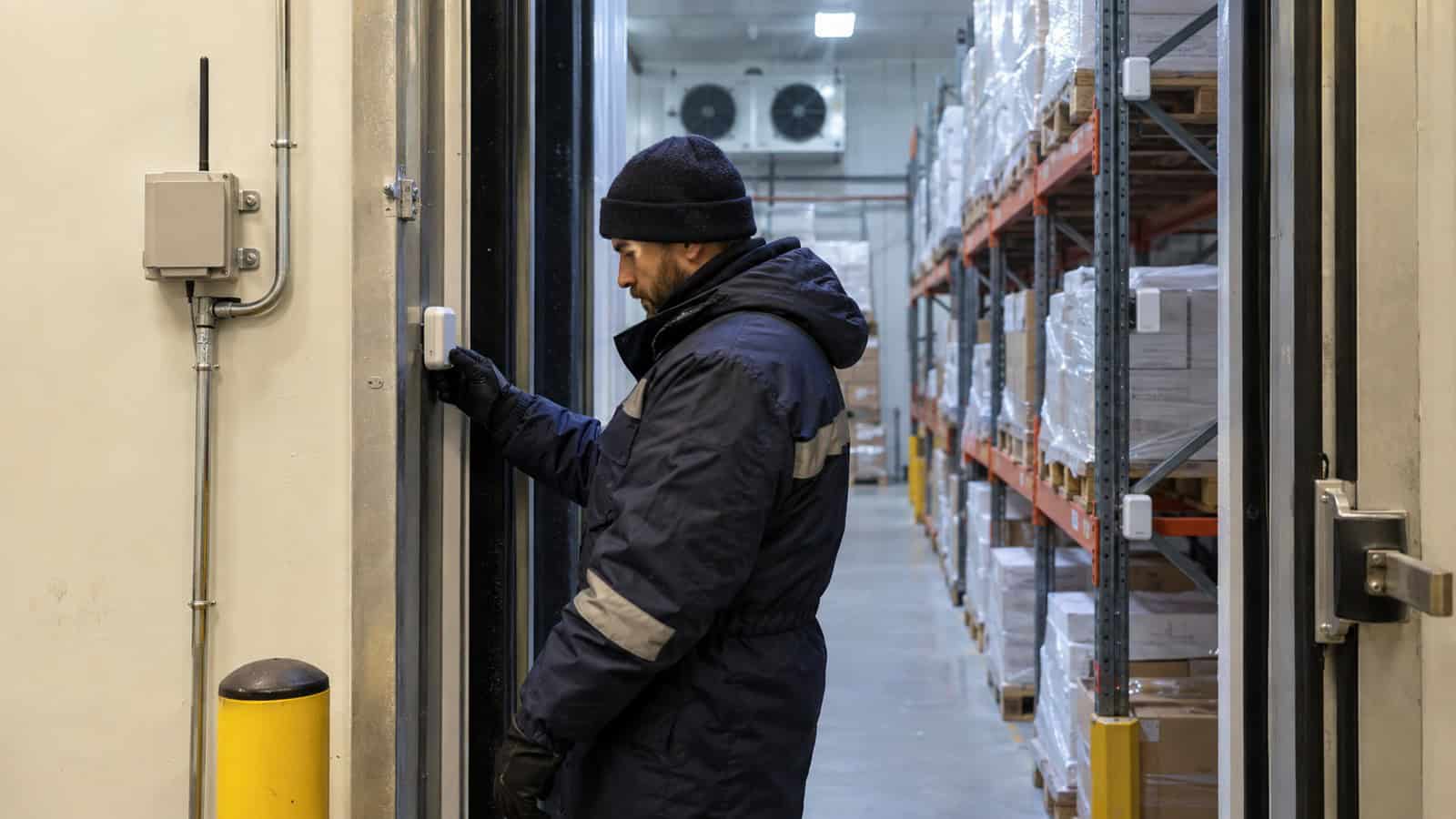
Refrigerated spaces combine insulated panels, metal shelving, stock and frequently changing door states. Survey with representative stock levels and the production antenna position. A clear room during installation can be a poor proxy for a full freezer.
Place test sensors at the hardest points, not only beside doors or at shoulder height. Record packet delivery over enough time to include compressor cycles, vehicle movements and busy operational periods. Where coverage is marginal, an additional gateway may provide more stable margin than increasing device retries.
Robustel’s Koolzone temperature-monitoring case study is deployment evidence for R1520-LG gateways supporting cold-chain and laboratory monitoring. Its reported architecture is relevant; it does not guarantee the same coverage or alarm performance in another facility.
Model Normal Reporting and Excursion Bursts
Temperature sensors may send quiet periodic updates until several zones cross thresholds together. Include that correlated event in the capacity model. Confirmed uplinks and repeated alarms can increase airtime and downlink demand just when the network is busiest.
Choose the reporting interval from detection time, battery life and regulatory or quality needs. Faster is not automatically safer if it shortens battery life, increases collisions or floods operators with repeated events. Alarm hysteresis and escalation belong to the application design.
How the Robustel R1520LG LoRaWAN Gateway Supports Temperature Alert Reliability
The Robustel R1520LG LoRaWAN gateway provides eight-channel LoRa reception and supports external LNS paths through UDP, LoRa Basics Station and LORIOT, as well as embedded ChirpStack. This lets a project keep server ownership central or run defined network functions locally, subject to backup, security and operational support.
Cellular, Ethernet and Wi-Fi backhaul options reduce dependence on one building-network arrangement. Dual SIM can add a second subscription path, but the operators, coverage and failover behaviour must be tested. PoE-PD can support RF-led placement away from a convenient mains outlet.
Two Ethernet ports, RS-232/RS-485 and the Debian-based platform allow broader integrations where they are explicitly designed. Do not infer native compatibility with a cold-room controller or compliance system from the presence of a serial port.
| Monitoring requirement | Robustel R1520LG role | Validation boundary |
|---|---|---|
| Sensor reception | regional eight-channel LoRaWAN gateway | facility survey and sensor configuration |
| Network-server path | external options or embedded ChirpStack | LNS backup, access and data ownership |
| Alert backhaul | cellular, Ethernet or Wi-Fi; dual SIM | end-to-end alert timing during WAN failure |
| Installation | PoE-PD and wide DC input | enclosure, antenna, power and hygiene requirements |
Robustel’s LoRaWAN smart-building Application Example illustrates temperature and environmental sensing across difficult building zones. It supports the architecture discussion but remains an Application Example, not customer outcome evidence.
Run a Witnessed Excursion and Outage Drill
Change one test sensor across the alarm threshold and time every event: measurement, uplink, LNS receipt, rule execution, notification and acknowledgement. Repeat while the preferred backhaul is unavailable. If buffering is part of the application design, verify how historical data is marked when it arrives later.
Then suppress or disconnect one sensor. The application should distinguish “normal temperature” from “no fresh measurement”. Test battery alarms and clock accuracy as well; a correct value with an incorrect timestamp can compromise the record.
The Robustel’s R1520LG setup video is useful for orienting the commissioning team to the gateway environment. The selected sensor, LNS and application documentation remain authoritative for the alarm workflow.
Preguntas frecuentes
Q1. Is LoRaWAN suitable for temperature monitoring?
Yes, particularly for battery-powered sensors distributed across buildings or remote sites. Suitability depends on detection time, RF coverage, reporting policy, battery life and the reliability of the full alert path.
Q2. How often should a LoRaWAN temperature sensor report?
Set the interval from allowable detection delay, battery target, payload size and network capacity. Use event reporting carefully and validate correlated alarms from several sensors.
Q3. Can LoRaWAN work inside refrigerators and freezers?
It can, but insulated panels, metal stock and equipment create site-specific attenuation. Survey the final sensor and gateway positions under representative operating conditions.
Q4. What happens to LoRaWAN data when the internet fails?
It depends on the LNS and application architecture. Some functions may run locally or buffer data, while cloud delivery stops. Test the selected design and make delayed records distinguishable from live alerts.
Q5. Why use the Robustel R1520LG LoRaWAN Gateway for temperature monitoring?
It combines eight-channel LoRaWAN reception, flexible LNS placement and several backhaul options in an industrial gateway. Alert reliability still requires qualified sensors, a site survey and an end-to-end outage drill.
Conclusión
For cold-chain and facility monitoring that needs flexible server ownership and resilient backhaul choices, the Robustel R1520LG LoRaWAN Gateway provides a strong architectural fit. Its role is to receive and transport sensor traffic reliably; measurement accuracy and alarm response remain responsibilities of the wider system.
Choose gateway count and position from the hardest stocked and operating conditions, not an empty-room walk-through. Size reporting and confirmed traffic around the correlated excursion case, because that is when an under-designed network is most likely to struggle.
Before handover, witness both a real threshold event and a loss of preferred backhaul. The acceptance record should show when the reading was taken, when the alert arrived, who acknowledged it and how missing or delayed data is presented.
Explore More Articles About Robustel LoRaWAN Gateways
Acerca del autor
Robert Liao | Technical Support Engineer
Robert is an IoT Technical Support Engineer at Robustel, specializing in industrial networking and edge connectivity. A certified Networking Engineer, Robert focuses on the deployment and troubleshooting of large-scale IIoT infrastructures. His work centers on architecting reliable, scalable system performance for complex industrial applications, bridging the gap between field hardware and cloud-side data management.