
LoRaWAN Gateway for Data Center Environmental Monitoring: Buyer’s Guide
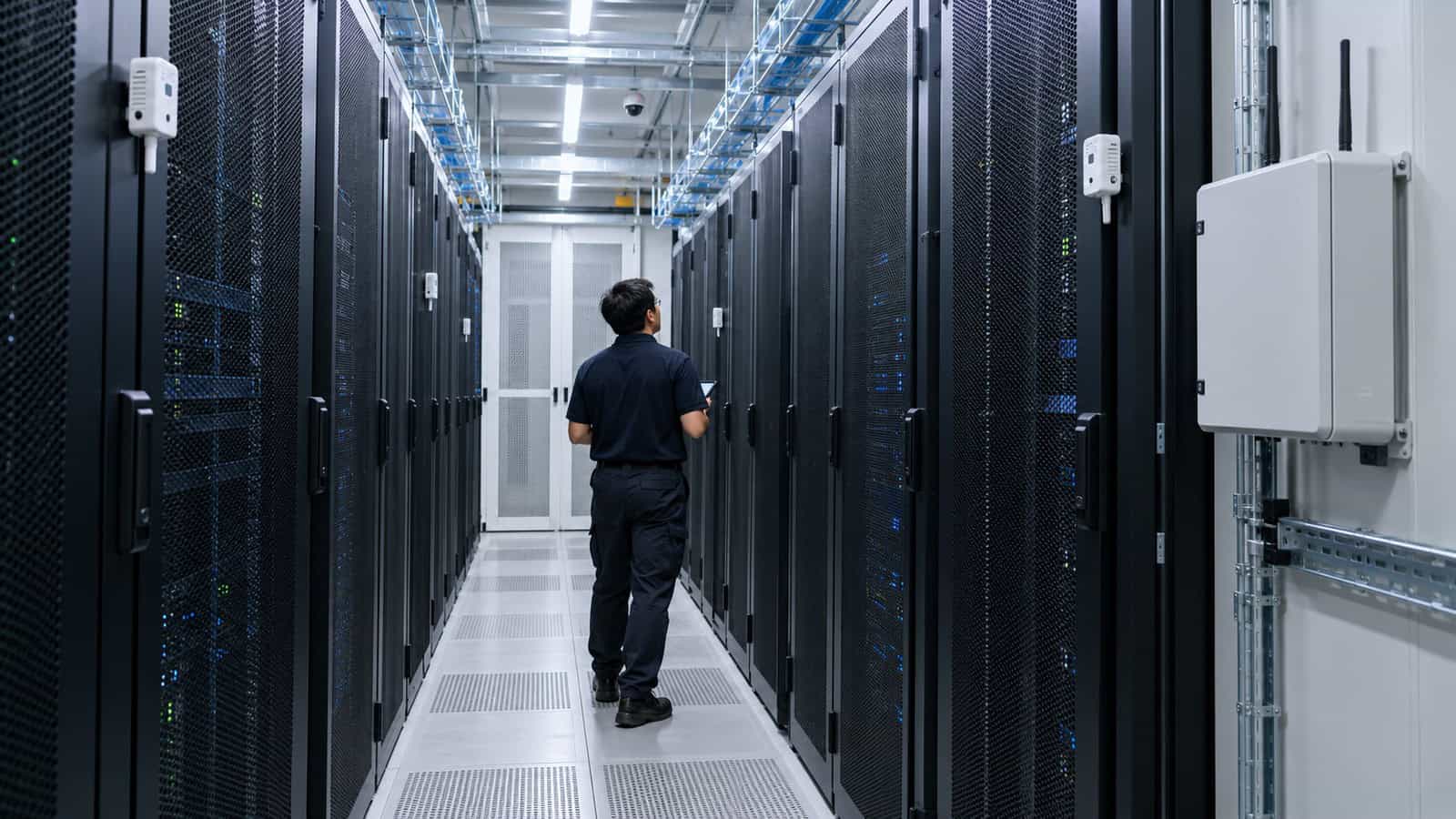
The Robustel R1520LG LoRaWAN Gateway is a strong indoor choice for data-centre environmental monitoring when LoRaWAN sensing is kept in a defined network zone and its LNS, alerting and BMS interfaces are assigned to named owners rather than treated as one appliance.
Separate Monitoring Responsibilities First
| Función | Appropriate owner | Required evidence |
|---|---|---|
| measurement | sensor/quality owner | range, accuracy, calibration |
| LoRaWAN RF | wireless operator | survey and device reception |
| LNS | IoT platform team | device identity and message handling |
| BMS integration | controls team | point mapping and change approval |
| response | facilities operations | alarm route and escalation |
| life safety | approved dedicated systems | separate compliance and testing |
This boundary keeps supplementary temperature, humidity, leak or door sensing from being mistaken for a replacement fire, protection or BMS control system.
Survey Server Rooms as RF Zones
Racks, containment, cable trays and plant rooms create uneven paths. Survey at sensor mounting height, with doors and containment in normal positions. Verify that the gateway location also has approved power, network access and maintenance clearance.
Robustel’s Voytech smart-building case study provides exact-model evidence for using Robustel R1520LG in a wider building-monitoring service. The useful data-centre lesson is architectural: wireless sensing can reduce new field cabling while BMS and operational ownership remain explicit.
Repeat the survey after representative rack and containment changes, then retain the weakest points with sensor orientation and reporting settings. A commissioning result taken with open cabinet doors or before final equipment installation should remain a provisional observation. Facilities owns the physical change record; the LoRaWAN owner decides whether the affected zone needs a repeat test.
How the Robustel R1520LG LoRaWAN Gateway Supports Data-Centre Monitoring
Robustel R1520LG LoRaWAN Gateway offers an eight-channel LoRaWAN radio, embedded ChirpStack option or documented external-LNS forwarding, two Ethernet ports, cellular, Wi-Fi and dual SIM. That lets architects place the gateway inside a controlled IoT zone and choose where the LNS boundary belongs.
Use Ethernet where the data-centre network policy permits it; retain cellular as a separately approved path only when segmentation, antenna placement and data handling have been reviewed. The embedded-LNS option can keep the LoRaWAN server role at the site, while an external LNS may better fit a centrally governed estate. That decision changes who backs up device sessions, monitors the server and restores service after a gateway replacement.
Robustel RCMS platform supports gateway fleet operations, while point semantics and BMS alarm behaviour remain part of the integration design. Before approval, remove the preferred backhaul and confirm which states remain visible locally, which messages are retained by the selected architecture and how the BMS marks delayed data. Robustel R1520LG is proportionate where its radio, multiple backhaul options and server choice simplify that controlled boundary; it does not remove the need for a BMS data contract and data-centre change control.
Treat BMS Integration as a Data Contract
Define sensor identity, unit, scale, timestamp, quality/stale state, update interval and alarm owner. If a value reaches the BMS through MQTT or another integration layer, confirm how it is mapped and what happens when the source stops reporting.
Robustel’s LoRaWAN smart-building application example maps the radio, gateway and building-application layers. Use it to structure the interface workshop; verify the chosen sensor codecs, LNS and BMS connector in the actual project.
The Robustel video of “LoRaWAN Gateway Applications” can help facilities and IT agree on the intended sensing role before security review begins.
Put the Gateway Through Change Control
Document firmware, configuration, LNS credentials, network rules, SIM policy and recovery access. Test loss of a sensor, gateway, Ethernet path and upstream application. A change is complete only when monitoring resumes and stale or replayed values are interpreted correctly.
Attach the change ticket to a pre-change baseline: gateway and LNS health, the last valid reading for representative sensors, alarm delivery and the approved network path. After the change, compare the same observations and retain any backlog or timestamp anomaly. The network owner can then close connectivity, while facilities or BMS owners separately confirm that environmental values and alarm rules are still meaningful.
Preguntas frecuentes
Q1. Can LoRaWAN work in a data centre?
Yes, but racks and containment create complex RF conditions. Survey the installed environment and keep the gateway in an approved network and power design.
Q2. Does a LoRaWAN gateway need a network server?
Yes. The LNS may run externally or, on suitable gateways, as an embedded option. Ownership and recovery differ between those designs.
Q3. Can LoRaWAN connect to a BMS?
It can feed a BMS through a verified integration path. Payload decoding, point mapping, units, quality and permissions must be defined.
Q4. Is LoRaWAN suitable for alarm systems?
It can support operational notifications when the complete delivery path is engineered and tested. Do not substitute it for a required life-safety system without the relevant approval.
Q5. When is the Robustel R1520LG LoRaWAN Gateway suitable for a data centre?
It fits indoor projects needing flexible LNS ownership and Ethernet/cellular/Wi-Fi backhaul inside a controlled IoT architecture with clear BMS and alert responsibilities.
Conclusión
The Robustel R1520LG LoRaWAN Gateway is best suited to data-centre sensing projects that keep the LoRaWAN service visible as its own managed layer. Its flexible LNS and backhaul choices support integration without blurring the boundaries of BMS control or life-safety systems.
Approve the gateway alongside the RF survey, data contract, segmentation rules and outage test. Those artefacts make supplementary wireless sensing useful without creating an unowned path into a critical facility.
Explore More Articles About Robustel LoRaWAN Gateways

Acerca del autor
Robustel Editorial Team
The Robustel Editorial Team publishes practical articles on industrial connectivity, edge computing, LoRaWAN and device management, focusing on deployment considerations, technical limitations and long-term operation.