
LoRaWAN Duty Cycle Calculator Guide: EU868 Airtime, Downlinks and Capacity
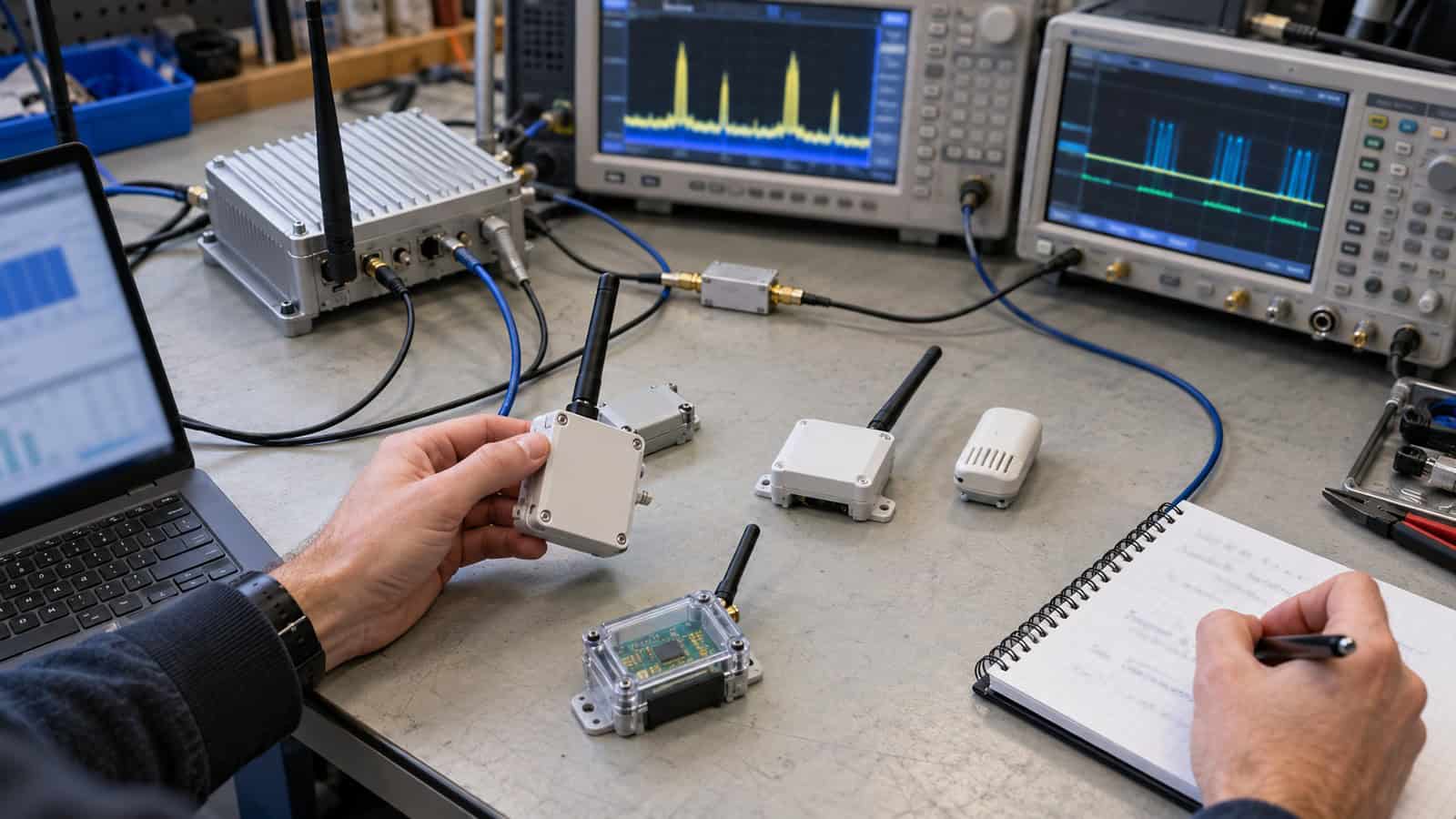
The Robustel R1520LG LoRaWAN Gateway gives EU868 projects a choice of external network-server connections or an embedded ChirpStack option, but no gateway can remove regional duty-cycle rules or the airtime consumed by the endpoint profile. A useful calculator therefore starts with each message on air and ends with gateway and downlink demand over the real reporting schedule.
Airtime Is the Unit That Connects Design to Capacity
Message count alone is misleading. Airtime changes with spreading factor, bandwidth, coding rate, preamble, payload and header settings. The calculator should produce time-on-air for one uplink, then multiply it by scheduled messages, retries and event bursts for each device class.
For a simple planning model:
daily uplink airtime = airtime per transmission × scheduled transmissions × retry factor
Keep the variables visible. If a spreadsheet returns one capacity number without showing the assumed spreading-factor mix and payload distribution, it hides the decision that matters most. A few distant nodes at high spreading factors can consume much more airtime than many nearby nodes sending the same payload.
EU868 Limits Belong to Sub-Bands and Devices
EU868 uses channel and sub-band rules that must be checked against the current regional requirements and the chosen network plan. A 1% duty cycle, where applicable, represents 36 seconds of transmission in one hour, but it should not be applied blindly to every channel and every device. Listen-before-talk or other mechanisms may change what is permitted in a specific implementation.
Document the frequency plan, channel set and applicable duty-cycle or access rule. Then show how endpoints distribute their uplinks. This is a compliance and coexistence input, not merely a gateway specification.
Downlinks Are Usually the Scarcer Resource
The gateway receives on multiple channels, yet a transmission occupies its radio resources and must meet its own regulatory limits. Confirmed uplinks, application acknowledgements, device commands, join traffic and ADR responses all create downlink demand. A design that acknowledges every routine reading can look acceptable in an uplink-only calculator and fail once the network starts responding.
Robustel’s vaccine and laboratory monitoring case study provides deployment evidence that operational value comes from dependable sensor data and alarm handling. It does not disclose a universal message profile, so use the case to frame the consequence of missing data, not to populate the calculator.
Add these downlink events explicitly
- joins and re-joins after a shared power or RF incident;
- confirmed-message acknowledgements;
- configuration or threshold changes;
- scheduled device-control traffic; and
- recovery bursts after the LNS or backhaul returns.
Calculate Busy Windows, Not Only Daily Averages
A daily total can pass while a ten-minute meter-read window overloads the channel or the application. Group traffic into the shortest operational interval that matters. Randomise non-critical reporting where the endpoint design allows it, and test the largest credible simultaneous recovery.
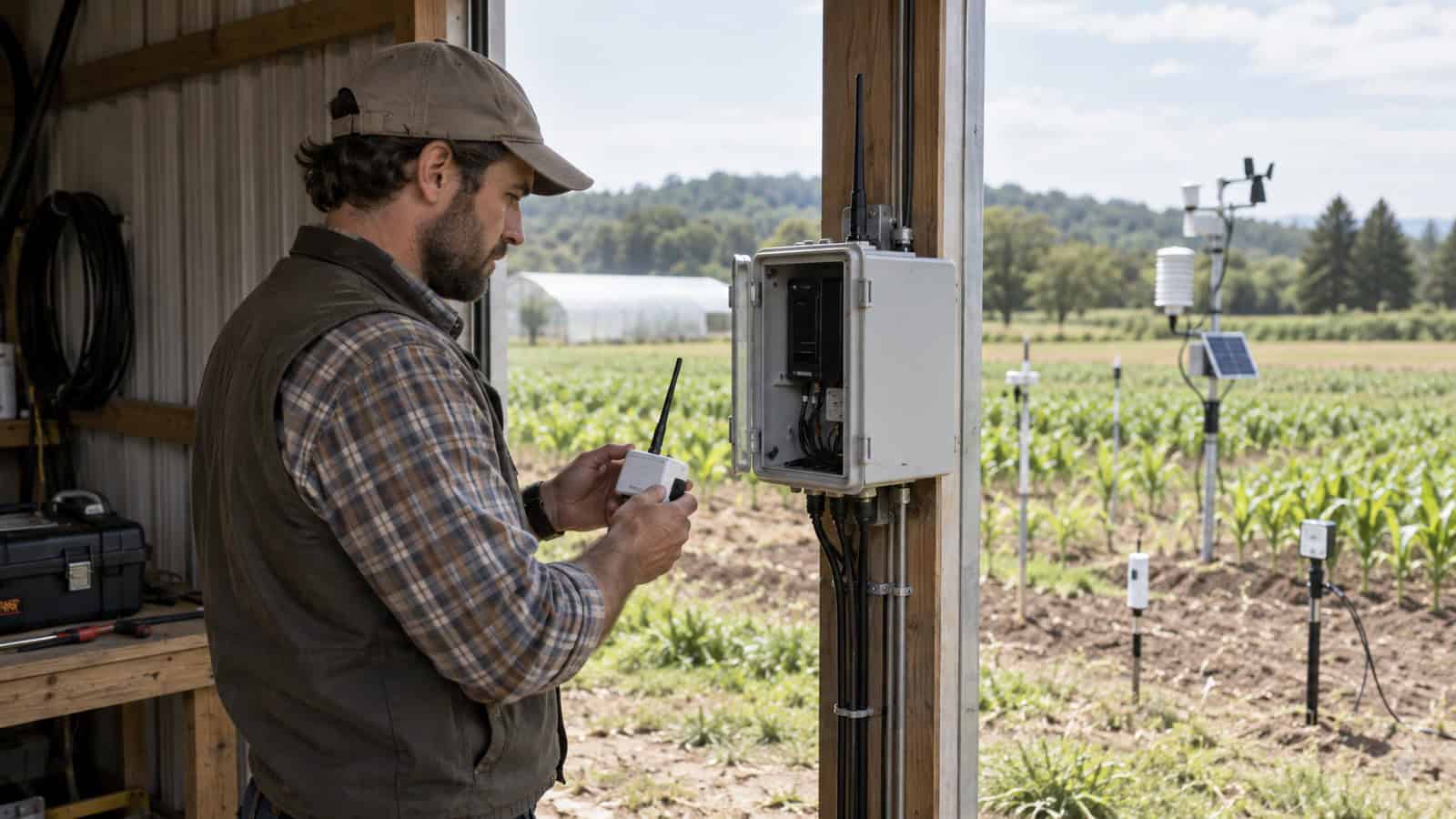
Robustel’s private smart-farm application example uses the R1520LG in a low-rate sensing architecture and gives the traffic workshop a realistic set of device roles to name. Build separate normal, RF-degraded and restart profiles from the project’s reporting intervals, confirmations, retries and downlink policy instead of allowing one daily average to represent all three.
Use a sensitivity table rather than one result:
| Scenario | Payload | SF mix | Retry assumption | Downlink policy | Decision |
|---|---|---|---|---|---|
| Normal | Project value | Surveyed estimate | Measured | Exceptions only | Baseline |
| RF degraded | Same | More high-SF nodes | Más alto | Same | Check headroom |
| Restart storm | Join payloads | Mixed | Project value | Join responses | Test recovery |
How the Robustel R1520LG LoRaWAN Gateway Supports Measurable EU868 Designs
The Robustel R1520LG LoRaWAN gateway is an eight-channel LoRaWAN gateway supporting external UDP packet forwarding, LoRa Basics Station and LORIOT, plus an embedded ChirpStack option. It combines dual-SIM LTE, Ethernet, Wi-Fi, RS-232, RS-485 and PoE-PD, giving designers several backhaul and server-ownership choices.
Those features determine where logs and network-server decisions are visible; they do not establish how many endpoints a project can support. Use the calculator, RF survey and LNS statistics to answer that question. Robustel RCMS platform can manage the gateway estate, while the LNS remains the source for join, frame-counter, airtime and device-level evidence.
The Robustel video “What Is a LoRaWAN Gateway?” gives the traffic workshop a shared view of the gateway’s radio and forwarding role before airtime, downlinks and LNS statistics are calculated from the project configuration.
Validate the Model With LNS Evidence
During a pilot, export spreading-factor distribution, uplink and downlink counts, retries, joins, RSSI/SNR and gateway reception diversity. Compare the observed airtime with the calculator and update the assumptions. A large difference means either the model or the field behaviour is incomplete.
Set an acceptance margin rather than designing to the regulatory edge. That margin must cover seasonal propagation, new devices, firmware changes and incident recovery.
Preguntas frecuentes
Q1. What is the LoRaWAN duty cycle?
It is the proportion of time a radio transmits within a defined period and band or sub-band. The applicable limit depends on regional rules and the channel plan.
Q2. How is LoRaWAN airtime calculated?
It is calculated from spreading factor, bandwidth, coding rate, preamble, header mode and payload length. A capacity model then multiplies that airtime by transmissions, retries and event bursts.
Q3. Does a higher spreading factor use more airtime?
Yes. It improves link budget at the cost of a longer transmission for the same payload, so a high-SF population can materially reduce network headroom.
Q4. Why are LoRaWAN downlinks limited?
The gateway must transmit them under regional access rules and cannot receive in the same way while transmitting. Excess acknowledgements or commands therefore consume a constrained shared resource.
Q5. Does the Robustel R1520LG LoRaWAN Gateway determine network capacity?
It supplies an eight-channel gateway and flexible LNS/backhaul architecture, but capacity follows the endpoint traffic, RF conditions, regional plan and downlink policy. Those inputs must be modelled and measured.
Conclusión
The Robustel R1520LG LoRaWAN Gateway makes it practical to place the network-server boundary where the project needs it, while the duty-cycle calculation remains an endpoint-and-airtime problem. A credible capacity answer includes the spreading-factor distribution, downlink policy and busiest recovery window, not a single device total.
Keep the calculator beside the LNS export after the pilot. Updating one from the other turns theoretical headroom into an operating limit the service team can defend.
Explore More Articles About Robustel LoRaWAN Gateways


Acerca del autor
Robustel Editorial Team
The Robustel Editorial Team publishes practical articles on industrial connectivity, edge computing, LoRaWAN and device management, focusing on deployment considerations, technical limitations and long-term operation.