
LoRaWAN Device Onboarding at Scale: Gateway, OTAA and Provisioning Guide
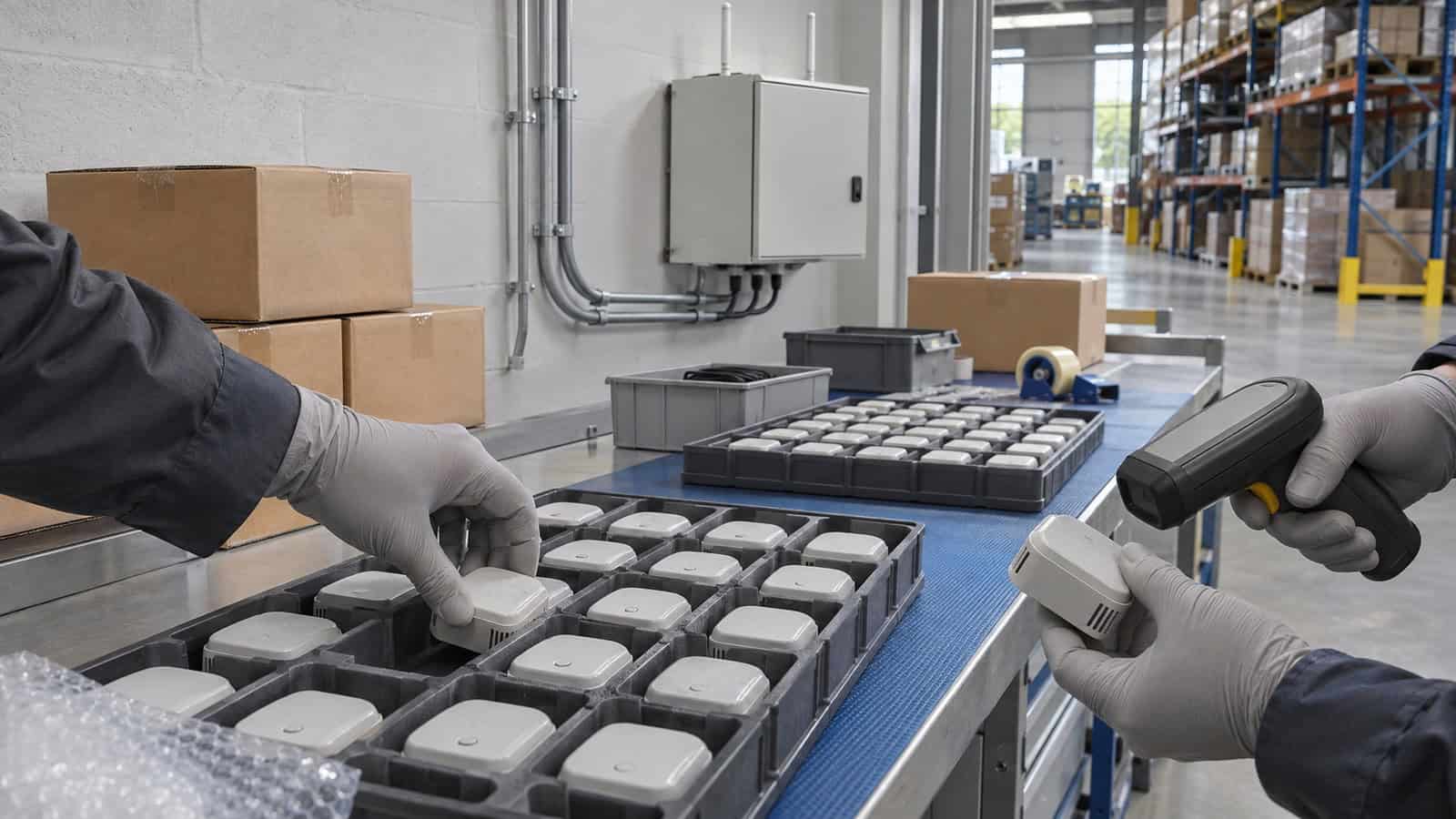
The Robustel R1520LG LoRaWAN Gateway can forward to an external LNS or run an embedded ChirpStack server, but scaling onboarding still requires separate control of gateway configuration, OTAA identities, device profiles, payload codecs, locations and acceptance records. The gateway receives radio traffic; it does not automatically create trustworthy device inventory or safely distribute every sensor’s keys.
A scalable process treats each device as a governed record before it reaches site. The objective is a repeatable handoff from purchasing to provisioning, installation and operations, with secrets protected and every join linked to the intended asset.
Choose the LNS ownership model before building inventory
An external LNS centralises device and gateway management across sites, while an embedded LNS can keep a local deployment self-contained. The decision changes who owns tenant creation, profiles, keys, backups, upgrades and incident access. Do not let installers discover that ownership boundary during commissioning.
| Decision | External LNS | Embedded LNS | Evidence required |
|---|---|---|---|
| Device registry owner | central platform team | site/gateway owner | named account and backup owner |
| Gateway connection | packet forwarder/Basic Station as supported | local service | authenticated connection and status |
| Site outage behaviour | depends on backhaul and design | local join/data path may remain available | supervised outage test |
| Scaling method | API/import or platform workflow | repeatable local template/import | versioned provisioning file |
The Robustel R1520LG overview video below is useful for orienting teams to the gateway and LNS choices. The production design must then identify the exact server, tenant, region and backup procedure.
Build a device record before keys are handled
The minimum record should contain manufacturer, model, serial number, DevEUI, JoinEUI, activation method, regional plan, device profile, payload-codec version, expected reporting interval, asset identifier and intended location. Keep the AppKey in an approved secret system, not in a shared spreadsheet, email or installation photo.
Use separate fields for physical asset and LoRaWAN identity. A sensor may be replaced while the monitored pump, room or meter remains the same. If those identities are merged into one name, replacement and historical analysis become unreliable.
Robustel’s Voytech wireless BMS case study shows why preconfigured devices and repeatable installation matter in building rollouts. Translate that operating idea into an importable inventory and a site worksheet rather than relying on installer memory.
Assign provisioning work through a responsibility matrix
| Task | Device supplier | Network/LNS owner | Installer | Operations |
|---|---|---|---|---|
| provide unique identifiers | accountable | verifies format | checks label | retains record |
| create device profile | supplies radio/firmware facts | accountable | informed | approves change path |
| handle OTAA secrets | supplies through secure route | imports and protects | no routine access | audits access |
| map physical location | supplies label | provides naming rule | accountable at site | validates asset link |
| prove join and payload | supports device behaviour | observes LNS | triggers device and records result | accepts evidence |
The matrix prevents a common failure: every party completes its own task, yet nobody owns the end-to-end proof that the installed device joined the correct tenant with the correct profile and represents the intended asset.
How Robustel R1520LG LoRaWAN Gateway supports scalable onboarding
The Robustel R1520LG LoRaWAN Gateway provides an eight-channel LoRaWAN gateway, EU868/AU915/AS923/US915 variants, 4G/LTE and Wi-Fi backhaul, PoE-PD, external LNS options and an embedded ChirpStack LNS. Those capabilities let a project choose central or local server ownership while placing the indoor gateway where RF performance is useful.
| Onboarding pain | Verified capability | Workflow effect | Acceptance evidence |
|---|---|---|---|
| LNS architecture differs by project | external forwarding or embedded ChirpStack | select one owner and provisioning path | gateway/LNS status and backup record |
| installation point lacks fixed power/data | optional PoE-PD and cellular/Wi-Fi backhaul | separate RF placement from cabinet constraints | power, backhaul and RF survey record |
| many sites need consistent operations | RCMS-enabled management | monitor gateway state without storing device keys in RCMS notes | gateway inventory and change history |
Robustel;s private LoRaWAN with R1520LG and ChirpStack guide can support a local-LNS build. Confirm firmware and preserve the server database before a gateway replacement; hardware replacement without the LNS state can turn a simple swap into device re-provisioning.
Commission in batches with explicit stop rules
Start with one device from each manufacturer and firmware group. Verify the regional plan, device profile, join request, accepted join, uplink decoding, engineering units, timestamp, reporting interval and physical asset mapping. Only then release the remaining batch.
Use a ledger that records pass/fail and the exact reason. Stop the batch if identifiers are duplicated, keys are unavailable through the approved route, the profile differs from the device firmware, payload decoding is wrong or the site uses a different frequency plan. Do not “fix later” by creating ad hoc profiles with unknown ownership.
Robustel’s KoolZone cold-chain case study shows the operational importance of reliable sensing and multi-site visibility. In a cold-chain project, acceptance must include plausible values and timely reporting, not merely a successful join.
Hand over a recoverable service
The final pack should contain gateway model and firmware, LNS location and owner, tenant and region, encrypted backup location, device inventory export, profile and codec versions, installation map, join evidence, data-quality checks and replacement procedure. Secrets remain in the approved vault and are referenced by controlled identifier.
Test one replacement device and, for an embedded LNS, one server restore before scale rollout. The service is ready when another authorised engineer can replace a sensor or gateway without reconstructing the design from chat messages.
Preguntas frecuentes
Q1. How do I set up a LoRaWAN network?
Choose the regional plan and LNS ownership model, configure and authenticate the gateway, create device and service profiles, provision OTAA identities securely, then verify joins, decoded data and application delivery.
Q2. Does LoRaWAN need a gateway?
End devices need at least one gateway in radio range to forward LoRaWAN frames toward the network server. The gateway and LNS have separate roles, even when both functions run on one appliance.
Q3. What information is needed to add an OTAA device?
You normally need the device identity, join identity, application key, regional plan and a profile matching the device’s firmware and radio behaviour. Payload decoding also needs the correct codec or specification.
Q4. Can I build my own LoRaWAN device?
Yes, but production onboarding requires unique identities, secure key injection, regional compliance, tested firmware, a maintained payload format and a replacement process. A prototype joining once is not a fleet provisioning method.
Q5. How does the Robustel R1520LG LoRaWAN Gateway fit a scaled onboarding workflow?
It can connect to supported external LNS platforms or run embedded ChirpStack, with Ethernet, cellular or Wi-Fi backhaul. The project still needs a secure device registry, profile governance, key handling and batch acceptance process.
Conclusión
The Robustel R1520LG LoRaWAN Gateway is best suited to indoor building or plant deployments that need a choice between external and embedded LNS architecture with flexible backhaul. That choice should be made before device inventory and keys are distributed.
Scale by controlling identities, profiles, codecs and locations as versioned records, then release devices in tested batches. The gateway becomes replaceable and the sensor estate becomes operable only when those records survive the original commissioning team.
Explore More Articles About Robustel LoRaWAN Gateways

Acerca del autor
Robustel Editorial Team
The Robustel Editorial Team publishes practical articles on industrial connectivity, edge computing, LoRaWAN and device management, focusing on deployment considerations, technical limitations and long-term operation.