
How to Choose an Industrial LoRaWAN Gateway for Harsh Environments
An industrial LoRaWAN gateway should be selected against the conditions it will face after installation, not only the functions demonstrated during a desk test. The Robustel R1520LG LoRaWAN Gateway provides a useful reference for evaluating power, temperature, backhaul and remote-management requirements, while its published limits also show why no gateway fits every harsh site.
Consider a wastewater treatment operator installing LoRaWAN level, pressure and leak sensors across pump rooms and process areas. During testing, the gateway receives every sensor correctly. After installation, however, it sits inside a metal cabinet beside variable-frequency drives, uses an unstable DC supply and depends on cellular backhaul from a location that technicians visit only when something fails.
The problem is no longer whether the gateway supports LoRaWAN. The real question is whether the complete installation can tolerate the site’s thermal, electrical, radio and operational conditions.
A Harsh Environment Is Not Always an Outdoor Environment
The phrase harsh environment often suggests rain, dust or exposed outdoor equipment. Many industrial gateway failures, however, begin inside apparently protected buildings.
A factory cabinet may be dry but still experience:
- High internal temperatures
- Condensation during shutdown and restart
- Voltage variation from shared power supplies
- Electrical noise from motors and drives
- Poor LoRaWAN and cellular reception through metal
- Restricted airflow
- Limited access for maintenance
- Long periods without on-site supervision
An indoor gateway is therefore not automatically operating in a mild environment.
The Robustel R1520LG LoRaWAN Gateway has an IP30 enclosure and a published operating range of −20°C to +60°C. These specifications make it relevant to controlled industrial installations, but they do not qualify it for direct exposure to water, heavy dust or environmental conditions outside those limits.
The first selection step is to define the installation environment precisely:
Will the gateway be installed in a climate-controlled room, a ventilated control cabinet, an unconditioned plant room, a roadside enclosure or a fully exposed outdoor location?
Each answer produces a different protection, power and maintenance requirement.
Robustel Real-world example: difficult radio environments can exist indoors
In Robustel’s case study with KoolZone, LoRaWAN sensors monitor medical-grade refrigerators and ultra-low-temperature freezers across laboratories and other cold-chain environments. The appliances themselves can significantly attenuate short-range radio signals, while the wider deployment also depends on reliable cellular backhaul and remote gateway management. Robustel R1520-LG LoRaWAN Gateways bridge the local LoRaWAN sensors to the cloud, with RCMS supporting fleet-wide visibility and maintenance. The case illustrates why environmental suitability includes radio conditions and maintenance access, not only exposure to rain or dust.
See how these requirements change across applications: Watch “LoRaWAN Gateway Applications” for a quick overview of how LoRaWAN gateway roles vary between industrial deployment scenarios before comparing the two site examples below.
Convert Site Conditions into Failure Modes
A product specification becomes useful only when it is connected to a plausible site failure.
| Site condition | Likely operational problem | What the buyer should verify |
| High cabinet temperature | Thermal instability, restart or reduced service life | Published operating range and measured cabinet temperature |
| Unstable DC supply | Unexpected reboot or interrupted packet forwarding | Input range, power margin and restart behaviour |
| Motor or drive interference | Communication errors or damaged interfaces | Cable routing, grounding, isolation and EMC requirements |
| Metal cabinet | Weak LoRaWAN, Wi-Fi or cellular signals | External antenna location and cable design |
| Intermittent backhaul | Delayed or missing data at the LNS | Failover, buffering and reconnection behaviour |
| Remote unmanned site | High troubleshooting and travel cost | Central monitoring, logs and secure remote access |
| Dust or water exposure | Corrosion or hardware failure | Gateway IP rating and external enclosure design |
| Extreme ambient conditions | Operation outside published limits | Heating, cooling or a different equipment class |
This approach prevents vague requests such as “we need an industrial-grade gateway.”
A purchasing team should instead state: The gateway will operate inside a roadside cabinet where the measured internal temperature reaches 52°C, the available supply varies between 20 and 28 VDC, Ethernet is unavailable and cellular access must be remotely diagnosed.
That description can be tested against a datasheet and pilot plan. The label industrial cannot.
Power Problems Often Appear Before LoRaWAN Problems
A gateway may have good radio coverage and correct LNS settings but still fail because the site does not provide stable power.
Industrial locations use different supply arrangements:
- 12 or 24 VDC control power
- 48 VDC telecommunications power
- PoE from a managed switch
- Solar and battery systems
- Shared cabinet supplies serving other equipment
- Long DC cable runs with voltage drop
The Robustel R1520LG LoRaWAN Gateway supports a 9–60 VDC input range and can also receive power through IEEE 802.3at PoE-PD on ETH0. Its datasheet lists reverse-polarity and surge protection, with maximum power consumption stated as 10 W at 12 V.
These capabilities provide installation flexibility, but they do not remove the need for power engineering.
Wide Voltage Input Does Not Correct Every Supply Fault
A wide input range helps when the nominal supply differs between sites. It does not guarantee correct operation during:
- Short voltage interruptions
- Repeated brownouts
- Poor grounding
- High-energy surges
- Excessive ripple
- Incorrect polarity beyond the protection design
- Undersized power supplies
- Voltage drop along long cables
The pilot should test the gateway using the actual site supply or a representative power profile. Engineers should also confirm how the gateway restarts, reconnects to the cellular network and resumes forwarding after an interruption.
PoE-PD Has a Specific Meaning
PoE-PD means the gateway can receive power from compatible PoE infrastructure through its Ethernet port. It does not mean that the gateway supplies power to LoRaWAN sensors or other downstream equipment.
PoE may simplify gateway placement when the best radio position is away from a nearby power outlet. Its suitability still depends on cable length, switch capacity, grounding and the physical installation.
Radio Coverage and Backhaul Fail for Different Reasons
LoRaWAN coverage and IP backhaul are separate communication paths.
The first connects sensors to the gateway through LoRa radio. The second connects the gateway to an external LNS, cloud platform or management service through Ethernet, Wi-Fi or cellular networking.
A gateway may receive every sensor packet while the application receives nothing because the backhaul has failed. The reverse can also occur: cellular connectivity remains healthy, but poor gateway placement prevents the LoRaWAN radio from receiving sensors reliably.
Metal Cabinets Create an Antenna Problem
Installing all antennas inside a closed metal cabinet can significantly reduce LoRaWAN, Wi-Fi and cellular performance.
The solution is not automatically to purchase a higher-gain antenna. Engineers should first examine:
- Cabinet material
- Antenna location
- Cable length and loss
- Connector type
- Distance from electrical noise sources
- Required LoRaWAN frequency
- Cellular bands used by local operators
- Separation between antennas
The antenna system must also remain suitable for the radio equipment and regional regulations. Excessive cable length or an unsuitable antenna can cancel out the theoretical benefit of higher antenna gain.
Cellular Failover Requires More Than Two SIM Cards
The Robustel R1520LG gateway includes two Mini SIM slots and supports Ethernet, Wi-Fi and cellular connectivity.
Dual SIM can support two subscriptions, but it does not guarantee uninterrupted service. Both SIMs may depend on the same radio tower, shared infrastructure or upstream route. Failover may also require time to detect the fault, register on another network, obtain an IP address and restore application sessions.
For remote industrial sites, test:
- Primary-network loss
- SIM or operator switching
- LNS reconnection
- VPN recovery
- Handling of packets received during the interruption
- Application response to delayed or duplicate data
Backhaul resilience should be treated as a tested workflow rather than a feature-box claim.
Remote Management Is Part of Environmental Suitability
A harsh site is often difficult to reach. That makes remote operations part of the gateway-selection process.
Suppose a gateway at a pump station stops sending data. Without central visibility, the support team may not know whether the cause is:
- Loss of site power
- Cellular registration failure
- Weak signal
- An incorrect APN
- A failed VPN
- LNS disconnection
- A configuration change
- A firmware problem
- Physical damage to an antenna
If the only diagnostic method is a site visit, even a minor configuration issue becomes expensive.
The R1520LG supports Web, CLI, SMS and the Robustel RCMS remote device management platform. Its associated RCMS services include RobustLink, RobustVPN and Operation Console.
In a distributed deployment, remote management should support a defined operating process:
- View gateway and cellular status
- Compare signal conditions between sites
- Back up and distribute configurations
- Review logs before dispatching a technician
- Apply controlled firmware or application updates
- Access equipment behind the gateway where authorised
- Confirm that a replacement device has restored service
Remote management reduces avoidable visits, but it cannot solve every physical fault. Failed power supplies, damaged antennas, water ingress and broken cables still require site intervention.
Robustel Real-world example: hard-to-access gateways need an operating model, not just rugged hardware
Robustel’s case study with Danish network operator Cibicom shows this at nationwide scale. LoRaWAN gateways were installed at difficult-to-access locations such as masts and third-party properties, using an outdoor IP67 enclosure system and Cibicom’s LTE450 network for backhaul. The network is supported through Cibicom’s 24/7 operational model, reducing dependence on routine physical access. The original deployment used the legacy Robustel R3000-LG LoRaWAN Gateway; Robustel now identifies the R1520LG as its replacement model.
The lesson is broader than enclosure rating: environmental suitability comes from the complete installation, including physical protection, power, antennas, backhaul and the process used to support the gateway after deployment.
How the Robustel R1520LG LoRaWAN Gateway Fits Controlled Industrial Sites
The Robustel R1520LG LoRaWAN Gateway is a practical fit for industrial sites where the gateway remains within its published environmental limits but requires flexible power, backhaul and network architecture.
Scenario 1: An Indoor Process Facility
A food-processing plant wants to add LoRaWAN temperature, humidity and door sensors without extending signal cabling across production areas.
The gateway will be installed in a protected technical area. Ethernet is available, while cellular connectivity is required as a secondary path. The project uses a centrally managed external LNS.
The R1520LG fits this architecture through:
- Eight LoRaWAN receive channels
- Ethernet, Wi-Fi and cellular backhaul
- Dual physical SIM slots
- External LNS connectivity
- PoE-PD
- RCMS-based remote management
Its LoRaWAN specification lists version 1.0.4 with Class A and Class C support. The gateway offers up to eight channels receiving data simultaneously, but that figure must not be converted into a fixed number of supported sensors. Actual capacity depends on traffic volume, spreading factors, retransmissions, downlink demand and regional restrictions.
Scenario 2: A Remote Pump Station
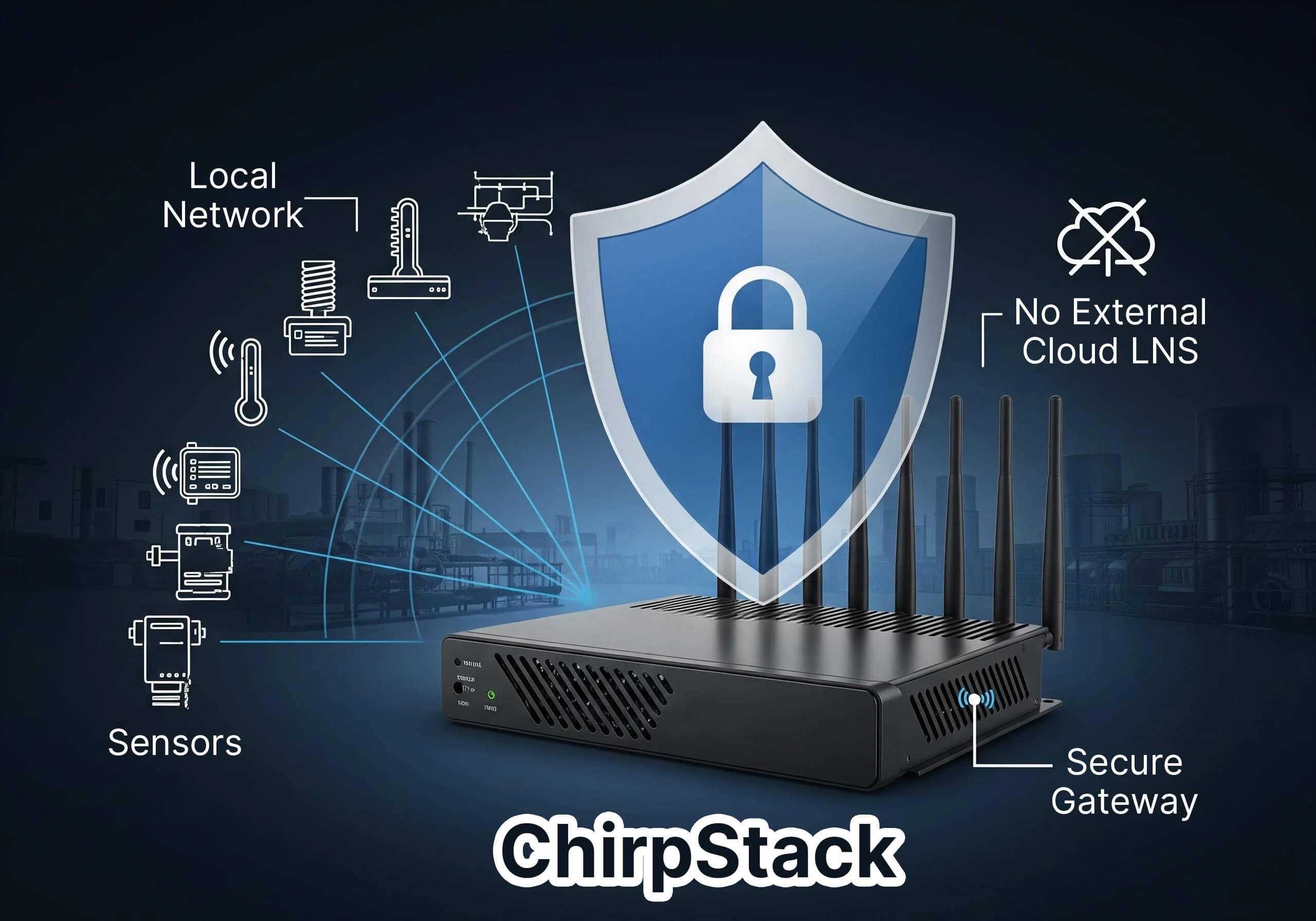
A utility site has no fixed broadband connection and uses cellular backhaul. The gateway sits inside a weather-protected cabinet, receives LoRaWAN level and equipment-status sensors and runs a local ChirpStack configuration.
The R1520LG can support this contained architecture, but the project still needs to verify:
- Cabinet temperature
- Cellular coverage at the antenna location
- Power quality
- Behaviour during backhaul loss
- Local LNS backup and upgrade procedures
- Physical enclosure rating
- Remote recovery process
The presence of a built-in LNS does not make the entire site independent of maintenance. Server configuration, device records, application integration and recovery still need an owner.
Where the R1520LG Is Not the Automatic Choice
A different architecture should be evaluated when:
- The gateway will be directly exposed to rain or dust without a suitable enclosure
- Site temperatures exceed its published limits
- The project mainly needs a low-resource forwarding point for a central ChirpStack network
- Extensive payload decoding and BMS or SCADA integration must occur at the edge
- The installation requires building-specific protocols such as KNX or M-Bus
- Application processing requires substantially greater compute or storage resources
Industrial suitability is a match between the site and the device—not a permanent property that applies to every deployment.
Preguntas frecuentes
Q1. What is an industrial LoRaWAN gateway?
An industrial LoRaWAN gateway combines LoRaWAN radio connectivity with hardware and management features intended for industrial installations. Buyers should still verify its power input, temperature range, enclosure rating, mounting, backhaul and remote-management functions. The term industrial does not mean the gateway is weatherproof or suitable for every factory, utility or outdoor environment.
Q2. Is an IP30 LoRaWAN gateway suitable for a harsh environment?
It may be suitable inside an appropriate protected installation. IP30 does not provide protection against water and offers limited protection against solid objects. An IP30 gateway should not be described as directly weatherproof. The cabinet or external enclosure, temperature control, cable entry, antenna arrangement and maintenance conditions must complete the physical protection design.
Q3. Why is wide-voltage input useful at industrial sites?
Industrial sites may provide different nominal supplies or experience voltage variation. A wide input range gives the installer more flexibility, but it does not correct every power problem. The Robustel R1520LG LoRaWAN Gateway supports 9–60 VDC, while the selected supply must still provide sufficient power and meet the site’s surge, grounding and interruption requirements.
Q4. Does dual SIM guarantee reliable LoRaWAN backhaul?
No. Dual SIM provides access to two subscriptions, but resilience depends on operator coverage, network independence, switching rules and application recovery. Both SIMs may share infrastructure or weak coverage at the same site. Test the complete recovery path from network loss to restored LNS and application connectivity.
Q5. Should an industrial LoRaWAN gateway include a built-in LNS?
Only when the architecture benefits from local network-server operation. A built-in LNS may simplify a contained site, while an external LNS may be more suitable for centrally managed multi-gateway networks. The choice does not determine environmental suitability; power, temperature, enclosure, radio design and remote operations must be assessed separately.
Conclusión
The Robustel R1520LG LoRaWAN Gateway fits controlled industrial environments that need flexible DC or PoE power, multiple backhaul options, external or built-in LNS architectures and central remote management. Its IP30 enclosure and −20°C to +60°C operating range also define clear installation limits.
Select an industrial LoRaWAN gateway by translating the real site into measurable stresses: cabinet temperature, supply quality, radio obstruction, backhaul availability and maintenance access. Then connect each stress to a published limit, protection method or test case.
A successful desk test proves that the gateway works. A representative qualification test shows whether it belongs at the site.
Explore more articles about Robustel’s LoRaWAN gateway in industrial IoT:


Acerca del autor
Robert Liao | Technical Support Engineer
Robert is an IoT Technical Support Engineer at Robustel, specializing in industrial networking and edge connectivity. A certified Networking Engineer, Robert focuses on the deployment and troubleshooting of large-scale IIoT infrastructures. His work centers on architecting reliable, scalable system performance for complex industrial applications, bridging the gap between field hardware and cloud-side data management.