
How to Choose a LoRaWAN Gateway Antenna for Better Coverage
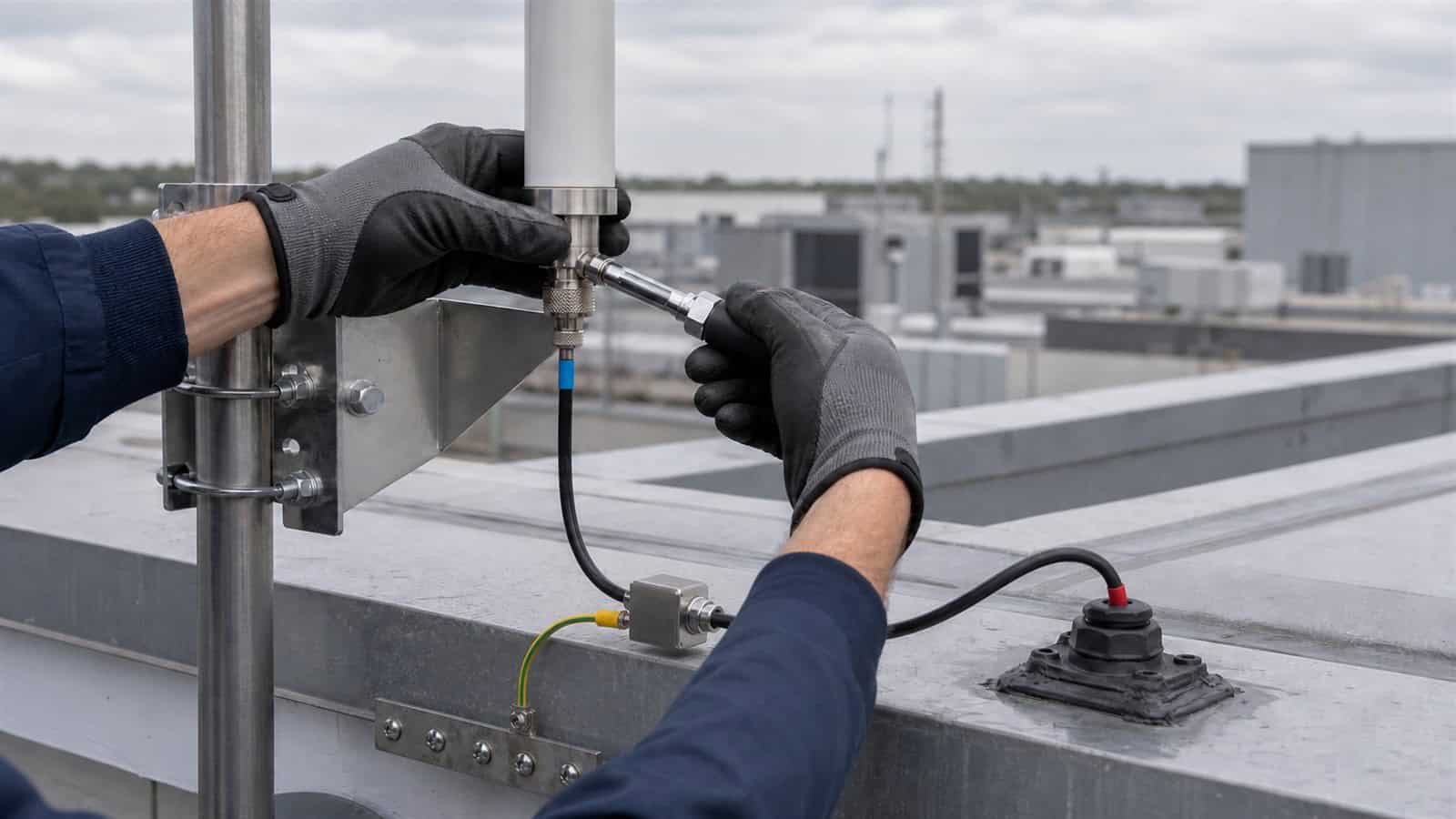
Choosing a LoRaWAN gateway antenna is not a matter of selecting the highest gain on a datasheet. A Robustel R1520LG LoRaWAN Gateway may be correctly configured, yet coverage can still disappoint if the antenna uses the wrong frequency band, sits behind metalwork or connects through a long, lossy feeder cable.
Consider a utility moving a gateway antenna from an indoor cabinet to the roof of a pumping station. The new antenna has higher stated gain and a clearer position, but the installation also introduces several metres of coaxial cable and additional connectors. If those losses and the antenna radiation pattern are ignored, the expected improvement may not appear at the sensor locations that actually matter.
The practical objective is therefore to design the complete RF path rather than buy an antenna in isolation:
Gateway RF interface
→ connector
→ coaxial cable
→ antenna
→ surrounding structure and terrain
→ LoRaWAN end deviceEach part can influence the final radio link.
Start at the Gateway RF Interface, Not the Gain Number
Before comparing antennas, confirm what the Robustel LoRaWAN gateway actually requires.
The first checks are straightforward:
- LoRaWAN regional frequency band
- Gateway antenna connector
- Intended indoor or outdoor installation
- Required cable length
- Available antenna mounting position
- End-device locations and orientation
- Local regulatory requirements
Frequency compatibility comes first. An antenna intended for one regional band should not be assumed suitable for another simply because both products are described as LoRaWAN equipment.
The R1520LG is available in regional LoRaWAN configurations including EU868, AU915, US915 and an AS923 variant depending on the ordered model. The gateway supports up to eight LoRaWAN receive channels simultaneously.
The antenna selected for a Robustel R1520LG deployment should therefore match the exact regional model and operating frequencies used by the project.
This sounds basic, but antenna decisions are often made late in a project, after the gateway has already been selected. At that point, an installer may focus on connector compatibility and gain while overlooking whether the antenna’s useful frequency range matches the deployed radio plan.
For readers who want a short refresher on where the antenna and gateway sit in the wider LoRaWAN architecture, Robustel’s What Is a LoRaWAN Gateway video provides a useful visual introduction. Antenna selection deals specifically with the radio side of that architecture; Ethernet, Wi-Fi or cellular backhaul begins after the LoRaWAN packet has already reached the gateway.
Match the Antenna to the Real Installation Geometry
After frequency compatibility is established, the next question is not “How much gain?” It is “Where must the RF energy go?”
Imagine a Robustel R1520LG LoRaWAN Gateway serving sensors across a production building. Some devices are on the same floor, while others sit two floors below around plant equipment. A high-gain antenna optimised for broad horizontal coverage may not necessarily be the best choice if important endpoints are distributed significantly above and below the antenna.
The same issue appears outdoors. A gateway on a mast serving sensors across relatively flat terrain presents a different geometry from a gateway beside a reservoir serving endpoints at different elevations.
Antenna selection should therefore consider:
- Horizontal and vertical distribution of sensors
- Antenna mounting height
- Nearby walls, roof structures and machinery
- Whether the antenna will be inside or outside a cabinet
- Orientation of the antenna
- Terrain and elevation differences
- Whether coverage is required mainly around the gateway or in one defined direction
Polarisation also matters. LoRaWAN installations often use vertically mounted antennas, but the end-device antenna may be internal, embedded or mounted in a less controlled orientation. Significant polarisation mismatch can introduce additional loss into an already difficult link.
Physical surroundings may be even more important.
A Robustel deployment illustrates this clearly: LoRaWAN monitoring for vaccines and labs with the R1520-LG.
In Robustel’s case study with KoolZone, LoRaWAN sensors monitor refrigerators, medical storage equipment and ultra-low-temperature freezers. These environments contain materials and enclosures that can attenuate wireless signals, while R1520-LG gateways receive the resulting LoRaWAN traffic and provide cellular connectivity to upstream systems.
The antenna lesson is not that one particular gain value solves cold-storage coverage. It is that the sensor environment forms part of the radio path. A gateway antenna cannot be selected intelligently without considering what the signal must penetrate before it reaches the gateway.
If one endpoint sits inside a heavily shielded freezer and another is in the open laboratory, the harder link may be the shorter one.
Higher Antenna Gain Is a Trade-Off, Not Free Range
Antenna gain is useful, but it is frequently interpreted too simply.
For a Robustel LoRaWAN gateway installation, a higher dBi figure does not mean that RF energy has been created. Antenna gain describes how radiation is concentrated relative to a reference pattern.
With many omnidirectional antennas, increased gain is achieved by concentrating more energy around the horizontal plane. The radiation pattern may become flatter, which can be useful when endpoints are spread across a relatively level area but less useful where sensors sit at substantially different elevations.
This is why two antennas with the same connector and frequency range may perform differently at the same site.
A project should consider gain together with:
- Radiation pattern
- Gateway height
- Sensor elevation
- Terrain
- Building geometry
- Cable loss
- Regional transmit-power constraints
Directional antennas create a different option. They can concentrate coverage towards a defined sector or remote area, but they sacrifice the broad azimuth coverage expected from an omnidirectional design. They are therefore appropriate only when the deployment geometry justifies that directionality.
The important engineering question is: Does the antenna pattern place useful RF energy where the LoRaWAN devices actually are?
Not: Which compatible antenna has the largest dBi number?
Regulation also sets a boundary. Gateway transmitter output, antenna gain and feeder losses need to be considered against the permitted radiated-power rules for the deployment region. Higher antenna gain should never be treated as an unrestricted way to increase coverage.
For European projects in particular, the regional frequency plan and applicable local radio regulations should be confirmed before finalising antenna gain and transmitter settings.
Count the Losses Between the Gateway and the Antenna
Antenna location often creates a practical compromise.
A Robustel R1520LG may be installed safely inside a technical cabinet while the LoRa antenna needs to be mounted several metres away or outside the building. Moving the antenna can improve the propagation path, but the cable connecting it to the gateway introduces feeder loss.
Longer cable is not automatically unacceptable. The correct question is whether the RF benefit gained by moving the antenna outweighs the additional cable and connector losses.
The complete feeder path may include:
Gateway connector
→ adapter or pigtail
→ coaxial cable
→ surge-protection component where required
→ additional connector
→ antennaEvery additional component deserves attention.
Cable loss depends on cable type, frequency and length. Connectors and adapters also contribute loss, while poor assembly, damaged cable or moisture entering an outdoor RF connection can cause further degradation.
This is why relocating an antenna to a roof using a long low-quality cable may produce a disappointing result even though the new mounting position is theoretically better.
Cable design should balance:
- RF loss
- Mechanical flexibility
- Outdoor suitability
- Connector compatibility
- Routing requirements
- Installation cost
- Future maintainability
Outdoor mounting adds another consideration: the RF system becomes part of an exposed infrastructure site.
Robustel real-world example: nationwide LoRaWAN network backhaul over LTE450 for Cibicom.
Cibicom’s Danish LoRaWAN network includes gateway sites at locations such as masts and third-party properties. The deployment originally used the now-legacy Robustel R3000-LG, with the R1520LG identified by Robustel as its current replacement, while LTE450 provides the upstream backhaul.
The case is primarily about wide-area LoRaWAN infrastructure and backhaul rather than antenna selection. Its relevance here is operational: a remote gateway site is a maintainable infrastructure node, not only an RF position. Cable routing, physical protection, access and the ability to inspect or replace components matter alongside radio performance.
The antenna with the strongest theoretical specification is of limited value if the completed installation is difficult to maintain correctly.
Test the Complete RF Path, Not the Antenna on a Bench
Once a candidate antenna has been selected, the Robustel gateway deployment should be tested with the actual cable, connectors and mounting arrangement that will be used in production.
A temporary antenna attached directly to the gateway on an engineer’s desk does not validate a roof-mounted antenna connected through a long feeder.
Testing should reproduce the final RF path as closely as practical.
| Test item | What should remain representative |
|---|---|
| Gateway | Final model and regional LoRaWAN configuration |
| Antenna | Intended type and gain |
| Cable | Final type and approximate length |
| Connectors | Production connector and adapter arrangement |
| Mounting | Representative height and orientation |
| End devices | Actual or technically representative sensor hardware |
| Sensor position | Difficult real deployment locations |
| Traffic | Representative reporting and downlink behaviour |
| Environment | Normal machinery, doors and site conditions where possible |
Begin with the endpoint most likely to fail.
If that path is unreliable, change one meaningful variable at a time. For example:
- Reposition the antenna.
- Reduce unnecessary feeder length.
- Compare an alternative antenna pattern.
- Adjust gateway height.
- Recheck the sensor installation.
- Test another gateway location if the path remains inadequate.
Changing the antenna, cable, gateway position and end-device settings simultaneously may improve the result, but it removes the ability to identify which change mattered.
Record repeated uplinks, RSSI, SNR and data rate rather than relying on one successful packet. Where the application depends on downlinks, verify those as well.
Coverage acceptance should be defined around application performance at representative endpoints, not around an expected percentage increase from changing antenna gain.
This also keeps the antenna question separate from LoRaWAN gateway range. The antenna is one contributor to the radio link; it does not define a universal gateway coverage distance.
How the Robustel R1520LG Fits the Antenna Design
The Robustel R1520LG LoRaWAN Gateway provides the active LoRaWAN gateway layer, while antenna selection remains part of the site-specific RF design.
For an industrial deployment, relevant R1520LG characteristics include:
- Regional LoRaWAN variants
- Up to eight simultaneous receive channels
- Ethernet, Wi-Fi and cellular backhaul
- PoE-PD and DC power options
- External or built-in LNS architectures
- RCMS-based remote device management
These functions can make it easier to place the gateway where the radio design requires it. For example, PoE-PD may allow the gateway to be installed closer to a suitable antenna position, while cellular backhaul can reduce dependence on an Ethernet connection at that location.
Neither capability replaces antenna engineering.
The R1520LG itself is IP30, so an exposed outdoor installation also requires a suitable protection system rather than assuming that an outdoor antenna makes the gateway weatherproof. Antenna cables, enclosure penetrations, sealing, grounding and any required surge protection must be assessed as part of the assembled site.
A practical antenna specification for a Robustel R1520LG deployment should therefore state more than one gain figure. It should document:
- Required frequency band
- Antenna type
- Gain and radiation pattern
- Conector
- Cable type and maximum planned length
- Mounting height and orientation
- Indoor or outdoor environmental requirement
- Regional regulatory constraints
- Representative field-test result
That creates a repeatable installation specification rather than an antenna selected by trial and error at every site.
Preguntas frecuentes
Q1. What antenna should I use for a LoRaWAN gateway?
Choose an antenna that matches the gateway’s regional frequency band, connector and installation environment. Gain should then be evaluated with radiation pattern, cable loss, mounting height and sensor distribution. There is no universal LoRaWAN gateway antenna because an indoor multi-floor building and a flat outdoor monitoring site impose different RF requirements.
Q2. Does a higher-gain LoRaWAN antenna always provide better coverage?
No. Higher gain changes the antenna radiation pattern rather than creating additional RF energy. Some higher-gain omnidirectional antennas concentrate energy more strongly around the horizontal plane, which may help one site geometry while reducing useful coverage at other elevations. Feeder loss and regional radiated-power limits must also be included in the decision.
Q3. Which antenna frequency should be used with the Robustel R1520LG?
The Robustel R1520LG LoRaWAN Gateway is available in different regional LoRaWAN configurations. The antenna should match the exact ordered gateway model and regional frequency plan rather than being selected simply because it is marketed as a LoRaWAN antenna. Local regulatory requirements should also be verified before deployment.
Q4. Does a longer antenna cable reduce LoRaWAN coverage?
A longer feeder introduces additional RF loss, with the amount depending on cable construction, frequency and length. That does not mean every long cable produces worse overall coverage: relocating the antenna may improve the propagation path enough to justify the feeder. Calculate or obtain the cable loss and then validate the completed installation on site.
Q5. Should a LoRaWAN gateway antenna be mounted as high as possible?
Not automatically. Greater height can improve some propagation paths, but the correct position depends on terrain, building structure, sensor elevation, antenna pattern and cable length. Moving the antenna higher may also require a longer feeder and more complex outdoor installation. Test candidate positions against the difficult endpoints rather than using maximum height as a universal rule.
Conclusión
Choosing a LoRaWAN antenna is a system-design task rather than a search for the highest gain.
The Robustel R1520LG LoRaWAN Gateway provides the LoRaWAN radio and network platform, but the useful coverage around it still depends on the complete RF path: regional frequency, antenna pattern, polarisation, cable loss, connector quality, mounting position and the physical environment around the end devices.
Start at the gateway interface and follow the signal all the way to the sensor. Match the antenna to the frequency and deployment geometry, account for every feeder component, and test the final installation rather than an idealised bench setup.
A better antenna choice is therefore not the one that promises the largest coverage increase. It is the antenna system that places sufficient RF performance where the application needs it while remaining compliant, repeatable and maintainable.
Explore more articles about Robustel’s LoRaWAN gateway in industrial IoT:



Acerca del autor
Robert Liao | Technical Support Engineer
Robert is an IoT Technical Support Engineer at Robustel, specializing in industrial networking and edge connectivity. A certified Networking Engineer, Robert focuses on the deployment and troubleshooting of large-scale IIoT infrastructures. His work centers on architecting reliable, scalable system performance for complex industrial applications, bridging the gap between field hardware and cloud-side data management.