
Multi-Serial Edge Gateway for Meter and Inverter Data Collection: Buyer’s Guide
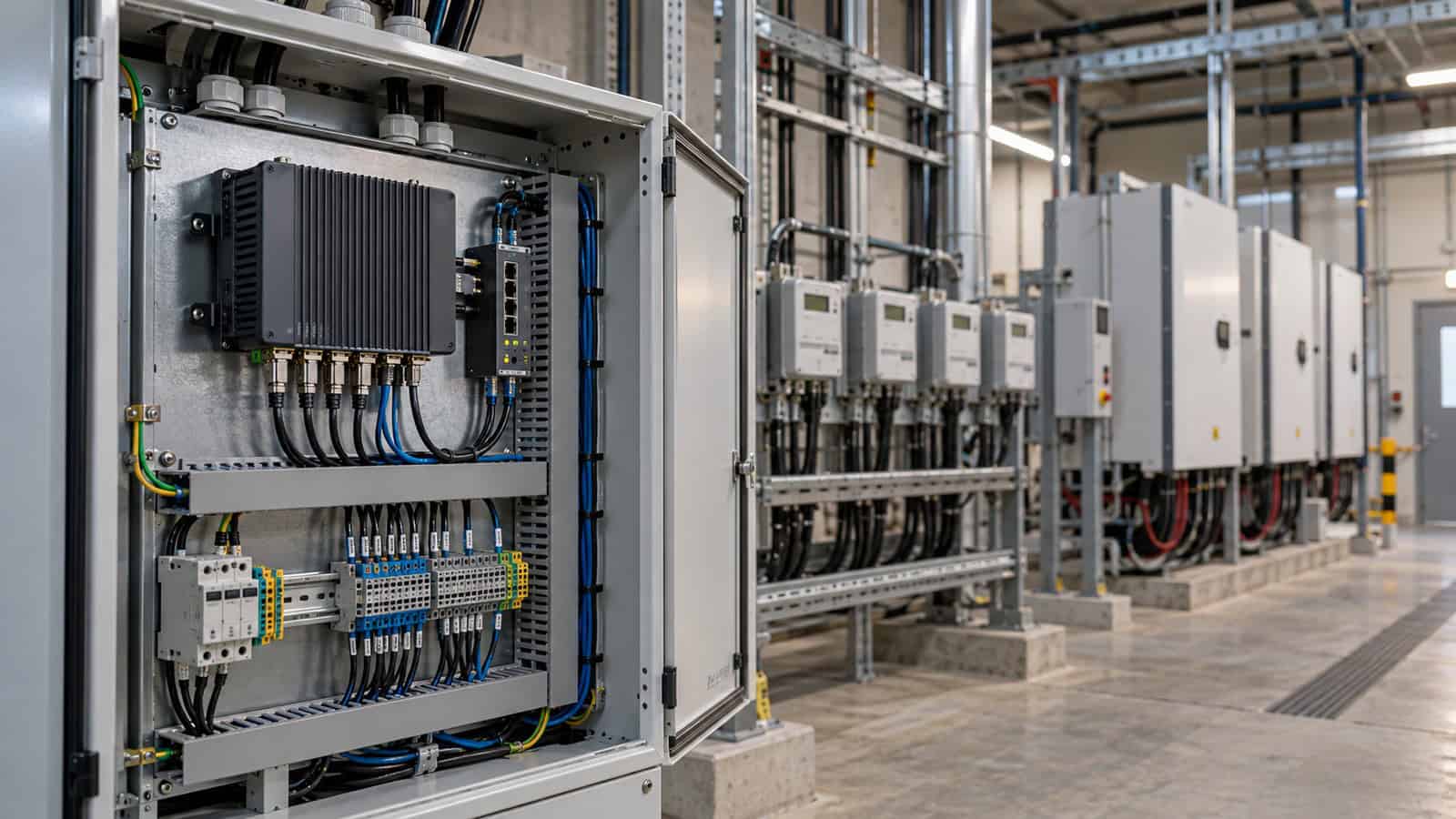
The Robustel EG3120e Edge Computing Gateway is a strong multi-serial choice when meters and inverters must be divided across up to four RS-485 ports, but capacity must be proved from baud rate, bus length, protocol timing, register count and polling deadlines rather than a device-count promise.
Decide Whether You Have One Bus or Several
Put devices with compatible electrical settings, baud/parity and protocol timing on the same physical bus. Separate equipment owned by different contractors, long cable runs, conflicting addresses or incompatible communication settings. A spare port can also create a clean commissioning boundary for a new plant area.
| Topology | Best fit | Main risk |
|---|---|---|
| one long shared bus | few compatible devices, simple route | one fault affects all devices |
| bus per equipment type | meters and inverters differ | more configuration objects |
| bus per owner/area | clear maintenance boundary | unused capacity on some ports |
| serial concentrator plus gateway | existing stable field network | extra device and failure domain |
Calculate the Polling Window
List every transaction: request/response size, timeout, retry policy and required interval. Add the slow or offline-device case because repeated timeouts often consume more of the cycle than healthy devices. Use a measured bus trace during commissioning instead of extrapolating from baud rate alone.
The Robustel video of “How to Collect PLC Data for SCADA, MES & Cloud with an Edge Gateway” provides a useful overview of the collection path. For the exact project, retain the device manuals and register maps that define valid addresses and timing.
Assign an owner to the worst-case cycle, not just the nominal interval. The controls or metering owner can confirm device timing and retry limits, while the edge-application owner records cycle duration, timeout count and stale-tag behaviour. The bus is accepted when a failed device cannot consume the entire window or make healthy data appear current after it has stopped updating.
How the Robustel EG3120e Edge Computing Gateway Supports Multi-Serial Collection
Robustel EG3120e Edge Computing Gateway provides up to four RS-485 ports, one RS-232 port, DI/DO, analogue inputs, CAN, Ethernet, Wi-Fi 6 and LTE/eSIM on a RobustOS Pro platform. Those interfaces allow several field buses to terminate at one edge node while keeping their electrical and polling schedules separate.
When Robustel EG3120e is paired with Robustel E2C Factory, the verified hardware interfaces and the software’s industrial data workflow can bring device configuration, collection, data handling and northbound delivery into one managed site. The benefit is a clearer commissioning and operations path, not an unlimited device count; confirm driver, firmware, memory and workload for the selected package.
Robustel’s machine-builder application example shows why a repeatable field-data and support boundary matters for distributed equipment. Use that lesson to standardise bus records and remote support, while the EG3120e documentation governs the exact serial interfaces.
Commission One Port at a Time
Start with one known device, verify identity and registers, then add devices while measuring cycle time and errors. Test a disconnected device, duplicate address and noisy/incorrectly terminated segment. Record which port degrades and whether the other buses continue normally.
Robustel’s secure remote access to industrial robots application example uses another Robustel edge gateway and shows why field assets, the gateway workload and the support path need separate ownership. Apply that same boundary to EG3120e serial buses while validating the exact meter and inverter registers locally.
Retain a pass record for each port: device list, observed cycle time, timeout/retry behaviour and the effect of one disconnected unit. When a second bus is added, compare the first port’s timing and error rate again. That simple before-and-after record reveals whether the new workload has created shared CPU or application pressure even though the electrical segments remain separate.
Hand Over the Bus as an Asset
Keep a port-by-port drawing, cable and termination notes, device addresses, protocol settings, register-map revision, poll groups and measured worst-case cycle. Add the person authorised to change each item. That record prevents a replacement meter or copied address from becoming an unexplained fleet-wide problem.
Treat the register map and poll schedule as versioned assets. A replacement device or firmware revision should trigger a controlled comparison of identity, scaling, counters and exception values before its data is released northbound. The handover is complete when maintenance staff can identify the correct port, isolate one device and restore the approved cycle without recreating the original commissioning work.
Häufig gestellte Fragen
Q1. How many devices can connect to an RS-485 bus?
The electrical standard permits multi-drop operation, but practical capacity depends on transceivers, cable, termination, baud rate, protocol timing and polling deadlines.
Q2. Can multiple RS-485 networks use one gateway?
Yes, when the gateway has independent serial ports. Each network can then retain its own electrical settings, addresses and poll schedule.
Q3. Do RS-485 devices need unique addresses?
Devices sharing a protocol bus normally need unique addresses. Duplicate addresses can create collisions or plausible but wrongly attributed data.
Q4. What causes RS-485 communication errors?
Common causes include wiring polarity, termination, grounding, cable topology, noise, duplicate addresses, incompatible settings and aggressive timeouts.
Q5. When is the Robustel EG3120e Edge Computing Gateway a good multi-serial fit?
It fits sites that need several independently managed RS-485 buses plus local processing and cellular or Ethernet connectivity, supported by a measured polling design.
Schlussfolgerung
The Robustel EG3120e Edge Computing Gateway is best used when four RS-485 ports create useful electrical and operational boundaries for meters and inverters. Its value comes from separating buses and managing their data path, not from a universal endpoint total.
Approve the topology from the worst-case poll cycle and fault tests, then hand over the bus record with the gateway configuration. That is what keeps a multi-serial design understandable after the original integrator leaves.
Explore More Articles About Robustel Edge Computing Gateways

Über den Autor
Robustel Editorial Team
The Robustel Editorial Team publishes practical articles on industrial connectivity, edge computing, LoRaWAN and device management, focusing on deployment considerations, technical limitations and long-term operation.