
Linux Edge Gateway Selection Guide: Debian, Containers and Remote Updates
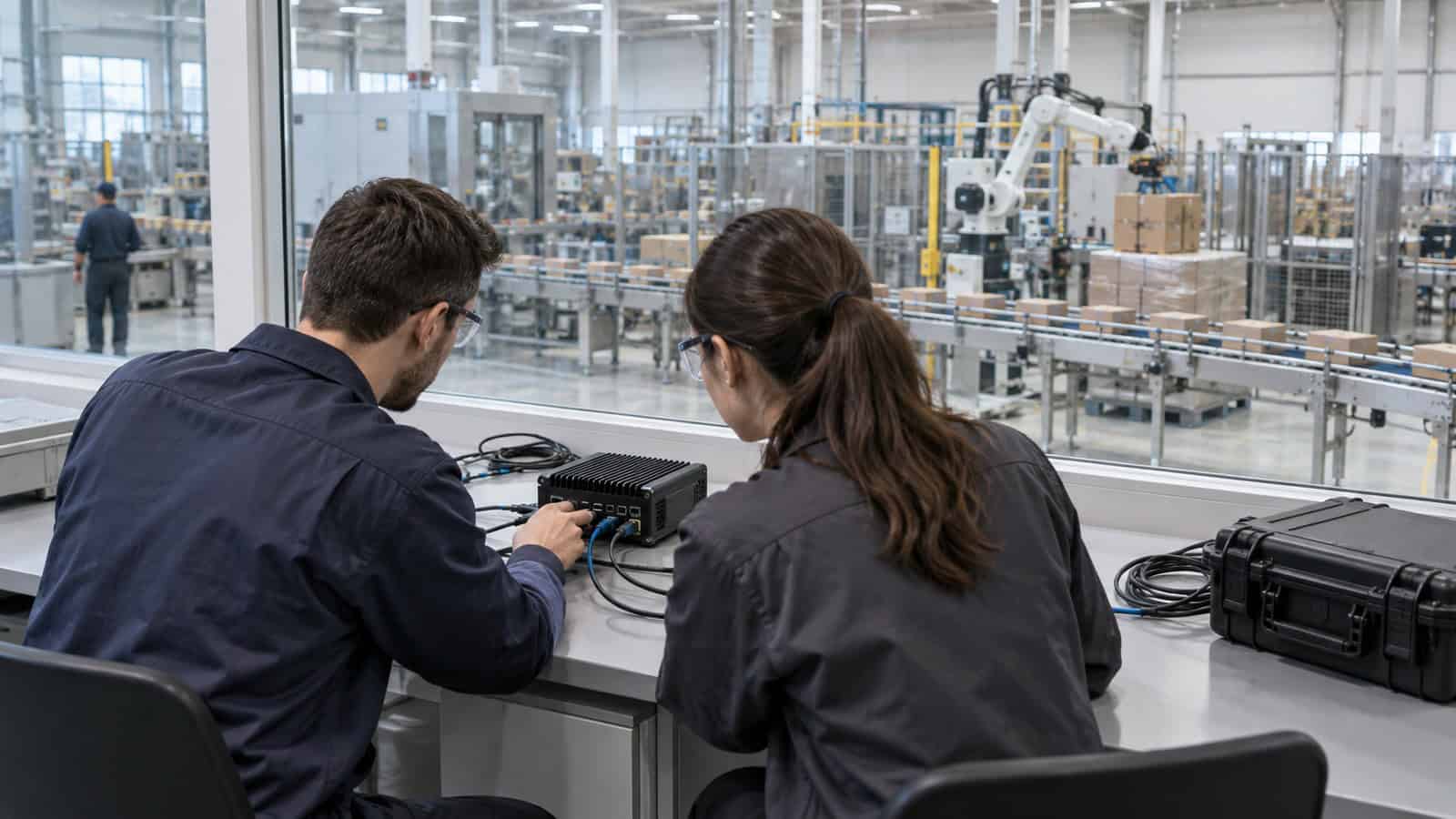
The Robustel EG5120 Industrial Edge Computing Gateway runs RobustOS Pro, a Debian-based environment for supported edge applications and containers. That openness is useful only when the organization also owns dependencies, storage, credentials, updates, rollback and long-term support.
Define the Application Contract Before Choosing a Package
List architecture, required libraries, privileged access, device interfaces, persistent volumes and network ports. “Runs on Linux” does not prove that a binary built for another CPU architecture, kernel feature or driver will work. Two deployments can use the same application image and still behave differently because one needs a serial-device permission, a host-network route or a writable volume that the other does not.
The contract should also state what remains available when the application is stopped. Routing, remote management and local data collection may have different owners, so a restart procedure must not assume that they all share one failure boundary.
| Area | Selection evidence | Operational owner |
|---|---|---|
| CPU architecture | Built and tested package/container | Development team |
| Runtime | Supported container/native application path | Platform team |
| Devices | Serial, USB, GPIO and permissions | Integration team |
| Storage | Images, data, logs and cleanup | Application owner |
| Networking | Ports, routes, certificates and firewall | Security/network team |
| Updates | Staging, rollback and recovery | Fleet operations |
Containers Package Software, Not Responsibility
Containers can make dependencies repeatable, but they still need trusted images, version control, resource limits, health checks, logs and persistent-data design. Test what happens when a container restarts, an image pull fails or storage fills.
Native applications have similar lifecycle needs. The correct packaging method depends on device access, performance, security and maintenance—not fashion.
Separate the Operating System, Application and Configuration Lifecycles
A Linux gateway rarely has just one thing to update. The base operating system, gateway firmware, application image, application data model and site configuration may all move at different speeds. Treating them as a single package makes rollback harder: an application defect can force an unnecessary platform rollback, while a security update can become tied to a slower application release.
Define compatibility between those layers and record it with every release. A useful deployment record includes the gateway hardware variant, platform version, application version, container image digest where applicable, configuration revision and migration status. That record makes a failed site diagnosable without relying on memory.
Configuration also needs its own protection. Separate secrets from ordinary settings, validate a new configuration before activation and retain a known-good version. If an application requires a schema migration, test both forward migration and the recovery path with representative field data.
Size Storage for Updates and Rollback
An update may temporarily require the old image, new image and working data at once. EG5120’s 64 GB eMMC provides useful room, while EG5200 offers 32 GB and broader physical interfaces. Available capacity after system use must be measured on the deployed configuration.
Set log rotation and data retention. A gateway that runs for months can fail from gradual storage exhaustion even when CPU and memory remain comfortable.
How Robustel EG5120, RobustOS Pro and E2C Factory Fit
The EG5120’s quad-core Cortex-A53 platform, 2/4 GB RAM variants, 64 GB eMMC, dual Gigabit Ethernet and industrial interfaces suit containerized integration and compatible local processing. The exact application must be tested against the selected hardware variant.
For teams that do not want to build every industrial-data service from separate containers, Robustel E2C Factory gives EG5120 a supported layer for data collection, local processing, data management, alarms, Node-RED and visualization. The combination can reduce custom integration and give fleet operators a more consistent application baseline. Any additional third-party container remains part of the project’s own compatibility, security and update contract.
The Smart Parking Application Example illustrates EG5120 local preprocessing in a distributed architecture. It shows a workload-placement option rather than a production update benchmark.
The Public Safety CCTV Application Example presents EG5100 for a lighter remote-camera role, reinforcing that Linux application scope should determine the hardware class.
Stage Remote Updates and Prove Recovery
Robustel RCMS supports documented remote fleet visibility and update workflows for supported products. An update process should stage a small ring, confirm health, preserve recovery access and define rollback. Remote management depends on power and connectivity; a failed boot or full storage device may still require site intervention.
Test interruption during download and installation, application migration and retained configuration. Credentials and signing policy should be part of the organization’s security design rather than assumed from Linux or containers.
Plan Recovery Before the First Remote Rollout
Remote updating is useful only when operators can tell whether the gateway, platform or application failed. Define health signals for each layer and decide how long the system waits before declaring an update unsuccessful. Preserve a management path that does not depend on the application being updated wherever the approved architecture allows it.
A pilot ring should represent difficult sites, not only the laboratory. Include constrained backhaul, intermittent power and realistic storage use. After the pilot, expand in controlled groups and stop automatically when the agreed failure threshold is reached. This is an engineering rollout policy; exact mechanisms depend on the deployed software and should be verified against current Robustel documentation.
Robustel Linux Gateway Fit
| Need | Starting point | Trade-off |
|---|---|---|
| Lightweight focused application | Robustel EG5101 | 1 GB RAM/8 GB eMMC class |
| More lightweight field interfaces | Robustel EG5100 | Two Fast Ethernet and configurable serial |
| Serial-rich 2 GB platform | Robustel EG3120e | Four RS-485; validate storage needs |
| Compact compute with 64 GB eMMC | Robustel EG5120 | Fewer Ethernet ports than EG5200 |
| Broad IP/peripheral topology | Robustel EG5200 | 32 GB eMMC; validate application footprint |
The EG5000 Series Quick Pitch video is a useful family introduction. Current product documentation and the deployed application remain the sources for implementation decisions.
Häufig gestellte Fragen
Q1. What does an edge gateway do?
It connects local equipment and networks, runs selected processing near the data source and passes the required information to upstream systems. The useful boundary is defined by the application: protocol conversion, buffering, analytics and local workflows place very different demands on the same hardware.
Q2. What is the purpose of a gateway in Linux?
In networking, a gateway provides a route from one network to another. An industrial Linux edge gateway goes further by hosting local applications and field interfaces, so routing is only one part of its role.
Q3. What is the difference between a router and an edge gateway?
A router primarily moves traffic between networks. An edge gateway may also translate protocols, collect and process machine data, run containers or applications, and make selected functions available when the central connection is interrupted.
Q4. What are the disadvantages of edge computing?
Compute distributed across sites creates more software instances, security boundaries and update paths to manage. It can reduce central dependence for selected functions, but it also requires disciplined version control, resource monitoring, rollback planning and clear ownership of field failures.
Q5. When is the Robustel EG5120 Industrial Edge Computing Gateway a good fit?
It suits compact deployments that need Debian-based applications, substantial eMMC storage, dual Gigabit Ethernet and a validated higher-compute workload. Confirm CPU architecture, libraries, drivers and container requirements with the production application, then test update and rollback behaviour before scaling.
Schlussfolgerung
The Robustel EG5120 Industrial Edge Computing Gateway fits Linux edge projects that value a compact platform and substantial local storage. Choose it with an application contract and tested update/rollback procedure. Linux flexibility becomes operational value only when its lifecycle has an owner.
Explore more articles about Robustel’s edge computing gateways in industrial IoT:

Über den Autor
Robert Liao | Technical Support Engineer
Robert is an IoT Technical Support Engineer at Robustel, specializing in industrial networking and edge connectivity. A certified Networking Engineer, Robert focuses on the deployment and troubleshooting of large-scale IIoT infrastructures. His work centers on architecting reliable, scalable system performance for complex industrial applications, bridging the gap between field hardware and cloud-side data management.