
Best Dual SIM 5G Router Features for Reliable WAN Failover
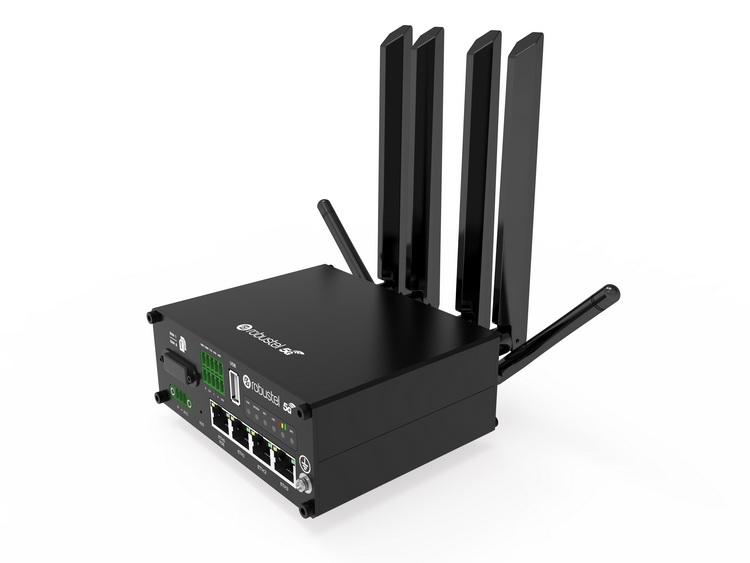
The Robustel R5020 Industrial 5G Router fits sites that need two physical cellular subscriptions, 5G/LTE connectivity and multiple WAN options, but dual SIM alone does not create reliable failover. Resilience depends on the complete recovery sequence from failure detection through operator registration, routing, VPN restoration and application reconnection.
That distinction becomes obvious during a real outage. A router can show the backup SIM as registered while the PLC-to-cloud session is still down, the VPN is negotiating again, or the application has not reopened its connection. For operations, the outage ends when the required service is restored—not when the modem icon turns green.
A Second SIM Only Protects Against Independent Failures
In this guide, “best” means the feature set that makes failover measurable and supportable rather than a ranking of routers or vendors. The current Robustel 5G Router portfolio includes dual-SIM models with LTE fallback and centralized management, but the value of a second subscription depends on the failure domain it actually isolates.
If both SIMs use networks with poor coverage at the same site, the second slot adds little resilience. If both paths depend on the same damaged antenna system or the router loses power, neither subscription can help. A cloud outage also remains a cloud outage regardless of which operator is active.
This is why the failover design should be written around failures rather than features.
| Failure condition | Can another SIM help? | Main limitation |
|---|---|---|
| Primary SIM/account failure | Usually | Backup subscription must already be valid and configured |
| Primary operator outage | Potentially | Second operator needs genuinely usable coverage |
| Poor local RF conditions | Potentially | Both operators may still be weak at the site |
| Shared antenna damage | Usually not | Both SIMs depend on the same RF hardware |
| Router power loss | Nein | Both cellular paths disappear |
| VPN endpoint failure | No direct protection | WAN recovery does not restore the unavailable endpoint |
| Cloud/application outage | Nein | Both paths may reach the same failed service |
The purchasing question is therefore not “Does it have dual SIM?” It is “Which failure does the second path remove, and which failures remain common?”
Follow the Complete Failover Sequence
WAN failover is a chain of events.
The primary path first has to become unusable. The health-check logic then needs enough evidence to treat the condition as a real fault rather than a transient delay. The backup SIM must activate, register with the operator, receive an address and establish a working route. Only after that can VPNs and application sessions recover.
A useful acceptance test records those stages separately:
| Recovery stage | What to measure |
|---|---|
| Service loss begins | Time the application becomes unusable |
| Failure detected | Health-check delay and threshold |
| Backup path activated | SIM activation time |
| Operator registration | Registration completion |
| IP connectivity | Address, DNS and route availability |
| VPN restoration | Tunnel recovery time |
| Application recovery | Time the actual field service is usable |
| Preferred path returns | Stability before switchback |
The long section in the original draft describing this sequence was one of its strongest parts because it reflects how incidents are actually diagnosed. The improvement needed is to keep the engineering depth while making the service-level conclusion more explicit: router recovery and service recovery are not the same event.
A health check should also test the right destination. Cellular registration and signal strength only prove that the modem is attached to a network. If the business service depends on a private VPN endpoint, DNS service or specific cloud API, a useful probe needs to detect when that path has become unusable.
Carrier Diversity Has to Be Proven at the Site
Two commercial operator names do not necessarily create two independent networks.
Subscriptions can share towers, roaming partners, upstream infrastructure or private APNs. The only useful backup operator is one that can actually carry the required workload at the installed antenna position when the preferred path is unavailable.
Robustel’s Jones Technology retail resilience Case Study provides a useful real deployment lesson here. Jones Technology selected site-appropriate SIMs based on local coverage rather than assuming one operator would perform equally across a nationwide estate. The same case also shows why RF-hostile back-of-house environments can dominate router selection if the cellular equipment is installed where reception is poor.
A mobile deployment adds another complication. Robustel’s Emergency Services and Public Safety Vehicles Application Example describes vehicles crossing inconsistent coverage zones while carrying dispatch, mapping, video and other operational traffic. In that scenario, carrier diversity and LTE fallback matter because the failure domain moves with the vehicle rather than remaining fixed at one site.
These examples do not mean dual SIM is seamless. They show why the backup path needs its own RF and application validation.
VPN and Application Recovery Decide the Real Outage Time
One of the easiest mistakes in a failover test is stopping the stopwatch when the router receives a new IP address.
Established sessions may not survive a change of WAN path. IPsec or OpenVPN tunnels may need to negotiate again. A private APN route may return on a different timetable from public internet access. Some field devices retry quickly, while others hold a failed TCP session for much longer.
This is where a two-minute WAN target can become a five-minute service outage even though the router itself changed SIMs much earlier.
A representative test should therefore include the actual application behind the router. If a remote telemetry unit publishes every thirty seconds, verify the first successful post-failover message. If the site supports a control-room VPN, verify that the required subnet is reachable. If local devices rely on DNS, confirm resolution after the path changes.
Robustel’s High-Speed Branch Office Routing over 5G Application Example is useful because it treats the R5020 as part of a wider branch architecture with segmentation, VPN access, 5G and fixed WAN paths. The lesson is that failover needs to preserve the service architecture, not just cellular connectivity.
How the Robustel R5020 Industrial 5G Router Fits a Resilient WAN Design
The Robustel R5020 Industrial 5G Router combines two physical Mini SIM slots, 5G/LTE connectivity, four Gigabit Ethernet ports, Wi-Fi, separate RS-232 and RS-485 interfaces and centralized management support. It can use Ethernet or Wi-Fi as a preferred path with cellular failover, or operate with 5G as the primary WAN.
That makes the R5020 a good fit where the router is expected to operate the local network as well as provide cellular resilience. It can keep industrial equipment, IP devices and local users behind the same managed edge while the upstream path changes.
Robustel’s R5020 Product Video gives a concise view of the router’s 5G and local-network role. The engineering decision comes afterwards: the deployment still has to configure failure thresholds, operator priorities, restoration timing and application recovery for the actual site.
The Robustel RCMS platform adds centralized fleet visibility, configuration and update workflows. During a WAN incident, that can help teams compare SIM status, signal conditions and device state across a distributed estate, although RCMS cannot remain reachable when every path to the router is unavailable.
The R5020 also has clear limitations. Two SIMs do not mean two simultaneously active modems, switching can interrupt established sessions, both subscriptions normally share the same router power and antenna architecture, and LTE fallback can provide less capacity than 5G. Those limits belong in the acceptance plan rather than in a footnote after deployment.
Test Switchback as Carefully as Failover
Returning to the preferred path can be just as disruptive as moving away from it.
If the primary operator briefly recovers and then fails again, an aggressive switchback policy can create repeated session resets. A restoration timer or stability threshold may be more appropriate than immediately moving every connection back.
This is one of the places where a lab test can look cleaner than the field. An engineer can disconnect and reconnect a cable once, while a marginal cellular path may move above and below the health threshold repeatedly for several minutes.
The acceptance test should therefore include unstable recovery, not only complete outage and clean restoration.
For a site that must recover within two minutes, define whether that target means internet reachability, VPN restoration or the first successful application transaction. The metric has to be agreed before testing starts.
Häufig gestellte Fragen
Q1. Does a dual SIM 5G router provide seamless failover?
Not automatically. Recovery can include failure detection, SIM activation, operator registration, IP assignment, route changes, VPN restoration and application reconnection. Each stage can add interruption.
Q2. Should the two SIM cards use different mobile operators?
Often yes when the objective is carrier diversity, but two operator names do not guarantee independent infrastructure. Coverage and the complete service path should be validated at the site.
Q3. Is eSIM necessary for reliable dual SIM failover?
No. Two physical SIMs can support resilient operation when the subscriptions and failover logic are suitable. eSIM mainly changes provisioning and operator-profile management; it does not remove network registration or application recovery time.
Q4. How does the Robustel R5020 Industrial 5G Router support WAN failover?
The Robustel R5020 Industrial 5G Router provides dual physical SIMs, 5G/LTE connectivity, multiple WAN options, VPN functions and centralized management support. The project still needs to configure health checks, operator priorities and end-to-end recovery.
Q5. What should be measured during a failover test?
Measure failure detection, SIM activation, operator registration, IP recovery, VPN recovery, the first successful application transaction, switchback stability and any data loss or manual intervention.
Schlussfolgerung
The Robustel R5020 Industrial 5G Router provides the hardware and network functions needed for a resilient dual-SIM deployment, but resilience comes from the complete recovery design rather than the number of SIM slots.
Prove carrier diversity at the final installation, measure every stage from failure detection to restored application service, and test the return to the preferred path under unstable as well as clean conditions.
Two SIMs create an alternative route. A verified failover sequence turns that alternative into operational resilience.
Explore more articles about Robustel industrial 5G routers:


Über den Autor
Robert Liao | Technical Support Engineer
Robert is an IoT Technical Support Engineer at Robustel, specializing in industrial networking and edge connectivity. A certified Networking Engineer, Robert focuses on the deployment and troubleshooting of large-scale IIoT infrastructures. His work centers on architecting reliable, scalable system performance for complex industrial applications, bridging the gap between field hardware and cloud-side data management.