
How to Validate 5G SA Registration Before an Industrial Rollout
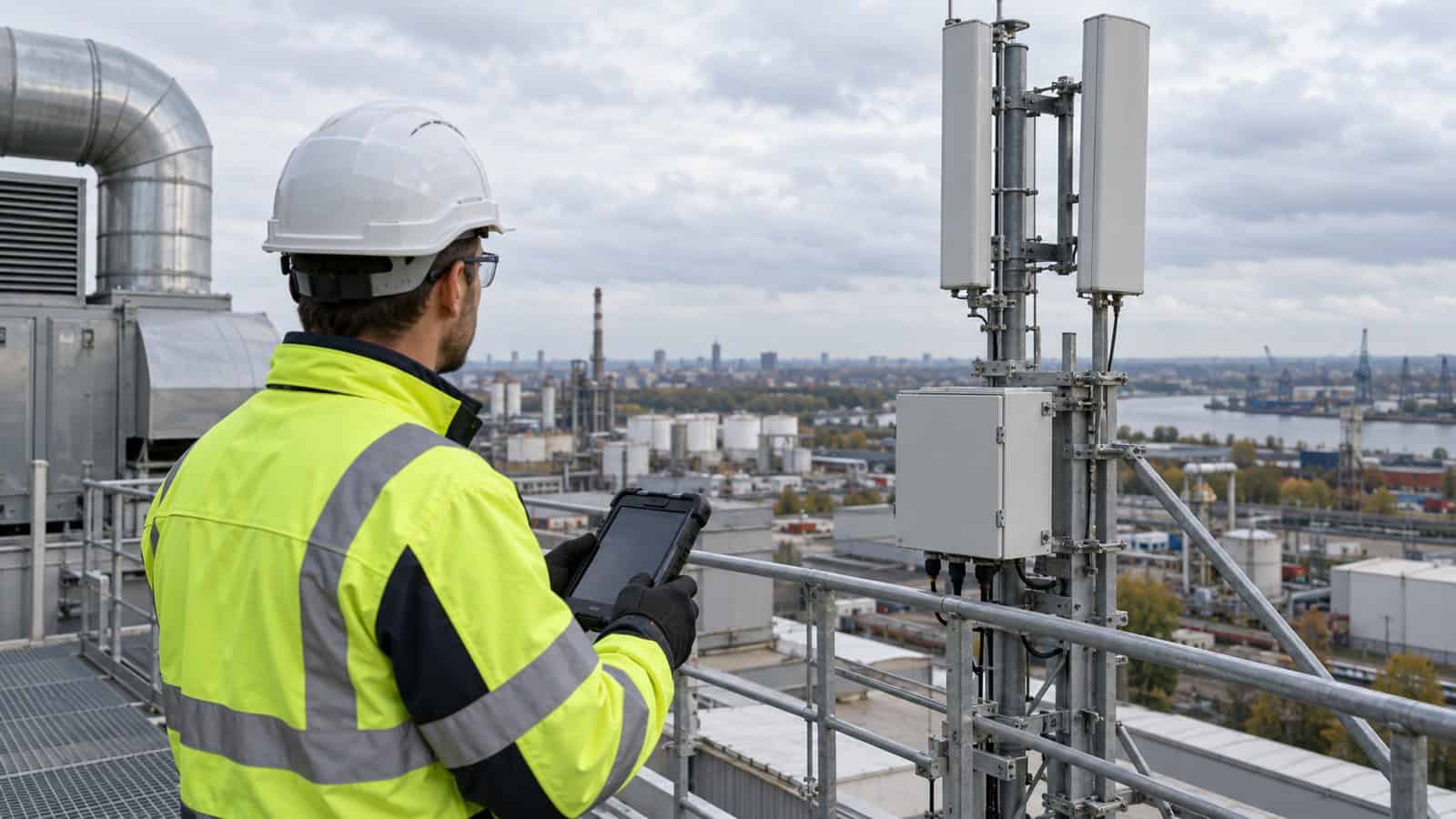
The Robustel R2120-5G Industrial 5G PoE Router supports 5G NR SA and NSA variants, but a compatible modem does not by itself prove that a deployed SIM has registered on a Standalone service. Before rollout, the team needs evidence from the exact order code, mobile subscription, APN, serving network and application path—and it needs that evidence at representative sites rather than only on a lab bench.
Define What “SA Working” Must Prove
Start by separating four claims that are often compressed into one screenshot. The router can support SA bands; the operator can offer SA in the target area; the subscription can be authorised for the service; and the active session can actually use it. A 5G indicator can be useful, yet it may not explain the core architecture or show that the intended data path is complete.
Write the acceptance statement before testing. For example: “This order code, firmware, SIM profile and APN shall establish a data session on the intended SA service at the test location, receive the required addressing, reach the approved private endpoint and recover after a controlled loss of radio.” That wording creates evidence an engineer can collect.
| Evidence layer | Question | Typical record |
|---|---|---|
| Product | Does this exact order code support the required SA bands? | Datasheet and order-code table |
| Subscription | Is SA and the APN enabled for this SIM? | Operator confirmation and SIM identity |
| Registration | What radio/core mode is currently active? | Router/modem status capture |
| Data session | Was the expected IP addressing assigned? | Interface and route record |
| Application | Can approved traffic complete end to end? | Timed transaction or reachability test |
Confirm the Regional Variant Before Inserting the SIM
Match the regional order code, bands and certifications to the intended country and operator. Do the same for the R5010, R5020 family or R5030 if one of those models is being evaluated; the fact that each supports SA/NSA does not make their band tables or certifications interchangeable.
Record firmware and modem versions with the hardware identity. If a later update changes registration behaviour, that baseline lets support distinguish a software change from an operator-side or site-side change.
Robustel’s traffic-camera and road-signage application example uses the R2120 series in a remote roadside architecture. It demonstrates why the validation target must include the actual workload and remote-management path: a radio session has operational value only when the authorised service remains reachable from the control environment.
Test SIM, APN and Addressing as One Contract
Obtain the APN, authentication method, IP allocation model, roaming policy and SA entitlement directly from the service provider. Avoid copying settings from a handset or another tariff. A SIM may register on the mobile network while the packet session fails, or it may receive an address that cannot support the intended inbound or VPN design.
Use a simple status table during the test:
- identify the SIM and active slot;
- capture the selected operator, access technology and bands;
- confirm the configured and negotiated APN;
- record the assigned IP, gateway, DNS and routes; and
- test the approved endpoint using the same protocol the application will use.
If the project requires private addressing or a private APN, verify the return route from the enterprise network. Successful outbound internet access is not equivalent to private OT reachability.
Read Registration Evidence Without Over-Interpreting It
Collect both the router status and the operator’s service confirmation where possible. The useful evidence is the combination of registered mode, serving cell/band, session addressing and a completed application transaction. Do not infer an SA service from a logo, speed test or the absence of LTE in a user interface.
Robustel’s video on “What Is an Industrial 5G Router and When Do You Need One?” helps project stakeholders agree on the router’s role before reviewing radio captures. The engineering record still comes from the selected unit and network at the time of acceptance.
Run a negative test as well. Remove SA availability only through an approved lab or operator method, or move to a known non-SA location, and observe whether the unit rejects the service, falls back according to policy or loses the session. The expected outcome depends on the configured network preference; document it rather than assuming “SA only” or “automatic” is always correct.
How the Robustel R2120-5G Industrial 5G PoE Router Supports SA Validation at Camera Sites
The Robustel R2120-5G industrial 5G router provides 5G/4G/3G/2G connectivity, dual SIM, cellular/Ethernet/Wi-Fi failover, five Gigabit Ethernet ports and four 802.3af/at PoE-PSE ports. It also supports VPN, firewall, serial and I/O functions through RobustOS and can be managed through Robustel RCMS platform. Those capabilities make it suitable for validating the complete path around powered cameras or edge devices, not just the modem registration state.
For SA testing, keep the PoE workload active. Multiple cameras, VPN encryption and management traffic create a more credible production condition than an idle router on a bench. At the same time, treat radio mode and application performance as separate results: SA registration does not establish a universal latency or throughput figure.
Robustel’s smart-parking application example provides a wider field architecture in which cameras and other devices have distinct data paths and support needs. Use that separation when writing the test: check router registration, camera reachability, platform delivery and remote recovery as individual stages, so a failure can be placed in the correct layer.
Move from One Successful Test to Rollout Evidence
A rollout needs a location matrix, not one green result. Include the easy, marginal and operationally important sites. Test with the final antenna type and cable, the enclosure closed and representative equipment active. Repeat during different network-load periods if the service risk justifies it.
For each site, preserve:
- unit, order code, firmware and modem version;
- SIM, operator, APN and service entitlement;
- antenna, cable and installation position;
- SA/NSA and band evidence;
- addressing, VPN and application checks; and
- loss-and-recovery behaviour.
Set a rollout gate before the first batch. A site that reaches the internet but cannot prove the required private path, recovery policy or SA entitlement should remain an exception until the evidence is complete.
FAQs
Q1. What is 5G Standalone?
5G Standalone uses a 5G radio access network with a 5G core rather than relying on an LTE core for the service architecture. Availability and enabled features still depend on the operator, subscription, spectrum and device configuration.
Q2. What is the difference between 5G and 5G Standalone?
The general 5G label can include Non-Standalone and Standalone deployments. NSA uses LTE elements in the architecture, while SA uses a 5G core. A device indicator alone may not expose that distinction clearly.
Q3. Should 5G Standalone be enabled?
Enable or prefer it when the operator supports the required service and the project has tested coverage, addressing, recovery and application behaviour. Automatic or NSA operation may remain appropriate where SA is not consistently available.
Q4. What happens when 5G Standalone is unavailable?
The result depends on device settings and network service. The router may use NSA or 4G, or it may lose service if configured for a restrictive mode. Test the intended fallback policy rather than assuming it.
Q5. How do you verify SA on the Robustel R2120-5G Industrial 5G PoE Router?
Use the exact regional order code and current firmware, confirm the SIM/APN entitlement with the operator, capture the active radio and session state, then complete an application transaction and a controlled recovery test. Keep the result with the site acceptance record.
Conclusion
The Robustel R2120-5G Industrial 5G PoE Router gives camera and edge-device projects a capable SA/NSA platform, but rollout approval should be based on a chain of product, subscription, registration and application evidence. “5G connected” is a useful observation; it is not the whole acceptance result.
Define the claim first, test the production path under representative load and preserve the negative test. That approach makes an SA issue diagnosable and keeps a network or subscription assumption from becoming a fleet-wide commissioning problem.
Explore More Articles About Robustel 5G Routers

About the Author
Robustel Editorial Team
The Robustel Editorial Team publishes practical articles on industrial connectivity, edge computing, LoRaWAN and device management, focusing on deployment considerations, technical limitations and long-term operation.