
Private 5G Router Integration Guide for Legacy PLC and Ethernet Networks
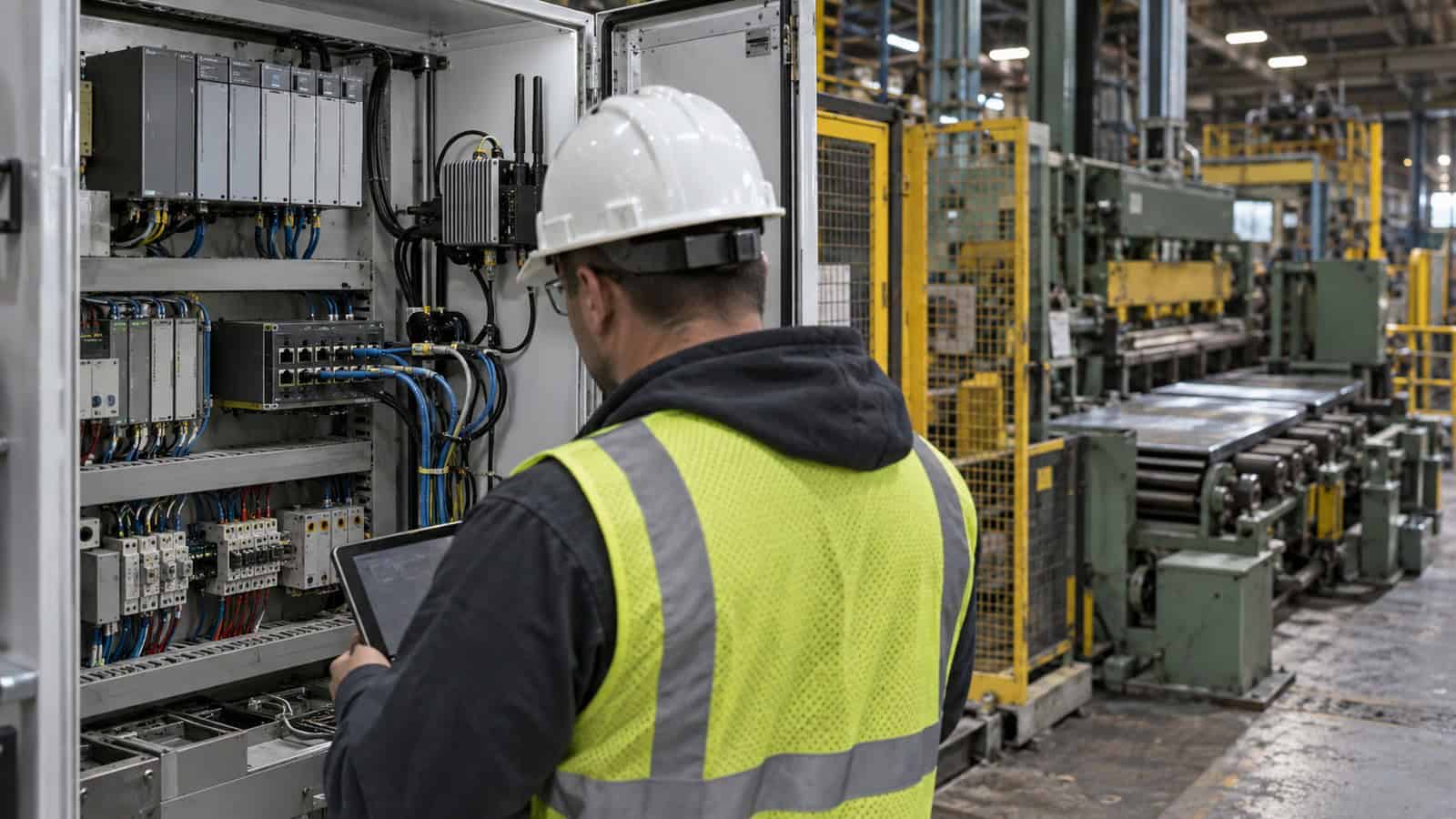
The Robustel R5020 Industrial 5G Router can connect Ethernet and serial equipment to a private 5G design while keeping the existing PLC network intact. The important word is “integrate.” A private cellular core does not make a legacy controller 5G-native, and a router should not be inserted into a control path without documenting addressing, timing, security zones and the safe behaviour when the radio link is lost.
Brownfield projects work best when they preserve proven control locally and use 5G for supervision, data access, mobility or service connectivity. If a process depends on deterministic or safety-rated communication, keep that function in the validated control system unless the complete replacement architecture has been engineered and approved for it.
Begin at the PLC Boundary
List every device connected to the proposed router and classify its traffic. Engineering workstations, historians, HMIs, maintenance cameras and PLC telemetry create different risk and bandwidth. Mark which sessions are initiated from the machine side and which require controlled remote access.
| Interface path | Appropriate private-5G role | Boundary to preserve |
|---|---|---|
| PLC Ethernet to router LAN | telemetry, diagnostics or supervisory access | local machine control remains inside the cell |
| RS-485 instrument to router | protocol transport or defined gateway function | register map, polling rate and failure values are documented |
| Camera or vision device | event images or remote review | benchmark upstream load; do not infer processing capacity from a port |
| Mobile AGV controller | supervised mobility and telemetry | safety response cannot rely on an unproven WAN |
| Plant IT uplink | management and approved application routes | OT/IT zones and firewall ownership stay explicit |
Robustel tips: Do not connect first and segment later. Give the router a defined zone, restrict routes and use outbound sessions or approved VPN access. The private cellular network may provide an isolated radio domain, but the Ethernet side still needs conventional security engineering.
Decide Where the Private Core Breaks Out
Traffic may stay on site through a local core and application platform, or it may exit to an enterprise data centre or cloud. That choice affects latency, failure domains and who operates the service. A local breakout can reduce dependence on an external WAN for defined workflows, but the local core, DNS, time source and application hosts then require their own availability plan.
Document subscriber identity and onboarding. The SIM or eSIM profile used by the router must be authorised for the private network, and the modem must support the required regional bands and 5G mode. “5G capable” does not prove compatibility with a particular private RAN or core.
Translate Legacy Protocols Deliberately
The Robustel R5020 documents Ethernet, RS-232 and RS-485 interfaces plus Modbus RTU-to-TCP capability in its software feature set. That can reduce an extra converter for a defined integration, but it does not create a complete data model. The controls team still needs register definitions, scaling, byte order, polling intervals, exception handling and timestamp policy.
Where a PLC already exposes Ethernet, decide whether the router should transport the protocol transparently or whether an edge application should normalise selected tags. Transparent access is simple but may expose more of the controller than the remote user needs. Data publishing can create a smaller boundary but introduces software, storage and lifecycle ownership.
Engineer Mobility Without Making Radio a Safety Function
Private 5G is attractive for AGVs, mobile robots and yard equipment because one cellular domain can cover movement that would otherwise cross several Wi-Fi cells. That does not justify moving emergency stops or certified safety logic onto an unvalidated link.
Robustel’s Reliable 5G Connectivity for AGVs application example uses an R5020-class 5G router or gateway as the communications hub on the vehicle. Its useful architectural lesson is to connect the controller locally by Ethernet and treat the mobile network as a supervised data path. It is not a promise of latency, handover performance or safety integrity for another factory.
Plan Addressing and Remote Access Before the Pilot
Private networks may offer addressing options that differ from public cellular, but that does not remove the need for an IP plan. Decide whether devices receive fixed or managed addresses, how overlapping machine subnets are handled and which systems can initiate connections.
For remote maintenance, prefer a controlled, auditable path. Limit access to the required PLC, HMI or service port and define who can approve the session. Avoid a design in which the router silently bridges an entire machine cell into a wide enterprise network.
The 5G Connectivity and Remote Access for Autonomous Delivery Robots and Drones application example by Robustel uses the R5020 and shows the same practical need for supervised access to a moving asset. The useful lesson for a brownfield cell is not the vehicle itself; it is the separation between local machine communications, the mobile network and an authorised support path. That pattern still requires project-specific addressing, credentials and recovery tests.
How the Robustel R5020 Industrial 5G Router Fits Brownfield Private 5G Integration
The Robustel R5020 Industrial 5G Router provides four Gigabit Ethernet ports configurable as four LAN or one WAN plus three LAN, one RS-232 and one RS-485 interface, one digital input and output, dual physical SIM slots and optional features that vary by model, including PoE-PD or vehicle-oriented configurations. It supports 5G and LTE according to the current product documentation.
That interface mix makes it useful between a private cellular domain and a compact legacy equipment zone. It can attach a PLC, HMI or local switch while keeping serial equipment available. The exact regional variant, bands and private-network interoperability still need confirmation with the network provider; the public product page cannot certify an undeclared private core.
Where the router only needs to hand 5G to an existing firewall, the R5010 may be the cleaner internal option. Where several powered Ethernet devices must be consolidated, R2120-5G has four PoE-PSE ports. Select the physical role first so the private-network project does not become an excuse to redesign a working control cabinet.
Robustel RCMS platform can manage the router estate, while the private-network team operates the RAN and core and the controls team owns the PLC application. Put those three responsibilities into the support model. One management platform does not replace the others.
Prove Loss and Recovery at Every Boundary
The pilot should include normal telemetry, a remote maintenance session and the largest credible data burst. Then remove the private radio service, interrupt the local core or application, reboot the router and disconnect one local interface at a time. Verify that the PLC continues its approved local behaviour and that queued data or remote sessions recover as designed.
Measure from the application, not only from the network. Record missing samples, timestamp quality, duplicate data, operator alarms and the state after reconnection. A clean ping result can still hide a broken tag mapping or a remote session that reconnected to the wrong machine subnet.
The Robustel R5020 product video below is useful for an initial hardware overview. The integration sign-off should rely on the selected variant’s documentation and the test evidence from the intended private network.
FAQs
Q1. What are the advantages of using a private 5G network?
Potential advantages include controlled coverage, local policy, managed mobility and the option to keep defined traffic on site. Whether those benefits appear depends on spectrum, radio design, devices, core architecture and the team operating the network.
Q2. How does a private 5G network work?
It uses a dedicated or logically isolated radio access network, subscriber identities and a 5G core under an organisation’s or service provider’s control. Devices must support the relevant bands and provisioning, and applications need a defined path through or out of the private domain.
Q3. What is the difference between private 5G and public 5G?
Public 5G is operated by a mobile carrier for a broad subscriber base. Private 5G gives one organisation more control over local radio, subscriber and traffic policy, but also adds responsibilities for design, monitoring and support.
Q4. What are the benefits of a private network?
The main benefits can be clearer access policy, controlled addressing, local traffic paths and reduced dependence on shared infrastructure. A private label does not make the network automatically secure or reliable; it still needs engineering and lifecycle management.
Q5. When should the Robustel R5020 Industrial 5G Router be considered for private 5G integration?
Consider it when a brownfield site needs a 5G router with several Gigabit Ethernet ports and serial interfaces between the private cellular domain and legacy equipment. Confirm the exact modem variant and interoperability with the chosen private network before deployment.
Conclusion
The Robustel R5020 Industrial 5G Router fits brownfield private 5G projects that need a practical bridge to Ethernet and serial equipment without replacing the local PLC architecture. Its interfaces are useful because they let the project define a small, controlled integration boundary.
Keep deterministic control local, verify the private-network mode and subscriber design, and test data semantics through loss and recovery. When the owners of the router, private core and PLC can each explain their boundary, private 5G becomes a supportable plant service rather than another opaque network in the cabinet.
In the field, I would not sign off the pilot from a successful ping or a single maintenance session. I would ask the controls engineer to identify one process that must continue locally, remove each upstream dependency in turn and then watch the team restore normal operation from its written procedure. That exercise exposes ownership gaps while the project is still small enough to correct them.
Explore More Articles About Robustel 5G Routers
About the Author
Robert Liao | Technical Support Engineer
Robert is an IoT Technical Support Engineer at Robustel, specializing in industrial networking and edge connectivity. A certified Networking Engineer, Robert focuses on the deployment and troubleshooting of large-scale IIoT infrastructures. His work centers on architecting reliable, scalable system performance for complex industrial applications, bridging the gap between field hardware and cloud-side data management.