
Zero-Defect Manufacturing: A Guide to Edge AI Vision & NPUs
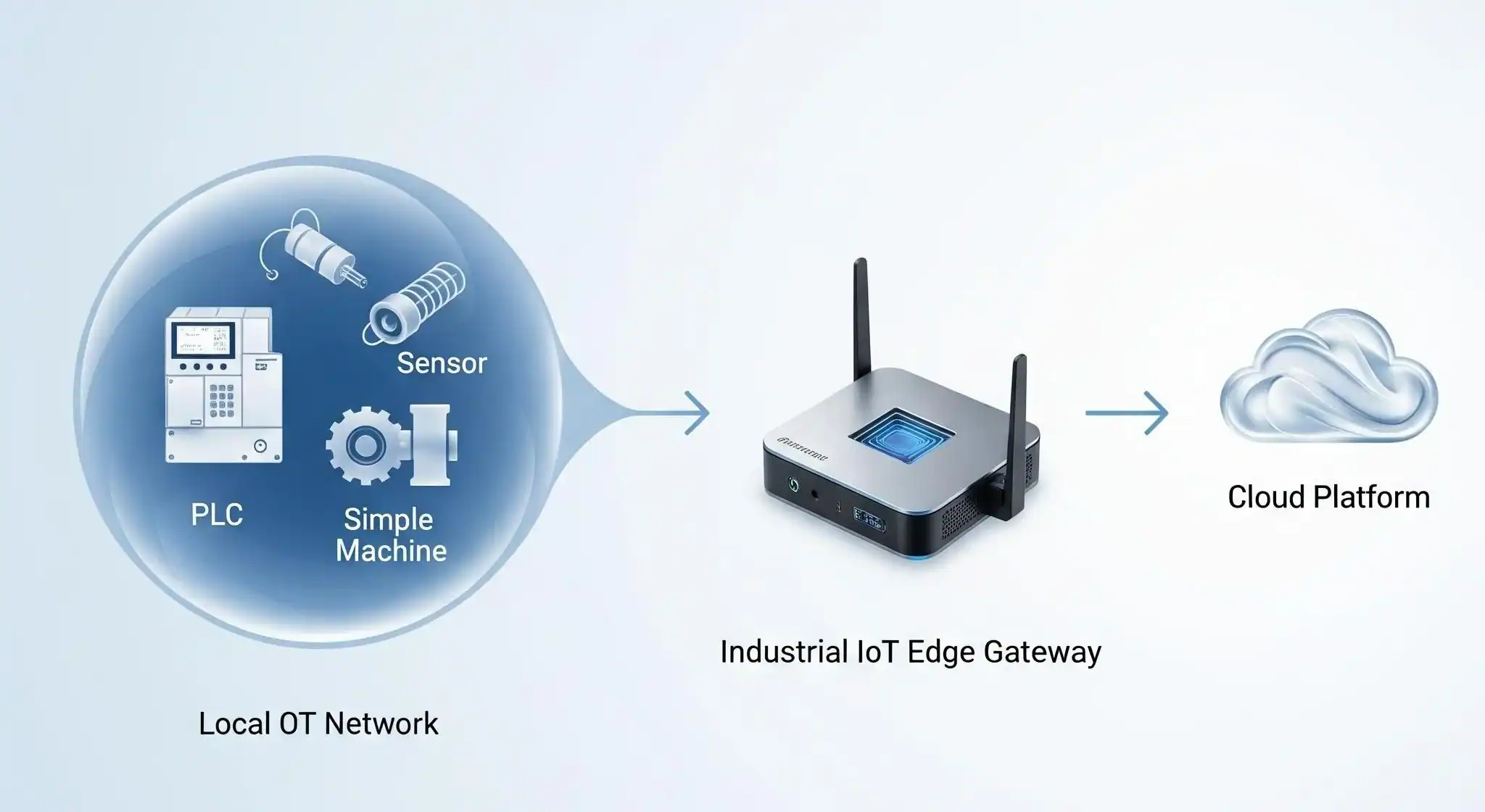
In high-speed smart factories, manual inspection and Cloud-based AI both face a common enemy: Inconsistency and Latency. Manual oversight is limited by human fatigue, while Cloud AI is throttled by massive bandwidth costs and unpredictable network jitter. This guide explores the architectural shift to Industrial Edge AI—moving intelligence to the production line for 100% automated quality control.
What You Will Learn:
- The Latency Solution: Why keeping inference local is the only way to achieve the sub-millisecond response times required for high-speed reject arms.
- The Hardware Core: How a dedicated NPU (Neural Processing Unit), such as the 2.3 TOPS unit in the Robustel EG5120, provides the mathematical horsepower for complex vision models without the thermal overhead of a CPU.
- The Docker Workflow: A 4-step roadmap from mounting industrial IP cameras to deploying containerized AI models via RCMS.
- Deterministic ROI: How a self-correcting production loop slashes scrap rates and ensures absolute detection consistency across a 24/7 operation.
Introduction: The Invisible Failure in Manual Inspection
I was recently on the floor of a high-speed electronics assembly plant, watching a conveyor belt where hundreds of intricate components zipped by every minute. At the end of the line, a veteran inspector was staring intently at each part, scanning for microscopic solder defects. He was a professional, but the reality was clear: he’s human. He blinks, he suffers from ocular fatigue, and in a 10-hour shift, his detection consistency will inevitably drop.
This is the classic quality control dilemma. Manual inspection is a bottleneck—slow and prone to subjective error. However, the traditional “Cloud AI” alternative is equally flawed. Attempting to stream high-resolution, high-FPS video to the cloud for analysis triggers massive bandwidth costs and, more critically, inference latency that is too slow to trigger a real-time reject arm.
Let’s be clear: there is a superior third option that bridges this gap. The solution is to move the intelligence to the lens. The solution is Industrial Edge AI.
Defining Edge AI—The Engine of Real-Time Vision
In practical terms, Edge AI refers to the deployment of deep learning models where the “inference”—the actual process of analyzing an image and making a decision—happens directly on local hardware at the network’s edge.
For Machine Vision, this decentralized architecture isn’t just an alternative; it is the only viable path for two critical reasons:
1. Data Reduction at the Source
A high-resolution industrial camera is a data firehose, churning out massive volumes of raw pixels every second. Constant streaming of 4K or high-FPS video to a distant data center is a “bandwidth killer” that leads to astronomical cloud egress costs. Edge AI flips the script: the gateway processes the video locally and only transmits the metadata (e.g., “Part ID: OK” or “Defect Detected”) to the cloud, reducing network load by over 99%.
2. Deterministic, Sub-Millisecond Decisions
In a smart factory, a conveyor belt moving at several meters per second doesn’t wait for a cloud handshake. Any network jitter or round-trip delay could result in a defective part slipping through before the reject arm can react. By keeping the capture-to-decision loop local, Edge AI ensures deterministic latency—guaranteeing a response in milliseconds, regardless of your internet connection status.
The Engine of Inference—Unlocking the NPU
How does a rugged, fanless box on a factory floor outperform a cloud server in real-time response? The answer lies in a fundamental architectural shift: the NPU (Neural Processing Unit).
To understand its impact, think of a standard CPU as a versatile generalist—excellent at handling OS tasks and logic, but inefficient at the repetitive, massive-scale linear algebra required by deep learning. An NPU is the specialist. It is a purpose-built silicon co-processor integrated into the gateway’s SoC (System on Chip), designed for one mission: executing AI model inference with extreme mathematical efficiency.
Take the Robustel EG5120 as a benchmark. Its integrated NPU provides 2.3 TOPS (Trillion Operations Per Second) of dedicated AI performance. By offloading vision tasks from the CPU to the NPU, the gateway can execute complex object detection or segmentation models hundreds of times faster while maintaining a low thermal envelope. This specialized hardware is the “secret sauce” that allows sophisticated AI to run reliably in harsh, high-temperature industrial environments without active cooling.
From Pixels to Profits—The 4-Step Edge AI Workflow
Implementing a real-time vision system doesn’t have to be a multi-year R&D project. Here is how a high-performance quality control loop operates in a modern smart factory:
Step 1: High-Speed Image Acquisition
A high-resolution industrial IP camera (or a USB3.0/GigE Vision camera) is mounted directly over the inspection point. It connects to the industrial edge gateway via a ruggedized Ethernet cable, ensuring a high-bandwidth, low-noise data feed of the production line.
Step 2: Containerized Model Deployment
You don’t need to manually configure every gateway. A deep learning model—pre-trained in the cloud to recognize your specific product defects (like YOLOv8 or SSD) thrives in a Docker container. Using a cloud management platform like Robustel RCMS, you can push this containerized intelligence to your entire fleet of gateways simultaneously.
Step 3: Low-Latency Inference at the Edge
As the live stream hits the gateway, the NPU takes over. It performs frame-by-frame analysis in milliseconds, comparing the “live” part against the inference model. Because the processing happens on-device, the system can spot minute deviations—scratches, cracks, or missing components—without waiting for a cloud handshake.
Step 4: Deterministic OT Action
The gateway doesn’t just “report” a problem; it solves it. Using its onboard isolated Digital I/O (DO) ports, the gateway sends a direct electrical signal to the production line’s PLC or a pneumatic reject arm. Within milliseconds of a defect being spotted, the faulty part is physically diverted from the line, ensuring 100% inspection coverage.
Conclusion: Redefining the Standard of Zero-Defect Manufacturing
Real-time Edge AI for quality control has moved beyond the “pilot project” phase. It is now a battle-tested, high-impact architecture delivering measurable ROI by slashing scrap rates and automating high-speed inspection lines where manual oversight fails.
By integrating a purpose-built Industrial Edge Gateway—one that pairs a dedicated NPU with a ruggedized, fanless design—manufacturers can finally bridge the gap between AI research and shop-floor reality. This isn’t just about replacing a human eye; it’s about building a self-correcting production loop that is more consistent than manual labor, more responsive than cloud-only models, and robust enough to define the next decade of Industry 4.0 efficiency.
The real question for engineers isn’t if Edge AI works, but how it scales across a diverse fleet of legacy hardware. While visual inspection is the most visible use case, the same NPU-driven logic is currently revolutionizing Predictive Maintenance and Autonomous Mobile Robots (AMRs).
FAQs
Q1: What’s the main difference between using an IoT Edge device as a gateway and a simple router?
A1: A simple router just forwards IP traffic. An IoT Edge device as a gateway is an intelligent computer. It can understand and translate non-IP protocols (like Modbus), run custom applications locally (edge computing), and manage the identities and security for downstream devices.
Q2: Do all IoT Edge devices support these gateway patterns?
A2: Not all. The ability to function effectively as a protocol translation gateway depends on the device having the right physical interfaces (like serial ports), a flexible OS (like Debian-based RobustOS Pro), and support for running custom software (like Docker containers).
Q3: How many downstream devices can connect to one IoT Edge Gateway?
A3: This depends on the gateway’s processing power and the amount of traffic each device generates. For simple protocol translation with low data rates, a powerful device like the EG5120 could handle dozens or even hundreds of downstream devices.
About the Author
Robert Liao | Technical Support Engineer
Robert Liao is an IoT Technical Support Engineer at Robustel, specializing in industrial networking and edge connectivity. A certified Networking Engineer, Robert focuses on the deployment and troubleshooting of large-scale IIoT infrastructures. His work centers on architecting reliable, scalable system performance for complex industrial applications, bridging the gap between field hardware and cloud-side data management.