
Breaking Barriers in
Global IoT:
Managing and Overcoming the Challenges Presented by Global 4G/LTE IoT Deployments.
White Paper – Executive Summary
Brief
Global IoT deployments promise scale and efficiency — but in practice, manufacturers face two stubborn roadblocks: LTE frequency fragmentation and costly, region-specific certifications . With 70+ LTE bands worldwide and varying operator requirements, “plug and play” connectivity across borders is anything but simple.
This whitepaper outlines how Robustel’s GLOBAL series of routers solves these challenges head-on, combining broad frequency coverage, extensive global certifications, and innovative software features like Smart Reboot and RobustVPN. By reducing risk, cutting certification costs, and simplifying fleet management, Robustel helps OEMs bring connected products to market faster — and operate them with greater reliability worldwide.
What you’ll learn
- Why LTE fragmentation makes global coverage complex — and how to overcome it.
- The realities of regulatory, telecom, and operator certifications, and why they drive up deployment costs .
- How Robustel’s GLOBAL routers are engineered with broad frequency support and certification coverage to reduce complexity.
- How Smart Reboot ensures resilient roaming and uptime, reducing costly site visits.
- How RobustVPN enables secure, low-cost remote access to devices across any SIM, network, or region.
- How Robustel’s global testing program validates reliability across continents, ensuring performance where it matters most.
Introduction
Most OEMs and Machine Builders who sell products globally quite reasonably believe that adding cellular connectivity to their products should be a relatively trivial undertaking.
“Buy a SIM and a 4G router and plug it in – Simple! – Right?”
Not quite…
Unfortunately, there are two issues that act as a major impediment to that goal, and despite lots of discussion around IoT and standardisation, 4G frequency fragmentation and costly certifications remain a barrier for many.
Problem 1: LTE Fragmentation
“LTE Fragmentation” is a complex way of saying that there are lots of different frequencies used around the world for 4G and many of them are incompatible with each other.
In fact, if we look at how difficult global deployments have become it makes for quite surprising reading:
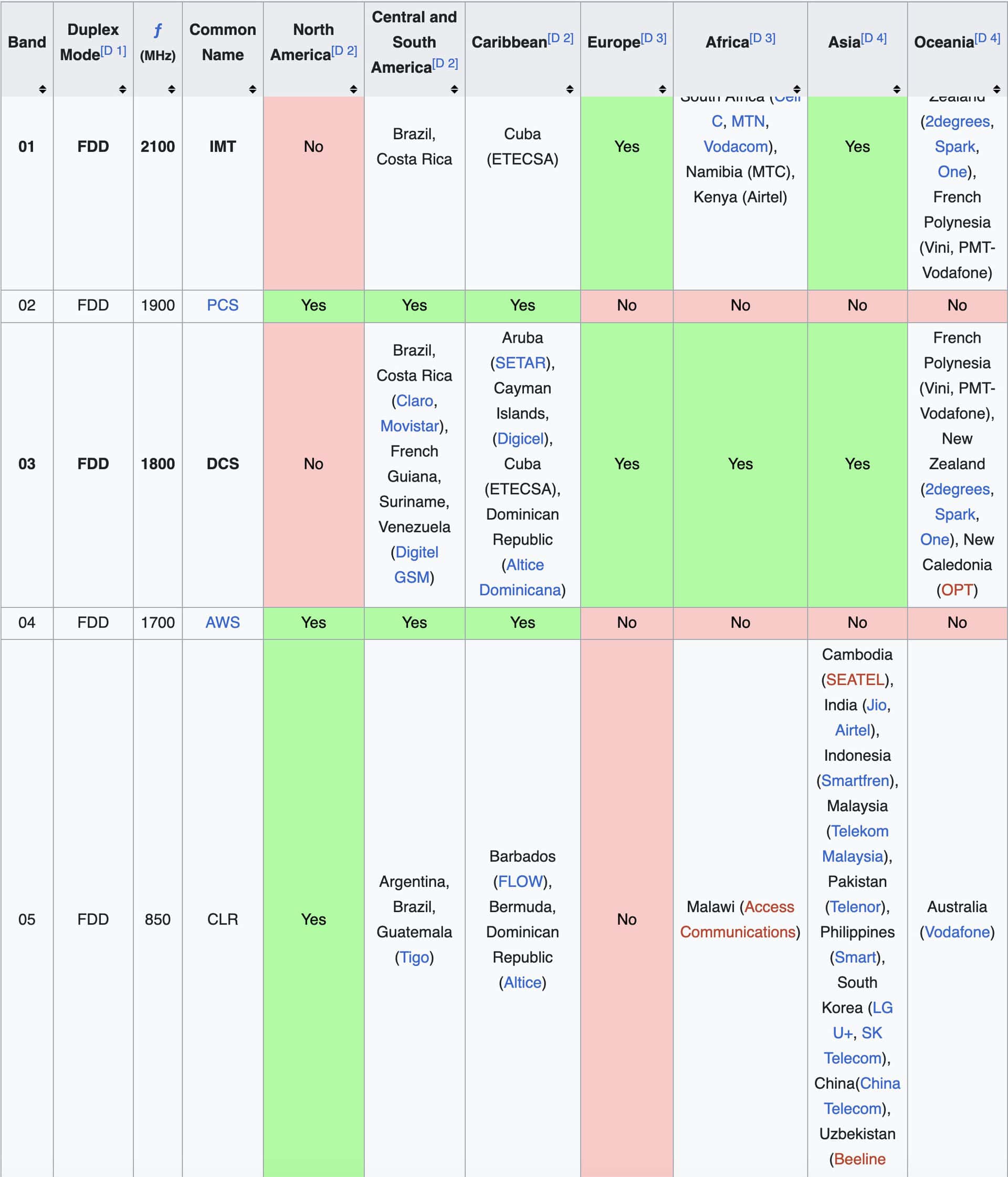
At the time of writing it is very hard to give a definitive figure on the number of 4G bands to provide network coverage on every operator in every region.
The table here is shared to provide some understanding as to why this is the case.
Thie excerpt features just 5 rows from the full Wikipedia entry on Global LTE bands out of a total of 72 bands listed.
However, if one consults section 5.5-1 of “E-UTRA Operating Bands” in 3GPP TS 36.101 (Tech Spec from the governing body of 4G), the total count is 88 bands!
Whatever the precise and current number,
70+ bands illustrates a total lack of harmonisation and evidence of bureaucracy working squarely against those that want to do IoT deployments on a global basis.
It’s possible to consider 3G, but many operators have been or are switching off their networks. 2G (GPRS) could be an option for low-bandwidth applications but the threat of 2G being discontinued in one or several regions makes the prospect of 2G deployments in 2020 quite risky and unpalatable.
The effect of this patchwork quilt of frequencies on manufacturers is to make global deployment expensive (one-size-fits-all products have traditionally been expensive,) or complicated (it is necessary to use a 4G router or module on a “per-region” basis), leading to multiple products being required and no way to work from a single fixed Bill of Materials (BOM) – every device deployed has to have a specific module/router to ensure coverage.

Problem 2: Certifications – Mandatory & Operator
“Europe is Easy!”
This is a phrase we often use when discussing cellular deployments within the European Union. Good harmonisation for both frequencies and certification means that so long as a cellular product has CE certification and conforms to “GCF” requirements (see: https://www.globalcertificationforum.org/) then the product is deemed legally acceptable to be put on the market AND fit for purpose by the network operators in the EU.
The fact it is relatively “easy” gives many EU based manufacturers a ‘false sense of security’ and so make assumptions that deploying products outside the EU is just as easy and subject to the same criteria as those deployed in the EU. Fully accepting what global certification really entails is often a bitter pill to swallow for those keen to provide a connected service and regularly results in a disappointing about-turn on a business venture due to the costs involved.
Regulatory Certification/Compliance
Some of the most famous examples of regulatory certification are:
- CE – European standard
- FCC – USA standard
These are broadly mandatory for all types of electronic RF product sold in the relevant continent. The standards reference several tests that must be completed and only if the tests are successful then the products can be legally made available for sale.
Some countries allow FCC or CE to be refenced within their jurisdiction but there are also many that insist on their own specifics standards being met.
Failure to conform is a legal issue and in the worst cases, non- compliance can result in imprisonment for company Directors, especially when products pose a threat to health and safety.
Telecom Industry Certification
GCF (https://www.globalcertificationforum.org/) and PTCRB (https://www.ptcrb.com/) are organisations responsible for certifying that a cellular product
will fundamentally not “break” a mobile operator’s network and is fit for purpose.
Exactly where they sit in the hierarchy of manufacturer obligations is beyond the scope of this document but suffice it to say that they ultimately equate to expenditure of time and money for anyone developing cellular products.
Operator Certification
Many people are surprised to discover that despite gaining regulatory and telecom industry certification there can be yet more hurdles to get over before a product can be sold.
Operator certification is yet another process that must be completed – fundamentally to assure the network operator that your device is fit to operate on their network. Common examples of this requirement come from AT+T and Verizon in the USA.
Only a minority of operators make an absolute mandate that this must be done but it is generally the more influential ones and so it has to be considered as part of overall deployment considerations.
Operator certification equates to yet more time and money.

Robustel’s Solution to Global Deployment Challenges
The new “GLOBAL” router series from Robustel will be one of the world’s first globally applicable LTE routers offered at a highly competitive price – something that has been unachievable until very recently (as of 2020).
This opportunity has come about due to more competitive “global” 4G (LTE) chipsets/modules becoming available and Robustel’s drive to gain fast time to market on such a desirable product.
A global router requires two things; global frequencies and global certifications. Both have traditionally been expensive to achieve, putting an entry barrier on bringing such a product to market and any that have must have an associated premium price tag, putting them out of the reach of many IoT applications – especially at scale.
Maintaining several versions of a router can mean greater stock-holding, multiple config files and a more complex process for associating Things/Devices with routers giving rise to more possibility of human error. Quite reasonably, clients often ask at the outset:
“Can’t I just have a 4G router that works everywhere?”
For these reasons, a one-size-fits-all 4G solution at an affordable price is a desirable product for global manufacturers/OEMs wanting to offer a “connected product” service, and it is this market that Robustel’s “GLOBAL” series aims to address.
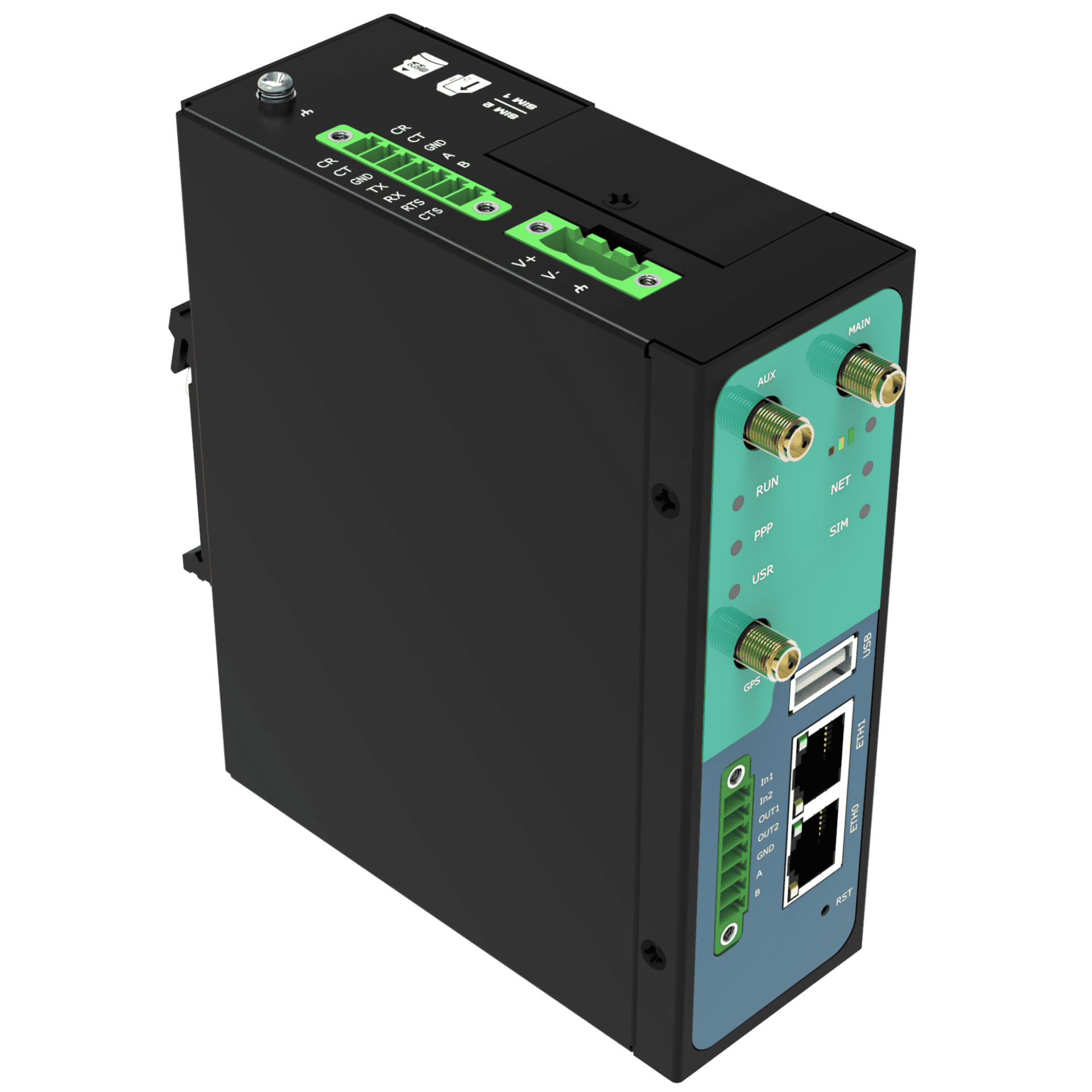
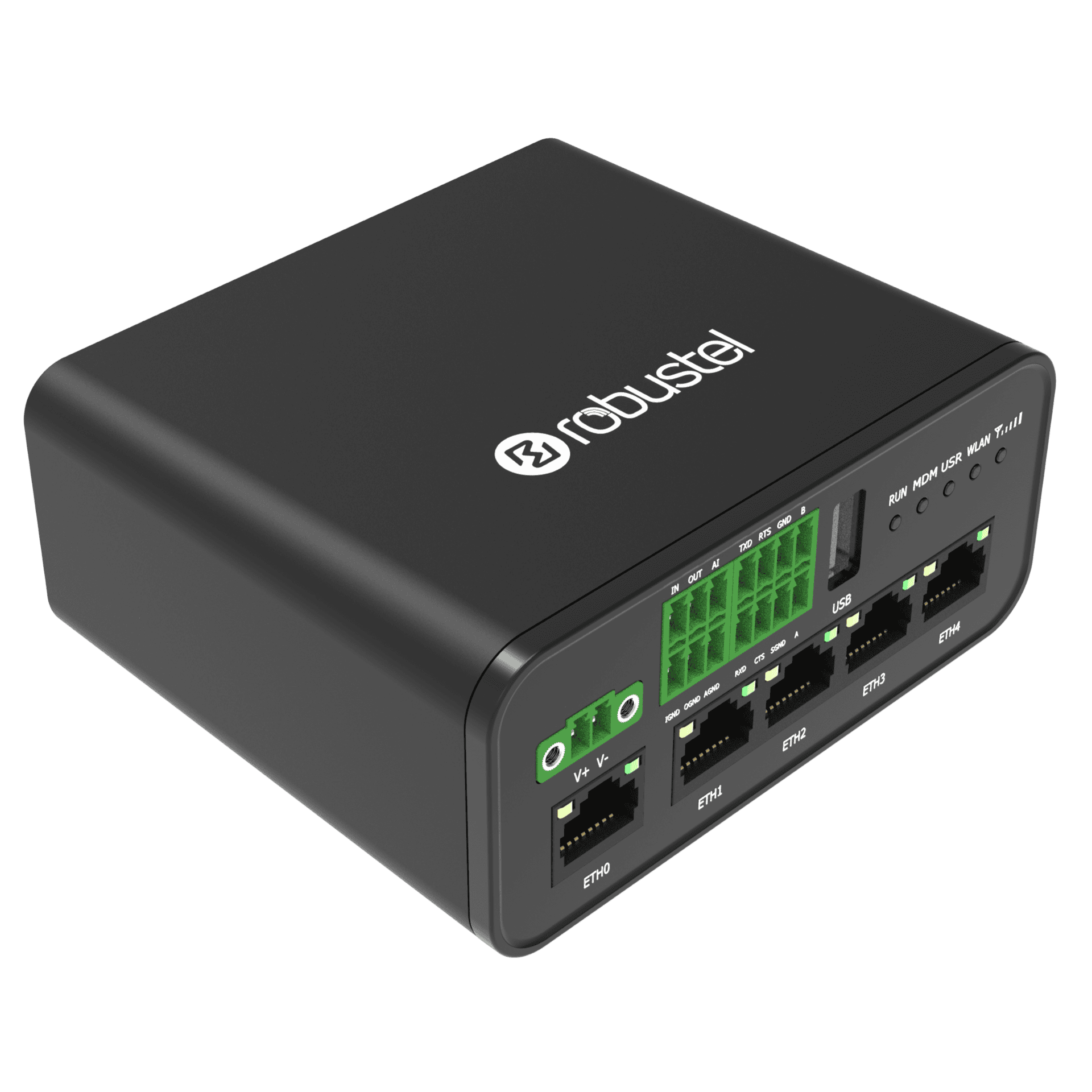
The current mainstays of Robustel’s GLOBAL router offering are as follows:
R3000-Global
R1520-Global
Apart from a large number of LTE frequencies providing coverage on all continents, the GLOBAL series has benefitted from very significant investment in costly certifications by Robustel making them the best certified products in their price bracket available today.
A full list of current, pending and road-mapped certifications for R1520 and R3000 are available from your Robustel representative. If a router does not have a specific certification for a customer project, Robustel will entertain getting that certification to allow the project to be fulfilled. Such an exercise would form part of an overall negotiation in the procurement of Robustel hardware. Robustel’s R+D team have extensive experience in gaining global certifications and are happy to provide consultancy on the subject matter to find the most cost-effective solution to a specific set of project requirements.
Global testing – Robustel has done it so you don’t have to
4G/LTE is a vastly complex system with many technologies working together to deliver an excellent experience for most consumers. However, the needs of industrial users are a little different with connections to mainly static assets (ones that can never move to a better signal area!) requiring as close to 100% uptime as possible.
In any new technology there can be teething problems throughout the supply chain (SIMs/components/firmware) and on this premise, Robustel committed to shipping an “R3000-GLOBAL” around the world to measure real world performance and to check for anomalies or unexpected behaviour.
Test Regime
The primary goal was to check the network attachment/registration process and the subsequent building of a data connection in a variety of locations.
It also served as an opportunity to test Robustel’s unique “Smart Reboot” capability, which is described later in this document.
In each location the router was powered on and standard boot routine took place. Close scrutiny was given to the network selection process which, in the absence of a “last known good network” depends on the router performing a dynamic scan for available networks then choosing from those with a “good quality signal” as defined by signal strength being above an acceptable threshold. If multiple networks meet the criteria then the router chooses from available networks at random to share/distribute the connection load on surrounding cellular networks/cells.
In all locations the router performed as expected building connections automatically within an acceptable period to networks as follows:
|
Location |
Network |
|---|---|
|
Guangzhou, China |
China Unicom |
|
Melbourne, Australia |
Telstra |
|
Brighton, UK |
Three UK |
|
Munich, Germany |
Vodafone Germany |
|
Florida, USA |
AT&T |
|
Toronto, Canada |
Bell |
USA – A Special Case
Of particular importance is the testing performed in North America where traditionally the two major networks have required different router models for technological and political reasons.
Typically, the choice has been for a Verizon approved router or an AT+T approved router, which is not ideal for those just wanting the best possible coverage, logistical simplicity & reliability. The R3000-GLOBAL, when used with an appropriate SIM can achieve a 4G Connection on all major US networks as follows:
- AT&T
- Verizon
- T-Mobile
- Sprint
Traditionally, Verizon and Sprint used CDMA technology which was incompatible with the GSM cellular technology used by AT+T and T-Mobile.
With the advent of 4G this incompatibility has been removed as all operators have converged on LTE (4G) meaning that a single roaming SIM plus a “GLOBAL” router could now provide internet access on all major operators in the US.
A cost-effective 4G router that can connect to both AT+T and Verizon is a desirable solution as many US organisations choose one
or other and stick with that operator for political or financial reasons.
OEMs need to be able to cater for these “customer choices” without imposing a significant financial constraint on the overall solution and it is precisely this that the GLOBAL series can help with in the USA.
Smart Reboot & Smart Roaming – Robustel’s unique solution to a Global problem
Roaming SIM cards are often sold as a way to improve reliability in IoT applications but there are many examples of unsuccessful outcomes by virtue of the 4G router not roaming to a different network when Data Comms has failed on the current network.
A detailed explanation of this issue is available in the Smart Roaming product brief available in our Smart Roaming White Paper
In short, the process that routers use to determine which network to use (Automatic Network Selection) only uses signal strength to determine a usable network and this doesn’t necessarily correlate with a network that can actually transmit data.
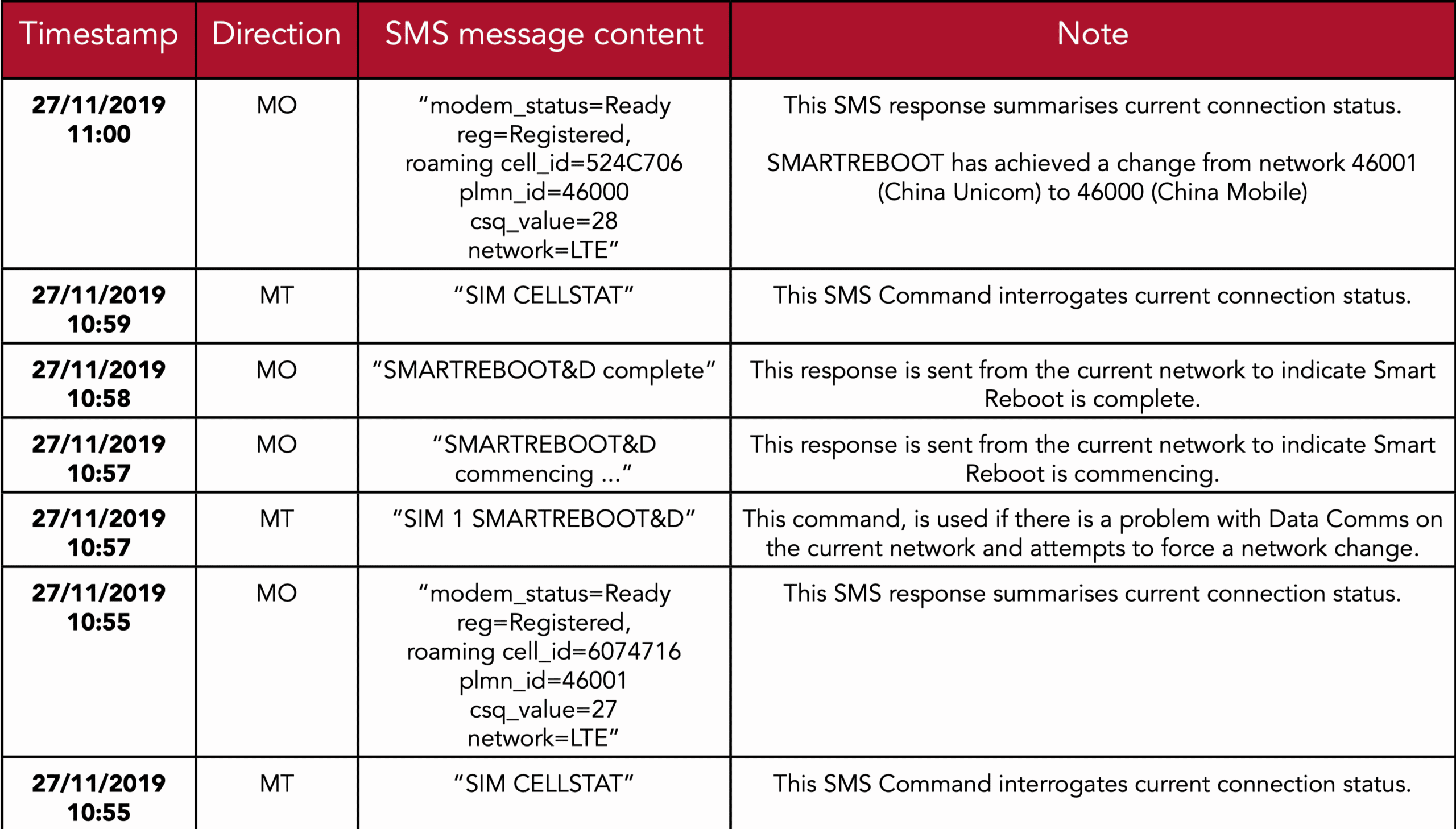
By sending an SMS message to a Robustel router with the body – “SIM1 SMARTREBOOT”, the router will delete the ‘last known good network’ from the SIM then reboot the router. This means the router will perform a scan and choose a network at random from a list of networks with adequate signal strength per the 3GPP definition of Automatic Network selection.
The Global test project was an excellent opportunity to stress test Smart Reboot in different environments.
In the context of globally deployed routers, a simple SMS Smart Reboot message could be the difference between having to visit site or not. A 10c SMS message could save a $1000 site visit by airplane.
Smart Reboot performed as expected in all countries – an example use of Smart Reboot features below whilst the router was in China. Note that the SMS message sequence is chronologically from the bottom up with a description of each ‘action’ in the “Note” column alongside:
Communications problems are always a threat when dealing with 3rd party RF systems but the stakes are much higher when deploying globally and the cost of a site visit can escalate to thousands of dollars. This is why Robustel’s Smart Reboot capability can be an invaluable aid when trying to manage an estate of widely dispersed 4G routers.
RobustVPN – Another Piece of the Jigsaw
Another challenge for OEMs deploying globally is the issue of remote access. If part of the installed equipment includes a PC running applications such as Teamviewer or Logmein then an instantaneous outbound connection to devices connected to a 4G router can be relatively easy to achieve.
However, many IoT devices don’t have the luxury of such consumer-friendly software packages (and associated hardware to run Operating Systems) and the ability to connect directly to a device by IP address and TCP port number is essential – and this, very often, is where the problems start!
By their nature, 4G networks do not make easy provision for such “inbound” connections, so a solution to this issue – often known as the ‘one way problem’ – must be found.
The simplest option is to go to a SIM provider that offers a fixed IP SIM and associated VPN service but it is not always possible or desirable (SIM contracts can be risky and onerous) for the OEM to dictate which SIM cards are used by the end customer in every location.
There is also the issue that in some regions a roaming SIM can be prohibitively expensive so a different ‘local’ SIM needs to be used and this is where Robustel’s RobustVPN service can be an invaluable solution.
RobustVPN is an innovative application of Cloud Based VPN tunnelling technology to provide Robustel routers with fixed private IP addresses that allow easy remote access from anywhere in the world.
Robustel’s Microsoft Azure hosted server takes care of the complicated setup issues typically associated with OpenVPN, including certificate exchange and passwords.
RobustVPN is entirely SIM independent – this means ANY SIM card from any provider can be used and a fixed IP service is effectively overlaid on top of that 4G SIM.
RobustVPN is also “bearer independent” – this means that not only can it work on any 4G SIM, it can also work across any wired or wireless internet connection, giving complete flexibility when the available internet connection type on each site may vary. RobustVPN is also used across Satellite modem (VSAT) connections on global shipping routes.
Partner with Robustel: Taking your IoT Application Global
Global IoT deployments are challenging but they don’t have to be prohibitive. Robustel has invested in the certifications, field testing, and advanced features that make worldwide connectivity practical and cost-effective. Partner with our experts today to simplify your deployment strategy, reduce risks, and accelerate time to market with IoT solutions that work anywhere in the world.
Partnering with Robustel on your global strategy gives you:
- Global Frequency Expertise: Robustel’s GLOBAL router series is engineered to handle the fragmented world of 4G LTE bands, ensuring seamless connectivity across regions without the complexity or cost of multiple device SKUs.
- Certified Worldwide: With heavy investment in global certifications, Robustel removes a major barrier to market entry — giving OEMs affordable, globally certified products that are ready to deploy anywhere.
- Proven Risk Reduction: From Smart Reboot to real-world stress testing on every continent, Robustel has built safeguards that reduce downtime, avoid costly site visits, and de-risk global rollouts.
- Secure Remote Access: Robustel’s advanced VPN and remote management tools simplify connectivity to devices anywhere in the world, lowering support costs and making global IoT deployment practical and sustainable.