
Stop Trenching, Start Bridging: How Private LoRaWAN Liberates Your Legacy Modbus Data
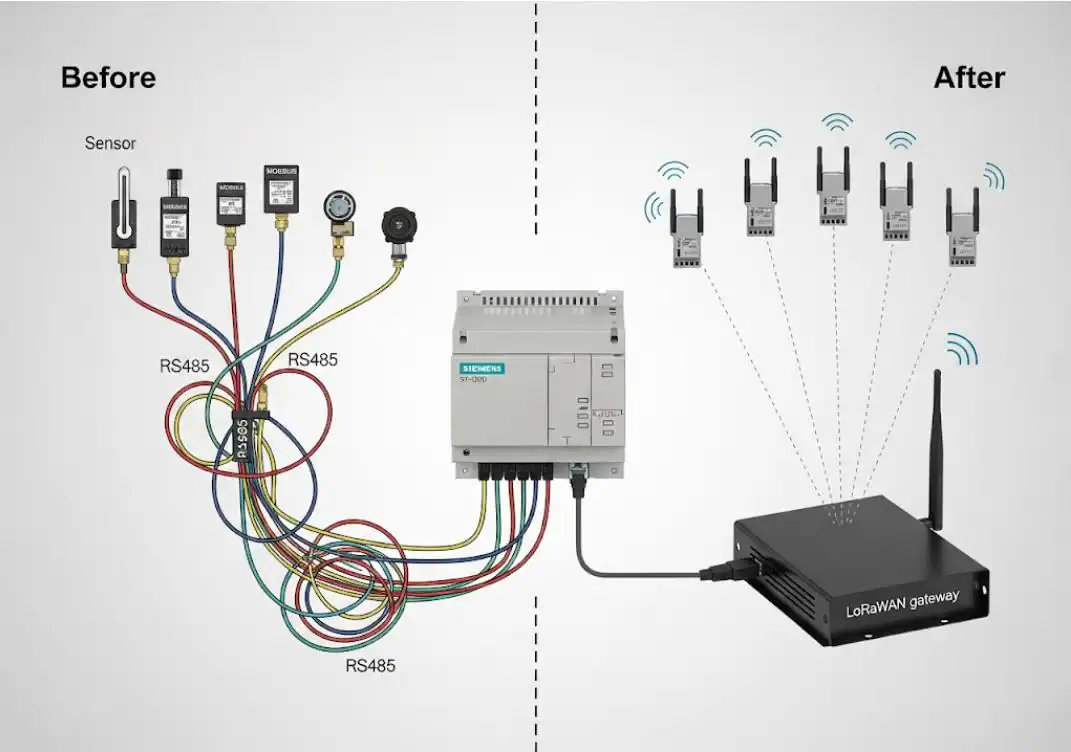
Your factory floor is filled with reliable equipment speaking the industry’s lingua franca: Modbus. But these valuable assets are often “tethered” by aging RS485 cables, creating data silos. This guide provides a practical roadmap for Private LoRaWAN-Modbus Integration—the ultimate strategy for modernizing operations without a costly “rip-and-replace” overhaul.
What we will cover:
- The Modernization Mindset: Why integrating, not replacing, legacy sensors is the fastest path to ROI.
- Two Core Architectures: How to deploy Distributed Sensor Meshes and Transparent Wireless Bridges.
- The Power of the Edge: Using an intelligent gateway (like the Robustel R1520LG) to act as a local Modbus TCP Server and Internal LNS.
- Data Sovereignty: How a private network eliminates subscription fees and keeps your industrial control loops 100% local.
Introduction: Breaking the “Wired Cage” of Industrial Modbus
I’ve walked through countless industrial facilities, and the story is always the same. Rows of reliable sensors, VFDs, and power meters are all dutifully communicating over Modbus RTU. They rely on kilometers of daisy-chained RS485 cables. For decades, this wired backbone has been the gold standard for stability.
But today, that cable is becoming a cage.
Modern operations demand agility. What happens when you need to monitor a storage tank 500 meters away, across a concrete yard where trenching is impossible? Or when adding a single data point requires weeks of manual wiring and high labor costs?
This is where many modernization projects stall. The cost of “running one more wire” is often prohibitive. However, the solution isn’t to replace your proven Modbus assets—it’s to liberate them. By integrating Private LoRaWAN, you can bridge those kilometer-wide gaps with a secure, long-range radio link. It’s about cutting the cord on legacy systems and giving your “trapped” data a new lease on life.
But “cutting the cord” isn’t a one-size-fits-all process. Depending on your existing site layout, there are two primary architectural paths to achieve this wireless transformation. Let’s start with the most common scenario: handling distributed, individual sensors.
Architecture A: The Distributed LoRaWAN Sensor Mesh
Successful LoRaWAN Modbus integration depends on choosing the right architecture for your specific environment. The most common pattern for expanding sensor deployments is the Distributed Sensor Mesh.
The Setup: Wireless “Plug-and-Play” Nodes
Instead of trenching kilometers of RS485 cables, you deploy LoRaWAN-native nodes. These can be integrated sensors or a LoRaWAN-to-Modbus adapter connected to a standard pressure or temperature sensor. These nodes convert local Modbus RTU signals into encrypted LoRaWAN packets, transmitting them over a long-range radio link.
The Gateway’s Role: The Intelligent Modbus TCP Server
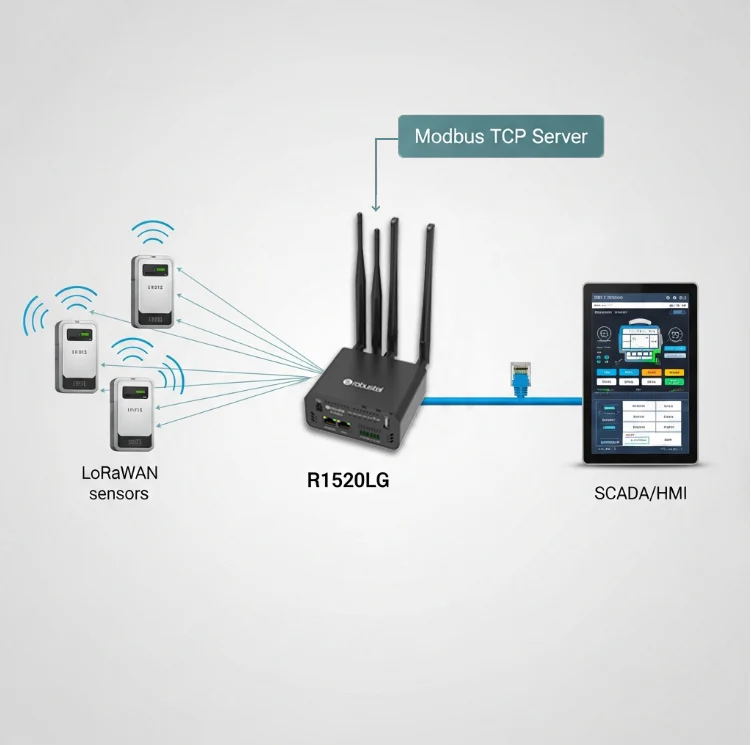
In a private network, a central gateway like the Robustel R1520LG does more than just “receive” data. It acts as an Intelligent Modbus TCP Server:
- Data Collection: The gateway’s built-in LoRaWAN Network Server (LNS) collects encrypted payloads from all wireless nodes.
- Protocol Conversion: It decodes the raw radio packets and maps them to specific Modbus Registers within the gateway’s memory.
The “Aha!” Moment: Virtual Wiring
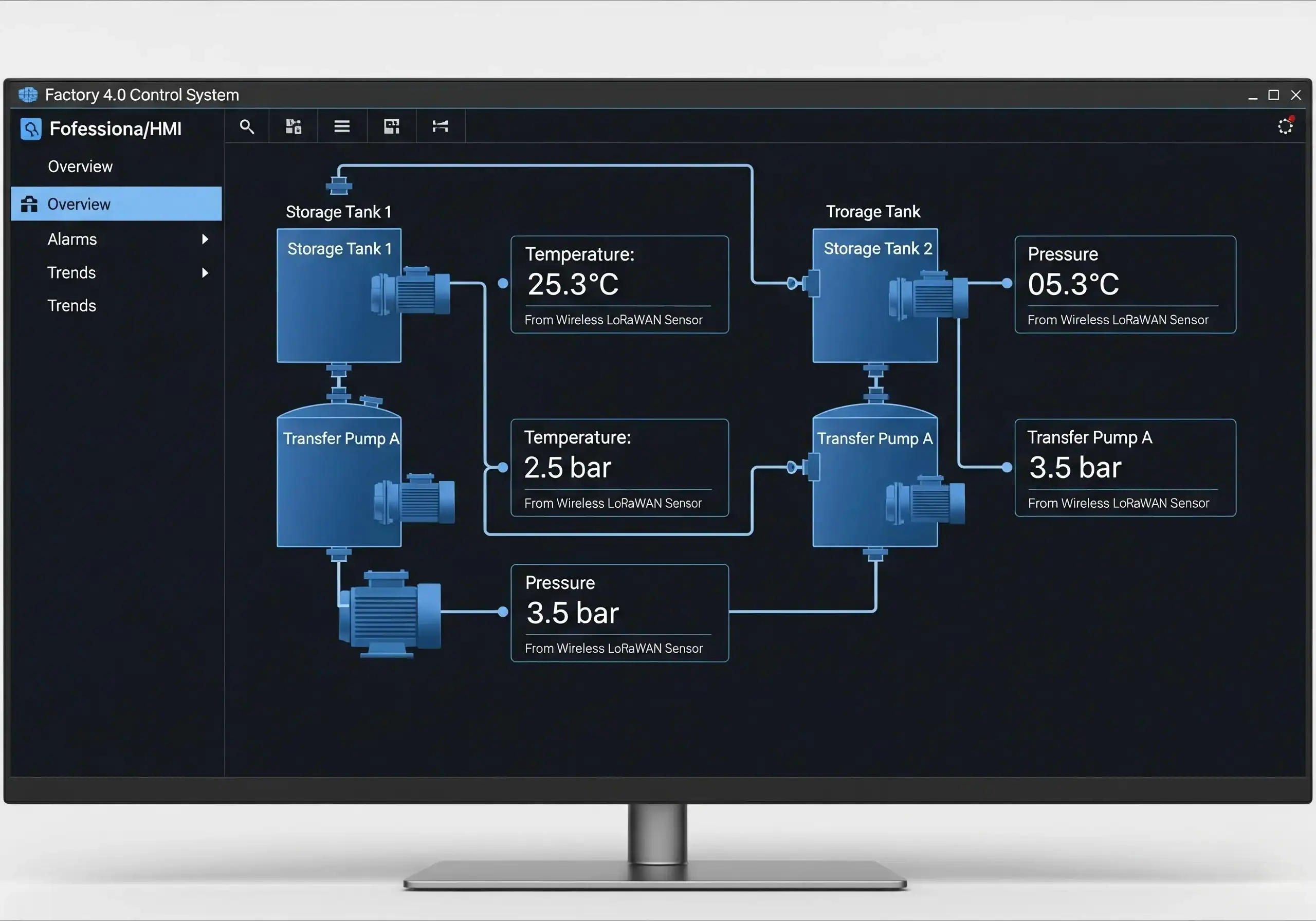
Your central PLC no longer needs to worry about radio frequencies. It simply polls the gateway over the local Ethernet via Modbus TCP. To the PLC, a sensor a kilometer away appears as if it were a local Modbus slave connected by a “virtual wire.” This architecture eliminates cloud latency and keeps your industrial control loop entirely within your local firewall.
While Architecture A handles individual sensors beautifully, industrial sites often face a different challenge: what if you already have an entire cluster of Modbus devices at a remote location? This requires a more robust “bridging” approach.
Architecture B: The LoRaWAN-to-Modbus Transparent Bridge
Architecture B is the ultimate solution for “Data Silos” like remote pump houses or solar arrays where multiple devices are already linked locally.
The Setup: The Remote “Sub-Master”
Imagine a remote site with ten Modbus VFDs already daisy-chained to a local controller. Instead of a costly fiber run, you install a LoRaWAN-enabled Edge Gateway at the remote site.
- Local Polling: The gateway acts as a Modbus Client (Master), locally polling all devices over RS485 at high speed.
- Packetization: It bundles this register data into compressed LoRaWAN packets for long-range backhaul.
The Result: Virtual Fiber at a Fraction of the Cost
At your central control room, a Master Gateway receives these packets and populates its internal Modbus TCP map. To your main SCADA system, the entire remote pump house appears as a single, local device. By using Private LoRaWAN, you avoid the monthly “per-packet” fees and high latency of public cellular networks, creating a “virtual fiber” link that you own and control.
Whether you are deploying a distributed mesh or a remote bridge, both architectures share a common requirement: a “brain” capable of more than just simple packet forwarding. In a private industrial network, the gateway’s intelligence is the deciding factor in system uptime.
The Key Enabler: Why the “Intelligent Edge” is Non-Negotiable
The Robustel R1520LG is specifically designed to be the translator and manager of your private industrial network through three critical capabilities:
- Native Industrial Connectivity: Built-in RS485 and RS232 ports allow it to communicate directly with your existing wired Modbus RTU devices without external converters.
- The Power of RobustOS (Debian-Based): Running on a powerful Debian-based OS, the R1520LG can execute custom Python scripts or Node-RED flows locally. It can filter or alarm based on Modbus values before they ever leave the gateway.
- Dual-Role Architecture (LNS + Modbus Server): The R1520LG can simultaneously host a local LoRaWAN Network Server (LNS) and act as a Modbus TCP Server. This “all-in-one” approach eliminates the need for external servers, reducing both cost and potential failure points.
Conclusion: Future-Proofing Your Industrial Data Sovereignty
Your legacy Modbus infrastructure isn’t a liability—it’s a goldmine of operational intelligence. Modernizing your plant doesn’t require a “rip-and-replace” overhaul. By implementing a Private LoRaWAN Modbus strategy, you bridge the gap between deterministic reliability and wireless flexibility.
An intelligent edge gateway like the Robustel R1520LG empowers you to deploy sensors anywhere, maintain total local control, and maximize the ROI of your legacy assets. It’s time to stop letting cables dictate your operational boundaries. Unleash your trapped data and build a private infrastructure that grows with your vision.
FAQs
Q1: Can Private LoRaWAN meet the real-time latency requirements of Modbus?
A: While not for sub-millisecond motion control, it is highly effective for SCADA monitoring. By using a Private LNS on the R1520LG, you eliminate cloud delays, providing update rates from 1 second to several minutes—perfect for tank levels and environmental sensing.
Q2: How is Modbus data encrypted when transmitted over the air?
A: Every packet undergoes AES-128 bit encryption at two levels (Network and Application). In a private deployment, these keys never leave your facility, ensuring a “closed-loop” security environment.
Q3: How many remote Modbus devices can a single R1520LG gateway manage?
A: It can theoretically manage hundreds of nodes. In a practical Architecture B scenario, the limit is determined by your “polling interval”—the less frequently you need updates, the more devices you can support.
About the Author
Robert Liao | Technical Support Engineer
Robert Liao is an IoT Technical Support Engineer at Robustel, specializing in industrial networking and edge connectivity. A certified Networking Engineer, Robert focuses on the deployment and troubleshooting of large-scale IIoT infrastructures. His work centers on architecting reliable, scalable system performance for complex industrial applications, bridging the gap between field hardware and cloud-side data management.