
Public vs. Private LoRaWAN: Why Industrial Leaders are Switching to On-Premise LNS
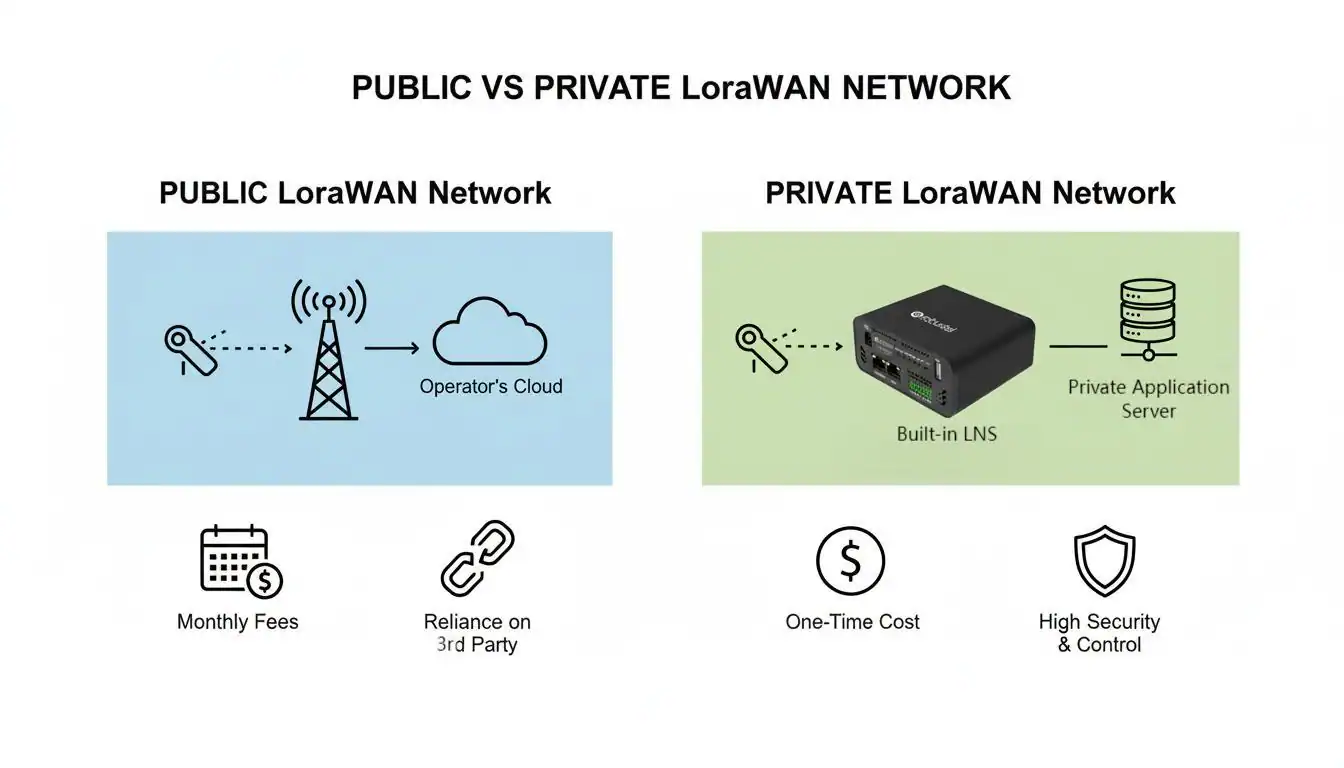
In the IT/OT convergence era, data sovereignty is non-negotiable. While public networks offer convenience, a Private LoRaWAN Network provides the “Holy Trinity” of industrial IoT: Uncompromising Security, Offline Reliability, and Zero Subscription Fees. By leveraging industrial gateways with a built-in LoRaWAN Network Server (LNS), like the Robustel R1520LG, businesses can now deploy a self-contained, secure ecosystem without external cloud dependencies.
Key Takeaways for 2026:
- A private LoRaWAN network means you control all of your own components: your gateways, your Network Server, and, most importantly, your data flow.
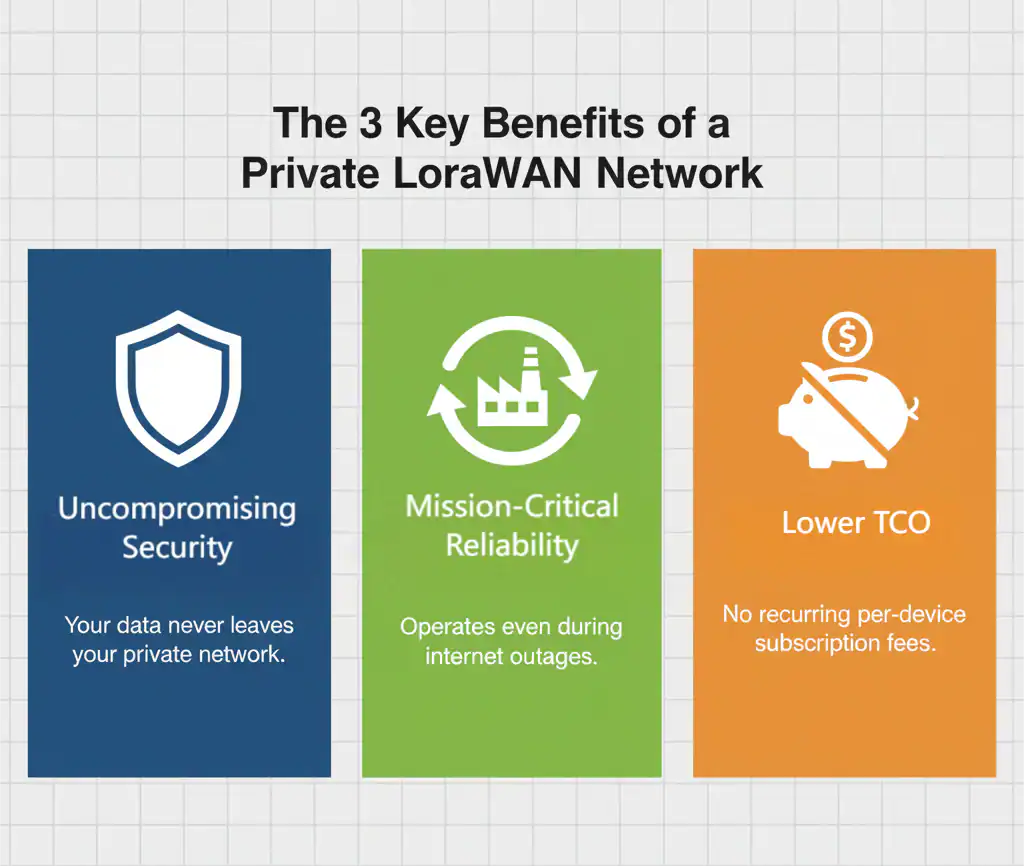
- The three primary benefits over using a public network are: uncompromising security (data never leaves your control), mission-critical reliability (it can operate offline), and lower TCO (no ongoing, per-device subscription fees).
- The core of a private network is the LoRaWAN Network Server (LNS).
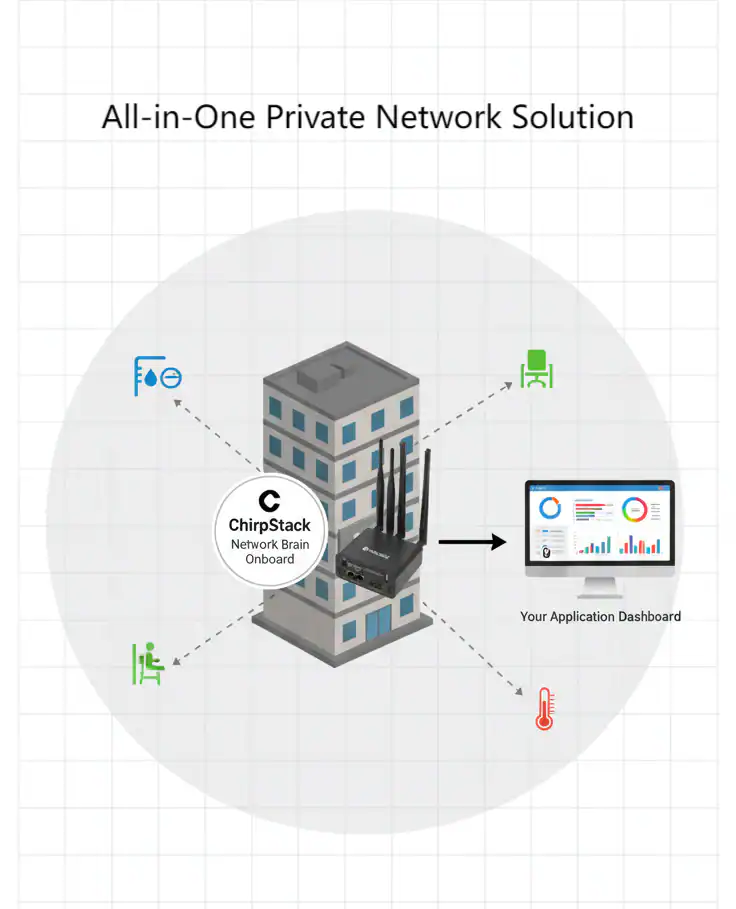
- Modern industrial gateways like the Robustel R1520LG can run a full LNS (such as the open-source ChirpStack) directly on the device, creating a powerful, all-in-one private network solution right out of the box.
Introduction: Why “Owning the Network” is the Professional Standard
I’ve sat down with dozens of systems integrators who face the same crossroads: “Do we pay for a public subscription, or do we build our own?”
For a 10-device pilot, public networks (like Helium or Senet) are fine. But for mission-critical industrial or municipal infrastructure, the math changes. If you are serious about long-term reliability and cybersecurity, you don’t just use a network—you own it.
Real ownership means mastering the data orchestration—from the Spreading Factor at the sensor level to the MQTT payload at the gateway.
Public vs. Private LoRaWAN Networks: What’s the Difference?
To see why enterprises are making the pivot, we must look at how data actually travels. In a public model, you are a tenant; in a private model, you are the landlord of your own spectrum.
| Feature | Public LoRaWAN Network | Private LoRaWAN Network (Built-in LNS) |
| Data Decryption | Occurs in the operator’s cloud server | Occurs locally inside the Robustel Gateway |
| Network Tuning | Generic, non-adjustable ADR | Granular control over Spreading Factors (SF7-SF12) |
| Offline Operation | Total failure during backhaul outage | Continuous local decoding & data buffering |
| Integration | Requires complex Cloud-to-Cloud API | Direct MQTT/HTTP push to local or private Cloud |
3 Technical Pillars of the Robustel Private Advantage
For any serious industrial, enterprise, or municipal deployment, the case for a private network is overwhelming.
1. Maximum Security & The “Triple Key” Encryption
This is often the most important factor. On a public network, your AppSKey (Application Session Key) is processed by a server you don’t control.
For sensitive industrial control data, municipal water system data, or private corporate information, this is often an unacceptable security risk. In a private LoRaWAN network, your data travels directly from your sensor to your gateway and then to your own private server. It never touches a third-party system, giving you complete data privacy and control.
- The Robustel Edge: Using the integrated ChirpStack LNS, you manage the Join Server locally. The 128-bit AES encryption keys never leave your hardware. This architecture is essential for complying with NIS2 or NERC CIP standards in critical infrastructure.
2. Mission-Critical Reliability
The real ‘aha!’ moment for many operations managers comes when they ask, “What happens if the internet connection at my gateway location fails?“
On a public network, if the gateway loses its internet backhaul, it becomes a paperweight. It can no longer forward sensor data, and your entire network is blind.
The Resilience: On a private LoRaWAN network that uses a gateway with a built-in LNS, the network can continue to operate completely offline. The gateway can continue to receive and process sensor data, and even use local logic to control other devices. The data is buffered and then synced to the cloud when the connection is restored. This is essential for mission-critical reliability.
3. Radical TCO
Public networks typically charge a recurring subscription fee for every single device on the network. For a small pilot, this is manageable. But for a smart metering project with 10,000 devices, these fees quickly become a massive, ongoing operational expense.
- The Math: A private network replaces monthly fees with a one-time hardware investment. By hosting the LNS on the gateway, you also eliminate the cost of a separate Linux server. For most industrial users, the payback period is less than 18 months.
The Key Component: The All-in-One Gateway with a Built-in LNS
In the past, building a private network was complex because you needed to set up and manage the LNS software on a separate, dedicated server. This is no longer the case.
The technology that makes private networks so accessible today is the all-in-one industrial gateway that is powerful enough to run the entire LNS software stack directly on the device. A gateway running ChirpStack, a powerful and popular open-source LNS, can act as the complete, self-contained brain for your entire private network. This dramatically simplifies deployment and reduces hardware costs.
Expert Checklist: Deploying for Success
- Site Audit: Measure RSSI levels to identify gateway placement and avoid “near-far” interference.
- Hardware Selection: Deploy an industrial gateway (e.g., R1520LG) with a pre-installed LNS App.
- LNS Setup: Activate ChirpStack and configure your Channel Plans (e.g., EU868 or US915).
- Secure Onboarding: Batch-import devices using OTAA (Over-the-Air Activation) for maximum security.
- Payload Decoding: Upload JS Codecs to the LNS to ensure data is “application-ready.”
- Redundant Backhaul: Use Smart Failover to switch between Ethernet and 4G/5G.
- Data Forwarding: Point the MQTT output to your local ERP or cloud dashboard.
Conclusion: Take Control of Your IoT Future
For any enterprise, industrial operator, or municipality with mission-critical security and reliability requirements, building a private LoRaWAN network is the superior strategic choice. It offers unparalleled control over your data, resilience against outages, and a more predictable long-term cost structure.
And with the advent of modern, all-in-one industrial gateways with built-in Network Servers, deploying your own private network has never been more accessible, powerful, or cost-effective.
FAQs
Q1: What is the real-world range of LoRaWAN?
A1: In open, line-of-sight environments, LoRaWAN can reach over 15km. However, in dense urban areas or deep industrial sites with heavy concrete and metal interference, the reliable range is typically between 2km and 5km. Its “Deep Penetration” capability is what makes it superior for indoor or underground monitoring.
Q2: LoRaWAN vs. NB-IoT: Which should I choose?
A2: It comes down to autonomy and cost. LoRaWAN allows you to build your own Private Network with no monthly SIM fees and better battery life (up to 10 years). NB-IoT relies on cellular carriers and requires a monthly subscription for every device. For remote sites or high-security industrial floors, LoRaWAN is usually the winner.
Q3: Is LoRaWAN good for real-time control applications?
A3: Generally, no. LoRaWAN is optimized for sending small, infrequent data packets. While it can send downlinks, the latency isn’t suitable for high-speed command-and-control. For real-time robotics or safety shut-offs, 5G/Edge Gateways are the better fit.
Q4: Can I run multiple use cases on a single network?
A4: Absolutely—and that’s where the ROI really climbs. A single industrial gateway in a smart building can simultaneously manage water leak detectors for facility teams, asset trackers for IT, and occupancy sensors for the energy team.
Q5: Should I use a Public or Private network?
A5: Public networks are great for wide, generic coverage. However, Private LoRaWAN Networks are the industrial standard. They give you total control over your coverage, data ownership, and security, with zero ongoing connectivity fees once the gateway (like a Robustel unit) is installed.
About the Author
Robert Liao | Technical Support Engineer
Robert Liao is an IoT Technical Support Engineer at Robustel, specializing in industrial networking and edge connectivity. A certified Networking Engineer, Robert focuses on the deployment and troubleshooting of large-scale IIoT infrastructures. His work centers on architecting reliable, scalable system performance for complex industrial applications, bridging the gap between field hardware and cloud-side data management.