

Private 5G Router Selection Guide for Factories and Campuses

The Robustel R5020 Industrial 5G Router fits factories and campuses that need industrial equipment to connect through a compatible private 5G network while retaining Ethernet, Wi-Fi and serial connectivity at the machine side. Selecting the router, however, should start with the private network architecture, spectrum and provisioning model—not simply with whether the datasheet says “5G SA.”
Imagine a manufacturer preparing a private 5G network for AGVs, inspection systems and remote production assets. The radio network and 5G core have already been selected. The engineering team now needs routers for the machines. A procurement search finds several industrial 5G routers that support 5G Standalone, including the required-looking frequency bands.
That still does not prove that they will attach to this private network, receive the correct IP policy and reach the intended plant systems. The useful selection path is: Private 5G architecture → spectrum and band → device compatibility → SIM credentials → network provisioning → plant LAN → application → operations
The router should pass every stage before the project scales beyond the pilot.
Start with the Private Network, Not the Router Datasheet
“Private 5G” describes more than one network architecture. 3GPP defines Non-Public Networks for private use and distinguishes two broad models: a Standalone Non-Public Network (SNPN) that does not rely on functions provided by a public mobile network, and a Public Network Integrated NPN (PNI-NPN) that uses support from a public mobile network. The ownership, authentication and network-selection model can therefore change according to how the private network has been built. Non-Public Networks (NPN) provides the underlying architectural distinction.
That means a factory should not begin its router specification with: Must support private 5G.
A more useful requirement is: Must connect to this specific private 5G network.
For a Robustel 5G router deployment, obtain the network information before freezing the hardware:
- Is the network 5G SA, NSA or another operator-integrated architecture?
- Which radio band is actually deployed?
- Which network identifiers and subscription model are used?
- Who provisions the SIM or subscriber credentials?
- Which APN or 5G data-network configuration is required?
- What IP addressing will the router receive?
- Which plant networks should that connection reach?
- Will equipment remain inside the private network or also use public cellular coverage?
- Who operates the RAN and core after commissioning?
These questions belong to the network design, not the router manufacturer alone. A router can support 5G SA and still require confirmation against the particular RAN, core, subscription and provisioning environment used by the project.
That is why SA support is a starting requirement, not a private-network compatibility certificate.
Match the Router to Spectrum and 5G SA Architecture
Once the network architecture is known, move to the radio. Suppose the factory operates a 5G SA network using a particular mid-band allocation. The industrial router installed on an AGV must support the corresponding frequency band in SA mode, not merely support that frequency under another radio configuration.
This sounds obvious, but product specifications can list:
- SA bands
- NSA bands
- LTE bands
- Different regional modem variants
The project needs the exact intersection:
Network operating band
- required SA/NSA mode
- router regional variant
The current Robustel R5020 Industrial 5G Router portfolio illustrates why this check matters. Different R5020 variants support different regional band combinations, while current models include 5G NR SA and NSA operation across multiple bands. Certain variants list bands including n48, n77 and n78, but the exact model must be matched to the target network and deployment region.
Do not reverse this logic by assuming: Router supports n78 → router is ready for our private 5G network.
Band compatibility answers only the radio-frequency part of the problem. The router must still register using the network’s subscription and authentication model and then receive a usable data connection. A sensible pilot therefore proves actual attachment to the production-like private network rather than approving hardware from a band table alone.
Provision SIM, Network Access and Addressing as One Connectivity Profile
The next failure point often appears after the radio hardware has been confirmed. The router sees the private network but does not establish the expected session. Now the investigation moves from RF compatibility to provisioning.
A Robustel private 5G router may require a SIM provisioned specifically for the enterprise network. Depending on the network architecture, the connectivity profile can include subscriber credentials, network selection information and the appropriate APN or 5G data-network settings.
These parameters should be treated as one approved site or device profile rather than separate values copied between spreadsheets.
For each router class, record:
| Provisioning item | What to confirm |
|---|---|
| Router variant | Correct regional modem and supported band |
| 5G mode | SA/NSA requirement matches network |
| SIM/subscription | Approved for the private network |
| Network identity | Required network-selection parameters |
| APN / data-network profile | Correct enterprise data path |
| IP allocation | Static, dynamic or assigned enterprise range |
| DNS | Required internal/external resolution |
| Routing | Which plant networks are reachable |
| Security policy | Permitted traffic and management paths |
| Fallback | Whether public LTE/5G is required or prohibited |
This becomes particularly important when the project moves from one test router to 50 AGVs. A manually edited APN on one pilot device is manageable. Fifty machines with undocumented differences are not.
The commissioning target should therefore be: one known-good connectivity profile that can be reproduced across the intended fleet.
SIM provisioning also needs an owner. The enterprise network team, private-network supplier and OT integrator should know who is responsible when a router fails authentication. Otherwise, an apparent “router fault” can circulate between three support organisations while the machine remains offline.
Connect Private 5G Back to the Plant LAN Without Flattening the Network
Successful 5G registration still does not mean the industrial application is ready. Consider an AGV. Its controller connects locally to the industrial router over Ethernet. The router attaches to the private 5G network. The private core then provides a path towards the control system.
The architecture may look like:
- AGV controller
- → Ethernet
- → 5G router
- → private 5G RAN
- → private 5G core
- → plant network
- → fleet-management application
Every arrow has a different owner and security boundary. A common design mistake is to concentrate so heavily on the private 5G radio that the integration into the existing OT network is left until commissioning.
The project should decide in advance:
- Which machine-side subnets exist
- Which systems AGVs or field devices need to reach
- Whether traffic should be routed or otherwise integrated into the plant architecture
- Which network segments must remain isolated
- Which ports and services are required
- How remote maintenance traffic is separated from production traffic
- Whether internet access is allowed
- How return routing works from plant applications to the mobile asset
Private 5G should not become a reason to flatten previously separated OT, IT and guest networks into one broad address space. The router is the boundary between the mobile network and local machine network, so the required routing, firewall and segmentation policy should be designed deliberately.
Robustel’s application example for AGVs on the factory floor shows this architecture clearly. The AGV controller connects directly to a Robustel 5G industrial router or gateway over Ethernet, while the cellular side uses a private 5G/LTE path across the plant. The example also separates AGV communications from shared office and guest wireless traffic.
The important lesson is not that every AGV requires private 5G. It is that when private cellular is selected, the router sits at a very specific integration point: wired machine network on one side, private mobile infrastructure on the other.
That boundary needs to be engineered as carefully as the radio link.
A stationary router can attach successfully to a private 5G network and still fail the requirement that matters on a moving industrial asset.
Consider an AGV operating between production cells, storage areas and loading zones. During commissioning, the router may show strong signal while the vehicle is parked beside the engineer. Once the AGV follows its normal route, however, it may pass metal racking, machinery, doorways and other areas where the radio conditions change quickly. The important question is no longer whether the router can register with the network from one position, but whether the application remains usable as those conditions change.
For that reason, a mobile acceptance test should follow the actual operating route. Engineers should identify locations where signal quality deteriorates, verify behaviour when the device moves between radio cells where applicable, and deliberately test a temporary loss of coverage. The most useful measurement is the time between the application becoming unavailable and becoming usable again. Network reattachment may occur before a VPN, MQTT session or other application connection has fully recovered, so modem status alone is not enough to define service restoration.
The antenna system should also be tested in its final installation rather than on an engineering bench. Antennas operating in free space can behave very differently after they are mounted on or inside an AGV, surrounded by metalwork, motors, batteries and electrical equipment. Antenna type, orientation, mounting position and cable routing can therefore affect the result as much as the router specification itself.
Power behaviour belongs in the same acceptance test. An AGV may remove or interrupt power when it is parked, charged or shut down. After a representative power cycle, the router needs to restart, register with the network and restore the required application path within an acceptable period. A router that reconnects to 5G but leaves the operational application offline for several minutes has not completed the recovery that the machine actually depends on.
Maintenance vehicles and campus shuttles create similar concerns, although their routes and power systems may be different. In each case, qualification should reproduce the movement, installation and recovery conditions of the real asset rather than relying on a static throughput result.
Robustel’s 5G overview video explains the broader capabilities that can make 5G relevant to industrial applications. For mobile equipment, those network capabilities still need to be validated against the final antenna installation, operating route and application-recovery behaviour before the connectivity design is accepted.decision should remain tied to the application requirement rather than the technology label.
How the Robustel R5020 Industrial 5G Router Fits Private 5G Factory Deployments
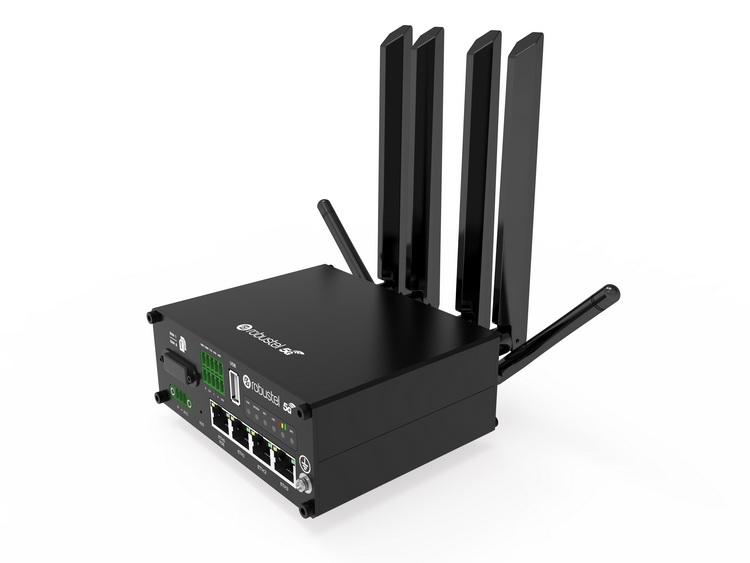
The Robustel R5020 Industrial 5G Router fits private 5G projects where machines, AGVs or other industrial equipment require cellular connectivity while retaining standard interfaces towards their local controllers and devices.
Its relevant architecture includes:
- 5G NR SA and NSA support on current regional variants
- 4G LTE fallback capability where appropriate to the network design
- Four Gigabit Ethernet interfaces
- Wi-Fi connectivity
- RS-232 and RS-485 interfaces
- Dual physical SIM support
- VPN and routing functions
- Remote management through RCMS
The combination allows the router to connect an existing machine architecture to a private cellular network without forcing every controller to become a native 5G device.
For an AGV: Controller → Ethernet → R5020 → private 5G
For fixed equipment in a difficult-to-cable zone: PLC / industrial device → Ethernet or serial → R5020 → private 5G
For a campus asset: Local IP equipment → R5020 → private network → central application
The value is the network boundary role, not simply 5G throughput.
The R5020 should still be qualified against the actual private network. Its support for SA, relevant bands and industrial interfaces does not imply universal compatibility with every SNPN, private core or enterprise provisioning model.
That qualification becomes especially important when network suppliers, router vendors and machine builders are different organisations.
The project needs an agreed working configuration rather than three independently valid datasheets.
Once routers are distributed across a factory or campus, operations also become part of selection. The Robustel RCMS remote device management platform can provide centralized visibility and management for Robustel router fleets, helping teams maintain configuration and investigate connectivity without treating every private 5G incident as a machine fault.
Remote management does not replace the private-network management system. It provides visibility into the router side of the boundary.
That distinction is useful during troubleshooting: Is the router powered and operating? Is the cellular connection established? Is the expected configuration present? Or does investigation need to move into the private RAN/core?The faster the support team can identify which side owns the failure, the easier a multi-vendor private 5G deployment becomes to operate.
Run a Private 5G Acceptance Path Before Fleet Rollout
The final router decision should be based on a repeatable acceptance path. Do not approve 100 routers because one unit displayed a 5G signal indicator. A stronger qualification sequence is:
1. Confirm architecture
Is this SNPN, operator-integrated private 5G or another defined architecture?↓
2. Confirm spectrum
Does the exact router variant support the deployed band in the required mode?↓
3. Confirm network attachment
Can the production SIM/subscription authenticate consistently?↓
4. Confirm data-network provisioning
Does the router receive the expected IP, DNS and routing?↓
5. Confirm plant integration
Can only the required OT/IT systems be reached?↓
6. Confirm application traffic
Does the real controller or machine application work end to end?↓
7. Confirm mobility where required
Does service remain acceptable along the actual AGV or campus route?↓
8. Confirm recovery
Does the router return correctly after coverage loss, network interruption or power cycle?↓
9. Confirm operations
Can support teams monitor, diagnose and restore the device remotely?↓
10. Freeze the approved profile
Are hardware variant, firmware, SIM profile and network configuration documented for rollout?This sequence changes procurement from: “We found a private 5G router.” to “We have validated a router configuration against our private 5G network and industrial application.”
That is a much stronger basis for scaling.
FAQs
Q1. Does a private 5G router need to support 5G Standalone?
It depends on the private-network architecture. Many private 5G deployments use Standalone architecture, but private networks can be implemented in different ways. The router should support the exact radio and core architecture used by the project rather than treating SA support alone as proof of compatibility.
Q2. Can the Robustel R5020 Industrial 5G Router connect to a private 5G network?
The Robustel R5020 Industrial 5G Router supports 5G NR SA and NSA on its current regional variants and can fit private-network applications when the required band, modem variant, subscription and network configuration are compatible. The exact private RAN/core environment should be validated during the pilot.
Q3. Which 5G band should I choose for a private factory network?
The router does not determine the operating spectrum. Start with the spectrum available and authorised for the private network in the deployment country and the band used by the selected RAN. Then choose a router variant that supports that band in the required 5G mode.
Q4. Why can a 5G router see the private network but still fail to connect?
Radio detection confirms only part of the connectivity path. Authentication credentials, SIM provisioning, network identity, APN or data-network configuration, modem compatibility and private-core policies may still prevent a working data session. Troubleshooting should separate RF detection from network attachment and IP connectivity.
Q5. What should factories test before deploying private 5G routers to every AGV?
Test the complete application rather than only download speed. Validate network attachment, IP routing, controller communication, coverage across the actual route, mobility behaviour, recovery after temporary signal loss, antenna installation, power cycling and remote diagnostics. Record the approved hardware and connectivity profile before fleet rollout.
Conclusion
Choosing a private 5G router for a factory or campus should begin with the network that the router must join.
The Robustel R5020 Industrial 5G Router provides 5G SA/NSA connectivity and industrial Ethernet, Wi-Fi and serial interfaces that can bridge existing machines into a private cellular architecture. Those capabilities are useful only when the exact R5020 variant, operating band, SIM profile, network configuration and plant-routing design match the deployment.
Follow the path in order: Private-network architecture → spectrum → router variant → subscription → IP connectivity → plant integration → application → mobility → operations
Then validate the real machine on the real network before scaling. A private 5G router should not be selected because it supports the right technology names. It should be selected because the complete device, network and application path has been proven to work as one repeatable industrial configuration.
Explore more articles about Robustel industrial 5G routers:


About the Author
Robert Liao | Technical Support Engineer
Robert is an IoT Technical Support Engineer at Robustel, specializing in industrial networking and edge connectivity. A certified Networking Engineer, Robert focuses on the deployment and troubleshooting of large-scale IIoT infrastructures. His work centers on architecting reliable, scalable system performance for complex industrial applications, bridging the gap between field hardware and cloud-side data management.