
OpenWRT NXP IoT Gateway: Is There a Better Alternative for Industrial 5G IoT?
Choosing between a custom OpenWRT NXP IoT Gateway and a commercially supported 5G IoT Edge Gateway is a critical decision for any industrial edge computing project. While the NXP i.MX 8M Plus processor paired with OpenWRT offers a flexible, networking-focused DIY solution, does it meet the security and reliability standards of a mission-critical deployment?
This guide compares the strengths of OpenWRT against a Debian-based alternative, like RobustOS Pro on the Robustel EG5120. We analyze key differences in industrial security, system stability, and application development to help you choose the right path for your infrastructure.
Introduction: The Seductive Power of “Complete Control”
If you’re an embedded systems engineer, the idea of building your own OpenWRT NXP IoT Gateway is incredibly appealing. You get total control. You can compile your own firmware, include only the packages you need, and build a lean, mean networking machine powered by a fantastic processor like the NXP i.MX 8M Plus. On paper, it looks like the perfect solution for your next 5G project.
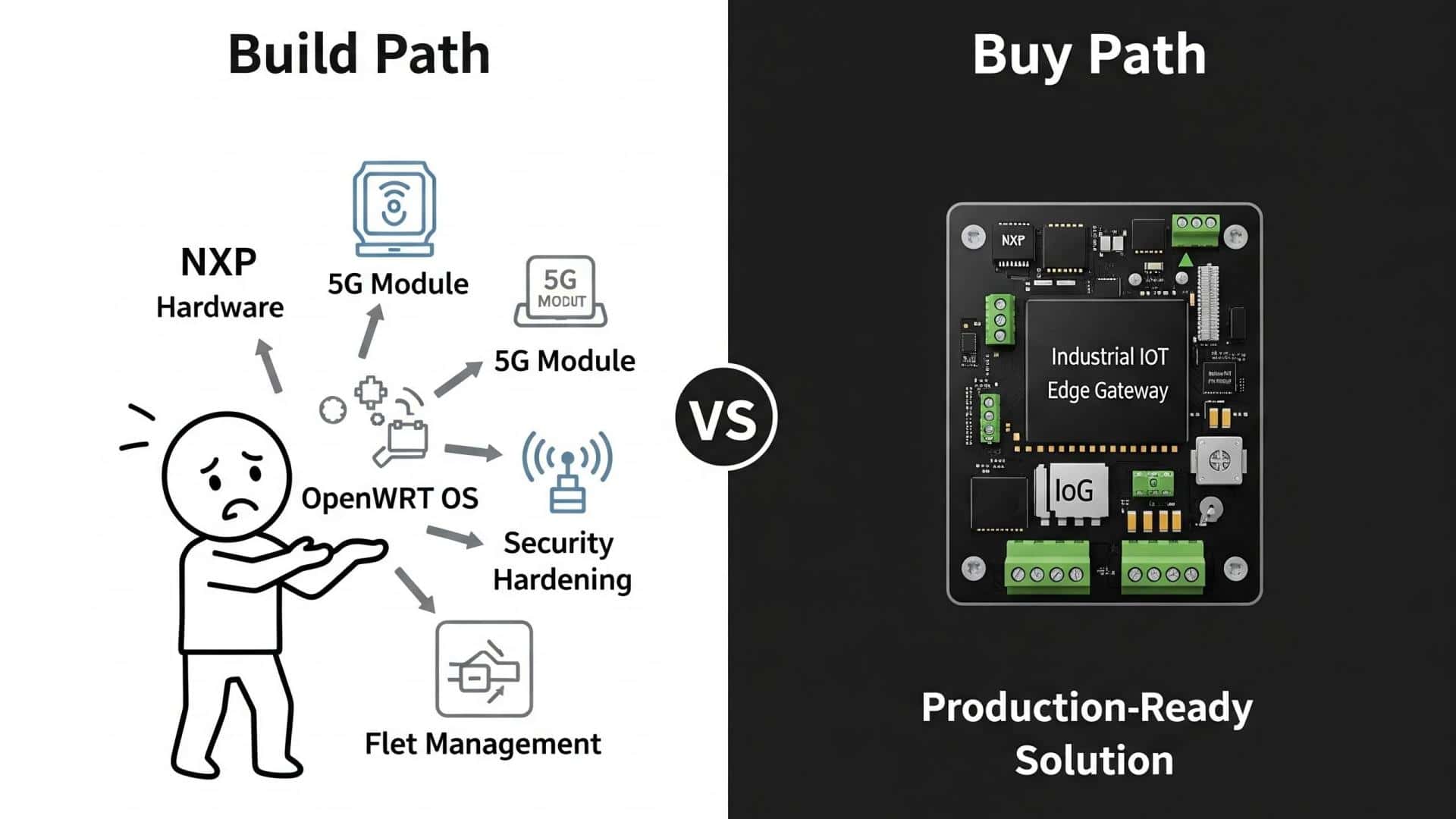
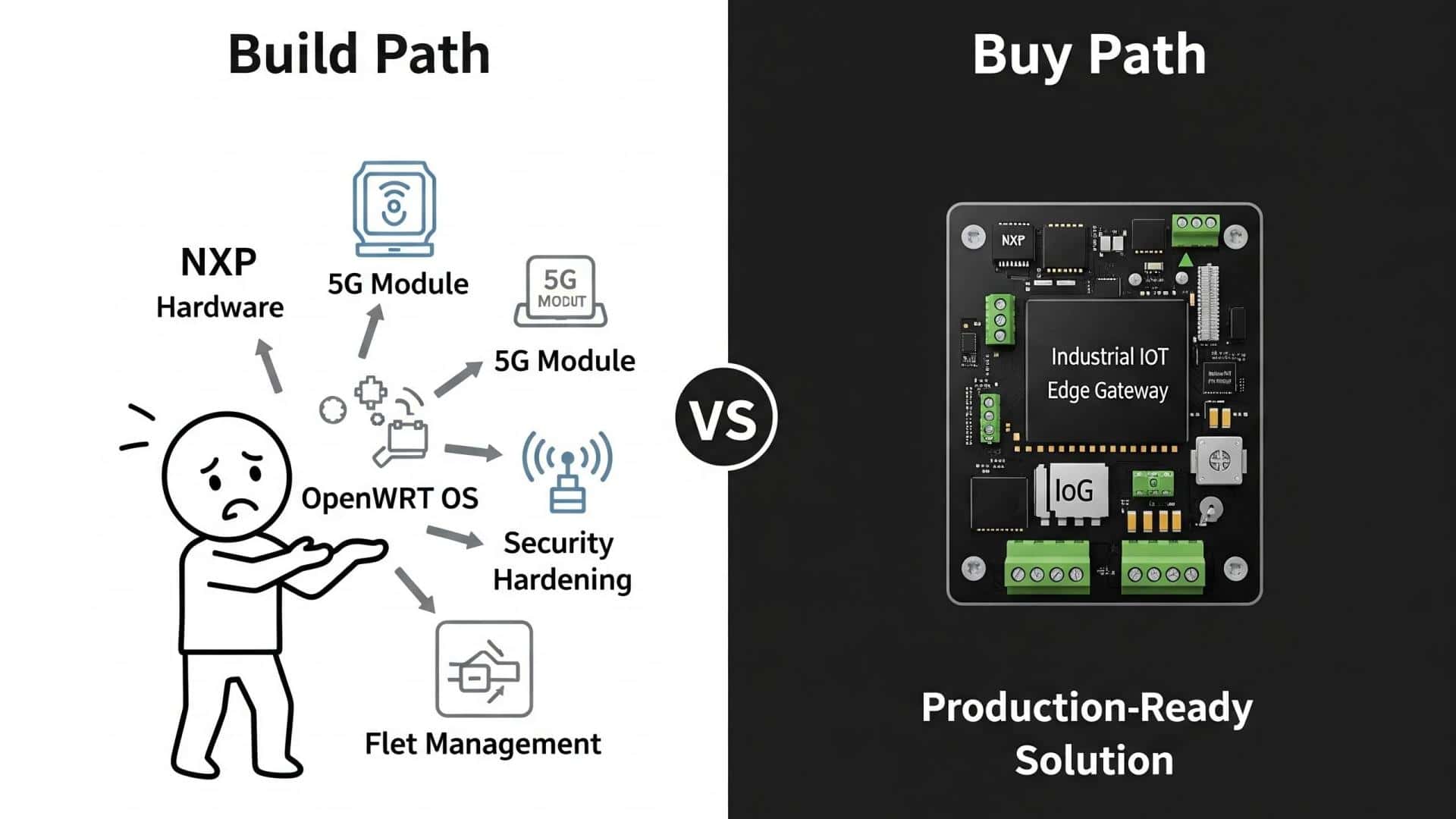
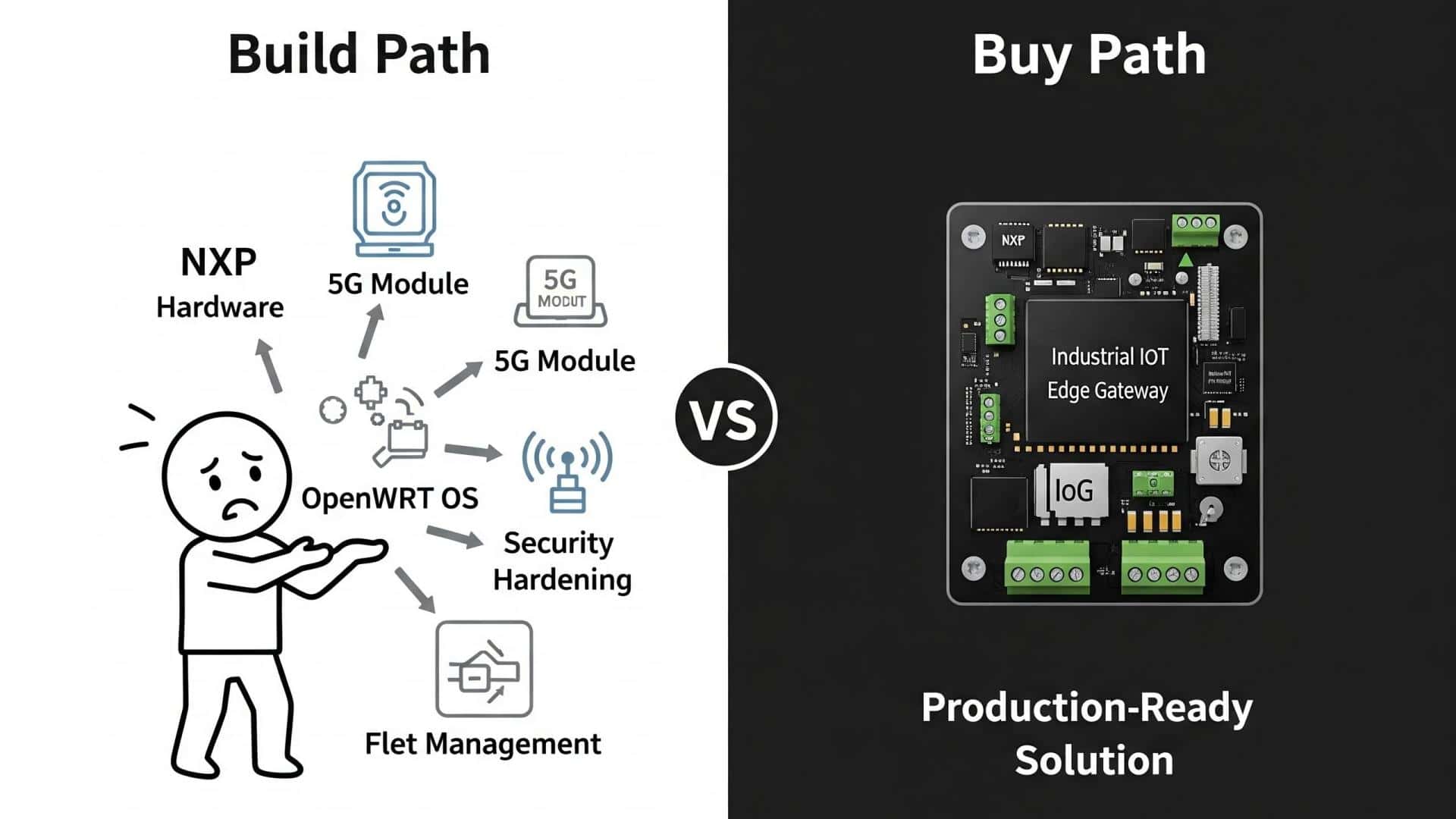
But I’ve been in this industry for a long time, and I’ve seen this story play out many times. The journey from a working OpenWRT prototype to a fleet of 500 secure, reliable, and manageable industrial gateways is filled with hidden costs and engineering nightmares. So, what starts as a quest for control often ends in a battle against unforeseen complexity. The question isn’t “Can you build an OpenWRT NXP IoT Gateway?” The real question is, “Should you?” Before you go down that path, it’s critical to understand what a true Industrial IoT Edge Gateway demands.
The Strengths: Why OpenWRT is a Great Networking OS
Let’s give credit where it’s due. OpenWRT is a phenomenal open-source project and an excellent choice for building custom routers and networking-focused gateways. Its strengths are undeniable:
- Lean and Lightweight: You can build a very small, efficient OS with only the services you need.
- Powerful Networking Features: It has an excellent web interface (LuCI) and extensive support for advanced routing, firewall, and network configuration. It is, first and foremost, a master of networking.
- Highly Customizable: You have complete freedom to modify and compile the system to your exact specifications.
When you pair this with a powerful SoC like the NXP i.MX 8M Plus, you have the makings of a high-performance networking device. But a modern industrial IoT Edge Gateway needs to be more than just a router.
The Industrial Challenge: Beyond Networking
This is the part of the story that’s often overlooked. Moving an OpenWRT NXP IoT Gateway into production reveals several critical gaps, especially when you need to run complex applications at the edge.
The Security and Compliance Gauntlet
Let’s be blunt: a default OpenWRT build is not secure enough for a critical industrial network. You are responsible for hardening it, which is a massive undertaking.
- Lack of Certified Development: The OS isn’t developed under a security-certified process like IEC 62443-4-1. This means you have no third-party assurance that secure coding practices were followed.
- No Pre-Certification: Your final, custom-built hardware will have zero regulatory or carrier certifications (FCC, CE, AT&T, Verizon etc.), making it illegal to sell commercially without an incredibly expensive and time-consuming testing process, especially for 5G.
The “Bricking” Nightmare: Reliability & Updates
What happens when you need to apply a critical security patch to 200 gateways in the field? With a custom OpenWRT build, you’re often on your own to create a reliable Over-the-Air (OTA) update system.
- Risk of Bricking: A remote update fails, and the device becomes an unresponsive “brick”, requiring a costly site visit.
- No Built-in Failback: Standard OpenWRT doesn’t have a dual-partition system for automatic rollback if an update fails. You have to build this complex reliability feature yourself.
The Scalability Trap: Fleet Management
Managing one OpenWRT NXP IoT Gateway is fun. Managing a fleet is a full-time job. You would need to integrate and manage a separate, third-party device management platform, adding another layer of complexity and cost.
An Alternative: A True Edge Computing OS
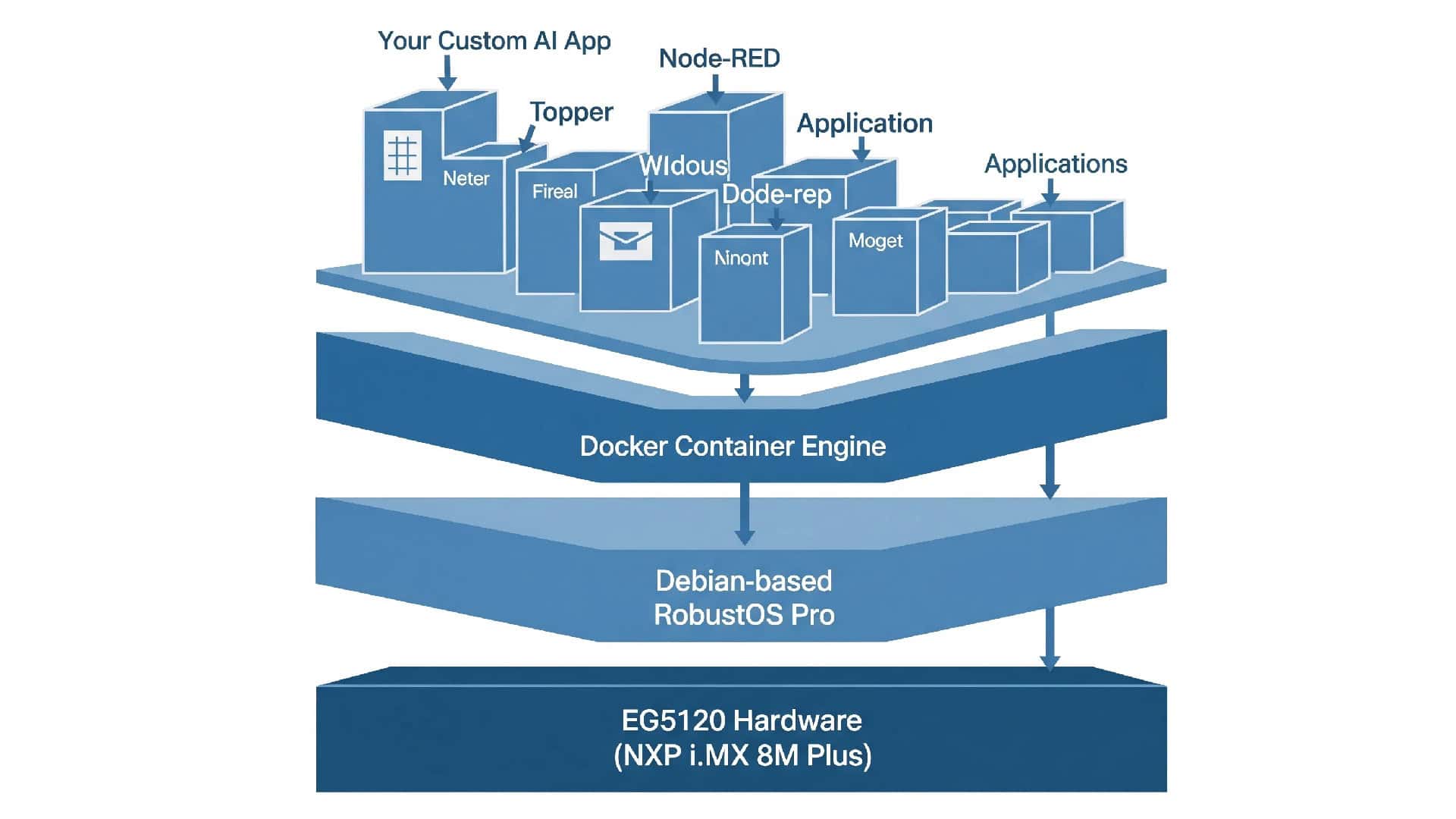
So, what’s the alternative? It’s not about giving up the flexibility of Linux. It’s about choosing a platform that excels at both networking and application processing. An industrial IoT edge gateway like the Robustel EG5120 provides this. It’s also powered by a high-performance NXP i.MX 8M Plus processor, but it runs RobustOS Pro, a hardened OS based on Debian 11 .
Why a Debian-based OS is a Better Choice for Edge Computing
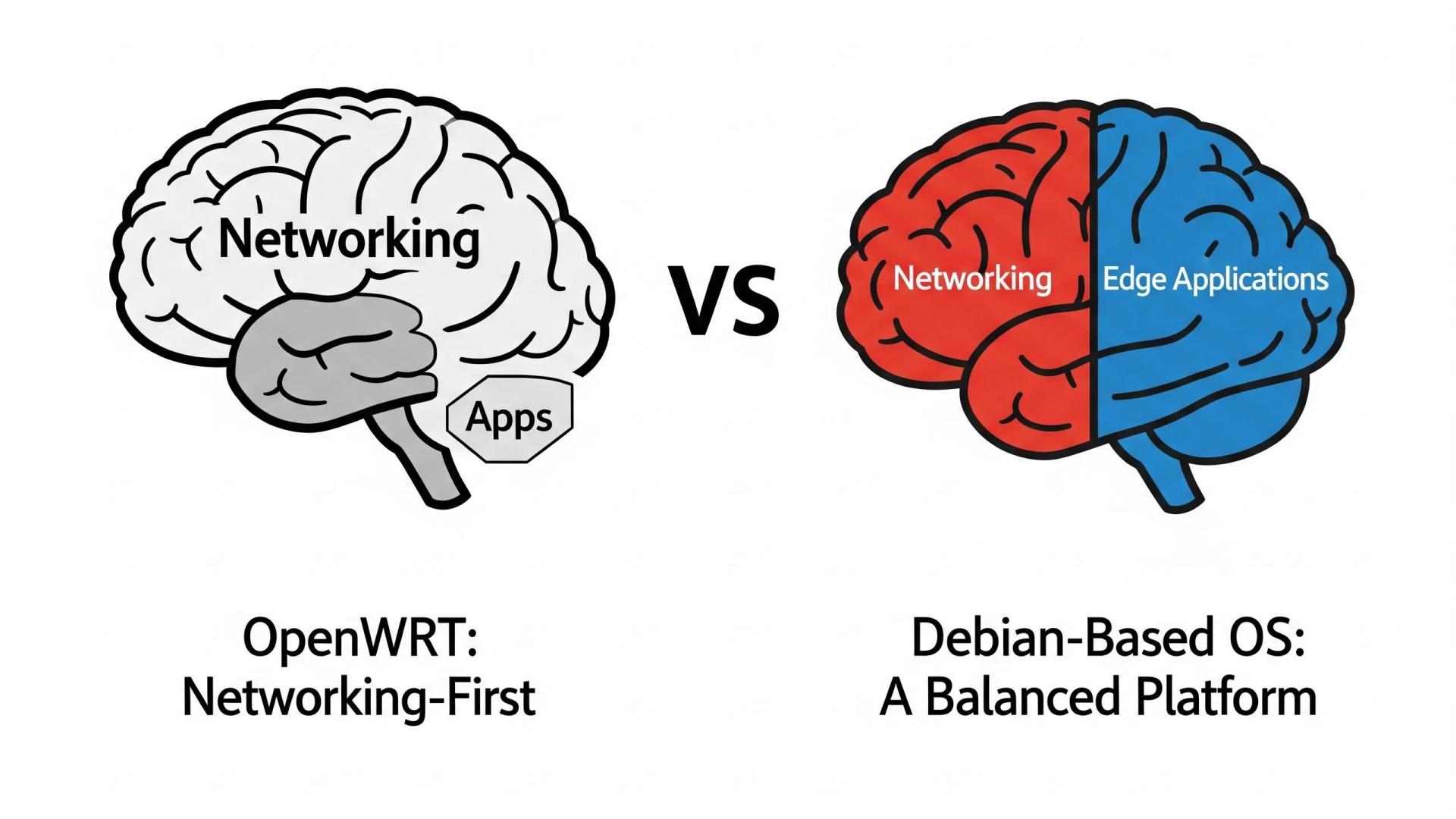
This is the core of the debate. While OpenWRT is a networking specialist, a Debian-based system is a true edge computing platform, offering a powerful balance of networking and application capabilities.
- A Massive Software Ecosystem: You have immediate access to tens of thousands of stable, pre-compiled applications and libraries via the apt package manager. Want to install a Python AI library or a time-series database? It’s one command away. This drastically accelerates application development.
- Container Freedom with Docker: RobustOS Pro fully supports Docker out-of-the-box. This allows you to package any application—from data analytics scripts to machine learning models—into a portable container and deploy it effortlessly. This level of application flexibility is a core strength over a more networking-focused OS.
- Built-in Security and Reliability: It comes with a hardened kernel, IEC 62443-4-1 certified development, and crucial features like Automatic System Failback built-in.
- Integrated Cloud Management: It is designed from the ground up to work seamlessly with a powerful fleet management platform like Robustel’s RCMS.
You get the power of the NXP i.MX 8M Plus and the openness of Linux, without having to spend hundreds of engineering hours reinventing the security, reliability, and management layers for your OpenWRT NXP IoT Gateway project.
Conclusion: About OpenWRT NXP IoT Gateway
Building a custom OpenWRT NXP IoT Gateway is an impressive technical feat. For a project where networking is the only challenge, it can be a viable option. However, for a scalable, secure, and reliable 5G industrial deployment that requires running complex edge applications, the hidden costs and risks are immense.
By choosing a production-ready industrial IoT edge gateway like the Robustel EG5120, you are making a strategic decision to invest in a lower Total Cost of Ownership (TCO). You get a platform that leverages the same powerful NXP hardware but provides a superior foundation for edge computing with its Debian-based OS, certified security, and scalable management. It allows you to focus on what truly matters: your application and your customers.
Watch: Discover more about the EG5120.
FAQs
Q1: If RobustOS Pro is based on Debian, is it as flexible as OpenWRT for application development?
A1: Yes, in many ways, it’s more flexible. While OpenWRT is heavily focused on networking functions, Debian offers a broader, general-purpose environment with a massive repository of easily installable software. With Docker support on RobustOS Pro, you can run virtually any application, making it a superior choice for edge computing.
Q2: What is the main advantage of choosing a gateway with a certified OS like RobustOS Pro?
A2: The main advantage is trust and reduced risk. An IEC 62443-4-1 certification and third-party penetration testing give you verifiable proof that the platform was built with security as a core principle. This is crucial for selling your solution to enterprise customers and protecting critical infrastructure.
Q3: Can I still get deep network configuration control with RobustOS Pro?
A3: Absolutely. RobustOS Pro provides a professional Web GUI and command-line interface (CLI) for granular control over its advanced networking features, including a full suite of VPNs, routing protocols, and firewall settings, rivaling the capabilities of a specialized OpenWRT build but in a pre-hardened, supported package.
About the Author
Robert Liao | Technical Support Engineer
Robert Liao is an IoT Technical Support Engineer at Robustel, specializing in industrial networking and edge connectivity. A certified Networking Engineer, Robert focuses on the deployment and troubleshooting of large-scale IIoT infrastructures. His work centers on architecting reliable, scalable system performance for complex industrial applications, bridging the gap between field hardware and cloud-side data management.