
Modbus RTU vs Modbus TCP: When Robustel EG5100 or EG5120 Edge Gateway Best Fits the Project

Robustel EG5100 edge computing gateway and Robustel EG5120 edge computing gateway can both connect serial and Ethernet Modbus equipment. The correct choice starts with the installed topology: RS485 instruments often favour Modbus RTU, Ethernet-native controllers favour Modbus TCP, and many industrial sites need both.
The gateway model should then match the scale of the integration. Robustel EG5100 suits focused protocol bridging and lightweight data processing, while EG5120 provides more memory, storage, Ethernet capacity, and application headroom for broader mixed-device projects. Neither product should be mechanically tied to only one Modbus transport.
Start with the Installed Equipment, Not the Protocol Name
Modbus defines an application-layer method for exchanging data with industrial devices. The same Modbus functions can operate over serial networks or Ethernet TCP/IP networks, while gateways can connect devices across these communication environments.
That means the first project question should not be: Is Modbus RTU or Modbus TCP more advanced? A more useful set of questions is:
- Which devices are already installed?
- Do they provide RS485, RS232, or Ethernet?
- How many independent device networks exist?
- Is an industrial Ethernet switch already available?
- What update interval does the application require?
- How far are devices located from the gateway?
- Will more devices be added later?
- How much local processing must run beside Modbus collection?
A brownfield factory may contain twenty RS485 meters that are expected to remain in service for another decade. Replacing them only to obtain Ethernet connectivity would add cost without necessarily improving the operational result.
A newer machine may already contain an Ethernet PLC, variable-frequency drive, and networked HMI. Adding a serial layer to that architecture would be equally unnecessary. The network should follow the equipment and project requirements rather than a general preference for one transport.
Before comparing Modbus RTU and Modbus TCP, it helps to clarify the role of an edge computing gateway. It is not tied to one field protocol or transport. Instead, it provides a common integration point for serial devices, Ethernet equipment, local applications, and upstream systems. Watch “What Is an Edge Computing Gateway?” for a concise overview.
When Modbus RTU Remains the Practical Fit
Modbus RTU is commonly used on serial networks in which one client polls one or more server devices. RS485 two-wire communication is the most common physical implementation for Modbus serial networks, while RS232 is generally associated with short point-to-point connections.
Modbus RTU remains a practical option for:
- Electricity, water, gas, and thermal meters
- Environmental sensors
- Variable-frequency drives
- Remote I/O
- Legacy controllers
- Battery or inverter equipment
- Building-management devices
- Distributed instruments with modest data rates
Existing RS485 Networks
The strongest reason to use Modbus RTU is often that a stable RS485 network already exists.
An edge computing gateway can collect values from that installed equipment without replacing every field device. The project can retain the physical layer while adding local normalization, buffering, cellular backhaul, or upstream data publishing.
Robustel EG5100 edge computing gateway provides two software-configurable RS232/RS485 ports, allowing a project to connect two independent serial paths or configure the interfaces according to the actual equipment.
Long Cable Runs and Distributed Instruments
RS485 is widely used for multidrop communication between devices distributed across an industrial site. The practical result depends on correct topology, cable selection, termination, grounding, device addressing, baud rate, and electrical conditions.
The Modbus protocol cannot correct:
- Reversed RS485 polarity
- Duplicate server addresses
- Incorrect serial framing
- Poor termination
- Uncontrolled star wiring
- Excessive electrical noise
- An unsuitable polling schedule
These conditions should be verified before evaluating the gateway application.
Modest and Predictable Data Volumes
Modbus RTU is often sufficient when devices expose a limited number of registers and the application accepts a controlled polling cycle.
The complete cycle depends on:
- Number of devices
- Registers requested from each device
- Number and size of requests
- Baud rate
- Device response time
- Retry count
- Communication errors
Adding devices to one serial bus can lengthen the time required to poll the entire network. The project should calculate the cycle rather than assuming that every register can be refreshed at the same high frequency.
When Modbus TCP Simplifies the Site Architecture
Modbus TCP carries Modbus application data through TCP/IP networks. An implementation may contain Modbus TCP clients and servers as well as gateways connecting Ethernet devices to serial Modbus subnetworks.
It is often a natural fit for:
- Ethernet PLCs
- Networked controllers
- Modern drives
- Industrial computers
- Protection or monitoring devices
- Existing plant Ethernet networks
- Systems requiring IP-based diagnostics
- Sites with several applications consuming device data
Ethernet-Native Equipment
When a PLC or controller already provides Modbus TCP, the gateway can communicate over the existing Ethernet network without adding a serial conversion stage.
This can simplify:
- Cabling around the gateway
- IP-based device identification
- Integration with existing switches
- Remote network diagnostics
- Communication with several Ethernet devices
- Expansion of the local device network
Robustel EG5120 edge computing gateway provides two Gigabit Ethernet ports that can be configured as LAN or WAN interfaces. This gives it more local network bandwidth than the two Fast Ethernet ports on Robustel EG5100, although actual application performance still depends on the connected devices and software workload.
Several IP Devices at One Site
An Ethernet network can be easier to expand when a cabinet contains several PLCs, controllers, cameras, engineering systems, or other IP devices.
A separate industrial switch may still be needed. Two Ethernet ports on a gateway do not mean that every device should be connected through a simple daisy chain or placed on one unsegmented network.
The architecture should define:
- IP address ownership
- VLAN or subnet design
- Allowed communication paths
- Firewall rules
- Gateway and device responsibilities
- Network-failure behaviour
Modbus TCP does not automatically provide security simply because it uses Ethernet. Access control, segmentation, VPNs, firewalls, and application permissions must be designed separately.
Higher or More Concurrent Data Demand
Modbus TCP may offer a more suitable transport when the project must collect larger data sets from several Ethernet devices or maintain multiple communication sessions.
This does not mean that TCP is universally faster in practice. Performance can still be affected by:
- Device response time
- PLC communication limits
- Network congestion
- Polling configuration
- Application design
- Gateway CPU and memory use
- Other services sharing the network
The protocol choice should be validated using the actual devices and register workload.
Most Industrial Sites Need a Hybrid Modbus Architecture
The most realistic project is often neither RTU-only nor TCP-only.
A production site may contain:
- RS485 energy meters
- An Ethernet PLC
- A serial environmental sensor
- A networked HMI
- Digital equipment-status inputs
- A cellular or Ethernet WAN connection
In that architecture, the edge computing gateway collects data from both Modbus RTU and Modbus TCP sources, then converts the device-specific information into one consistent local or upstream data model.
A simplified hybrid path may look like this:
RS485 meters → Modbus RTU
Ethernet PLCs → Modbus TCP
Both paths → Robustel edge computing gateway
Gateway → normalization, buffering, application logic, or upstream publishing
The value of the gateway is not that it forces every device to use the same physical network. It provides a common integration point while allowing suitable field equipment to remain on its existing transport.
| Site Component | Appropriate Local Path | Gateway Responsibility |
| Existing RS485 meter | Modbus RTU | Poll and interpret registers |
| Ethernet PLC | Modbus TCP | Read approved variables |
| Legacy point-to-point device | RS232 | Collect supported serial data |
| Upstream platform | IP application protocol | Publish normalized information |
| WAN interruption | Local application and storage | Retain selected records where implemented |
A hybrid design also creates clearer migration options. New Ethernet equipment can be introduced without immediately removing functioning serial devices.
Separate the Protocol Decision from the Gateway Decision
The choice between Modbus RTU and Modbus TCP determines how the gateway communicates with field equipment.
The choice between Robustel EG5100 edge computing gateway and Robustel EG5120 edge computing gateway determines how much local computing, storage, networking, and application capacity the project has available.
These are related decisions, but they are not the same decision.
| Project Requirement | Robustel EG5100 Direction | Robustel EG5120 Direction |
| Modbus RTU devices | Supported through configurable serial ports | Supported through configurable serial ports |
| Modbus TCP devices | Supported through Fast Ethernet | Supported through Gigabit Ethernet |
| Serial-port quantity | 2 × configurable RS232/RS485 | 2 × configurable RS232/RS485 |
| Ethernet | 2 × 10/100 Mbps | 2 × 10/100/1000 Mbps |
| RAM | 1 GB DDR3 | 2 GB or 4 GB LPDDR4 |
| Internal eMMC | 8 GB | 64 GB |
| Local workload | Focused bridging, buffering, and preprocessing | Broader or more concurrent applications |
| Cellular direction | Dual-SIM 4G/LTE | Dual-SIM 4G or 5G variants |
| AI acceleration | No dedicated NPU listed | 2.3 TOPS NPU |
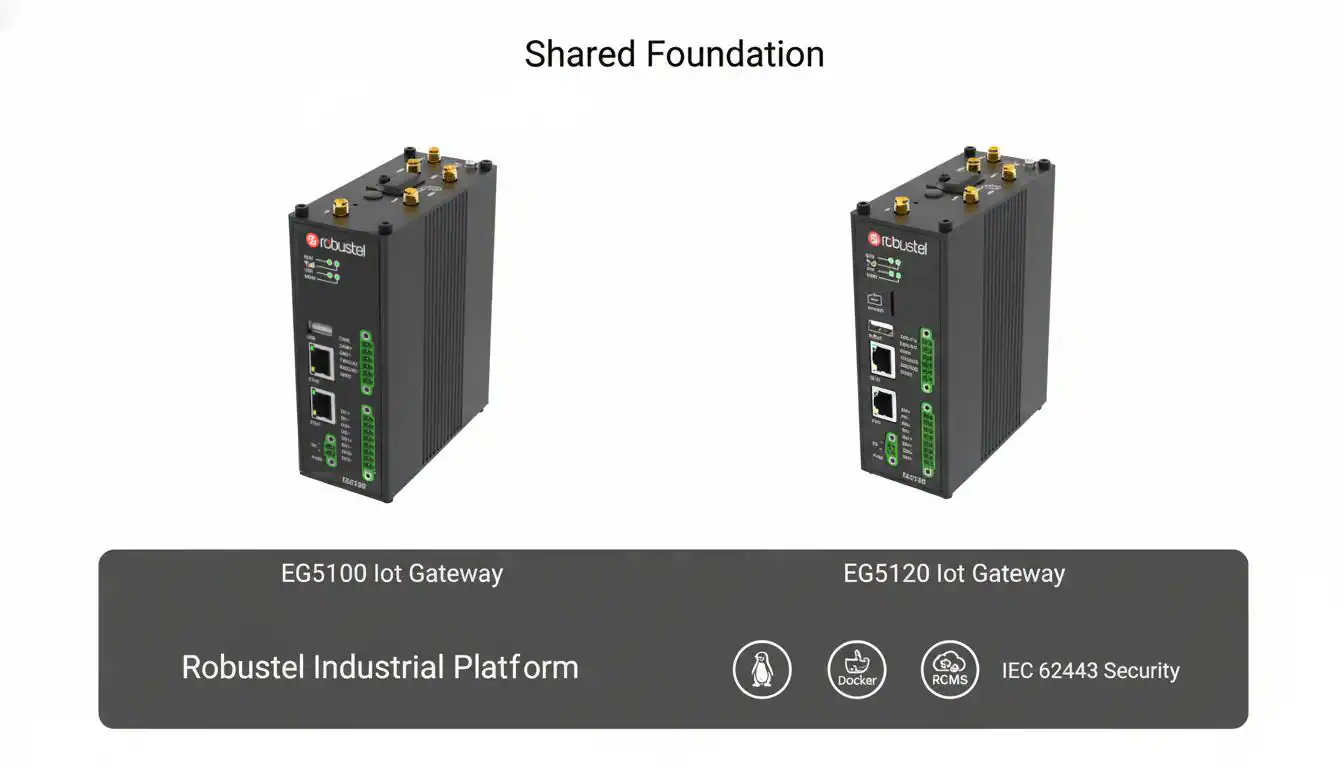
Current Robustel specifications show that both models provide two software-configurable RS232/RS485 interfaces and support RobustOS Pro. EG5100 uses a 792 MHz Cortex-A7 processor, 1 GB DDR3, 8 GB eMMC, and two Fast Ethernet ports.
Robustel EG5120 edge computing gateway uses a quad-core Cortex-A53 processor at 1.6 GHz, 2 GB or 4 GB LPDDR4, 64 GB eMMC, and two Gigabit Ethernet ports. It also includes a 2.3 TOPS NPU, although that AI resource is not itself a reason to choose Modbus TCP instead of RTU.
Choose EG5100 for a Focused Integration Layer
Robustel EG5100 edge computing gateway is the more proportionate direction when:
- The workload centres on serial or modest Ethernet data collection
- Two Fast Ethernet ports are sufficient
- Local applications remain lightweight
- Storage requirements are limited
- Protocol bridging and buffering are the main tasks
- 4G backhaul meets the project requirement
Robustel positions EG5100 for protocol bridging, local buffering, normalization, and secure transmission to SCADA or cloud systems. Its RobustOS Pro environment supports Docker containers, Debian-compatible packages, and custom development, but its 1 GB RAM and 8 GB eMMC establish a clear resource boundary.
Choose EG5120 for a Broader Mixed-Device Workload
Robustel EG5120 edge computing gateway becomes the stronger direction when:
- Gigabit Ethernet is useful
- More RAM is needed for concurrent services
- The application needs greater local storage
- Several protocol connectors run together
- A local database or longer buffering period is planned
- 5G is required for a separately validated WAN workload
- Compatible local inference is also part of the wider project
The selection should remain workload-based. A site does not need EG5120 merely because it contains a Modbus TCP PLC, and an RS485-heavy project is not automatically limited to EG5100.
Validate the Topology Before Approving the Product
A representative test should include the real Modbus devices, planned register maps, expected polling intervals, and complete gateway application.
Test the RTU Side
Verify:
- RS485 wiring and polarity
- Baud rate, parity, and stop bits
- Unique device addresses
- Register values and data types
- Full polling-cycle duration
- Timeout and retry behaviour
- Recovery after one device is disconnected
- Recovery after the gateway restarts
Test the TCP Side
Verify:
- IP addressing
- Network segmentation
- Device connection limits
- Required Modbus unit identifiers
- Concurrent communication
- Switch and cable behaviour
- Recovery after an Ethernet interruption
- Access-control rules
Test the Hybrid Application
The Robustel gateway should then be tested with both paths active.
Confirm that:
- RTU polling does not become unstable under the full workload
- TCP devices remain responsive
- Timestamps from different sources can be compared
- Device failures are identified separately
- Gateway resource use remains acceptable
- Buffered records retain the correct source time
- The application recovers after reboot
- WAN failure does not stop approved local collection
The test should focus on the worst expected combination of device count, register quantity, polling rate, application services, and network traffic—not only one successfully connected device.
FAQs
Q1. Is Modbus TCP always faster than Modbus RTU?
No. Modbus TCP may support higher network capacity and several Ethernet devices, but actual performance still depends on controller response time, polling design, network congestion, and gateway workload. A well-designed Modbus RTU network can be sufficient for meters and sensors with modest update requirements. The decision should follow the installed equipment, required cycle time, wiring conditions, and tested project workload.
Q2. Can Modbus RTU and Modbus TCP devices use the same edge gateway?
Yes, when the gateway provides both compatible serial and Ethernet interfaces and the deployed application supports both data sources. The gateway can poll RS485 devices through Modbus RTU and communicate with Ethernet controllers through Modbus TCP, then normalize the selected points into one data model. Device limits, polling intervals, interface count, software resources, and failure recovery still need project validation.
Q3. When should a project choose Modbus RTU instead of Modbus TCP?
Modbus RTU remains practical when the site already has RS485 meters, drives, sensors, or controllers that operate reliably and do not need replacement. It also suits distributed devices with modest data rates and limited Ethernet infrastructure. The project must still verify topology, termination, device addresses, serial settings, and polling-cycle length. RTU is not obsolete simply because newer equipment offers Ethernet.
Q4. Does Modbus TCP make an industrial network secure?
No. Modbus TCP uses Ethernet and TCP/IP, but this does not automatically provide encryption, authentication, or access control. The project should use network segmentation, firewalls, VPNs, controlled routing, and device permissions where appropriate. Modbus write functions need especially careful restriction. Moving from RS485 to Ethernet may simplify connectivity and diagnostics, but security must still be designed as a separate layer.
Q5. How should teams choose between Robustel EG5100 and EG5120 for Modbus projects?
Choose by workload and integration scale rather than by assigning Robustel EG5100 to RTU and Robustel EG5120 to TCP. EG5100 fits focused protocol bridging, lightweight preprocessing, and modest storage needs. EG5120 provides more memory, storage, and Ethernet capacity for broader mixed-device applications or concurrent services. Both can support serial and Ethernet Modbus paths, subject to the selected application, configuration, and production testing.
Conclusion: Modbus RTU vs Modbus TCP Takeaway
Robustel EG5100 edge computing gateway and Robustel EG5120 edge computing gateway both support serial and Ethernet Modbus integration. The decision between Modbus RTU and Modbus TCP should follow the installed equipment, cabling, device count, polling requirement, and network topology.
Modbus RTU remains practical for RS485 meters, sensors, drives, and long-lived field equipment. Modbus TCP is a natural fit for Ethernet-native PLCs and IP-based industrial networks. Many brownfield and expanding sites need a hybrid architecture that preserves both.
The product decision follows a different boundary. EG5100 fits focused protocol bridging and lightweight local processing, while EG5120 provides more computing, storage, and Ethernet headroom for broader applications. Treating RTU versus TCP and EG5100 versus EG5120 as separate decisions produces a more accurate and maintainable industrial design.
Related Reading on Edge Computing in Industrial IoT:

About the Author
Robert Liao | Technical Support Engineer
Robert is an IoT Technical Support Engineer at Robustel, specializing in industrial networking and edge connectivity. A certified Networking Engineer, Robert focuses on the deployment and troubleshooting of large-scale IIoT infrastructures. His work centers on architecting reliable, scalable system performance for complex industrial applications, bridging the gap between field hardware and cloud-side data management.