
Managed Private Cellular & 5G: The 2026 Enterprise Deployment Strategy
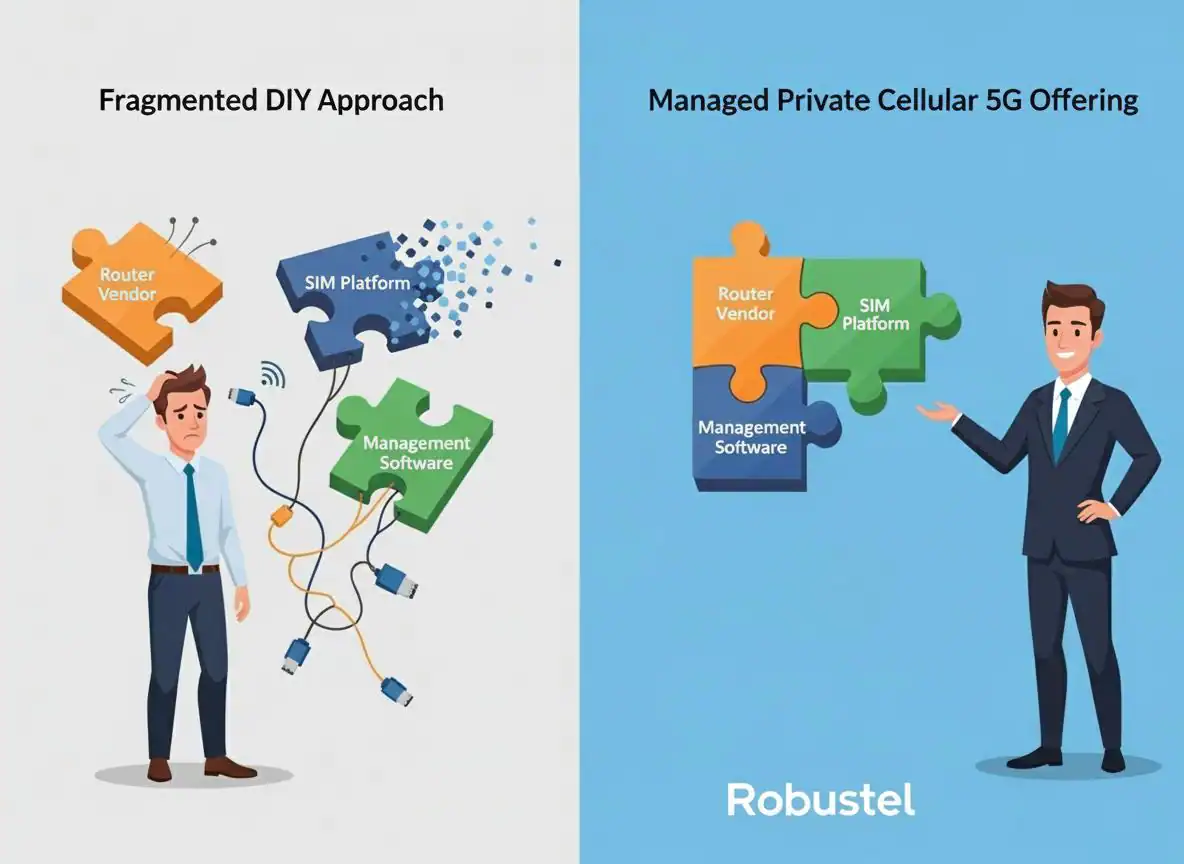
In the mission-critical landscape of 2026, a Managed Private Cellular & 5G Offering has evolved from a luxury to a strategic necessity. For enterprises demanding sub-10ms latency and absolute data sovereignty, the “Do-It-Yourself” model—fragmented hardware, disparate SIM management, and siloed security—is quickly becoming a liability.
A true managed offering is a vertically integrated ecosystem that synchronizes high-performance Industrial 5G Routers with a centralized orchestration layer. This guide explores how a unified architecture—combining the 3GPP R16-compliant R5020 Lite with the RCMS Cloud Platform—delivers a “carrier-grade” experience with the simplicity of a single pane of glass.
Key Technical Insights:
- The Integration Shift: Why moving from a “collection of parts” to a Managed Ecosystem eliminates “Integration Hell” and reduces the Total Cost of Ownership (TCO).
- Operational Agility: Leveraging Zero-Touch Provisioning (ZTP) to deploy global 5G nodes in minutes, not weeks, without specialized on-site technicians.
- Defense-in-Depth Security: How a Silicon-to-Cloud security model (IEC 62443-4-1 compliant) protects your private spectrum from edge vulnerabilities.
- The Scalability Pillar: The role of RobustVPN and real-time telemetry in maintaining 24/7 operational continuity across a distributed private network.
Introduction: Moving Beyond the “Integration Hell” of Private 5G
I’ve sat across the table from dozens of IT Directors and CTOs who are genuinely excited about Private 5G. They see the vision: the ultra-low latency, the high-density sensor arrays, and the Data Sovereignty that a private cellular network brings to a factory, warehouse, or massive campus. But that excitement often evaporates the moment they face the “Day 1” reality of deployment.
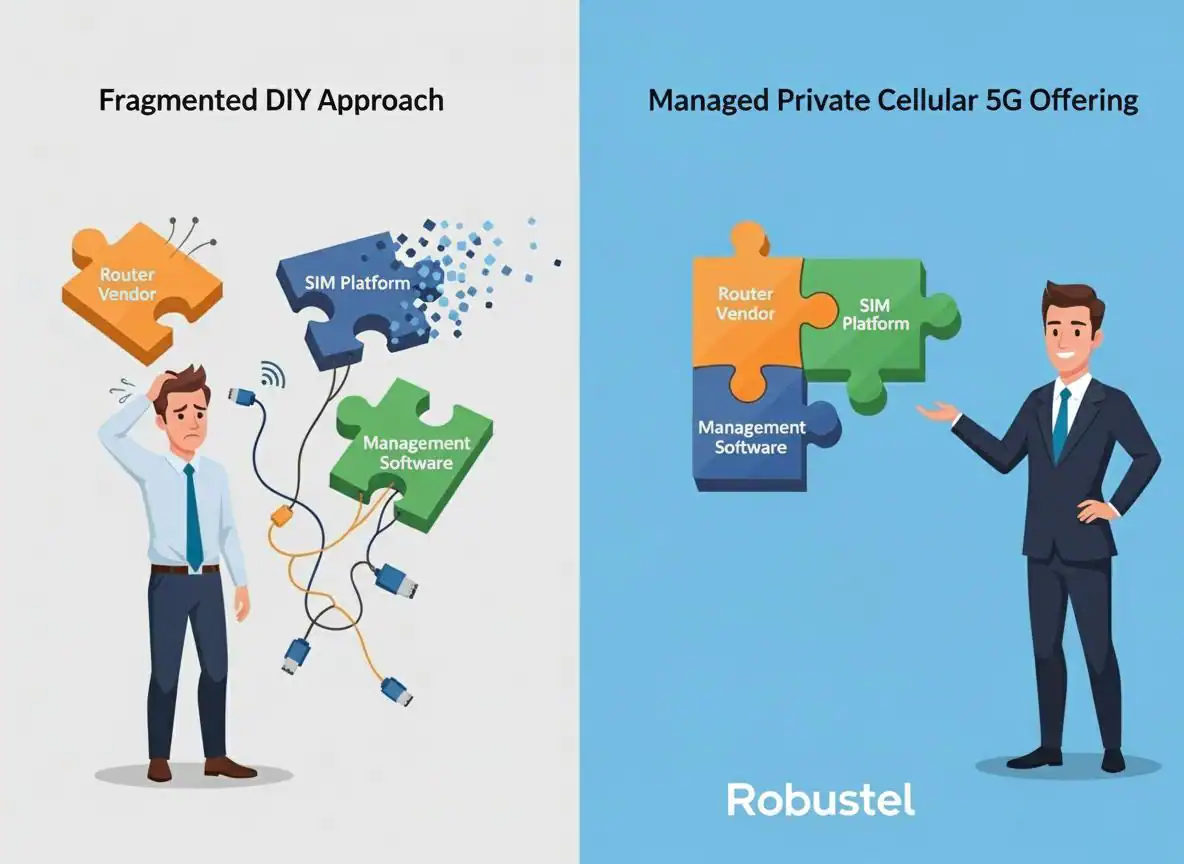
The “DIY” approach is the primary culprit. Sourcing Industrial Cellular Routers from one vendor, a SIM management layer from a second, and an orchestration tool from a third creates what we call “Integration Hell.” You end up with a fragmented system where every update risks a multi-point failure.
Let’s be clear: a mission-critical Private 5G network isn’t just a collection of hardware; it’s a vertically integrated, Managed Private Cellular 5G Offering. This shift from “buying parts” to “deploying a managed ecosystem” is what actually makes Industry 4.0 scalable. By unifying hardware, connectivity, and management into a single pane of glass, you move from managing complexity to managing outcomes.
The Three Pillars of a Unified Managed Ecosystem
To move beyond the fragmentation I just described, a true Managed Private Cellular 5G Offering must function as a synchronized, end-to-end ecosystem rather than a collection of standalone parts. It is the seamless integration of these three foundational layers that delivers the “carrier-grade” experience enterprise customers actually need:
1. Mission-Critical Hardware: The Industrial Foundation
The hardware is your site’s physical anchor. A standard router won’t cut it in a private spectrum environment. You need an Industrial Cellular Router specifically engineered for Private 5G (including support for N77/N78/N79 bands and CBRS). This foundation must be ruggedized for 24/7 thermal stability and provide the high-gain antenna arrays necessary to maintain a stable link in high-interference industrial zones.
2. Orchestration & Intelligence: The Single Pane of Glass
A managed offering is defined by its visibility. Through a Centralized Cloud Management Platform (like RCMS), the entire fleet transitions from “individual boxes” to a manageable fabric. This layer enables Zero-Touch Provisioning (ZTP), real-time telemetry on signal quality (RSRP/RSRQ), and bulk firmware orchestration—ensuring your network scales without scaling your headcount.
3. Holistic Security: Defense-in-Depth
Security cannot be an afterthought; it must be baked into the silicon and the cloud. A comprehensive model covers the entire attack surface: from a Secure Boot hardware root-of-trust and a hardened Operating System to encrypted VPN tunneling and multi-factor authentication for the management platform itself.
The Hardware Foundation—Engineering the R5020 Lite for Private 5G
To translate these three pillars into a physical deployment, you need a gateway that acts as more than a simple modem. The Robustel R5020 Lite is the architectural starting point, purpose-built to bridge the gap between complex 5G RAN (Radio Access Networks) and the harsh reality of the industrial edge.
1. 3GPP Release 16: Future-Proofing for URLLC
The R5020 Lite isn’t just “5G-ready”; it’s optimized for the 3GPP Release 16 standard. This is the critical threshold for Ultra-Reliable Low-Latency Communication (URLLC). Whether you are orchestrating a fleet of Autonomous Mobile Robots (AMRs) or streaming 4K tele-operation video, the R5020 Lite ensures your private spectrum delivers on its promise of sub-10ms determinism.
2. Industrial-Grade Resilience & Redundancy
A private network is only as strong as its weakest link. For mission-critical uptime, the R5020 Lite features a ruggedized enclosure and a wide operating temperature range (-20°C to +60°C). Beyond the physical, it incorporates Dual-SIM Failover and Smart Roaming logic, providing the network redundancy required to eliminate single points of failure in complex radio environments.
3. A Hardened OS: Security by Design (IEC 62443)
In a private 5G environment, the router is a primary security gate. The R5020 Lite runs RobustOS, a Linux-based operating system developed under the IEC 62443-4-1 cybersecurity standard. Independently penetration tested, this hardened OS ensures that your hardware root-of-trust is as secure as the encrypted data tunnels it creates.
The Management Core—Orchestrating the Fleet with RCMS
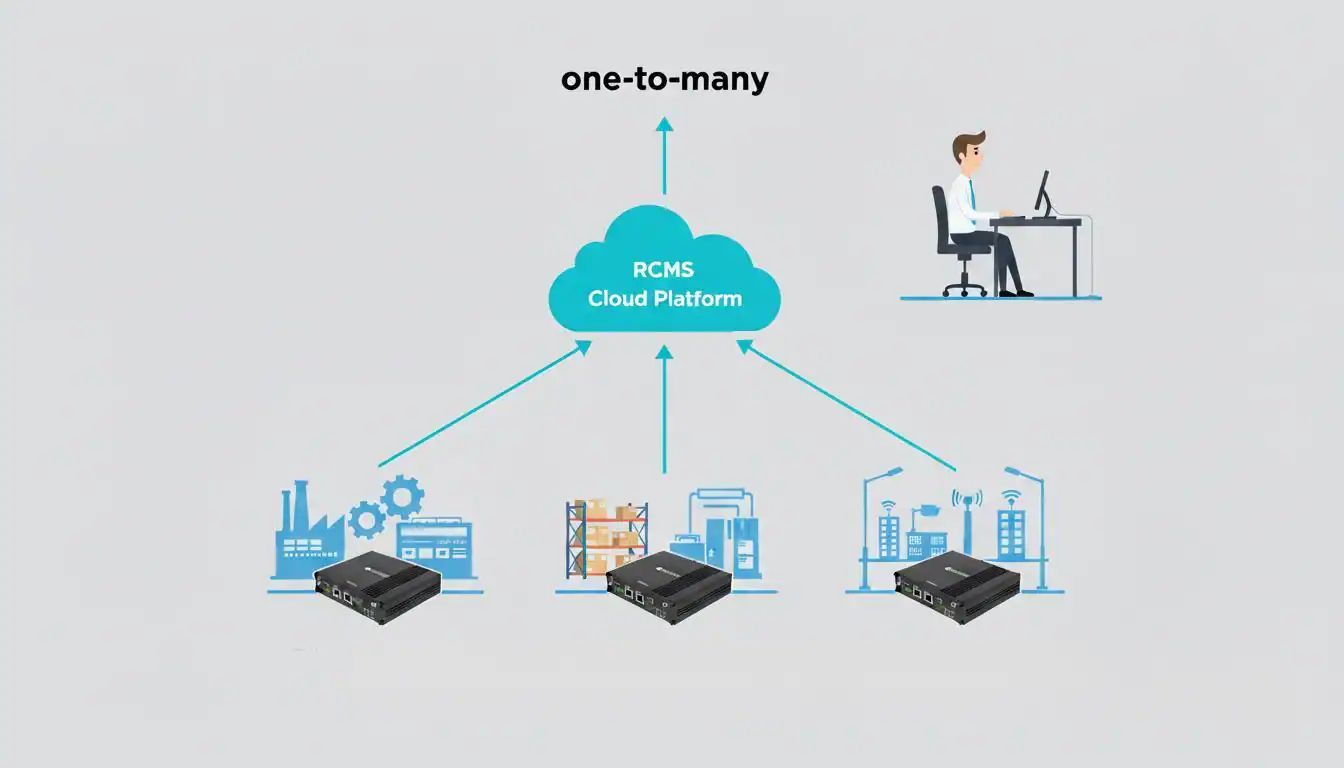
A high-performance router is only as effective as the system that manages it. This is where the Robustel Cloud Manager Service (RCMS) elevates the R5020 Lite from a standalone device into a fully Managed Private Cellular 5G Offering. RCMS acts as the centralized “brain,” providing the orchestration required to run a secure, distributed network at scale.
1. Fleet-Wide Visibility & Real-Time Telemetry
Managing a private 5G network requires more than just knowing if a device is “up.” RCMS provides a single, intuitive dashboard offering deep Real-Time Telemetry. You can monitor signal integrity (SINR/RSRP), track data consumption patterns, and verify link stability for every node in your private layout, ensuring you can preemptively address connectivity gaps before they impact production.
2. Zero-Touch Provisioning (ZTP): Scaling Without Friction
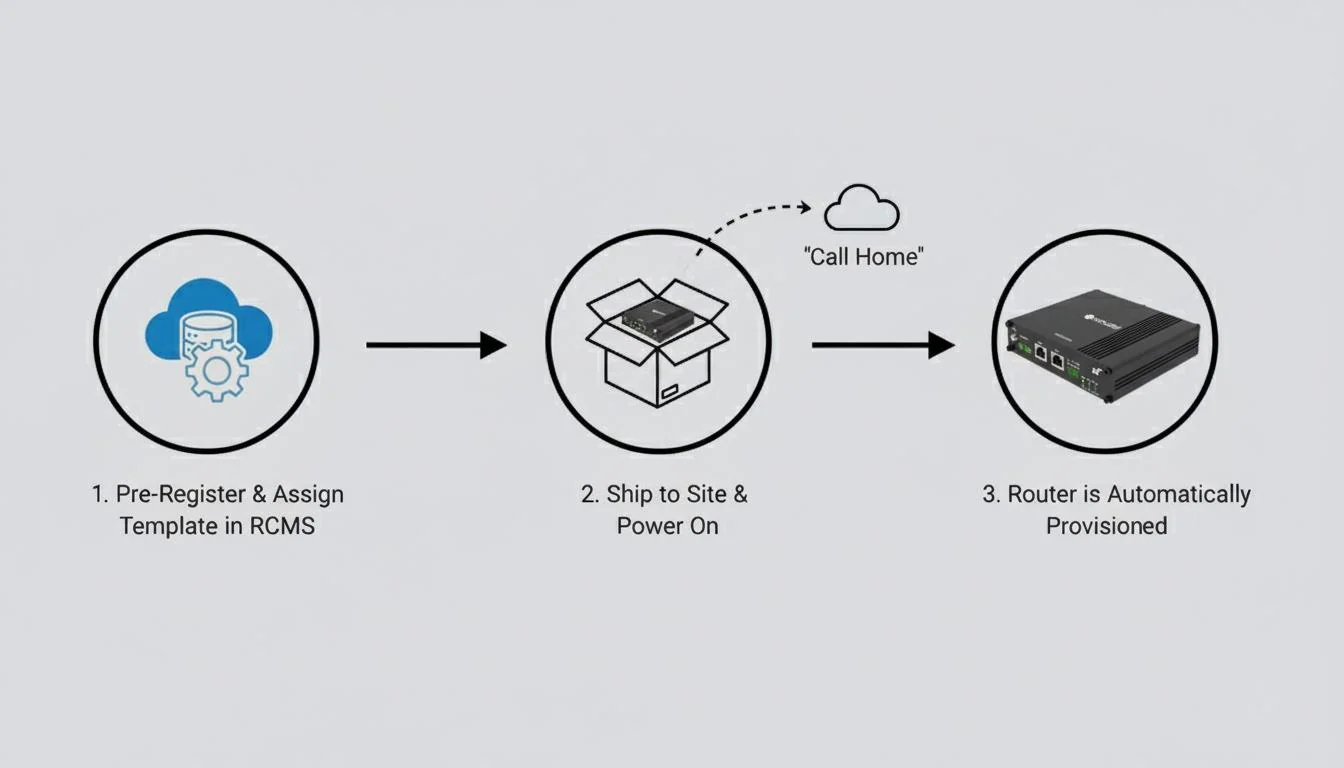
The true “aha!” moment for any enterprise deployment is Zero-Touch Provisioning (ZTP). RCMS allows you to ship a factory-default R5020 Lite directly to a remote site. The moment it’s powered on, it securely “phones home” to RCMS, authenticates, and automatically pulls its entire configuration profile. This eliminates the need for specialized on-site technicians, slashing deployment timelines from weeks to hours.
3. Secure Remote Access & Overlay Networking
Troubleshooting shouldn’t require a flight ticket. RCMS integrates RobustVPN, a sophisticated overlay networking tool that creates an encrypted, on-demand tunnel to any router—and the industrial assets behind it (PLCs, HMIs, Cameras). This allows your support team to perform remote diagnostics and firmware logic updates with Zero-Trust security, without ever exposing your sensitive private network to the public internet.
The Security Model—A Vertically Integrated Defense-in-Depth
A fragmented, multi-vendor “Frankenstein” solution doesn’t just create management headaches; it creates security silos. A unified Managed Private Cellular 5G Offering replaces these gaps with a cohesive, end-to-end security architecture where every layer—from the physical port to the cloud dashboard—is aware of the other.
1. Hardened Foundation: From Silicon to Cloud
Security isn’t a feature; it’s a baseline. The Robustel R5020 Lite features a hardened, Linux-based OS that acts as the first line of defense at the edge. This integrity extends through encrypted management tunnels to the RCMS platform, ensuring that your command-and-control traffic is never exposed to the public internet, effectively creating a Private Management Overlay.
2. Enterprise-Grade Encryption Suite
To protect your mission-critical OT data, the R5020 Lite supports a comprehensive suite of industrial VPN protocols. Whether your architecture demands the gold-standard stability of IPsec, the flexibility of OpenVPN, or the high-performance throughput of WireGuard, you can establish secure, encrypted tunnels from the remote edge directly into your corporate data center or private cloud.
3. Centralized Vulnerability Management
In the world of cybersecurity, “static” is another word for “vulnerable.” Through RCMS, your security posture becomes dynamic. You can orchestrate fleet-wide Security Patches and firmware updates with a single click. This centralized approach ensures that every node in your private 5G network is shielded against the latest CVEs (Common Vulnerabilities and Exposures) without requiring a single truck roll.
Conclusion: Simplification is the Ultimate Sophistication
At its core, a Managed Private Cellular 5G Offering is a strategic decision to trade fragmented complexity for operational certainty. The “DIY” era of enterprise connectivity—where IT teams spent more time troubleshooting handshakes between different vendors than actually analyzing data—is quickly becoming a liability.
By unifying a high-performance terminal like the Robustel R5020 Lite with a cloud-native orchestration layer like RCMS, you aren’t just buying hardware; you are investing in a vertically integrated ecosystem. This synergy is what finally delivers on the true promise of Private 5G: a network that is as reliable as a wired connection, as flexible as Wi-Fi, and fundamentally more secure than both.
The goal of modern IIoT shouldn’t be to build the most complex network possible—it should be to build the most invisible one. A managed approach ensures that your connectivity stays in the background, robust and silent, allowing your business to focus on the applications that actually drive ROI.
Ready to simplify your 5G roadmap? Let’s move beyond the “collection of parts” and start building a cohesive future.
Curious about the global 5G rollout? Discover how Robustel and GSL are paving the way for 5G adoption in Türkiye.
FAQs
Q1: What is the difference between a private 5G network and a public 5G network?
A1: A public 5G network is the service you get from major carriers like AT&T or Verizon. A private 5G network is a dedicated, localized cellular network built exclusively for a single enterprise, providing greater control over security, performance, and data traffic.
Q2: Can I use the R5020 Lite with a private 5G network built on technologies like CBRS?
A2: Yes. The R5020 Lite is designed to support a wide range of global 5G bands, making it suitable for deployment in various private 5G network architectures, including those using the Citizens Broadband Radio Service (CBRS) spectrum in the United States.
Q3: Is a managed private cellular 5G offering more expensive than a DIY solution?
A3: While the initial hardware cost might be comparable, the Total Cost of Ownership (TCO) of a managed offering is almost always lower. When you factor in the massive savings from eliminating third-party management software licenses, reducing on-site technician visits through ZTP, and simplifying security management, the integrated approach provides a far better long-term value.
About the Author
Robert Liao | Technical Support Engineer
Robert Liao is an IoT Technical Support Engineer at Robustel, specializing in industrial networking and edge connectivity. A certified Networking Engineer, Robert focuses on the deployment and troubleshooting of large-scale IIoT infrastructures. His work centers on architecting reliable, scalable system performance for complex industrial applications, bridging the gap between field hardware and cloud-side data management.