
LoRaWAN Use Cases 2026: 5 Real-World Scenarios Driving Industrial ROI
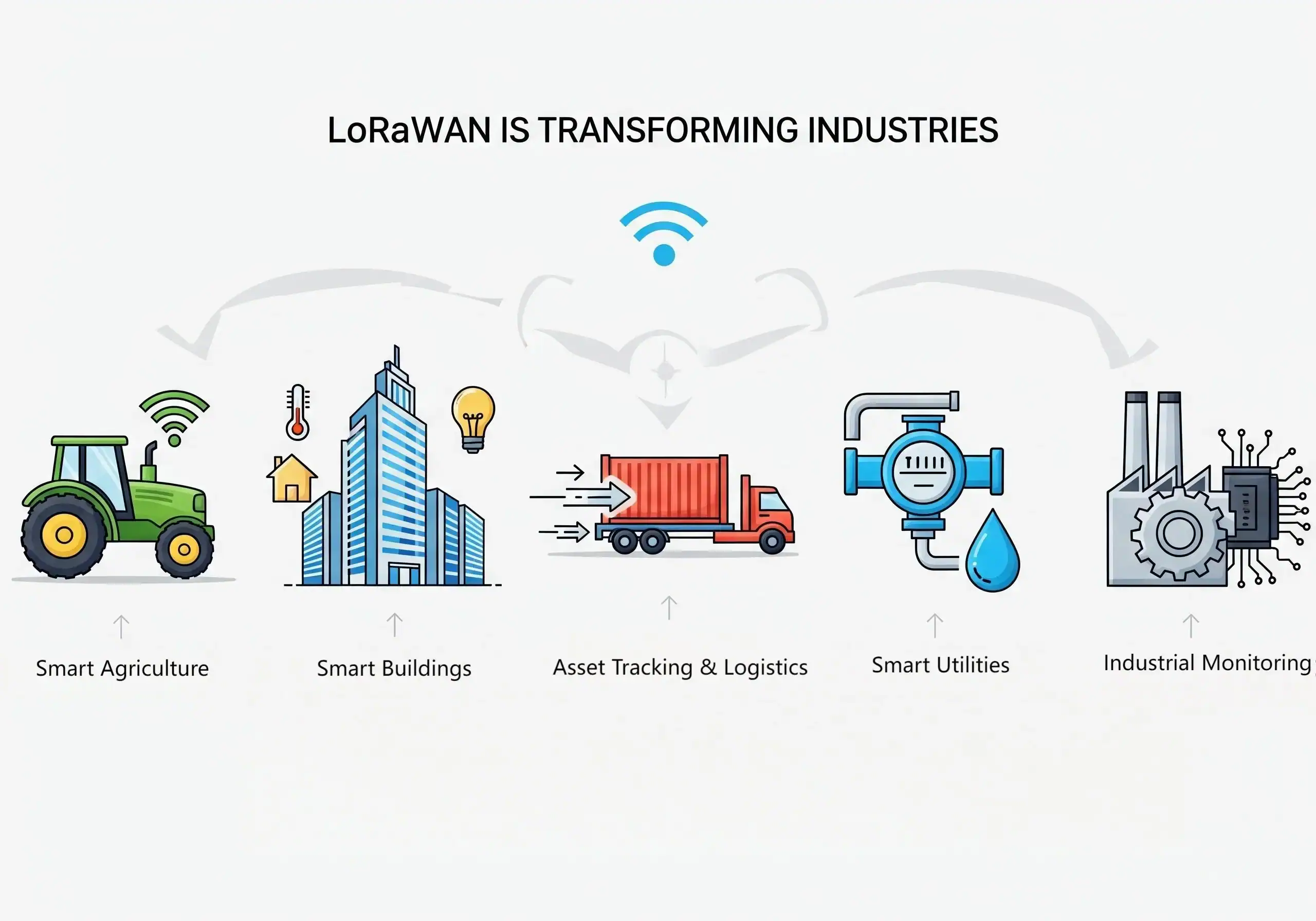
What makes LoRaWAN the go-to standard for the “Unconnected World”? While 5G excels in speed, LoRaWAN (Long Range Wide Area Network) dominates in distance and power efficiency. This guide moves beyond theory to explore 5 top-tier LoRaWAN use cases—from smart agriculture to industrial monitoring—demonstrating how businesses are achieving tangible ROI through LPWAN technology and Edge Computing.
Key Takeaways for 2026:
- Zero-Power Barriers: How to connect assets in harsh environments without Wi-Fi or cellular coverage.
- Infrastructure Retrofitting: Using LoRaWAN gateways to digitize legacy buildings and utility meters.
- TCO Optimization: Why the 10-year battery life of LoRaWAN sensors drastically reduces the Total Cost of Ownership (TCO).
- The Gateway Factor: The critical role of industrial-grade bridges (like the Robustel R1520LG) in ensuring data integrity.
Introduction: Solving the “Last Mile” of Industrial IoT
I’ve found that any new technology is only as good as the real-world problems it solves. It’s easy to talk about protocols and data rates, but the real magic happens when that technology makes a farmer’s land more fertile, a building manager’s job easier, or a supply chain more visible.
That’s what’s so exciting about LoRaWAN. It was purpose-built to solve the oldest and most difficult challenges in industry: Range, Power, and Cost. To see this technology in action, we have selected five diverse high-impact scenarios. While these sectors differ, they all share a common need: the ability to capture mission-critical data where traditional Wi-Fi or cellular networks reach their limits. Let’s explore how LoRaWAN is turning these “unreachable” locations into actionable business intelligence.
LoRaWAN Use Case #1: Smart Agriculture & Precision Farming
The Challenge: How do you effectively manage thousands of acres of farmland where there is no power and no Wi-Fi? Farmers need real-time data to optimize irrigation and protect their crops.
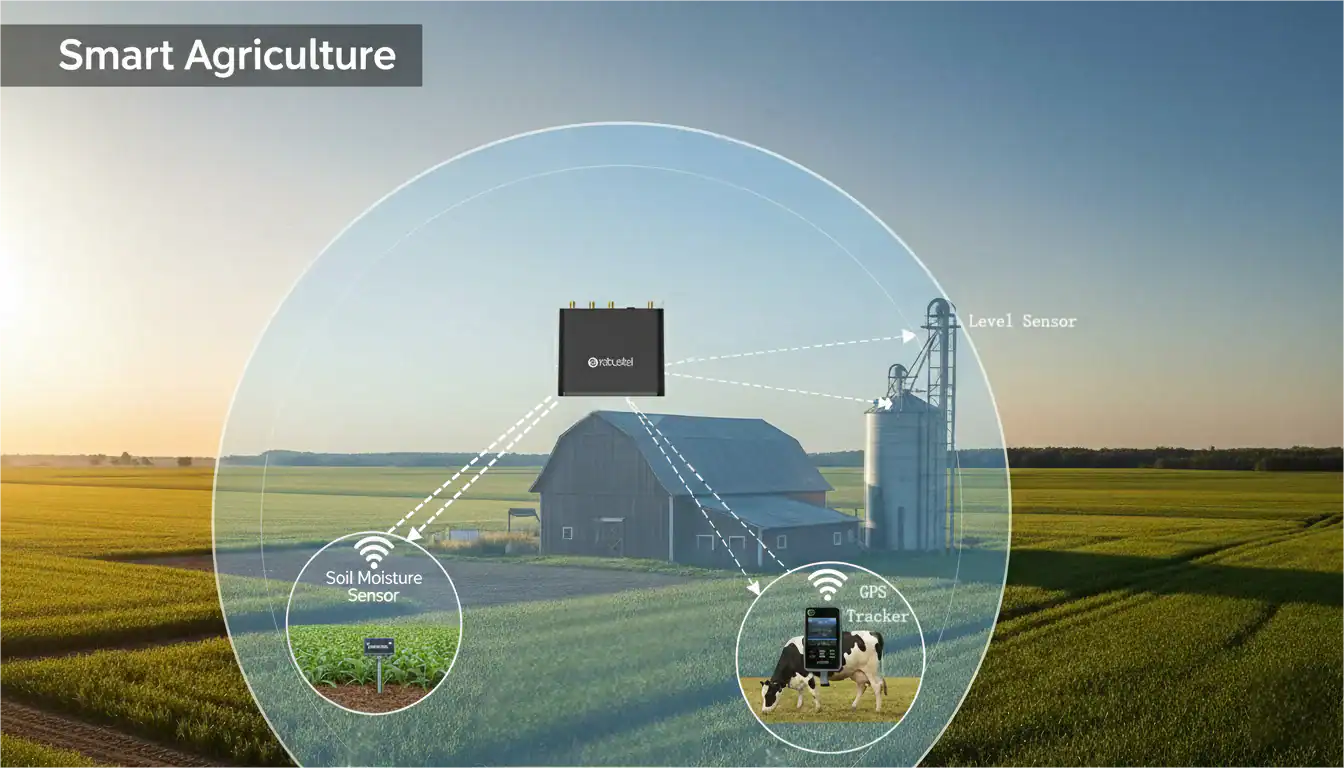
The LoRaWAN Solution: A single Industrial LoRaWAN Gateway can provide coverage to an entire property (up to 15km). Farmers can deploy hundreds of battery-powered sensors to:
- Monitor Soil Health: Measure moisture and nutrient levels to enable Precision Irrigation, saving up to 30% of water resources.
- Livestock Telemetry: Track location and health with GPS ear tags that last for years on a single battery.
- Environmental Auditing: Monitor grain silos to prevent spoilage via long-range humidity and CO2 alerts.
The Payoff: Increased yields and significant resource savings by moving from “scheduled” to “data-driven” farming.
LoRaWAN Use Case #2: Smart Buildings & Facility Management
The Challenge: Commercial buildings are massive consumers of energy. Facility managers must reduce costs and improve sustainability without the disruptive cost of new wiring in a 50-story structure.
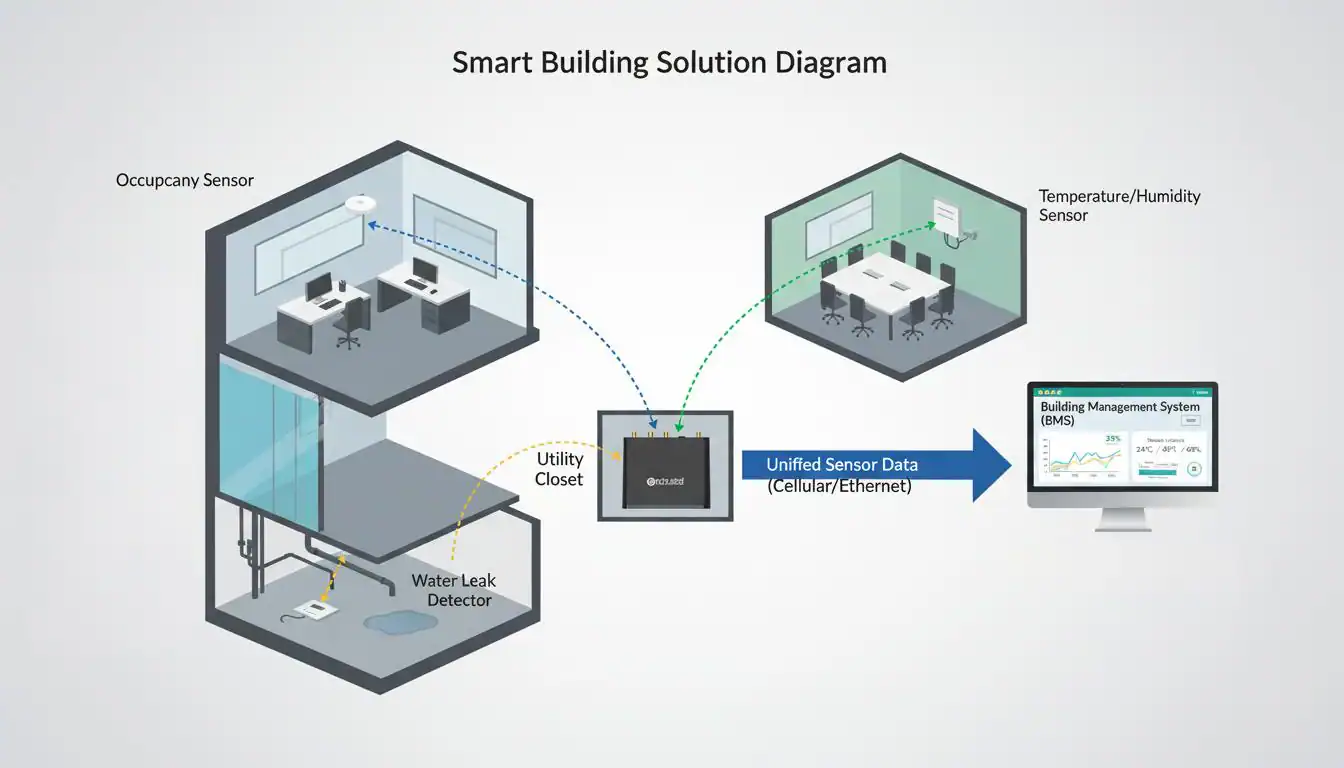
The LoRaWAN Solution: LoRaWAN for smart buildings allows for Non-Invasive Retrofitting. Wireless sensors bridge data to legacy Building Management Systems (BMS):
- Occupancy-Based HVAC: Adjusting lighting and air conditioning only when rooms are occupied.
- Catastrophic Leak Detection: Instant alerts from wireless sensors in basements or bathrooms to prevent million-dollar water damage.
- Indoor Air Quality (IAQ): Continuous monitoring of CO2 levels to ensure occupant health and ESG compliance.
The Payoff: Drastic reductions in energy consumption and lower operational risks through proactive monitoring.
LoRaWAN Use Case #3: Asset Tracking & Logistics
The Challenge: How do you keep track of thousands of non-powered assets—like shipping containers, trailers, or high-value pallets—once they leave your facility?
The LoRaWAN Solution: Because of the technology’s Ultra-Low Power Consumption, LoRaWAN-based GPS trackers can report their location periodically for 5 to 10 years on a single battery.
- End-to-End Visibility: Gain complete supply chain transparency even in remote transit zones.
- Asset Utilization: Eliminate “lost” trailers and optimize logistics planning.
The Payoff: Reduced theft, improved inventory turnover, and a significantly more efficient logistics network.
LoRaWAN Use Case #4: Smart Metering (Utilities)
The Challenge: The immense recurring labor cost of sending technicians to manually read thousands of water and gas meters spread across a city or region.
The LoRaWAN Solution: Deploying a city-wide network and retrofitting existing meters with LoRaWAN transmitters. These devices “wake up” to report data securely via AES-128 encryption.
- Automated Meter Reading (AMR): Instant, accurate billing without human intervention.
- Leak & Fraud Detection: Analyzing consumption patterns in real-time to identify anomalies in the grid.
The Payoff: Complete elimination of manual reading costs and vastly improved billing accuracy.
LoRaWAN Use Case #5: Industrial Monitoring & Predictive Maintenance
The Challenge: How do you monitor a critical pump or motor in a hazardous area of a factory where running new cables is impractical or unsafe?
The LoRaWAN Solution: Deploying ruggedized, Battery-Powered Industrial Sensors that can be magnetically attached to machinery in minutes to monitor:
- Vibration & Temperature: Detecting early signs of bearing failure or overheating.
- Edge Intelligence: Modern gateways can process this data locally, only sending an alert to the cloud when a threshold is breached.
The Payoff: Moving from reactive repairs to Predictive Maintenance, preventing unplanned downtime that can cost thousands of dollars per hour.
The Common Denominator: The Industrial LoRaWAN Gateway
While these five use cases span completely different environments—from open farmlands to deep concrete basements—they all rely on a single point of convergence to bring their data to life.
None of these sensors can “talk” to the cloud on their own. Whether it’s a soil sensor 10km away or a leak detector in a sub-floor, they all depend on a Common Denominator: the industrial-grade gateway. This device acts as the secure, always-on bridge that gathers data from thousands of nodes and uses a robust internet backhaul, like 4G/5G cellular, to relay it to the network server. Without a gateway built for high interference and industrial reliability, the entire ROI chain breaks.
Conclusion: Unlocking Data from the Unconnected
As you can see, the applications are diverse, but the theme is the same: LoRaWAN’s unique ability to communicate over long distances with minimal power is unlocking valuable data from assets that were previously “dark.” By bridging the gap between the physical world and digital intelligence, businesses can finally solve their most unique and difficult connectivity challenges.
Pro Tip:
For more industry-specific inspiration, browse Robustel’s real-World Case Studies to see how our LoRaWAN gateways are powering the next generation of IoT.
- LoRaWAN Monitoring for Vaccines and Labs with the R1520-LG.
- Cutting BMS cabling costs with LoRaWAN and the Robustel R1520-LG
FAQs
Q1: What is the real-world range of LoRaWAN?
A1: In open, line-of-sight environments, LoRaWAN can reach over 15km. However, in dense urban areas or deep industrial sites with heavy concrete and metal interference, the reliable range is typically between 2km and 5km. Its “Deep Penetration” capability is what makes it superior for indoor or underground monitoring.
Q2: LoRaWAN vs. NB-IoT: Which should I choose?
A2: It comes down to autonomy and cost. LoRaWAN allows you to build your own Private Network with no monthly SIM fees and better battery life (up to 10 years). NB-IoT relies on cellular carriers and requires a monthly subscription for every device. For remote sites or high-security industrial floors, LoRaWAN is usually the winner.
Q3: Is LoRaWAN good for real-time control applications?
A3: Generally, no. LoRaWAN is optimized for sending small, infrequent data packets. While it can send downlinks, the latency isn’t suitable for high-speed command-and-control. For real-time robotics or safety shut-offs, 5G Edge Gateways are the better fit.
Q4: Can I run multiple use cases on a single network?
A4: Absolutely—and that’s where the ROI really climbs. A single industrial gateway in a smart building can simultaneously manage water leak detectors for facility teams, asset trackers for IT, and occupancy sensors for the energy team.
Q5: Should I use a Public or Private network?
A5: Public networks are great for wide, generic coverage. However, Private LoRaWAN Networks are the industrial standard. They give you total control over your coverage, data ownership, and security, with zero ongoing connectivity fees once the gateway (like a Robustel unit) is installed.
About the Author
Robert Liao | Technical Support Engineer
Robert Liao is an IoT Technical Support Engineer at Robustel, specializing in industrial networking and edge connectivity. A certified Networking Engineer, Robert focuses on the deployment and troubleshooting of large-scale IIoT infrastructures. His work centers on architecting reliable, scalable system performance for complex industrial applications, bridging the gap between field hardware and cloud-side data management.