
What is an IoT Gateway? A 2026 Guide to Edge vs. Cloud Architecture
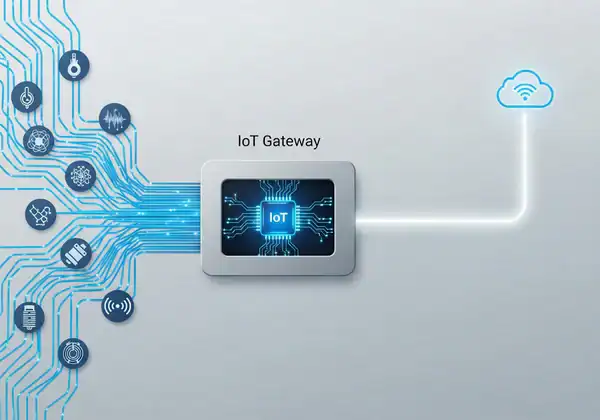
The term IoT Gateway is foundational to the Internet of Things, yet its evolving role in 2026 is often misunderstood. At its core, an IoT Gateway is a physical device or software program that serves as the bridge between local IoT devices (sensors/actuators) and the cloud.
This guide defines the essential functions of a modern gateway—such as protocol translation and edge security—while exploring the critical shift from standard data forwarders to powerful Industrial IoT (IIoT) Edge Gateways.
What we willcover:
- The Core Definition: How gateways act as “multilingual translators” for the physical world.
- Essential Functions: A breakdown of protocol translation, security, and data buffering.
- Edge vs. Cloud: Why modern IIoT is moving away from simple “data forwarding.”
- The Robustel EG5120: A look at high-performance hardware for Docker and Linux-based edge computing.
Introduction: The Bridge Between the Physical and Digital Worlds
The Internet of Things (IoT) has connected billions of physical devices to the internet, enabling them to collect and share data. However, these devices—sensors, actuators, and machines—often use low-power, short-range communication protocols like Zigbee, Bluetooth, or industrial protocols like Modbus, which cannot connect directly to the internet. This is where the IoT Gateway comes in.
Think of an IoT Gateway as a multilingual translator and a smart traffic controller for your “things”. It aggregates data from various local devices, translates their different languages (protocols) into a standard internet-friendly language (like MQTT or HTTPS), and then securely transmits that data to the cloud for processing and analysis. As IoT solutions become more advanced, the role of the gateway has evolved significantly with the rise of edge computing, creating a distinction between standard gateways and more intelligent edge gateways.
What is an IoT Gateway? KeyFunctionsExplained
An IoT Gateway is a centralized hub that connects local IoT devices and sensors to the cloud. To achieve this, it performs several essential functions that are critical for any successful IoT deployment.
- Protocol Translation: The most fundamental role of an IoT Gateway is to bridge different communication technologies and protocols. It collects data from devices using protocols like Modbus, OPC UA, BLE, or LoRaWAN and translates it into standard IP-based protocols like MQTT, CoAP, or HTTPS that cloud platforms can understand.
- Device Management: It manages the connections to and from local IoT devices, handling authentication and authorization to ensure only trusted devices can join the network.
- Security: An IoT Gateway acts as a critical line of defense, protecting the local device network from the public internet. It can implement firewall rules, access control lists, and create secure, encrypted communication tunnels (like VPNs) to the cloud, safeguarding sensitive data.
- Data Filtering and Buffering: It can filter out redundant or unnecessary data before sending it to the cloud, and it can buffer data locally if the internet connection is temporarily lost, preventing data loss.
How an IoT Gateway Works: The Data Journey
The process of moving data from a sensor to the cloud via an IoT Gateway typically follows three steps:
- Data Aggregation: The IoT Gateway collects data streams from multiple sensors and devices in its vicinity. For example, in a factory, it might collect temperature data from a Modbus sensor and status data from a PLC.
- Protocol Conversion: It then translates these various protocols into a single, common format, like MQTT with a JSON payload. This standardizes the data.
- Data Transmission: Finally, it uses its WAN connection (which could be Ethernet, Wi-Fi, or cellular) to securely send the standardized data to a cloud platform for storage, analysis, and visualization.
The Evolution: Standard IoT Gateway vs. IIoT Edge Gateway
In 2026, the industry has moved beyond simple data forwarding. The rise of edge computing has created an important distinction between standard gateways and more powerful edge gateways. Choosing the right architecture depends on where you want the “intelligence” to sit.
| Feature | Standard IoT Gateway | Industrial Edge Gateway |
| Primary Role | Data Forwarder | Local Processing Engine |
| Latency | High (Cloud round-trip) | Low (Real-time local action) |
| Dependency | Requires constant Cloud link | Can operate autonomously offline |
| Bandwidth | High (Sends all raw data) | Low (Sends only insights) |
1. The Standard IoT Gateway
These devices are cost-effective but limited. They perform essential translation, but the “thinking”—analytics and decision-making—happens in the cloud. This creates latency and high cellular bandwidth costs.
2. The Modern Industrial Edge Gateway
An Edge Gateway is an IoT hub with a high-performance onboard computer. By processing data at the “Edge” (where it is created), you gain:
- Millisecond Response: Critical for industrial safety and automation.
- Cost Efficiency: Only “summarized” data is sent to the cloud, slashing data plan costs.
- Enhanced Privacy: Sensitive data stays on-site rather than traveling over the open web.
Deep Dive: The Robustel EG5120 Edge Gateway
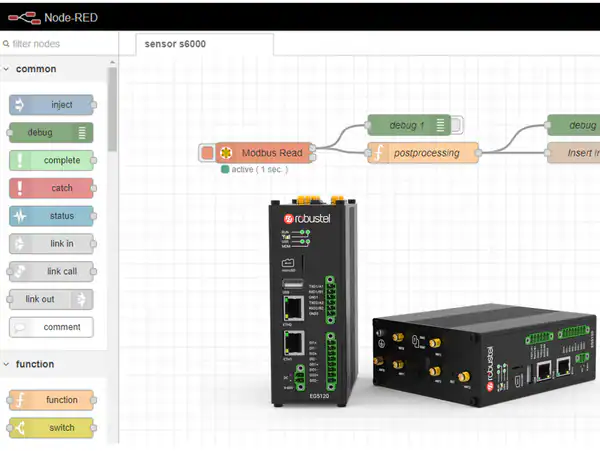
To make these concepts concrete, let’s look at a real-world example: the Robustel EG5120. It is a prime example of a modern Industrial IoT Edge Gateway that delivers on all the advanced capabilities discussed.
1. High-Performance Hardware and Rich Connectivity
The EG5120 is built on a high-performance Quad-Core ARM Cortex-A53, 1.6 GHz (NXP i.MX8) CPU, with 2 GB of DDR4 RAM and 16 GB of eMMC storage , providing a powerful hardware foundation for running complex edge applications. For connectivity, it offers global 4G LTE with Dual SIM failover, two Gigabit Ethernet ports, and multiple industrial interfaces like RS232/RS485 and DI/DO, making it incredibly versatile.
2. Open and Flexible Programming Environment
A key advantage of the EG5120 as an industrial IoT edge gateway is its software flexibility. It runs RobustOS Pro , an operating system based on Debian 11 (LTS) , which provides a familiar, open, and stable Linux environment for developers. This supports a wide range of programming languages including C, C++, Python, Java, Go, and Node.js. Furthermore, the out-of-the-box support for Docker allows developers to easily package and deploy any custom application in a container, dramatically simplifying development and deployment workflows.
3. Enterprise-Grade Security and Reliability
The EG5120 is engineered for trusted industrial deployments. Its operating system, RobustOS Pro, is developed under the stringent IEC 62443-4-1 cybersecurity standard and undergoes annual independent penetration testing . In addition to a powerful stateful firewall and a full suite of VPNs (IPsec, OpenVPN, Wireguard, etc.), it features Automatic System Failback , where a dual-system partition design prevents the device from failing during a remote update. This multi-layered security and reliability posture is critical for any serious industrial IoT edge gateway.
4. Simplified Cloud Management
The EG5120 fully integrates with the Robustel Cloud Manager Service (RCMS), a powerful platform for monitoring and managing your entire fleet of gateways. This allows for centralized OTA updates (for both the OS and containerized applications) and secure remote access to the gateway and its connected end devices, which dramatically reduces operational costs.
EG5120 Key Specifications Summary:
| Feature Category | Specification |
|---|---|
| System | |
| CPU | Quad-Core ARM Cortex-A53, 1.6 GHz (NXP i.MX8) |
| RAM / Storage | 2 GB DDR4 / 16 GB eMMC |
| Connectivity | |
| Cellular | Global 4G LTE Cat 4 (Dual SIM Failover) |
| Ethernet | 2 x Gigabit Ethernet (10/100/1000 Mbps) |
| Industrial Interfaces | 2 x RS232/RS485, 2 x DI, 2 x DO |
| Software | |
| Operating System | RobustOS Pro (Debian 11 based with LTS) |
| Containerization | Docker support |
| Key Software Support | Node-RED, MQTT, InfluxDB, Grafana, Modbus, OPC UA, BACnet, etc. |
Conclusion: Why the Edge is the Future
An IoT Gateway is a foundational component of any IoT system, but for serious industrial applications, an Industrial IoT Edge Gateway is essential. It is a powerful, intelligent computer that serves as the secure bridge between the physical and digital worlds, enabling real-time local processing, enhancing reliability, lowering operational costs, and providing the multi-layered security needed for demanding applications.
As IoT continues to expand, the role of the industrial IoT edge gateway will only become more critical. Devices like the Robustel EG5120, with their high-performance processors, open Debian-based OS, and integrated cloud management, represent the future of intelligent and scalable IoT deployments.
FAQs
Q1: What is the main difference between an IoT Gateway and a standard internet router?
A1: A standard router’s primary function is to forward IP data packets between networks. An IoT Gateway does this but also performs the critical function of protocol translation, converting non-IP based protocols (like Modbus, Zigbee, etc.) into IP-based protocols (like MQTT) that the internet and cloud platforms can understand.
Q2: Can I run custom applications on an industrial IoT edge gateway?
A2: Yes, on advanced gateways like the Robustel EG5120. It supports Docker, allowing you to deploy applications written in almost any language (C, C++, Python, Java, Go, Node.js, etc.) inside containers. This provides incredible flexibility for custom edge analytics and control logic.
Q3: Is an industrial IoT edge gateway secure?
A3: Security is a core function of an industrial IoT Gateway. They are designed to be a secure buffer between OT and IT. Features like a stateful firewall, extensive VPN support (IPsec, OpenVPN, etc.), and a hardened operating system like RobustOS Pro (which is certified to IEC 62443-4-1) are essential. Furthermore, RobustOS Pro undergoes rigorous, independent penetration testing annually to validate its resilience against real-world threats.
About the Author
Yang Tao | Founder & CEO
Robustel Yang Tao founded Robustel in 2010 with a vision to simplify industrial connectivity. Today, he leads a global team of over 300 experts, shipping mission-critical IoT solutions to more than 100 countries.
A firm believer in technical excellence, Yang dedicates 15% of revenue to R&D and operates a proprietary 5G smart factory. His commitment to security is backed by world-class certifications (IEC 62443, ISO 27001), ensuring that Robustel’s hardware is as secure as it is innovative.